AI Generated Quiz
A Level H1 Chemistry Atomic Structure Bonding Quiz
Free A Level H1 Chemistry Atomic Structure Bonding quiz, HY3 AI version, with questions, answers, and A Level-style practice for Singapore students.
These static practice materials are generated from the site's syllabus and paper-generation workflow, with source and model context shown so students and parents can evaluate the material before use.
Questions
Free quiz and exam paper access
Enter your details to view this paper
Your access is remembered on this device.
Answers
A-Level Chemistry H1 Quiz - Atomic Structure Bonding (Answer Key)
Total Marks: 40
Topic: Atomic Structure & Bonding (syllabus-first, complemented by LLM-inferred patterns; not claimed as past-year derived)
Section A Answers (Q1–8)
Q1 [1 mark]
Answer: Isotopes are atoms of the same element with the same number of protons but different numbers of neutrons.
Teaching note: Key idea — identity is set by proton number; mass changes with neutron number. Common mistake: saying "different mass number but same atomic number" without defining proton/neutron.
Q2 [1 mark]
Answer: Nucleon number = 17 + 18 = 35.
Teaching note: Nucleon number = proton number + neutron number. Method: 17 p⁺ + 18 n⁰ = 35.
Q3 [1 mark]
Answer: 1s² 2s² 2p⁶ 3s² 3p⁵
Teaching note: Fill orbitals in order: 1s, 2s, 2p (6 e⁻), 3s, 3p. Total = 17 e⁻.
Q4 [2 marks]
Answer: s (max 2 e⁻), p (max 6 e⁻), d (max 10 e⁻), f (max 14 e⁻). [½ each type, ½ each count]
Teaching note: H1 syllabus mentions s, p, d; f included for completeness. Mark breakdown: 1 mark for naming 4 types, 1 mark for correct maxima.
Q5 [2 marks]
Answer: Neon has a higher nuclear charge (10 p⁺ vs 11? Actually Ne=10, Na=11 — Na has more protons but outer e⁻ is in 3s, further from nucleus and shielded by inner shells) → Na's outer electron is shielded by 10 core e⁻ and in a higher shell, so less tightly held; Ne's outer e⁻ are in 2p, closer, less shielded. [1 for shielding, 1 for distance/shell]
Teaching note: Na (11 p⁺) IE lower than Ne (10 p⁺) because Na's valence e⁻ is in n=3, shielded by full n=1,n=2; Ne valence in n=2 no extra shell. Common trap: saying Na has lower because fewer protons (wrong).
Q6 [2 marks]
Answer: Fe: 1s² 2s² 2p⁶ 3s² 3p⁶ 3d⁶ 4s² → d-subshell has 6 e⁻. [1 for config, 1 for count]
Teaching note: Aufbau: 4s fills before 3d, but config written as …3d⁶ 4s². d electrons = 6.
Q7 [1 mark]
Answer: After removing 3 e⁻, the next e⁻ is from the inner shell (2p) which is much closer to nucleus and less shielded.
Teaching note: Al: 1s² 2s² 2p⁶ 3s² 3p¹ → 3rd IE removes 3p/3s, 4th removes core 2p → big jump.
Q8 [1 mark]
Answer: 1s² 2s² 2p⁶ (or [Ne])
Teaching note: Mg atom = 12 e⁻; Mg²⁺ loses 2 from 3s.
Section B Answers (Q9–14)
Q9 [2 marks]
Answer: Mg: [·Mg·] → Mg²⁺ + 2e⁻; O: ·Ö· → O²⁻; diagram shows Mg transferring 2 e⁻ to O, Mg²⁺ and O²⁻ with full outer shells. [1 transfer, 1 correct charges]
Teaching note: Dot-cross: Mg 2 outer e⁻, O 6 outer e⁻ → O gets 8. Common error: not showing charges.
Q10 [3 marks]
Answer: Shape: trigonal planar; bond angle: 120°. [1 shape, 1 angle, 1 explanation]
Explanation: B has 3 bonding pairs, 0 lone pairs → electron pairs repel equally → planar triangular arrangement minimises repulsion.
Teaching note: VSEPR: 3 regions = trigonal planar. No lone pair distortion.
Q11 [2 marks]
Answer: σ bond: head-on overlap of orbitals along internuclear axis; π bond: side-on overlap of p orbitals above/below axis. [1 each]
Teaching note: Single bond = σ; double = σ+π; triple = σ+2π.
Q12 [3 marks]
Answer: HF: polar (1 mark) because H–F bond is polar and molecule is bent/linear asymmetric → net dipole. CO₂: non-polar (1 mark) because two C=O bonds equal and opposite, linear → dipoles cancel (1 mark).
Teaching note: Symmetry cancels dipole.
Q13 [3 marks]
Answer: H₂O: hydrogen bonding + van der Waals; H₂S: dipole-dipole + van der Waals (no H-bond). [1] H₂O higher b.p. [1] because H-bond stronger than dipole-dipole [1].
Teaching note: O more electronegative than S, O–H enables H-bond.
Q14 [2 marks]
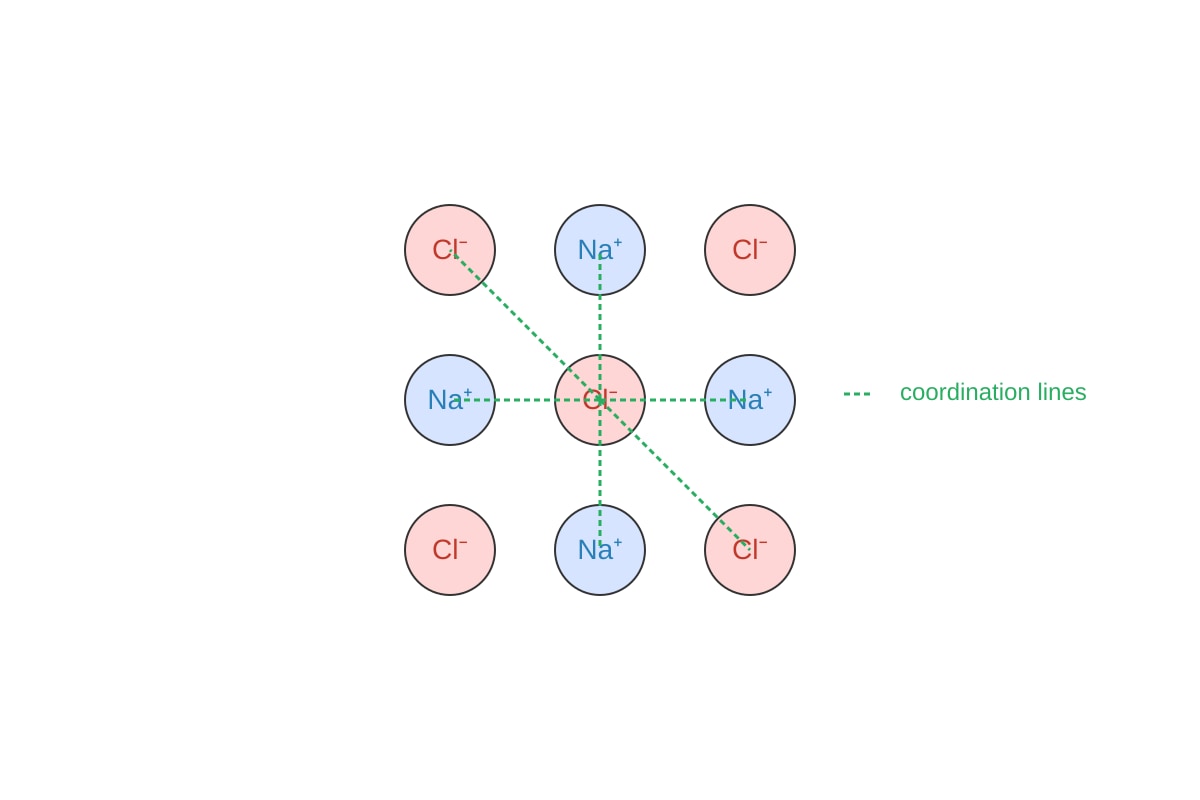
Answer: Coordination number = 6 for each ion [1]; property: high melting point / hardness / brittleness [1].
Teaching note: From placeholder: central ion surrounded by 6 opposites → 6:6 lattice (rock salt). Property from strong electrostatic forces.
Section C Answers (Q15–20)
Q15 [3 marks]
Answer: Group 1 [1]. Large jump after 1st IE (496 → 4562) shows only 1 valence e⁻ [1]; after that gradual increase within shell [1].
Teaching note: Pattern: big jump after n valence e⁻ removed → group = n.
Q16 [3 marks]
Answer: Shape: trigonal bipyramidal [1]; hybridisation: sp³d [1]; 5 bonding pairs, 0 lone pairs on P [1].
Teaching note: P has 5 valence e⁻, 5 Cl → 5 regions. Expanded octet allowed for Period 3.
Q17 [3 marks]
Answer: Statement false [1]. Diamond: each C sp³, all valence e⁻ in covalent bonds → insulator [1]. Graphite: sp² layers, delocalised e⁻ between layers → conducts electricity [1].
Teaching note: Structure determines conductivity; not identical.
Q18 [2 marks]
Answer: M_r = 14.0 + 4(1.0) + 14.0 + 3(16.0) = 14+4+14+48 = 80.0 [1 calc, 1 answer]
Teaching note: NH₄NO₃ = N₂H₄O₃. Step: 2N=28, 4H=4, 3O=48 → 80.
Q19 [2 marks]
Answer: In ice, water molecules form open hexagonal lattice via H-bonds [1]; this occupies more volume than liquid where H-bonds continually break/reform allowing closer packing [1].
Teaching note: Density anomaly due to H-bond network.
Q20 [2 marks]
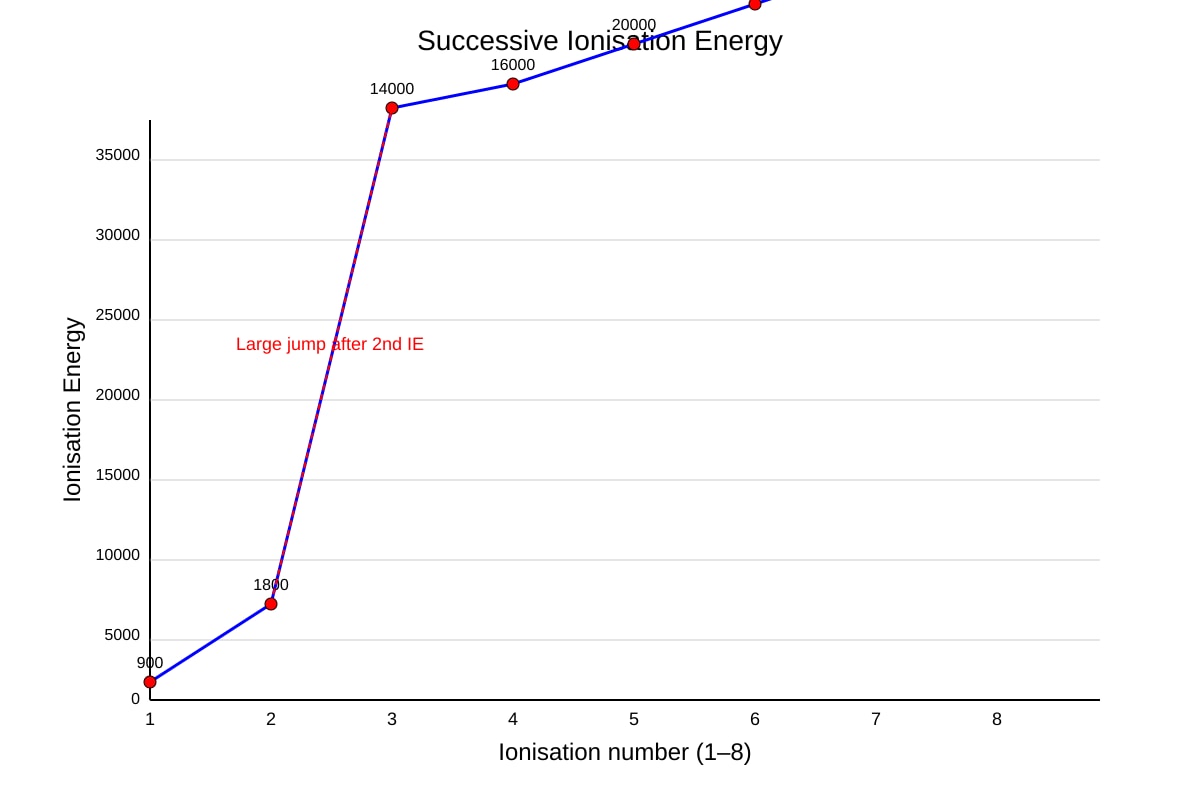
Answer: 2 outer e⁻ [1]; possible element: Be (Period 2) or Mg (Period 3) [1].
Teaching note: Large jump after 2nd IE → 2 valence e⁻. From graph values, IE1900, IE21800 fit Be (Be IE1=900, IE2=1757).