AI Generated Quiz
A Level H1 Chemistry Acids Bases Salts Quiz
Free AI-Generated Owl Alpha A Level H1 Chemistry Acids Bases Salts quiz with questions and answers for Singapore students. This page is rendered as a direct URL so the questions and answers can be discovered without pressing in-page buttons.
These static practice materials are generated from the site's syllabus and paper-generation workflow, with source and model context shown so students and parents can evaluate the material before use.
Questions
A-Level Chemistry H1 Quiz - Acids Bases Salts
Name: ___________________________
Class: ___________________________
Date: ___________________________
Score: ________ / 50
Duration: 60 minutes
Total Marks: 50
Instructions
- Answer ALL questions.
- Write your answers in the spaces provided.
- Show all working for calculation questions. Answers without working may not receive full marks.
- The number of marks for each question or part-question is shown in brackets [ ].
- You may use a calculator where appropriate.
- A copy of the Periodic Table and Data Booklet is provided separately.
Section A: Multiple Choice (Questions 1–5) [10 marks]
Each question is worth 2 marks. Choose the ONE best answer.
1. Which of the following best describes a weak acid?
A. An acid that has a very low pH value. B. An acid that partially dissociates in aqueous solution. C. An acid that does not conduct electricity. D. An acid that is present in low concentration.
2. The ionic product of water, , at 298 K is mol² dm⁻⁶. What is the pH of pure water at 298 K?
A. 1 B. 7 C. 10 D. 14
3. A buffer solution is prepared by mixing 0.20 mol dm⁻³ ethanoic acid () with 0.20 mol dm⁻³ sodium ethanoate (). Which action will cause the pH of the buffer to decrease?
A. Adding a small amount of solid sodium ethanoate. B. Adding a small amount of dilute sodium hydroxide solution. C. Adding a small amount of dilute hydrochloric acid. D. Diluting the solution with distilled water.
4. In the titration of 25.0 cm³ of 0.10 mol dm⁻³ sodium hydroxide with 0.10 mol dm⁻³ hydrochloric acid, what is the pH at the equivalence point?
A. 1 B. 3 C. 7 D. 13
5. Which salt, when dissolved in water, produces a solution with pH greater than 7?
A. Sodium chloride B. Ammonium chloride C. Sodium ethanoate D. Potassium nitrate
Section B: Structured Questions (Questions 6–15) [25 marks]
6. (a) Define the term strong acid.
.......................................................................................................................
....................................................................................................................... [1]
(b) Write an equation to show the dissociation of sulfuric acid, , in water. Include state symbols.
....................................................................................................................... [1]
(c) Explain why a 0.10 mol dm⁻³ solution of hydrochloric acid has a lower pH than a 0.10 mol dm⁻³ solution of ethanoic acid.
.......................................................................................................................
.......................................................................................................................
....................................................................................................................... [2]
[Total: 4 marks]
7. Calculate the pH of a 0.050 mol dm⁻³ solution of nitric acid, .
Working:
.......................................................................................................................
.......................................................................................................................
....................................................................................................................... [2]
8. Propanoic acid () is a weak acid with mol dm⁻³ at 298 K.
(a) Write an expression for the acid dissociation constant, , for propanoic acid.
....................................................................................................................... [1]
(b) Calculate the pH of a 0.15 mol dm⁻³ solution of propanoic acid. Assume that the concentration of undissociated acid at equilibrium is approximately equal to the initial concentration.
Working:
.......................................................................................................................
.......................................................................................................................
.......................................................................................................................
....................................................................................................................... [3]
[Total: 4 marks]
9. A student adds 0.020 mol of solid sodium hydroxide to 1.0 dm³ of 0.10 mol dm⁻³ ethanoic acid. Assume no change in volume.
(a) Identify the type of reaction that occurs.
....................................................................................................................... [1]
(b) Explain whether the resulting solution is a buffer solution.
.......................................................................................................................
.......................................................................................................................
....................................................................................................................... [2]
[Total: 3 marks]
10. A buffer solution is made by mixing 50.0 cm³ of 0.20 mol dm⁻³ ethanoic acid with 50.0 cm³ of 0.30 mol dm⁻³ sodium ethanoate.
(a) Calculate the concentrations of ethanoic acid and ethanoate ions in the resulting mixture.
Working:
.......................................................................................................................
.......................................................................................................................
....................................................................................................................... [2]
(b) Given that of ethanoic acid is mol dm⁻³, calculate the pH of this buffer.
Working:
.......................................................................................................................
.......................................................................................................................
....................................................................................................................... [2]
[Total: 4 marks]
11. Explain the following observation:
When a few drops of universal indicator are added to a solution of sodium carbonate, the indicator turns blue-purple. However, when the same test is performed on a solution of ammonium chloride, the indicator turns orange-red.
.......................................................................................................................
.......................................................................................................................
.......................................................................................................................
.......................................................................................................................
.......................................................................................................................
....................................................................................................................... [3]
12. Describe how you would prepare a solution of sodium chloride by an acid-base titration in the laboratory. Include the reagents used, the procedure, and how you would obtain pure sodium chloride crystals.
.......................................................................................................................
.......................................................................................................................
.......................................................................................................................
.......................................................................................................................
.......................................................................................................................
.......................................................................................................................
....................................................................................................................... [3]
13. Define the term neutralisation in terms of ions.
.......................................................................................................................
....................................................................................................................... [1]
14. A solution contains 0.025 mol dm⁻³ calcium hydroxide, .
(a) Write an equation for the dissociation of calcium hydroxide in water.
....................................................................................................................... [1]
(b) Calculate the pH of this solution at 298 K. ( mol² dm⁻⁶)
Working:
.......................................................................................................................
.......................................................................................................................
.......................................................................................................................
....................................................................................................................... [3]
[Total: 4 marks]
15. Explain why the pH of a solution does not change significantly when a small amount of dilute hydrochloric acid is added to a buffer containing ammonia and ammonium chloride, but the pH drops sharply when the same amount of acid is added to pure water.
.......................................................................................................................
.......................................................................................................................
.......................................................................................................................
.......................................................................................................................
.......................................................................................................................
....................................................................................................................... [3]
Section C: Application and Data Interpretation (Questions 16–20) [15 marks]
16. The following data were collected during the titration of 25.0 cm³ of 0.10 mol dm⁻³ ethanoic acid with 0.10 mol dm⁻³ sodium hydroxide.
| Volume of NaOH added / cm³ | pH |
|---|---|
| 0.0 | 2.9 |
| 5.0 | 4.2 |
| 10.0 | 4.6 |
| 12.5 | 4.7 |
| 15.0 | 5.2 |
| 20.0 | 6.0 |
| 22.0 | 7.0 |
| 24.0 | 8.7 |
| 25.0 | 11.0 |
| 26.0 | 12.0 |
| 30.0 | 12.3 |
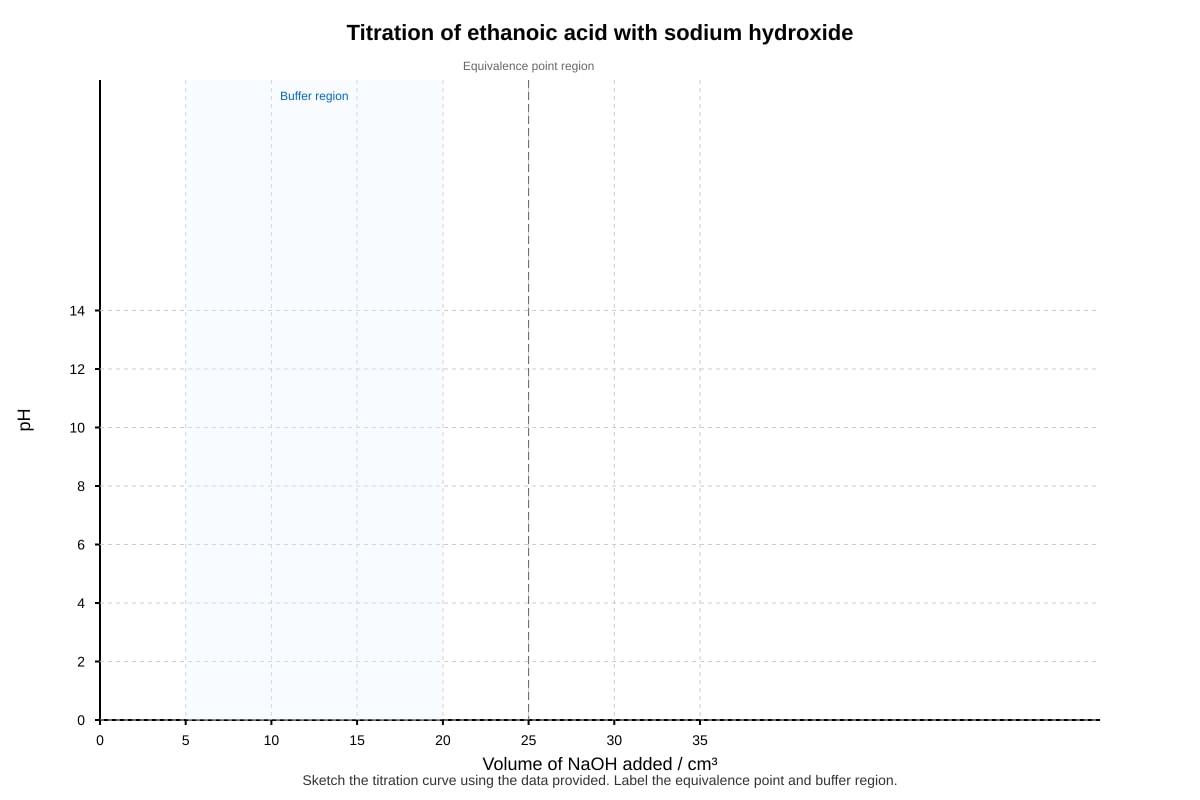
(a) Use the data to sketch a titration curve on the axes below. Label the equivalence point and the buffer region.
<image_placeholder> id: Q16-fig1 type: graph linked_question: Q16 description: Empty titration curve axes for student to sketch. x-axis: Volume of NaOH added / cm³, range 0 to 35. y-axis: pH, range 0 to 14. Grid lines at 5 cm³ intervals on x-axis and 2 pH unit intervals on y-axis. labels: x-axis label "Volume of NaOH added / cm³", y-axis label "pH", title "Titration of ethanoic acid with sodium hydroxide" values: x-axis range 0–35 cm³, y-axis range 0–14 must_show: Clearly labelled axes with units, grid lines, space for student to plot curve, equivalence point region around 25 cm³ and pH ~11, buffer region between ~5–20 cm³ </image_placeholder>
(b) From the data, estimate the pH at the equivalence point.
....................................................................................................................... [1]
(c) Explain why the pH at the equivalence point is greater than 7.
.......................................................................................................................
.......................................................................................................................
....................................................................................................................... [2]
(d) Suggest a suitable indicator for this titration. Explain your choice.
.......................................................................................................................
.......................................................................................................................
....................................................................................................................... [2]
[Total: 5 marks]
17. The pH of human blood is maintained at approximately 7.4 by the carbonic acid–hydrogen carbonate buffer system:
(a) Identify the weak acid and the conjugate base in this buffer system.
Weak acid: .............................................
Conjugate base: ............................................ [1]
(b) Explain how this buffer responds when a small amount of acid (excess ) enters the blood.
.......................................................................................................................
.......................................................................................................................
....................................................................................................................... [2]
(c) Explain how this buffer responds when a small amount of base (excess ) enters the blood.
.......................................................................................................................
.......................................................................................................................
....................................................................................................................... [2]
[Total: 5 marks]
18. A student is asked to determine the concentration of a solution of hydrochloric acid by titration with standard sodium hydroxide solution.
The student's results are shown below.
| Titration | Rough | 1 | 2 | 3 |
|---|---|---|---|---|
| Final burette reading / cm³ | 24.80 | 24.30 | 34.10 | 24.40 |
| Initial burette reading / cm³ | 0.00 | 0.00 | 9.80 | 0.00 |
| Volume used / cm³ | 24.80 | 24.30 | 24.30 | 24.40 |
(a) Calculate the average titre, discarding any anomalous results.
Working:
.......................................................................................................................
....................................................................................................................... [1]
(b) The concentration of the sodium hydroxide solution was 0.100 mol dm⁻³ and 25.0 cm³ of hydrochloric acid was used. Calculate the concentration of the hydrochloric acid.
Working:
.......................................................................................................................
.......................................................................................................................
.......................................................................................................................
....................................................................................................................... [3]
[Total: 4 marks]
19. Ammonia () is a weak base.
(a) Write an equation to show the behaviour of ammonia as a Brønsted-Lowry base in water.
....................................................................................................................... [1]
(b) A solution of ammonia has a concentration of 0.10 mol dm⁻³ and a pH of 11.1 at 298 K. Calculate the base dissociation constant, , for ammonia.
Working:
.......................................................................................................................
.......................................................................................................................
.......................................................................................................................
.......................................................................................................................
....................................................................................................................... [4]
[Total: 5 marks]
20. A farmer finds that the soil in a particular field has a pH of 4.5, which is too acidic for the crops he wishes to grow.
(a) Name a common substance that the farmer could add to the soil to raise the pH.
....................................................................................................................... [1]
(b) Explain, with the aid of an equation, how this substance raises the pH of the soil.
.......................................................................................................................
....................................................................................................................... [1]
(c) Explain why adding sodium hydroxide is not a suitable method for treating acidic soil on a large scale.
.......................................................................................................................
.......................................................................................................................
....................................................................................................................... [2]
[Total: 4 marks]
END OF QUIZ
Answers
A-Level Chemistry H1 Quiz - Acids Bases Salts
Answer Key
Section A: Multiple Choice
1. Answer: B
A weak acid is defined as an acid that partially dissociates in aqueous solution. This is a fundamental distinction in acid-base chemistry. The term "weak" refers to the degree of dissociation, not the concentration of the acid. A dilute strong acid can have a higher pH than a concentrated weak acid. Option A is incorrect because a weak acid does not necessarily have a very low pH — it depends on both strength and concentration. Option C is incorrect because weak acids do conduct electricity, albeit poorly, due to the presence of some ions. Option D confuses strength with concentration.
[1 mark]
2. Answer: B
In pure water, . Since , it follows that mol dm⁻³. Therefore, . Pure water is neutral at 298 K.
[1 mark]
3. Answer: C
Adding dilute hydrochloric acid introduces ions. In the buffer, the ethanoate ions () react with the added to form more ethanoic acid, but the addition of still causes a net increase in , which decreases the pH. Option A would increase the pH (more conjugate base shifts equilibrium to the left, reducing ). Option B would increase the pH (OH⁻ reacts with the weak acid, producing more conjugate base). Option D, dilution, does not significantly change the pH of a buffer because the ratio remains constant.
[1 mark]
4. Answer: C
Hydrochloric acid is a strong acid and sodium hydroxide is a strong base. At the equivalence point, the salt formed is sodium chloride (), which is derived from a strong acid and a strong base. The ions and do not hydrolyse in water, so the solution is neutral with pH = 7.
[1 mark]
5. Answer: C
Sodium ethanoate is the salt of a weak acid (ethanoic acid) and a strong base (sodium hydroxide). When dissolved in water, the ethanoate ion () undergoes hydrolysis:
This produces ions, making the solution alkaline (pH > 7). Sodium chloride and potassium nitrate are salts of strong acids and strong bases (pH = 7). Ammonium chloride is a salt of a weak base and a strong acid (pH < 7).
[1 mark]
Section B: Structured Questions
6. (a) A strong acid is an acid that completely dissociates (or ionises) in aqueous solution.
[1 mark]
Common mistake: Students sometimes say "fully ionises in water" — this is acceptable. Saying "dissociates into H⁺ ions" without specifying "completely" is incomplete.
(b)
or equivalently:
[1 mark] — Award the mark for correct products and state symbols. The equation must show complete dissociation (single arrow, not reversible).
(c) Hydrochloric acid is a strong acid and dissociates completely in water, producing a high concentration of ions. Ethanoic acid is a weak acid and only partially dissociates, so at the same concentration (0.10 mol dm⁻³), it produces a lower concentration of ions. Since , a lower means a higher pH (less acidic). Therefore, the HCl solution has a lower pH.
[2 marks] — 1 mark for identifying HCl as strong and ethanoic acid as weak. 1 mark for linking degree of dissociation to and hence pH.
7. Nitric acid () is a strong acid, so it dissociates completely:
Therefore, mol dm⁻³.
Answer: pH = 1.30
[2 marks] — 1 mark for stating that mol dm⁻³ (complete dissociation). 1 mark for correct pH calculation.
Common mistake: Students who treat as a weak acid and try to use will get the wrong answer. Always identify whether the acid is strong or weak first.
8. (a)
[1 mark] — The expression must have products over reactant. State symbols are not required in expressions.
(b) For a weak acid, (assuming and initial concentration).
Answer: pH = 2.85
[3 marks] — 1 mark for correct expression rearrangement. 1 mark for correct substitution. 1 mark for correct final answer (accept 2.85–2.86).
Common mistake: Forgetting to take the square root, or using the wrong concentration. Also, students sometimes write without squaring — this gives an incorrect answer.
9. (a) Neutralisation (or acid-base reaction).
[1 mark]
(b) Moles of initially = mol. Moles of added = 0.020 mol.
The reaction is:
NaOH is the limiting reagent. After reaction:
- Moles of remaining = mol
- Moles of (conjugate base) formed = 0.020 mol
The resulting solution contains both a weak acid and its conjugate base, so it is a buffer solution.
[2 marks] — 1 mark for calculating remaining moles of weak acid and moles of conjugate base. 1 mark for concluding it is a buffer because both components are present.
10. (a) Total volume of mixture = cm³ = 0.100 dm³.
[2 marks] — 1 mark for each correct concentration.
(b) Using the Henderson-Hasselbalch equation:
Answer: pH = 4.92
[2 marks] — 1 mark for correct calculation. 1 mark for correct substitution and final answer.
Alternative method: Using expression directly:
, so
11. Sodium carbonate () is a salt of a strong base (NaOH) and a weak acid (). The carbonate ion () undergoes hydrolysis in water:
This produces ions, making the solution alkaline (pH > 7), so universal indicator turns blue-purple.
Ammonium chloride () is a salt of a weak base () and a strong acid (). The ammonium ion () undergoes hydrolysis:
This produces (or ) ions, making the solution acidic (pH < 7), so universal indicator turns orange-red.
[3 marks] — 1 mark for identifying sodium carbonate as a salt of strong base/weak acid and explaining alkaline pH. 1 mark for identifying ammonium chloride as a salt of weak base/strong acid and explaining acidic pH. 1 mark for correct hydrolysis equations.
12. Reagents: Hydrochloric acid and sodium hydroxide solution.
Procedure:
- Using a pipette, transfer 25.0 cm³ of a known concentration of sodium hydroxide solution into a conical flask.
- Add 2–3 drops of a suitable indicator (e.g., phenolphthalein) to the conical flask.
- Fill a burette with hydrochloric acid of known concentration.
- Add the acid from the burette to the sodium hydroxide solution in the conical flask, swirling continuously, until the indicator changes colour at the endpoint (e.g., phenolphthalein changes from pink to colourless).
- Record the volume of acid used. Repeat the titration until concordant results are obtained.
Obtaining pure crystals: 6. Using the exact volume of acid needed (from the titration), mix the acid and alkali in the correct proportions without adding indicator. 7. Pour the resulting sodium chloride solution into an evaporating basin. 8. Heat the solution gently to evaporate most of the water until the solution is saturated (crystals begin to form at the edges). 9. Allow the saturated solution to cool slowly so that crystals form. 10. Filter the crystals, wash with a small amount of cold distilled water, and dry between filter papers or in a warm oven.
[3 marks] — 1 mark for correct reagents and titration procedure. 1 mark for using results without indicator to prepare the salt. 1 mark for correct crystallisation method (evaporate, cool, filter, dry).
13. Neutralisation is the reaction between ions (from an acid) and ions (from a base) to form water:
[1 mark] — The answer must refer to and ions forming water. Simply saying "acid reacts with base" is insufficient at A-Level.
14. (a)
[1 mark] — Must show 2 moles of per mole of .
(b) From the equation: mol dm⁻³.
Answer: pH = 12.70
[3 marks] — 1 mark for calculating mol dm⁻³. 1 mark for calculating . 1 mark for correct pH.
Common mistake: Forgetting that produces 2 moles of per mole of compound. Students who use will get pH = 12.40, which is incorrect.
15. In the ammonia–ammonium chloride buffer, the equilibrium is:
When a small amount of HCl is added, the ions react with the (the base component of the buffer):
The buffer absorbs the added by converting it into , so the change in (and hence pH) is very small.
In pure water, there is no buffer system. The added ions directly increase , causing a sharp drop in pH. For example, adding enough HCl to make mol dm⁻³ to pure water gives pH = 3, a dramatic change from pH 7.
[3 marks] — 1 mark for explaining that added reacts with in the buffer. 1 mark for stating that the buffer minimises the pH change. 1 mark for contrasting with pure water where added causes a sharp pH drop.
Section C: Application and Data Interpretation
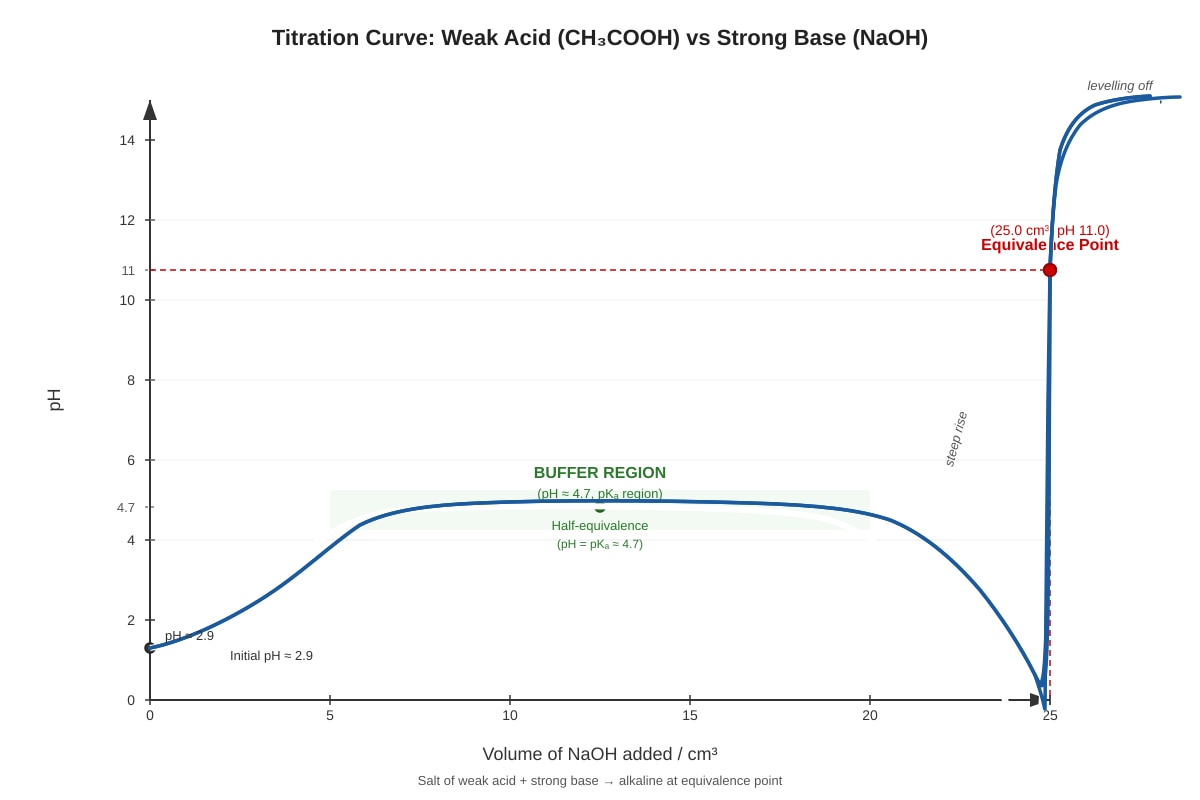
16. (a) The titration curve should show:
- Starting pH around 2.9 (weak acid).
- A gradual rise through the buffer region (approximately 5–20 cm³), with a relatively flat section around pH 4.7 (the region, at half-equivalence).
- A steep rise near 25.0 cm³ (equivalence point).
- Equivalence point at pH ≈ 11.0 (above 7 because the salt of a weak acid and strong base is alkaline).
- A levelling off at high pH as excess NaOH is added.
The equivalence point should be labelled at approximately 25.0 cm³, pH 11.0. The buffer region should be labelled in the relatively flat portion before the steep rise (approximately 5–20 cm³).
[Image placeholder note: The student's sketch should show a curve starting at pH ~2.9, rising gradually through a buffer region, then steeply through the equivalence point at ~25 cm³ and pH ~11, then levelling off. The equivalence point and buffer region should be clearly labelled.]
(b) From the data, the pH at the equivalence point (25.0 cm³) is 11.0.
[1 mark]
(c) At the equivalence point, all the ethanoic acid has been neutralised to form sodium ethanoate (). Sodium ethanoate is the salt of a weak acid and a strong base. The ethanoate ion () undergoes hydrolysis:
This produces ions, making the solution alkaline, so the pH is greater than 7.
[2 marks] — 1 mark for identifying the salt as being from a weak acid/strong base. 1 mark for explaining hydrolysis producing ions.
(d) Phenolphthalein is a suitable indicator. Its colour change range is approximately pH 8.2–10.0, which falls within the steep portion of the titration curve near the equivalence point. This means the colour change will occur very close to the true equivalence point, giving an accurate result.
[2 marks] — 1 mark for naming phenolphthalein (or any indicator with range within the steep region). 1 mark for explaining that its pH range falls within the steep portion of the curve.
17. (a) Weak acid: (carbonic acid)
Conjugate base: (hydrogen carbonate ion)
[1 mark] — Both must be correct.
(b) When excess enters the blood, it reacts with the hydrogen carbonate ion (the conjugate base):
The equilibrium shifts to the right (or the added is removed by reaction with ), so the increase in is minimised and the pH remains relatively stable.
[2 marks] — 1 mark for the correct equation showing reacting with . 1 mark for explaining that this removes the added and minimises pH change.
(c) When excess enters the blood, it reacts with the carbonic acid (the weak acid component):
Alternatively, reacts with from the equilibrium, causing the equilibrium to shift to the left to replace the , and the dissociates to replenish . The net effect is that the added is neutralised and the pH remains relatively stable.
[2 marks] — 1 mark for the correct equation or explanation. 1 mark for explaining that the buffer minimises the pH change.
18. (a) Titration 2 and Titration 3 both give 24.30 cm³ (concordant). Titration 1 (24.30 cm³) is also concordant. Titration 3 (24.40 cm³) is very close. The rough titration (24.80 cm³) is discarded.
Average titre = cm³
(Alternatively, using only titrations 1 and 2: cm³ — both approaches are acceptable.)
Answer: 24.33 cm³ (or 24.30 cm³)
[1 mark]
(b) The equation for the reaction is:
The mole ratio is 1:1.
Answer: 0.0973 mol dm⁻³ (or 0.0972 mol dm⁻³ if using 24.30 cm³)
[3 marks] — 1 mark for correct equation and 1:1 ratio. 1 mark for correct substitution. 1 mark for correct answer with appropriate significant figures.
19. (a)
[1 mark] — Must show the reversible arrow (equilibrium) since ammonia is a weak base.
(b) Given: pH = 11.1, so
At equilibrium: mol dm⁻³
mol dm⁻³ (or approximately 0.10 mol dm⁻³)
Answer: mol dm⁻³ (accept to depending on approximation used)
[4 marks] — 1 mark for calculating from pH. 1 mark for identifying . 1 mark for correct expression and substitution. 1 mark for correct final answer.
20. (a) Calcium carbonate (limestone) or calcium hydroxide (slaked lime) or calcium oxide (quicklime).
[1 mark] — Any one correct answer.
(b) Calcium carbonate reacts with the acid (e.g., ) in the soil:
This removes ions from the soil, thereby raising the pH (making it less acidic).
[1 mark] — Correct equation showing acid neutralisation.
(c) Sodium hydroxide is a strong base and is highly corrosive. It is difficult to control the amount added, and excess NaOH would make the soil too alkaline, which is also harmful to crops. Additionally, NaOH is expensive for large-scale agricultural use and can damage soil structure and harm microorganisms. Calcium carbonate (limestone) is preferred because it is cheap, safe to handle, and insoluble in water, so it does not easily over-treat the soil.
[2 marks] — 1 mark for stating that NaOH is too corrosive/dangerous or would make soil too alkaline. 1 mark for explaining why an alternative (e.g., limestone) is more practical (cheap, safe, or self-regulating).
END OF ANSWER KEY