A-Level Chemistry H1 Quiz - Acids Bases Salts
Name: ___________________________
Class: ___________________________
Date: ___________________________
Score: _______ / 40
Duration: 50 minutes
Total Marks: 40
Instructions:
- Answer all 20 questions.
- Section A: Short structured questions (1–8). Section B: Calculations and explanations (9–15). Section C: Data and applied contexts (16–20).
- Show all working for calculation questions. Use appropriate units and chemical notation.
- This quiz is syllabus-first practice content generated from LLM-inferred templates. It is not derived from official past-year papers.
Section A: Short Structured Questions (1–8)
1. What is meant by the term weak acid? Illustrate your answer with a balanced equation including state symbols. [2]
2. State the Brønsted–Lowry definition of a base. [1]
3. Write the conjugate acid–base pair for the reaction:
NH₃(aq) + H₂O(l) ⇌ NH₄⁺(aq) + OH⁻(aq) [2]
4. Calcium hydroxide is added to fermentation tanks to prevent the production of lactic acid from slowing down. Why does high acidity reduce the effectiveness of enzymes? [1]
5. Write the expression for the ionic product of water, K_w, at 25 °C. State its value. [2]
6. A solution has [H⁺(aq)] = 1.0 × 10⁻³ mol dm⁻³. Calculate its pH. [1]
7. Explain, using an equation, why sodium carbonate solution is basic. [2]
8. State and explain which indicator, methyl orange (pH range 3.1–4.4) or phenolphthalein (pH range 8.2–10.0), is suitable for the titration of strong acid with weak base. [2]
Section B: Calculations and Explanations (9–15)
9. A buffer solution contains 0.10 mol dm⁻³ ethanoic acid (CH₃COOH) and 0.15 mol dm⁻³ sodium ethanoate (CH₃COONa). The Kₐ of ethanoic acid is 1.8 × 10⁻⁵ mol dm⁻³. Calculate the pH of the buffer. [3]
10. Carbonic acid (H₂CO₃) dissociates in rainwater.
(a) Write a balanced equation, with state symbols, for the first dissociation of carbonic acid. [1]
(b) Write the expression for Kₐ for this dissociation. [1]
(c) Given [H₂CO₃] = 1.2 × 10⁻⁵ mol dm⁻³ and [HCO₃⁻] = [H⁺] = 2.0 × 10⁻⁶ mol dm⁻³, calculate Kₐ. [2]
11. 25.0 cm³ of 0.0080 mol dm⁻³ benzoic acid (C₆H₅COOH) was titrated with 0.010 mol dm⁻³ NaOH. Calculate the volume of NaOH required for complete neutralisation.
Equation: C₆H₅COOH + NaOH → C₆H₅COONa + H₂O [3]
12. Phosphoric acid (H₃PO₄) is a triprotic acid. Write the three dissociation equations with state symbols and explain why Kₐ₁ > Kₐ₂ > Kₐ₃. [4]
13. Calculate the pH of 0.020 mol dm⁻³ NaOH at 25 °C. (K_w = 1.0 × 10⁻¹⁴ mol² dm⁻⁶) [2]
14. A student adds 0.010 mol of solid NaOH to 1.0 dm³ of the buffer in Q9. Assuming no volume change, calculate the new pH. [3]
15. Explain how the CO₃²⁻/HCO₃⁻ system acts as a buffer in ocean water and why ocean acidification reduces its effectiveness. [3]
Section C: Data and Applied Contexts (16–20)
16. The table below shows pH values of 0.010 mol dm⁻³ solutions of four acids.
| Acid | pH |
|---|
| HA | 2.00 |
| HB | 3.00 |
| HC | 2.30 |
| HD | 4.00 |
(a) Which is the strongest acid? [1]
(b) Calculate [H⁺] for HB. [1]
(c) State one reason why HA is stronger than HD. [1]
17. The titration curve below shows the addition of NaOH to a weak acid.
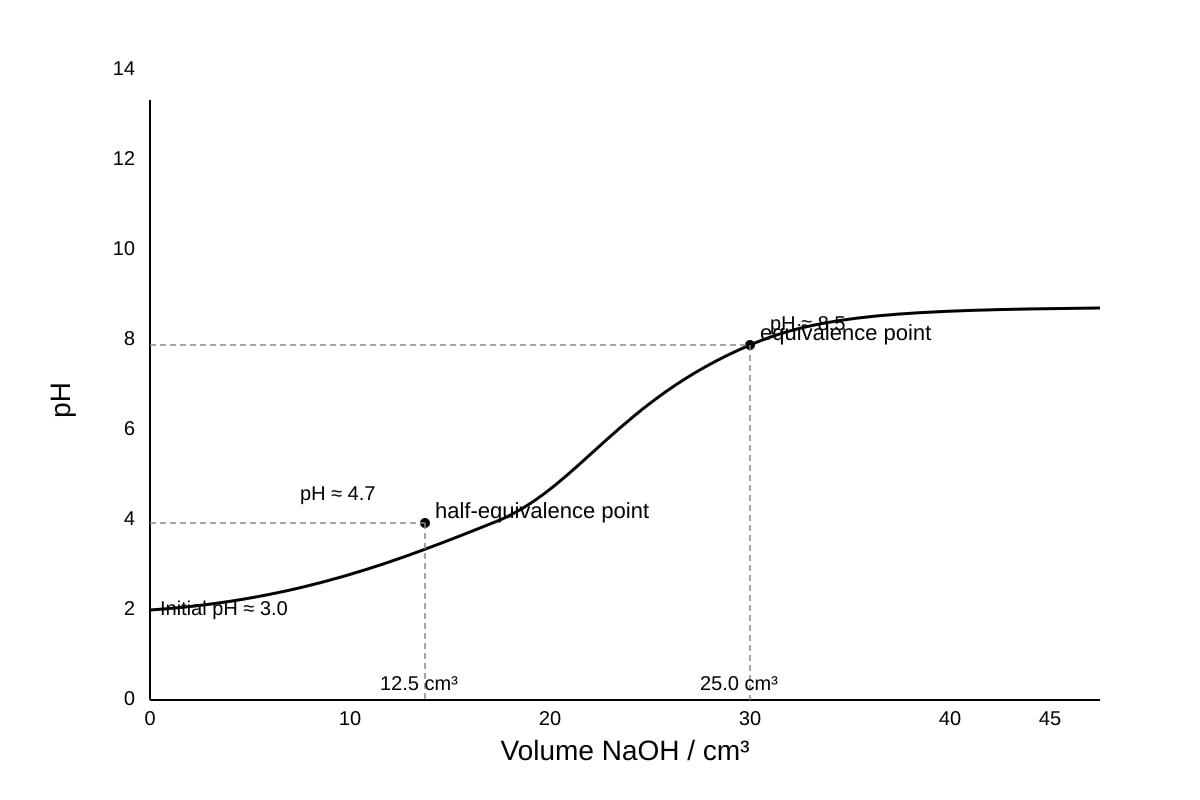
Generated graph for Q17.
(a) State the pH at the half-equivalence point. [1]
(b) Explain how this value relates to pKₐ. [1]
(c) Suggest a suitable indicator for this titration. [1]
18. A sample of coffee powder was extracted with water. 50.0 cm³ of extract required 18.4 cm³ of 0.0050 mol dm⁻³ NaOH to neutralise chlorogenic acid (monoprotic). Calculate the concentration of chlorogenic acid in the extract. [2]
19. State Le Chatelier's principle and apply it to explain the effect of adding H⁺ on the equilibrium:
HCO₃⁻(aq) ⇌ CO₃²⁻(aq) + H⁺(aq) [3]
20. Rainwater has pH 5.6 due to dissolved CO₂. If a lake's water contains HCO₃⁻ at 2.0 × 10⁻⁴ mol dm⁻³ and CO₃²⁻ at 1.0 × 10⁻⁵ mol dm⁻³, and Kₐ₂ for carbonic acid system is 4.8 × 10⁻¹¹, calculate the [H⁺] and pH of the lake water. [3]
</stage5_quiz_answers_md>
A-Level Chemistry H1 Quiz - Acids Bases Salts (Answer Key)
Total Marks: 40
Topic: Acids Bases Salts
Note: Syllabus-first practice generated from LLM-inferred templates. Not official past-year content.
Section A
1. [2 marks]
A weak acid is one that only partially dissociates/ionises in water.
Equation: CH₃COOH(aq) ⇌ CH₃COO⁻(aq) + H⁺(aq)
Marking: 1 mark for definition (partial dissociation), 1 mark for equation with reversible arrow and state symbols.
Teaching note: Strength refers to extent of dissociation, not concentration. Weak ≠ dilute.
Common mistake: Using → instead of ⇌; writing "does not dissociate".
2. [1 mark]
A Brønsted–Lowry base is a proton (H⁺) acceptor.
Teaching note: Contrast with Arrhenius base (produces OH⁻ in water).
3. [2 marks]
Conjugate acid–base pairs: NH₄⁺/NH₃ and H₂O/OH⁻.
Marking: 1 mark per pair.
Teaching note: Pair differs by one H⁺. NH₃ gained H⁺ to become NH₄⁺; H₂O lost H⁺ to become OH⁻.
4. [1 mark]
High acidity (low pH) denatures enzymes, changing the active site shape so substrate cannot bind.
Teaching note: H⁺ disrupts ionic/H-bonds in tertiary structure.
5. [2 marks]
K_w = [H⁺(aq)][OH⁻(aq)] = 1.0 × 10⁻¹⁴ mol² dm⁻⁶ at 25 °C.
Marking: 1 for expression, 1 for value.
6. [1 mark]
pH = –log(1.0 × 10⁻³) = 3.00
Teaching note: pH = –log₁₀[H⁺].
7. [2 marks]
CO₃²⁻(aq) + H₂O(l) ⇌ HCO₃⁻(aq) + OH⁻(aq); OH⁻ makes solution basic.
Marking: 1 equation, 1 explanation.
8. [2 marks]
Methyl orange is suitable. Strong acid–weak base titration gives acidic equivalence pH (~<7); methyl orange changes in acidic range. Phenolphthalein is for basic range.
Marking: 1 for choice, 1 for reason.
Section B
9. [3 marks]
pH = pKₐ + log([A⁻]/[HA])
pKₐ = –log(1.8 × 10⁻⁵) = 4.74
pH = 4.74 + log(0.15/0.10) = 4.74 + 0.18 = 4.92
Marking: 1 pKₐ, 1 ratio log, 1 final pH.
Common mistake: Swapping [HA]/[A⁻].
10. [4 marks total: (a)1, (b)1, (c)2]
(a) H₂CO₃(aq) ⇌ HCO₃⁻(aq) + H⁺(aq)
(b) Kₐ = [HCO₃⁻][H⁺] / [H₂CO₃]
(c) Kₐ = (2.0×10⁻⁶)(2.0×10⁻⁶) / (1.2×10⁻⁵) = 4.0×10⁻¹² / 1.2×10⁻⁵ = 3.3×10⁻⁷ mol dm⁻³
Teaching note: Use first dissociation only.
11. [3 marks]
n(acid) = 0.0080 × (25.0/1000) = 2.0×10⁻⁴ mol
1:1 ratio → n(NaOH) = 2.0×10⁻⁴ mol
V = n/c = 2.0×10⁻⁴ / 0.010 = 0.020 dm³ = 20.0 cm³
Marking: 1 mole acid, 1 mole base, 1 volume.
12. [4 marks]
(1) H₃PO₄(aq) ⇌ H₂PO₄⁻(aq) + H⁺(aq)
(2) H₂PO₄⁻(aq) ⇌ HPO₄²⁻(aq) + H⁺(aq)
(3) HPO₄²⁻(aq) ⇌ PO₄³⁻(aq) + H⁺(aq)
Each step weaker because negative charge increases, electrostatic attraction for H⁺ strengthens, harder to lose H⁺.
Marking: 3 equations (1 each), 1 explanation.
13. [2 marks]
[OH⁻] = 0.020 M; [H⁺] = K_w/[OH⁻] = 1.0×10⁻¹⁴ / 0.020 = 5.0×10⁻¹³
pH = –log(5.0×10⁻¹³) = 12.30
Marking: 1 [H⁺], 1 pH.
14. [3 marks]
New [OH⁻] from NaOH = 0.010 M; reacts with CH₃COOH:
CH₃COOH: 0.10 – 0.010 = 0.09 M; CH₃COO⁻: 0.15 + 0.010 = 0.16 M
pH = 4.74 + log(0.16/0.09) = 4.74 + 0.25 = 4.99
Marking: 1 new conc, 1 log term, 1 pH.
15. [3 marks]
CO₃²⁻ + H⁺ ⇌ HCO₃⁻; added H⁺ consumed by CO₃²⁻, pH stable. Ocean acidification adds excess H⁺ beyond buffer capacity, shifts equilibrium, reduces CO₃²⁻ available for marine organisms.
Marking: 1 equation, 1 action, 1 acidification effect.
Section C
16. [3 marks]
(a) HA (lowest pH = strongest). [1]
(b) [H⁺] = 10⁻³·⁰⁰ = 1.0×10⁻³ mol dm⁻³ [1]
(c) HA dissociates more (higher [H⁺]) due to weaker conjugate base / stronger acid nature. [1]
17. [3 marks]
(a) pH ≈ 4.7 [1]
(b) At half-equivalence, [acid]=[salt], pH = pKₐ. [1]
(c) Phenolphthalein (equivalence ~8.5). [1]
18. [2 marks]
n(NaOH) = 0.0050 × (18.4/1000) = 9.2×10⁻⁵ mol
n(acid) = same (monoprotic)
c = 9.2×10⁻⁵ / (50.0/1000) = 1.84×10⁻³ mol dm⁻³
Marking: 1 moles, 1 concentration.
19. [3 marks]
Le Chatelier: system opposes change. Adding H⁺ shifts equilibrium left, reducing CO₃²⁻, forming more HCO₃⁻.
Marking: 1 principle, 2 application.
20. [3 marks]
Kₐ₂ = [CO₃²⁻][H⁺]/[HCO₃⁻] → [H⁺] = Kₐ₂[HCO₃⁻]/[CO₃²⁻]
= (4.8×10⁻¹¹)(2.0×10⁻⁴)/(1.0×10⁻⁵) = 9.6×10⁻¹⁰ M
pH = –log(9.6×10⁻¹⁰) = 9.02
Marking: 1 rearrange, 1 [H⁺], 1 pH.
</stage5_quiz_answers_md>
<stage5_quiz_md>
A-Level Chemistry H1 Quiz - Acids Bases Salts
Name: ___________________________
Class: ___________________________
Date: ___________________________
Score: _______ / 40
Duration: 50 minutes
Total Marks: 40
Instructions:
- Answer all 20 questions.
- Section A: Short structured questions (1–8). Section B: Calculations and explanations (9–15). Section C: Data and applied contexts (16–20).
- Show all working for calculation questions. Use appropriate units and chemical notation.
- This quiz is syllabus-first practice content generated from LLM-inferred templates. It is not derived from official past-year papers.
Section A: Short Structured Questions (1–8)
1. What is meant by the term weak acid? Illustrate your answer with a balanced equation including state symbols. [2]
2. State the Brønsted–Lowry definition of a base. [1]
3. Write the conjugate acid–base pair for the reaction:
NH₃(aq) + H₂O(l) ⇌ NH₄⁺(aq) + OH⁻(aq) [2]
4. Calcium hydroxide is added to fermentation tanks to prevent the production of lactic acid from slowing down. Why does high acidity reduce the effectiveness of enzymes? [1]
5. Write the expression for the ionic product of water, K_w, at 25 °C. State its value. [2]
6. A solution has [H⁺(aq)] = 1.0 × 10⁻³ mol dm⁻³. Calculate its pH. [1]
7. Explain, using an equation, why sodium carbonate solution is basic. [2]
8. State and explain which indicator, methyl orange (pH range 3.1–4.4) or phenolphthalein (pH range 8.2–10.0), is suitable for the titration of strong acid with weak base. [2]
Section B: Calculations and Explanations (9–15)
9. A buffer solution contains 0.10 mol dm⁻³ ethanoic acid (CH₃COOH) and 0.15 mol dm⁻³ sodium ethanoate (CH₃COONa). The Kₐ of ethanoic acid is 1.8 × 10⁻⁵ mol dm⁻³. Calculate the pH of the buffer. [3]
10. Carbonic acid (H₂CO₃) dissociates in rainwater.
(a) Write a balanced equation, with state symbols, for the first dissociation of carbonic acid. [1]
(b) Write the expression for Kₐ for this dissociation. [1]
(c) Given [H₂CO₃] = 1.2 × 10⁻⁵ mol dm⁻³ and [HCO₃⁻] = [H⁺] = 2.0 × 10⁻⁶ mol dm⁻³, calculate Kₐ. [2]
11. 25.0 cm³ of 0.0080 mol dm⁻³ benzoic acid (C₆H₅COOH) was titrated with 0.010 mol dm⁻³ NaOH. Calculate the volume of NaOH required for complete neutralisation.
Equation: C₆H₅COOH + NaOH → C₆H₅COONa + H₂O [3]
12. Phosphoric acid (H₃PO₄) is a triprotic acid. Write the three dissociation equations with state symbols and explain why Kₐ₁ > Kₐ₂ > Kₐ₃. [4]
13. Calculate the pH of 0.020 mol dm⁻³ NaOH at 25 °C. (K_w = 1.0 × 10⁻¹⁴ mol² dm⁻⁶) [2]
14. A student adds 0.010 mol of solid NaOH to 1.0 dm³ of the buffer in Q9. Assuming no volume change, calculate the new pH. [3]
15. Explain how the CO₃²⁻/HCO₃⁻ system acts as a buffer in ocean water and why ocean acidification reduces its effectiveness. [3]
Section C: Data and Applied Contexts (16–20)
16. The table below shows pH values of 0.010 mol dm⁻³ solutions of four acids.
| Acid | pH |
|---|
| HA | 2.00 |
| HB | 3.00 |
| HC | 2.30 |
| HD | 4.00 |
(a) Which is the strongest acid? [1]
(b) Calculate [H⁺] for HB. [1]
(c) State one reason why HA is stronger than HD. [1]
17. The titration curve below shows the addition of NaOH to a weak acid.
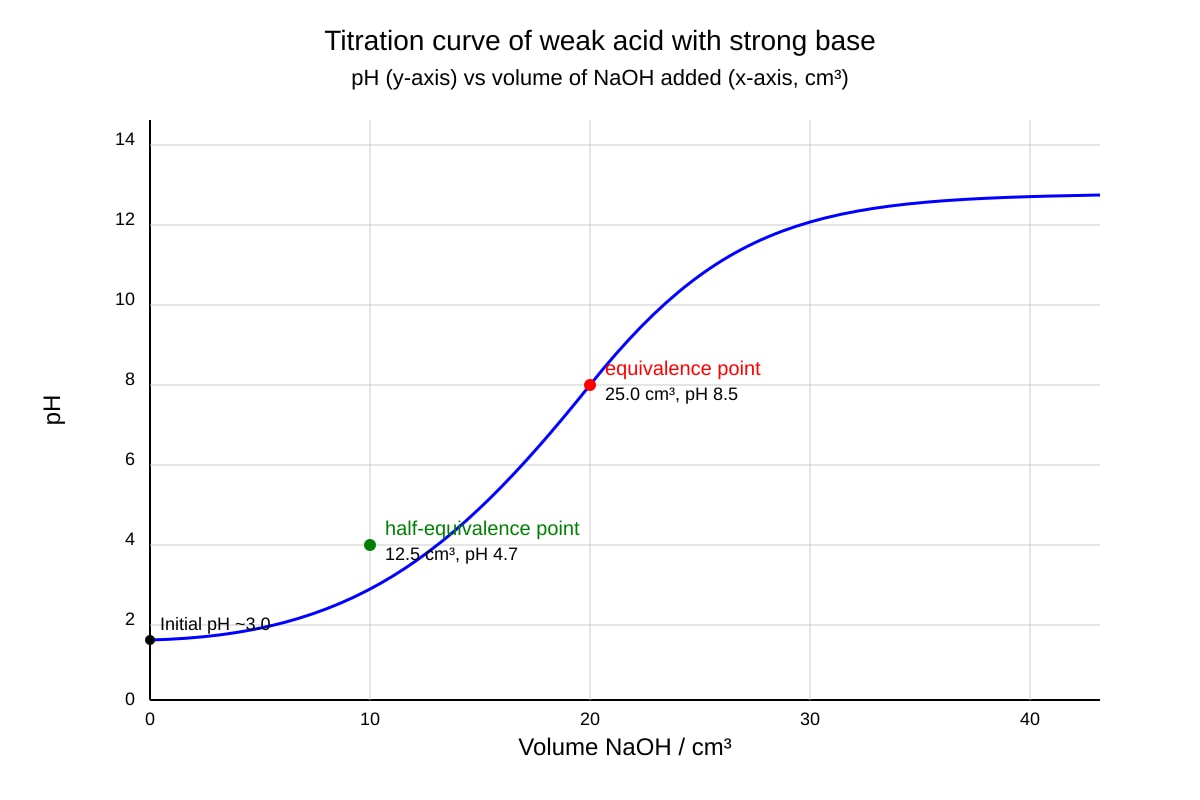
Generated graph for Q17.
(a) State the pH at the half-equivalence point. [1]
(b) Explain how this value relates to pKₐ. [1]
(c) Suggest a suitable indicator for this titration. [1]
18. A sample of coffee powder was extracted with water. 50.0 cm³ of extract required 18.4 cm³ of 0.0050 mol dm⁻³ NaOH to neutralise chlorogenic acid (monoprotic). Calculate the concentration of chlorogenic acid in the extract. [2]
19. State Le Chatelier's principle and apply it to explain the effect of adding H⁺ on the equilibrium:
HCO₃⁻(aq) ⇌ CO₃²⁻(aq) + H⁺(aq) [3]
20. Rainwater has pH 5.6 due to dissolved CO₂. If a lake's water contains HCO₃⁻ at 2.0 × 10⁻⁴ mol dm⁻³ and CO₃²⁻ at 1.0 × 10⁻⁵ mol dm⁻³, and Kₐ₂ for carbonic acid system is 4.8 × 10⁻¹¹, calculate the [H⁺] and pH of the lake water. [3]