From Real Exams Quiz
A Level H1 Chemistry Stoichiometry Moles Quiz
Free A Level H1 Chemistry Stoichiometry Moles quiz, HY3 Exam version, with questions, answers, and A Level-style practice for Singapore students.
These static practice materials are generated from the site's syllabus and paper-generation workflow, with source and model context shown so students and parents can evaluate the material before use.
Questions
A-Level Chemistry H1 Quiz - Stoichiometry Moles
Name: ___________________________
Class: ___________________________
Date: ___________________________
Score: _______ / 40
Duration: 60 minutes
Total Marks: 40
Instructions:
- Answer all 20 questions.
- Show all working clearly for calculation questions.
- Use the Data Booklet if needed.
- Write units where required.
Section A: Foundations of the Mole Concept (Questions 1–5)
1. Define the mole in terms of the Avogadro constant. [1]
2. Calculate the number of moles in 4.00 g of helium (He). (Relative atomic mass: He = 4.00) [2]
3. What is the relative molecular mass, Mr, of CuSO4⋅5H2O?
(Given: Cu = 63.5, S = 32.1, O = 16.0, H = 1.0) [2]
4. A sample contains 3.01×10²³ atoms of carbon. Calculate the mass of this sample. (C = 12.0; NA=6.02×10²³ mol⁻¹) [2]
5. State the meaning of the term "empirical formula". [1]
Section B: Formulae and Equations (Questions 6–10)
6. A compound has the following composition by mass: Na = 36.5%, S = 25.4%, O = 38.1%. Determine its empirical formula. (Na = 23.0, S = 32.1, O = 16.0) [3]
7. A hydrocarbon has molecular formula C6H12. Given its empirical formula is CH2, calculate its molecular mass. (C = 12.0, H = 1.0) [2]
8. Balance the following equation:
_ Al + _ O2 → _ Al2O3 [2]
9. Write the balanced ionic half-equation for the oxidation of Fe2+ to Fe3+. [1]
10. Construct the full redox equation from these half-equations:
Zn→Zn2++2e−
Cu2++2e−→Cu [2]
Section C: Stoichiometric Calculations (Questions 11–15)
11. Calculate the mass of CO2 produced when 5.00 g of CaCO3 is completely decomposed by heat.
CaCO3→CaO+CO2
(Ca = 40.1, C = 12.0, O = 16.0) [3]
12. 25.0 cm³ of 0.100 mol dm⁻³ HCl reacts exactly with 20.0 cm³ of Ba(OH)2.
2HCl+Ba(OH)2→BaCl2+2H2O
Calculate the concentration of Ba(OH)2 in mol dm⁻³. [3]
13. At room temperature and pressure (r.t.p.), 1 mole of gas occupies 24.0 dm³. What volume is occupied by 0.250 mol of O2 gas? [2]
14. In an experiment, 0.200 mol of H2 reacts with excess N2:
N2+3H2→2NH3
Calculate the amount, in moles, of NH3 formed. [2]
15. A solution contains 7.10 g of Na2SO4 in 250 cm³ of solution. Calculate its concentration in mol dm⁻³. (Na = 23.0, S = 32.1, O = 16.0) [3]
Section D: Data Interpretation and Redox (Questions 16–20)
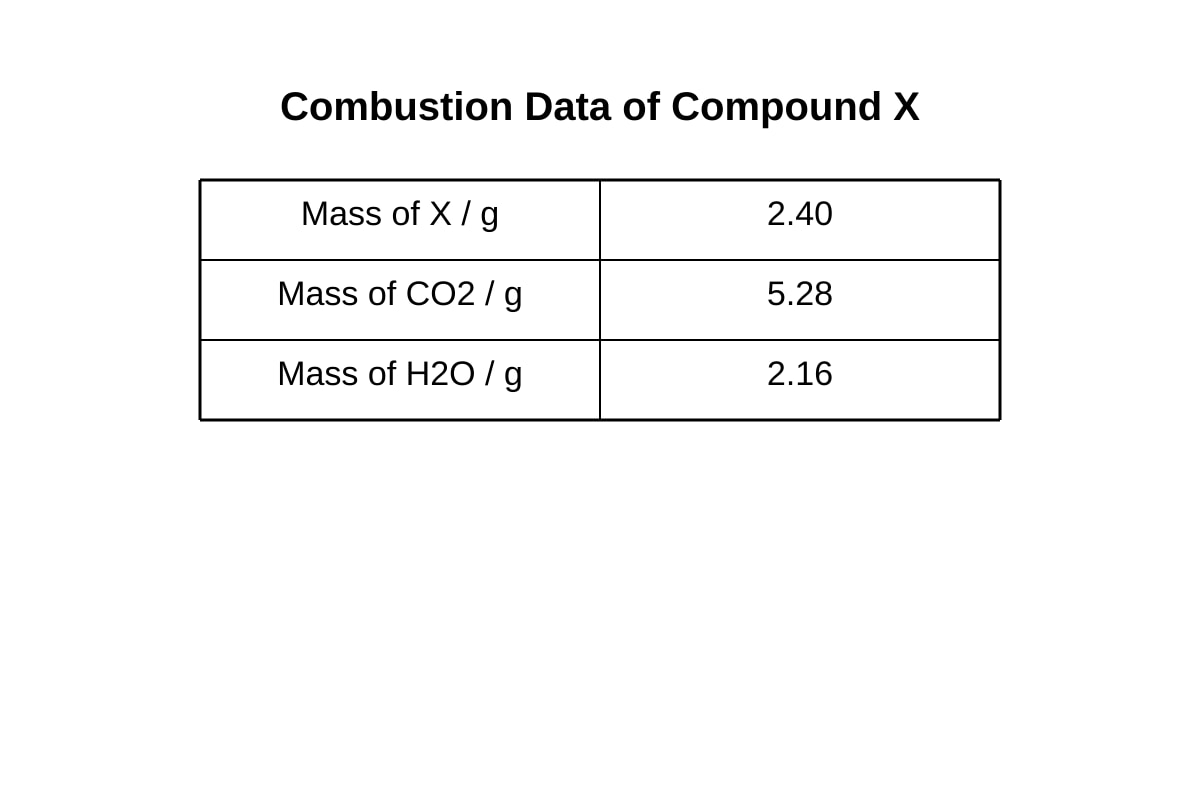
16. The following data were obtained for the combustion of a sample:
Image pending generation: table for Q16.
Using the table, calculate the mass of carbon and the mass of hydrogen in the 2.40 g sample. (C = 12.0, H = 1.0, O = 16.0) [3]
17. From the data in Q16, determine the empirical formula of compound X, assuming it contains only C, H and O. [3]
18. A redox reaction occurs:
Cl2+2I−→2Cl−+I2
State the species reduced and the change in oxidation number of chlorine. [2]
19. Calculate the volume of 0.500 mol dm⁻³ AgNO3 solution needed to react completely with 0.0100 mol of Cl− ions:
Ag++Cl−→AgCl [2]
20. 10.0 cm³ of a 0.200 mol dm⁻³ KMnO4 solution contains excess acid. It oxidises Fe2+ to Fe3+. The half-equations are:
MnO4−+8H++5e−→Mn2++4H2O
Fe2+→Fe3++e−
Calculate the amount, in moles, of Fe2+ that can be oxidised. [3]
Answers
A-Level Chemistry H1 Quiz - Stoichiometry Moles: Answer Key
Total Marks: 40
Topic: Stoichiometry & Moles (Syllabus 8873, Core Idea 3)
Section A: Foundations of the Mole Concept
Q1. [1 mark]
A mole is the amount of substance that contains the same number of specified entities as there are atoms in exactly 12 g of carbon-12; this number is the Avogadro constant, NA=6.02×10²³ mol⁻¹.
Teaching note: The mole links microscopic particles to measurable mass. Do not confuse "mass of carbon-12" with just any carbon.
Q2. [2 marks]
Step 1: n=Mrm=4.004.00=1.00 mol.
Mark breakdown: 1 mark for correct formula, 1 mark for correct answer with unit implied.
Common mistake: Using wrong Mr or forgetting it is an element (use Ar not Mr).
Q3. [2 marks]
Mr=63.5+32.1+4(16.0)+5(2(1.0)+16.0)=63.5+32.1+64.0+90.0=249.6
Mark breakdown: 1 mark for summing Cu+S+4O, 1 mark for adding 5H₂O correctly.
Note: Hydrated salt includes water of crystallisation.
Q4. [2 marks]
n=6.02×10233.01×1023=0.500 mol
m=n×Mr=0.500×12.0=6.00 g
Mark breakdown: 1 mark for moles, 1 mark for mass.
Q5. [1 mark]
The empirical formula is the simplest whole-number ratio of atoms of each element in a compound.
Section B: Formulae and Equations
Q6. [3 marks]
Divide % by Ar:
Na: 36.5/23.0=1.59
S: 25.4/32.1=0.791
O: 38.1/16.0=2.38
Ratio ÷ smallest (0.791): Na = 2.01 ≈ 2, S = 1, O = 3.01 ≈ 3
Empirical formula = Na2SO3
Mark breakdown: 1 mark for mole ratios, 1 mark for simplification, 1 mark for formula.
Q7. [2 marks]
Empirical mass CH2=12.0+2(1.0)=14.0
Molecular mass = 6×14.0=84.0
Mark breakdown: 1 mark for empirical mass, 1 mark for total.
Q8. [2 marks]
4Al+3O2→2Al2O3
Mark breakdown: 1 mark for Al coefficient, 1 mark for O₂ and product balanced.
Q9. [1 mark]
Fe2+→Fe3++e−
Q10. [2 marks]
Add half-equations (electrons cancel):
Zn+Cu2+→Zn2++Cu
Mark breakdown: 1 mark for correct species, 1 mark for balanced equation.
Section C: Stoichiometric Calculations
Q11. [3 marks]
Mr(CaCO3)=40.1+12.0+48.0=100.1
n(CaCO3)=5.00/100.1=0.0500 mol
1:1 ratio → n(CO2)=0.0500 mol
m(CO2)=0.0500×44.0=2.20 g
Mark breakdown: 1m moles CaCO₃, 1m moles CO₂, 1m mass.
Q12. [3 marks]
n(HCl)=0.100×(25.0/1000)=0.00250 mol
From eq: 2 mol HCl : 1 mol Ba(OH)₂ → n=0.00125 mol
c=0.00125/(20.0/1000)=0.0625 mol dm⁻³
Mark breakdown: 1m moles HCl, 1m moles Ba(OH)₂, 1m concentration.
Q13. [2 marks]
V=n×24.0=0.250×24.0=6.00 dm³
Mark breakdown: 1m method, 1m answer.
Q14. [2 marks]
3 mol H₂ → 2 mol NH₃
0.200×(2/3)=0.133 mol NH₃
Mark breakdown: 1m ratio, 1m answer.
Q15. [3 marks]
Mr(Na2SO4)=2(23.0)+32.1+64.0=142.1
n=7.10/142.1=0.0500 mol
c=0.0500/(250/1000)=0.200 mol dm⁻³
Mark breakdown: 1m Mr, 1m moles, 1m concentration.
Section D: Data Interpretation and Redox
Q16. [3 marks]
Mass C = (12.0/44.0)×5.28=1.44 g
Mass H = (2.0/18.0)×2.16=0.240 g
Mark breakdown: 1m for C calc, 1m for H calc, 1m both correct values.
Image note: Table must show 2.40 g X, 5.28 g CO₂, 2.16 g H₂O.
Q17. [3 marks]
Mass O = 2.40 – 1.44 – 0.240 = 0.720 g
Moles: C = 1.44/12 = 0.120; H = 0.240/1 = 0.240; O = 0.720/16 = 0.0450
Ratio ÷0.0450 → C=2.67≈8/3, H=5.33≈16/3, O=1 → ×3 → C₈H₁₆O₃
Mark breakdown: 1m O mass, 1m mole ratios, 1m empirical formula.
Q18. [2 marks]
Species reduced: Cl2 (0 to –1)
Change: oxidation number decreases from 0 to –1.
Mark breakdown: 1m species, 1m change.
Q19. [2 marks]
1:1 ratio → n(Ag+)=0.0100 mol
V=n/c=0.0100/0.500=0.0200 dm³ = 20.0 cm³
Mark breakdown: 1m moles, 1m volume.
Q20. [3 marks]
n(MnO4−)=0.200×(10.0/1000)=0.00200 mol
1 mol MnO4− accepts 5 mol e⁻ → total e⁻ = 0.0100 mol
1 mol Fe2+ gives 1 e⁻ → n(Fe2+)=0.0100 mol
Mark breakdown: 1m moles MnO₄⁻, 1m electron calc, 1m Fe²⁺ moles.
Free quiz and exam paper access
Enter your details to view this paper
Your access is remembered on this device.