From Real Exams Quiz
A Level H1 Chemistry Periodic Table Quiz
Free A Level H1 Chemistry Periodic Table quiz, HY3 Exam version, with questions, answers, and A Level-style practice for Singapore students.
These static practice materials are generated from the site's syllabus and paper-generation workflow, with source and model context shown so students and parents can evaluate the material before use.
Questions
Free quiz and exam paper access
Enter your details to view this paper
Your access is remembered on this device.
Answers
A-Level Chemistry H1 Quiz - Periodic Table: Answer Key
Total Marks: 40
Topic: Periodic Table
Section A Answers (1–10)
1. [1 mark]
Answer: Decreases.
Teaching note: Across Period 3, increased nuclear charge pulls electrons closer; shielding is similar (same shell), so atomic radius decreases from Na to Cl.
2. [2 marks]
Answer: 2Na(s) + 2H₂O(l) → 2NaOH(aq) + H₂(g)
Marking: 1 for correct formulae and balancing, 1 for state symbols.
Teaching: Sodium (Group 1) reduces water, forming alkali and hydrogen gas.
3. [2 marks]
Answer: Nuclear charge increases across the period; electrons are added to same shell so shielding is constant; greater attraction makes removal of electron harder.
Marking: 1 for nuclear charge, 1 for shielding/attraction.
4. [1 mark]
Answer: Giant covalent (or macromolecular).
Teaching: Silicon forms a diamond-like lattice with covalent bonds.
5. [1 mark]
Answer: AlCl₃
Teaching: Al is +3, Cl is -1.
6. [1 mark]
Answer: +5
Teaching: Na +1, O -2×3 = -6, total 0 → Cl = +5.
7. [1 mark]
Answer: Increases down the group.
Teaching: Larger atomic radius, easier loss of outer electron.
8. [1 mark]
Answer: 2HI(g) ⇌ H₂(g) + I₂(g) (or decomposition on heating)
Teaching: Group 17 hydrides decompose; HI is least stable.
9. [1 mark]
Answer: Basic.
Teaching: Oxide of metal (Group 2) is basic.
10. [2 marks]
Answer: Cl has smaller atomic radius and higher electronegativity; gains electron more easily than I.
Marking: 1 for size, 1 for electronegativity/electron gain.
Section B Answers (11–15)
11. [3 marks]
Answer: Na, Mg, Al are metallic with metallic bonding; melting point increases due to more delocalised electrons and higher charge (Na+ < Mg2+ < Al3+). Si has giant covalent structure needing much energy to break bonds, so highest.
Marking: 1 metallic bonding, 1 increasing strength to Al, 1 Si covalent explanation.
12. [2 marks]
Answer: Mg electron removed from 3s (full); Al removes from 3p which is higher energy and slightly shielded by 3s, so easier.
Marking: 1 for orbital difference, 1 for shielding/energy.
13. [3 marks]
Answer: Decreases down group. Atomic radius increases, shielding increases, so pull on bonding pair weaker.
Marking: 1 trend, 1 radius, 1 shielding.
14. [2 marks]
Answer: Acidic; P₄O₆ reacts with water to form H₃PO₃ (an acid), so oxide is acidic.
Marking: 1 character, 1 explanation via equation.
15. [3 marks]
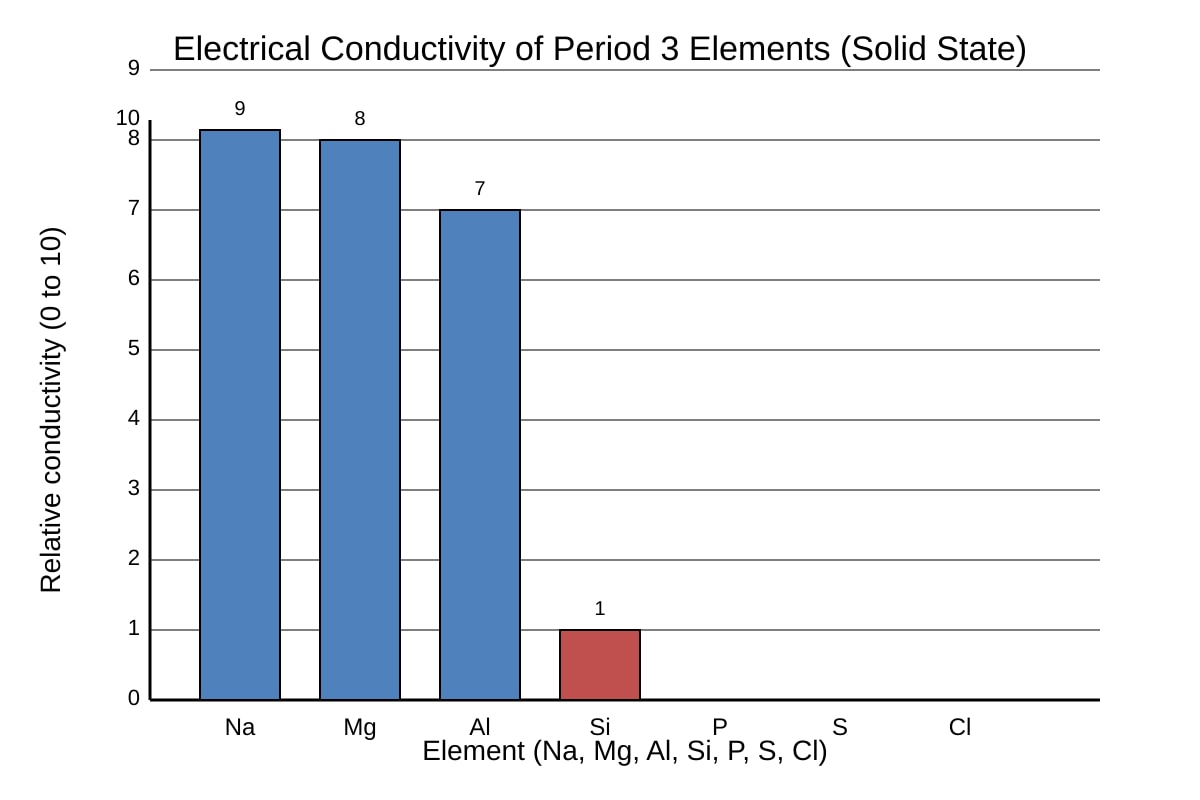
Answer: Na, Mg, Al conduct; they have delocalised electrons in metallic bonding. Si, P, S, Cl do not (covalent/ molecular).
Marking: 1 identify conductors, 2 bonding reason.
Section C Answers (16–20)
16. [4 marks]
Answer: NaCl(s) + H₂O(l) → Na⁺(aq) + Cl⁻(aq) (dissolves, neutral, ionic). SiCl₄(l) + 2H₂O(l) → SiO₂(s) + 4HCl(g) (hydrolyses, acidic).
Marking: 2 equations, 2 character contrast.
17. [3 marks]
Answer: Radius between Na and Mg (smaller than Na); IE between Na and Mg (higher than Na). Reason: more protons than Na, same shell.
Marking: 1 radius, 1 IE, 1 explanation.
18. [4 marks]
Al₂O₃ + 6HCl → 2AlCl₃ + 3H₂O; Al₂O₃ + 2NaOH → 2NaAlO₂ + H₂O.
Marking: 2 equations, 2 explanation of amphoteric.
19. [3 marks]
Answer: Down group, atomic radius increases, outer electron further from nucleus, shielding increases, easier loss; more vigorous reaction with water.
Marking: 1 radius, 1 shielding, 1 reactivity.
20. [4 marks]
Answer: Statement false; melting point rises Na–Si then drops (P, S, Cl low). Reason: change from metallic to covalent to molecular.
Marking: 1 reject, 1 evidence, 2 structural reason.