From Real Exams Quiz
A Level H1 Chemistry Organic Chemistry Quiz
Free A Level H1 Chemistry Organic Chemistry quiz, LongCat Exam version, with questions, answers, and A Level-style practice for Singapore students.
These static practice materials are generated from the site's syllabus and paper-generation workflow, with source and model context shown so students and parents can evaluate the material before use.
Questions
Free quiz and exam paper access
Enter your details to view this paper
Your access is remembered on this device.
Answers
A-Level Chemistry H1 Quiz - Organic Chemistry
Answer Key
Section A: Multiple Choice
1. Answer: C
Mark: 1
Explanation: Alkenes follow the general formula . fits this formula (, ), so it could be an alkene. Options A, B, and D follow (alkanes), meaning they are fully saturated.
Common mistake: Students confuse the general formula of alkanes () with that of alkenes ().
2. Answer: B
Mark: 1
Explanation: The longest carbon chain has 4 carbons (butane). The group is on carbon 2, so the IUPAC name is butan-2-ol.
Common mistake: Students may miscount the chain length or number from the wrong end.
3. Answer: B
Mark: 1
Explanation: Converting an alkene to an alcohol requires hydration: steam () with an catalyst at 300 °C and 60 atm. Option A describes dehydration (the reverse). Option C is halogenation. Option D is nucleophilic substitution.
Common mistake: Students confuse the conditions for hydration with those for dehydration.
4. Answer: C
Mark: 1
Explanation: Ethanoic acid () contains the carboxyl functional group . Option A () is the hydroxyl group in alcohols. Option B () is the aldehyde group. Option D () is the ester linkage.
Common mistake: Students confuse the carboxyl group with the hydroxyl group.
5. Answer: C
Mark: 1
Explanation: has structural isomers including butan-1-ol, butan-2-ol, 2-methylpropan-1-ol, 2-methylpropan-2-ol (four alcohol isomers), plus ether isomers such as ethoxyethane and methoxypropane. Option A is wrong because alcohols and ethers do not contain . Option B is wrong because there are 4 alcohol isomers, not 3. Option D is wrong because different isomers have different boiling points due to different structures and intermolecular forces.
Common mistake: Students forget to count all possible isomers or confuse alcohols with alkenes.
Section B: Short Answer & Structured Response
6.
(a) Definition: A homologous series is a family of organic compounds that have the same general formula, similar chemical properties, and successive members differ by a unit (14 g mol).
Mark: 1
(b) Two characteristics:
(i) They have the same functional group.
(ii) They show a gradual change in physical properties (e.g., boiling point) as the number of carbon atoms increases.
(Also acceptable: same general formula; similar chemical properties; differ by ; same general method of preparation.)
Mark: 1 (for both correct)
Common mistake: Students state "same molecular formula" instead of "same general formula."
7.
(a) 3-methylpentane
The longest chain has 5 carbons (pentane), with a methyl group on carbon 3.
Mark: 1
(b) Pentan-3-one
The longest chain has 5 carbons with a group on carbon 3.
Mark: 1
(c) Butanoic acid
A 4-carbon chain with a group.
Mark: 1
Common mistake: Students may name it as "butanal" (aldehyde) instead of "butanoic acid" (carboxylic acid), or miscount the chain length.
8.
(a) Structural formula of 2-methylprop-1-ene:
or drawn as:
        H   CH3
        |   |
    H—C = C—H
        |
        H
Mark: 1
(b) Cyclobutane (a cyclic isomer with formula ):
A square ring of 4 carbon atoms, each bonded to 2 hydrogens.
Mark: 1
Common mistake: Students may draw an acyclic isomer instead of a cyclic one, or draw a structure with the wrong molecular formula.
9.
(a) Electrophilic addition
Mark: 1
(b) Major product: 2-bromobutane
Mark: 1
(c) Explanation: The major product follows Markovnikov's rule. The hydrogen atom from adds to the carbon of the double bond that already has more hydrogen atoms, so the bromine adds to carbon 2 (which is more substituted). This occurs because the secondary carbocation intermediate () is more stable than the primary carbocation that would form if bromine added to carbon 1.
Mark: 2
Common mistake: Students may draw 1-bromobutane as the major product, not understanding Markovnikov's rule or carbocation stability.
10.
(a) Carboxylic acid group ()
The reaction with producing (which turns limewater milky) is characteristic of carboxylic acids.
Mark: 1
(b)
(Accept any correct carboxylic acid with formula .)
Mark: 1
(c) Compound X is propanoic acid:
It does not react with Fehling's solution because it is not an aldehyde.
Mark: 1
Common mistake: Students may draw an ester (e.g., ethyl methanoate) which also has the formula but would not react with to produce .
11.
Reagent and condition: Acidified potassium dichromate(VI), / , heat.
Observation with propan-1-ol: The orange solution turns green (propan-1-ol is oxidised to propanal and then to propanoic acid).
Observation with propan-2-ol: The orange solution turns green (propan-2-ol is oxidised to propanone).
(Note: Both primary and secondary alcohols cause the colour change. To distinguish them, use Tollens' reagent or Fehling's solution on the oxidation product — propanal from propan-1-ol gives a silver mirror with Tollens', while propanone from propan-2-ol does not.)
Alternative acceptable answer using Lucas' reagent (conc. HCl / ZnCl₂):
- Propan-1-ol: No visible change at room temperature (or very slow reaction on heating).
- Propan-2-ol: Solution turns cloudy within 5–10 minutes (formation of insoluble chloroalkane).
Mark: 3 (1 for reagent/condition, 1 for each observation)
Common mistake: Students may not specify both reagent and condition, or may confuse the observations for primary and secondary alcohols.
12.
(a) Reagent and condition: Acidified potassium dichromate(VI), / dilute , distillation (to remove ethanal before further oxidation).
Mark: 1
(b)
or
(Accept balanced equations using or . State symbols required for full credit.)
Mark: 1
(c) Observation: The orange solution turns green.
Mark: 1
Common mistake: Students may write "colourless to orange" (reversed) or omit state symbols.
13.
(a) Secondary alcohol
The group is attached to a carbon atom bonded to two other carbon atoms.
Mark: 1
(b) Two alkenes formed by elimination (dehydration):
But-2-ene:
But-1-ene:
Mark: 1
(c) Major product: But-2-ene
But-2-ene is the major product because it is more substituted (disubstituted alkene) and therefore more stable than but-1-ene (monosubstituted). This follows Saytzeff's rule: the more substituted alkene is the major product in elimination reactions.
Mark: 2
Common mistake: Students may draw but-1-ene as the major product, not understanding Saytzeff's rule.
Section C: Data Interpretation & Extended Response
14.
(a) Ethanal has a higher boiling point than ethane because ethanal is a polar molecule with permanent dipole-dipole interactions between molecules, whereas ethane is non-polar and only has weak van der Waals (London dispersion) forces. More energy is required to overcome the stronger intermolecular forces in ethanal.
Mark: 2
(b) Ethanoic acid has a higher boiling point than ethanol because ethanoic acid molecules can form dimers through two hydrogen bonds between two ethanoic acid molecules. This effectively doubles the molecular size for intermolecular bonding purposes, resulting in stronger overall intermolecular forces. Ethanol can only form single hydrogen bonds between molecules.
Mark: 3
Common mistake: Students may state that ethanoic acid has "more hydrogen bonds" without explaining the dimerisation concept.
(c) Although both ethanol and ethanal have similar molar masses (~46 g mol vs. 44 g mol), ethanol contains an group that can form hydrogen bonds between molecules. Ethanal has a group and exhibits permanent dipole-dipole interactions but cannot form hydrogen bonds with itself (no , , or bond). Hydrogen bonds are stronger than dipole-dipole forces, so more energy is required to separate ethanol molecules, giving it a higher boiling point.
Mark: 2
Common mistake: Students may incorrectly state that ethanal can form hydrogen bonds with itself.
15.
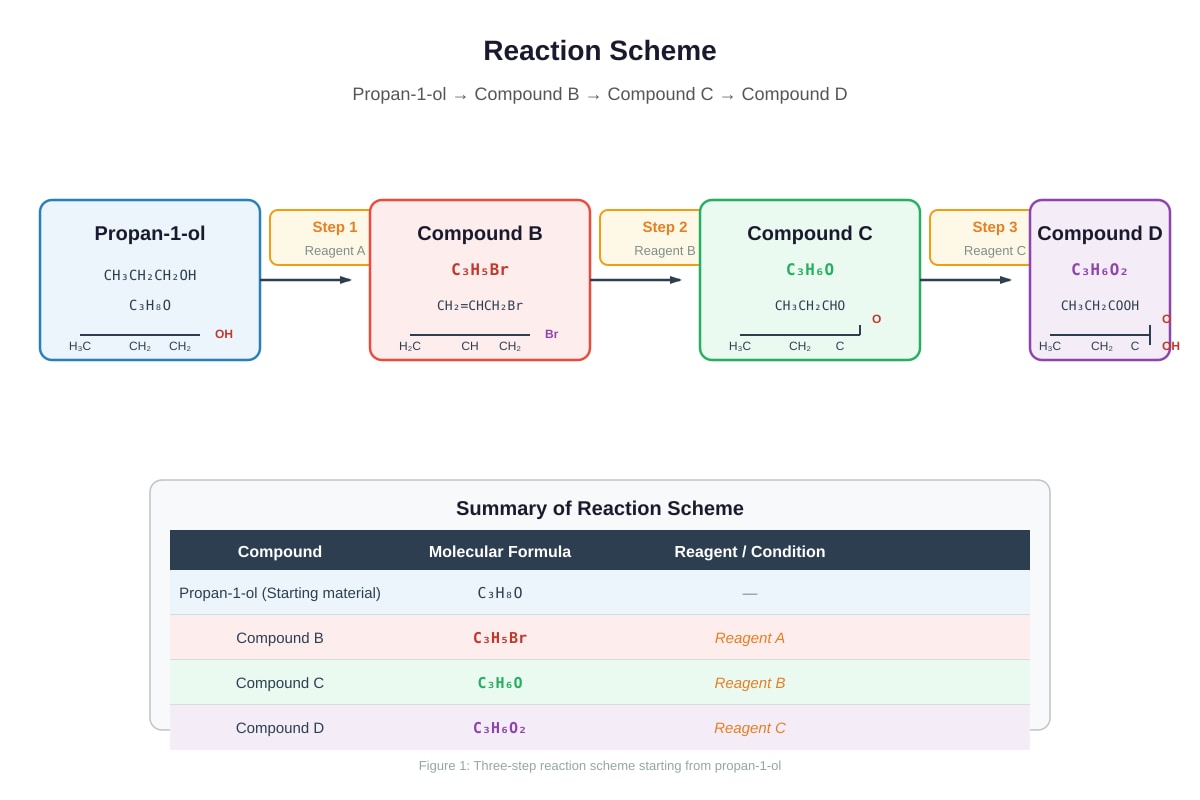
(a) Reagent A: Phosphorus tribromide () or hydrobromic acid () or / .
Type of reaction: Nucleophilic substitution.
Mark: 1
(b) Compound B: 1-bromopropane
Mark: 1
(c) Reagent B: Aqueous sodium hydroxide ((aq)), heat under reflux.
(This converts the bromoalkane to an alcohol via nucleophilic substitution.)
Mark: 1
(d) Compound C: Propan-1-ol
Mark: 1
(e) Reagent C: Acidified potassium dichromate(VI), heat under reflux.
(This oxidises the primary alcohol to a carboxylic acid.)
Mark: 1
(f) Compound D: Propanoic acid
Mark: 1
Common mistake: Students may draw propanal () instead of propanoic acid if they assume distillation conditions (which stop oxidation at the aldehyde stage) rather than reflux.
16.
(a) Propan-2-ol ()
Mark: 1
(b) The major product is propan-2-ol because the reaction follows Markovnikov's rule. In the electrophilic addition of water to propene, the hydrogen atom adds to the carbon of the double bond that already has more hydrogen atoms (carbon 1), and the group adds to carbon 2. This is because the secondary carbocation intermediate () formed is more stable than the primary carbocation () that would form if the added to carbon 1. The stability of the carbocation intermediate determines the major product.
Mark: 2
Common mistake: Students may name propan-1-ol as the product, not applying Markovnikov's rule.
(c) Electrophilic addition
Mark: 1
17.
(a) Working:
| Element | % | Ar | Moles (÷ Ar) | Ratio |
|---|---|---|---|---|
| C | 40.0 | 12 | 40.0/12 = 3.33 | 3.33/3.33 = 1 |
| H | 6.7 | 1 | 6.7/1 = 6.7 | 6.7/3.33 = 2 |
| O | 53.3 | 16 | 53.3/16 = 3.33 | 3.33/3.33 = 1 |
Empirical formula = ✓
Mark: 2
(b) Empirical formula mass of = 12 + 2(1) + 16 = 30 g mol
Molecular formula =
Mark: 1
(c) Compound Z reacts with 2,4-DNPH (confirms group) but not with Tollens' reagent (rules out aldehyde). Therefore Z is a ketone or another carbonyl compound that is not an aldehyde. With molecular formula , the only structure that fits is ethanoic acid (), which contains a group and reacts with 2,4-DNPH (carboxylic acids do react, though more slowly) but does not give a silver mirror with Tollens'.
(Note: If the question intends Z to be a ketone, the molecular formula would need to be . Given the data, Z is most likely ethanoic acid.)
Structural formula:
Mark: 1
Common mistake: Students may struggle to reconcile the 2,4-DNPH test (typically taught for aldehydes and ketones) with a carboxylic acid. The key is that the compound does NOT react with Tollens', ruling out an aldehyde.
18.
(a) Mechanism — Nucleophilic Substitution ():
The hydroxide ion () acts as a nucleophile. It attacks the partially positive carbon atom bonded to bromine from the backside. A curly arrow starts from the lone pair on and points to the carbon. Another curly arrow starts from the bond and points to bromine, showing the bond breaking heterolytically.
- Dipole on :
- Curly arrow from lone pair on to C
- Curly arrow from bond to Br
- Charges: shown, as product
Mark: 2
(b) Heterolytic bond fission — the bond breaks unevenly, with both electrons going to bromine.
Mark: 1
(c) Use: To introduce a hydroxyl group () into an organic molecule, converting a halogenoalkane to an alcohol. This is useful for synthesising alcohols that may be difficult to prepare by other methods.
Mark: 1
Common mistake: Students may draw the mechanism (with a carbocation intermediate) instead of for a primary halogenoalkane like bromoethane.
19.
(a) Repeating unit of poly(propene):
Drawn with square brackets, the group as a side chain, and bonds extending through the brackets.
Mark: 1
(b) Use: Packaging, ropes, carpets, laboratory equipment, food containers, automotive parts. (Any one valid use.)
Mark: 1
(c) Poly(propene) is not biodegradable because it consists of strong and covalent bonds that are non-polar and chemically stable. Microorganisms lack enzymes capable of breaking these bonds under normal environmental conditions. The polymer is also hydrophobic, making it resistant to hydrolysis.
Mark: 1
Common mistake: Students may state "it is a plastic" without explaining the chemical reason for non-biodegradability.
20.
Test 1: Add sodium carbonate () solution to each liquid.
- Effervescence (bubbles of ): Ethanoic acid — the only one that reacts with to produce carbon dioxide.
- No effervescence: Ethanol, ethyl ethanoate, phenol.
Test 2: Add iron(III) chloride () solution to the three remaining liquids.
- Purple/violet colour: Phenol — phenol forms a purple complex with .
- No colour change: Ethanol, ethyl ethanoate.
Test 3: Add acidified potassium dichromate(VI) and heat to the two remaining liquids.
- Orange solution turns green: Ethanol — it is oxidised by the dichromate.
- No colour change: Ethyl ethanoate — it is not readily oxidised.
Mark: 4 (1 mark for each correct identification step with observation)
Common mistake: Students may use only one reagent and fail to distinguish all four compounds, or may confuse phenol with ethanol (both have groups but phenol is acidic enough to react with ).
Mark Summary
| Section | Questions | Marks |
|---|---|---|
| A: Multiple Choice | 1–5 | 10 |
| B: Short Answer & Structured | 6–15 | 25 |
| C: Data Interpretation & Extended | 16–20 | 15 |
| Total | 20 questions | 50 |