From Real Exams Quiz
A Level H1 Chemistry Organic Chemistry Quiz
Free A Level H1 Chemistry Organic Chemistry quiz, HY3 Exam version, with questions, answers, and A Level-style practice for Singapore students.
These static practice materials are generated from the site's syllabus and paper-generation workflow, with source and model context shown so students and parents can evaluate the material before use.
Questions
Free quiz and exam paper access
Enter your details to view this paper
Your access is remembered on this device.
Answers
A-Level Chemistry H1 Quiz - Organic Chemistry: Answer Key
Total Marks: 40
Topic: Organic Chemistry (Extension Topic, Syllabus 8873)
Section A
1. [1 mark]
General formula of alkane:
Teaching note: Alkanes are saturated hydrocarbons with single C–C bonds only; each C forms 4 bonds so H count is 2n+2.
2. [1 mark]
Displayed formula of propan-1-ol:
CH₃–CH₂–CH₂–OH (all bonds shown: H on C's, O–H bond).
Common mistake: Drawing propan-2-ol (OH on middle C) – numbering from end nearest OH gives 1-ol.
3. [1 mark]
A homologous series is a family of compounds with the same general formula, similar chemical properties, and each successive member differs by a –CH₂– unit.
Teaching note: E.g., alkanes, alcohols.
4. [1 mark]
CH₂Br–CH₂Br (1,2-dibromoethane).
Equation: CH₂=CH₂ + Br₂ → CH₂BrCH₂Br. Addition across double bond.
5. [1 mark]
Carboxyl group (–COOH).
Teaching note: CH₃COOH is ethanoic acid, a carboxylic acid.
6. [1 mark]
Hydrogenation (addition reaction).
Common mistake: Confusing with hydration (with water).
7. [1 mark]
Propan-1-ol.
Teaching note: 3-carbon chain, OH on carbon 1.
8. [2 marks]
Reagent: acidified potassium dichromate(VI), K₂Cr₂O₇/H₂SO₄.
Condition: heat under reflux.
Marking: 1 mark reagent, 1 mark condition.
Common mistake: Using alkaline KMnO₄ (also works but not standard for H1).
Section B
9. [4 marks total]
(a) [2] Cl₂, UV light (or sunlight). Free-radical substitution.
(b) [2] NaOH(aq) (or steam), heat under pressure / warm aqueous NaOH. Nucleophilic substitution.
Marking: each step 1 reagent + 1 condition.
10. [3 marks]
CH₃CH₂OH has hydrogen bonding between molecules due to –OH group (1). Propane and dimethyl ether only have van der Waals / dipole-dipole (dimethyl ether) (1). More energy needed to overcome H-bonds so higher bp (1).
Teaching note: H-bond is strongest intermolecular force among these.
11. [3 marks]
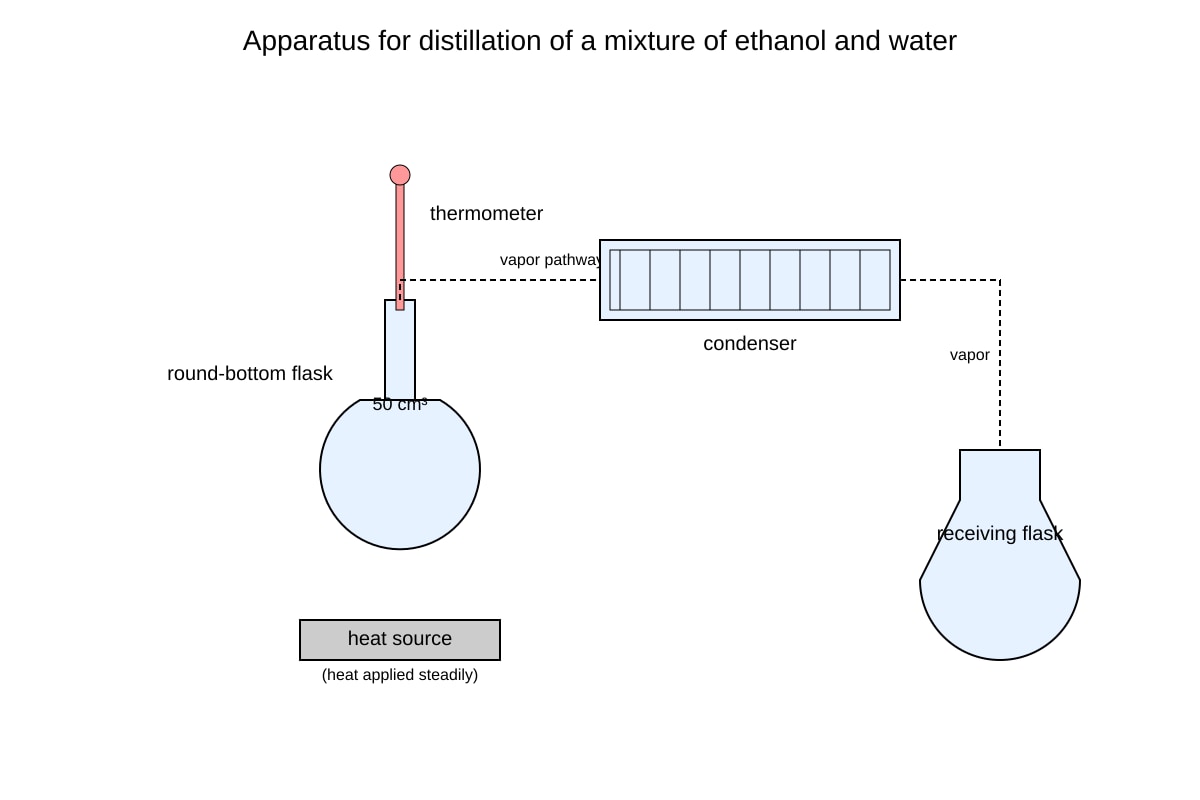
Ethanol (bp 78 °C) vaporises first (1). Vapour passes through condenser, cooled, collected in receiver (1). Water remains in flask (bp 100 °C) (1).
Image dependency: Apparatus must show condenser with cold water in/out, thermometer reading vapour temp.
12. [3 marks]
(a) [1] Alkene (deccolourises bromine water = unsaturation).
(b) [2] e.g., CH₂=CHCH₂CH₃ or CH₃CH=CHCH₃ (any C₄H₈ alkene).
Marking: correct double bond position.
13. [2 marks]
2 C₃H₇OH + 9 O₂ → 6 CO₂ + 8 H₂O
Method: Balance C (3→3 CO₂ per 1, so 2 gives 6), H (8→8 H₂O), O count 16 on right, 2 from alcohol + 9×2 = 20 left.
Common mistake: Forgetting coefficient 2.
14. [4 marks]
(a) [1] Poly(chloroethene) / PVC.
(b) [1] Addition polymer.
(c) [2] –CH₂–CHCl–CH₂–CHCl– (repeat unit shown at least twice).
Teaching note: No small molecule lost in addition polymerisation.
Section C
15. [4 marks]
Saturated: only single C–C bonds, general formula (1). Unsaturated: contains C=C or ring, general formula e.g. alkene (1). Saturated cannot decolourise bromine water (1). Unsaturated more reactive at double bond (1).
Marking: 1 each point.
16. [6 marks]
(a) [2] CH₃COOCH₂CH₃ + NaOH → CH₃COONa + CH₃CH₂OH
(b) [2] Sodium ethanoate and ethanol.
(c) [2] NaOH reacts with ethanoic acid product, shifting equilibrium right (1); water alone gives reversible hydrolysis, incomplete (1).
Teaching note: Base acts as a scavenger of acid.
17. [3 marks]
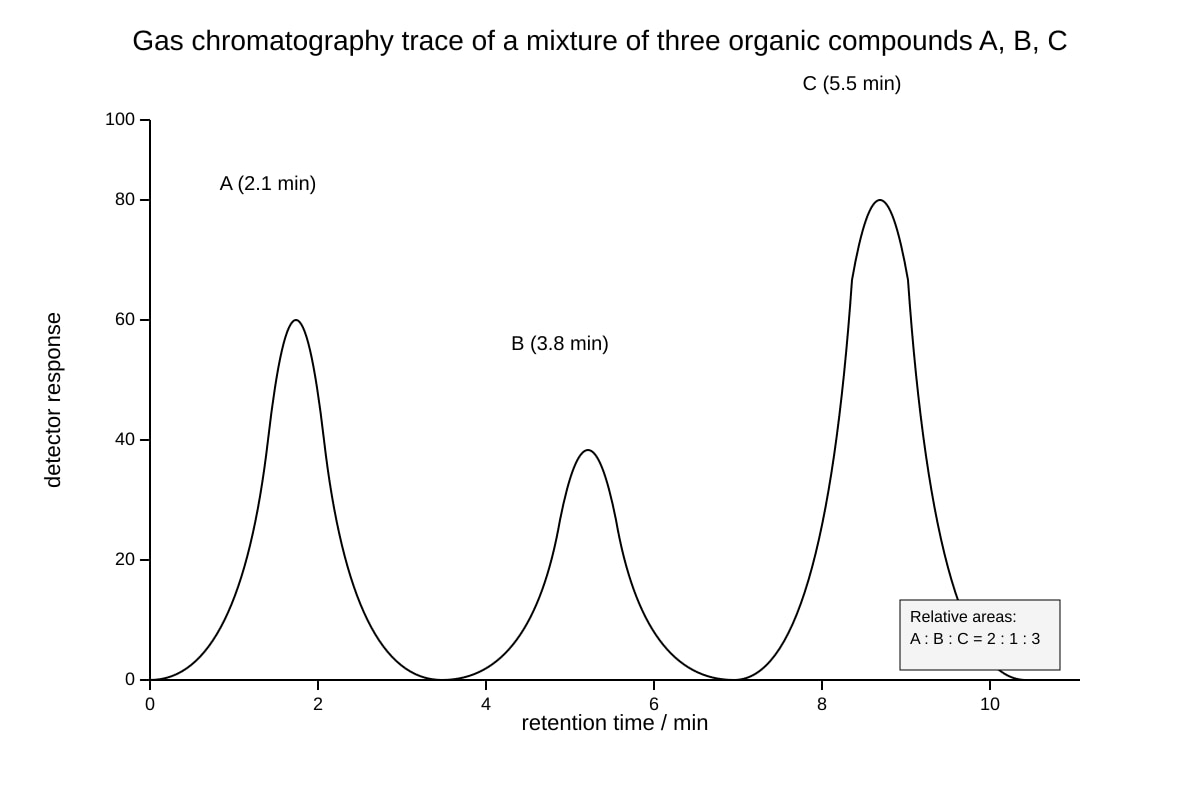
Percentage C = 3/(2+1+3) × 100 = 50% [2].
Use: separating/purifying mixtures, identifying compounds by retention time [1].
Image dependency: Peak areas must be readable from trace.
18. [3 marks]
Ethanol has –OH group forming H-bonds with water (1). Water also H-bonds (1). Miscible in all proportions due to similar intermolecular forces (1).
19. [4 marks]
(a) [2] Hexanedioic acid (adipic acid) and 1,6-diaminohexane (hexamethylenediamine).
(b) [1] Water.
(c) [1] High tensile strength / lightweight / durable.
20. [5 marks]
(a) [1] CH₃CH₂CH₂OH or CH₃CH(OH)CH₃.
(b) [2] Carbon neutral (plants absorb CO₂ when grown) / renewable / less SO₂ (1+1).
(c) [2] Add acidified K₂Cr₂O₇, orange to green on heating (1); confirms primary/secondary alcohol (1).