From Real Exams Quiz

A Level H1 Chemistry Kinetics Equilibrium Quiz

Free Exam-Derived Owl Alpha A Level H1 Chemistry Kinetics Equilibrium quiz with questions and answers for Singapore students. This page is rendered as a direct URL so the questions and answers can be discovered without pressing in-page buttons.

These static practice materials are generated from the site's syllabus and paper-generation workflow, with source and model context shown so students and parents can evaluate the material before use.

A Level H1 Chemistry From Real Exams Generated by Owl Alpha Updated 2026-06-07

Questions

<!-- TuitionGoWhere generation metadata: stage=3-0; model=openrouter/owl-alpha; model_label=Owl Alpha; generated=2026-06-06; Sources: Stage 2-1 real exam-derived templates and Stage 2-2 exam-enriched syllabus. -->

A-Level Chemistry H1 Quiz - Kinetics Equilibrium

Name: ________________________________________
Class: ________________________________________
Date: ________________________________________
Score: ______ / 50

Duration: 60 minutes
Total Marks: 50

Instructions:

  • Answer ALL questions.
  • Show all working for calculation questions. Answers without working may not receive full marks.
  • Include units where appropriate.
  • Use proper chemical notation (state symbols, equilibrium arrows, etc.).
  • The number of marks for each question or part-question is shown in brackets [ ].

Section A: Multiple Choice (Questions 1–5) [10 marks]

Each question is worth 2 marks. Choose the most appropriate answer.

1. The rate of a chemical reaction is found to double when the concentration of reactant X is doubled, while keeping all other conditions constant. What is the order of reaction with respect to X?

(a) Zero order
(b) First order
(c) Second order
(d) Third order

2. For the equilibrium:
2SO2(g)+O2(g)2SO3(g)ΔH=197 kJ mol12SO_2(g) + O_2(g) \rightleftharpoons 2SO_3(g) \quad \Delta H = -197 \text{ kJ mol}^{-1}

Which change will increase the value of the equilibrium constant KcK_c?

(a) Increasing the temperature
(b) Adding a catalyst
(c) Decreasing the temperature
(d) Increasing the pressure

3. Which of the following statements about a catalyst is correct?

(a) A catalyst increases the equilibrium constant of a reaction.
(b) A catalyst increases the rate of the forward reaction only.
(c) A catalyst provides an alternative reaction pathway with a lower activation energy.
(d) A catalyst increases the enthalpy change of a reaction.

4. The rate equation for a reaction is:
Rate=k[A]2[B]\text{Rate} = k[A]^2[B]

What are the units of the rate constant kk?

(a) mol1dm3s1\text{mol}^{-1} \text{dm}^3 \text{s}^{-1}
(b) mol2dm6s1\text{mol}^{-2} \text{dm}^6 \text{s}^{-1}
(c) mol3dm9s1\text{mol}^{-3} \text{dm}^9 \text{s}^{-1}
(d) s1\text{s}^{-1}

5. A reaction has an activation energy of 75 kJ mol175 \text{ kJ mol}^{-1}. When a catalyst is added, the activation energy is reduced to 45 kJ mol145 \text{ kJ mol}^{-1}. Which statement is true?

(a) The enthalpy change of the reaction becomes more negative.
(b) The equilibrium position shifts to the right.
(c) Both the forward and reverse rates increase by the same factor.
(d) The value of KcK_c increases.


Section B: Structured Questions (Questions 6–15) [25 marks]

6. Define the following terms:
(a) Rate of reaction [2]
(b) Order of reaction [2]


7. The decomposition of hydrogen peroxide was studied at 25 °C:

2H2O2(aq)2H2O(l)+O2(g)2H_2O_2(aq) \rightarrow 2H_2O(l) + O_2(g)

The following data were obtained:

Experiment[H2O2]/mol dm3[H_2O_2] / \text{mol dm}^{-3}Initial Rate / mol dm3s1\text{mol dm}^{-3} \text{s}^{-1}
10.101.20×1041.20 \times 10^{-4}
20.202.40×1042.40 \times 10^{-4}
30.404.80×1044.80 \times 10^{-4}

(a) Determine the order of reaction with respect to H2O2H_2O_2. Explain your reasoning. [2]
(b) Write the rate equation for this reaction. [1]
(c) Calculate the rate constant, kk, including its units. [2]


8. Consider the following equilibrium:

N2(g)+3H2(g)2NH3(g)ΔH=92 kJ mol1N_2(g) + 3H_2(g) \rightleftharpoons 2NH_3(g) \quad \Delta H = -92 \text{ kJ mol}^{-1}

(a) Write the expression for the equilibrium constant, KcK_c. [1]
(b) State and explain the effect on the yield of NH3NH_3 when:
    (i) the pressure is increased [2]
    (ii) the temperature is increased [2]


9. The reaction between nitrogen monoxide and chlorine is:

2NO(g)+Cl2(g)2NOCl(g)2NO(g) + Cl_2(g) \rightleftharpoons 2NOCl(g)

At equilibrium, the concentrations are: [NO]=0.050 mol dm3[NO] = 0.050 \text{ mol dm}^{-3}, [Cl2]=0.025 mol dm3[Cl_2] = 0.025 \text{ mol dm}^{-3}, [NOCl]=0.10 mol dm3[NOCl] = 0.10 \text{ mol dm}^{-3}.

Calculate the value of KcK_c and state its units. [3]


10. A reaction has the following energy profile:

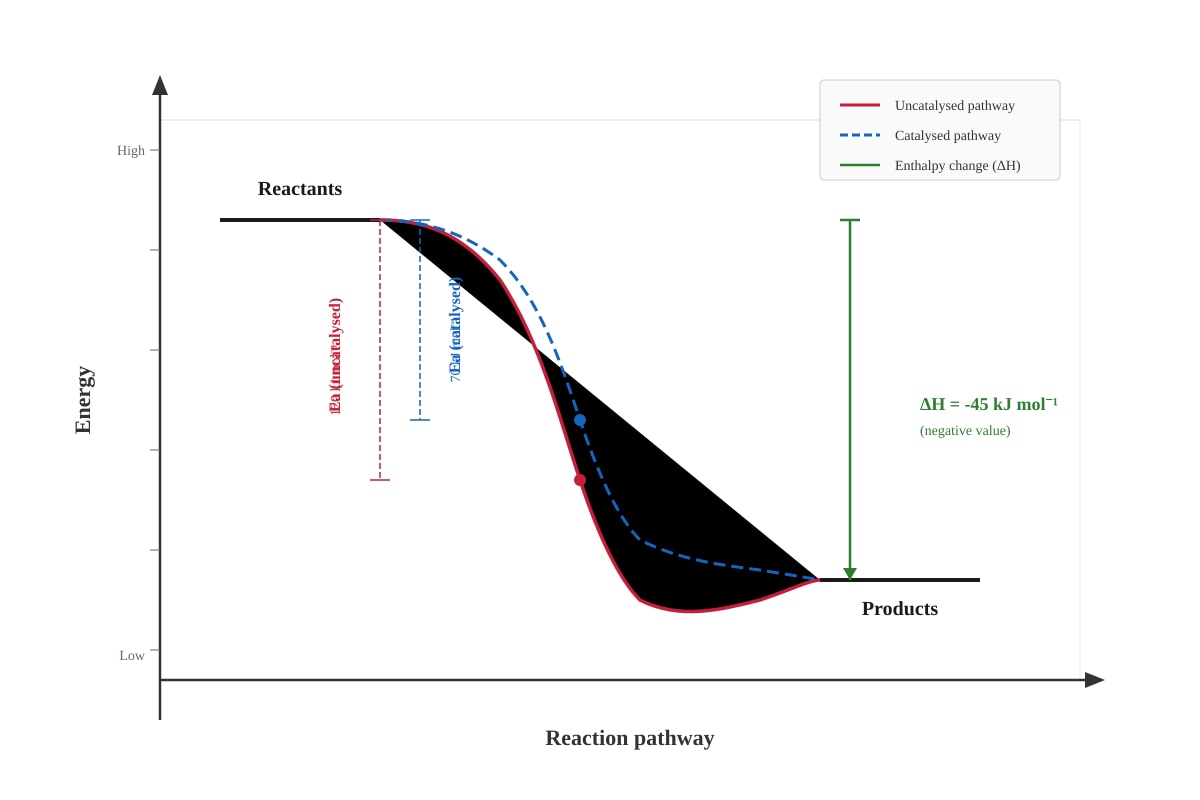
<image_placeholder> id: Q10-fig1 type: figure linked_question: Q10 description: Energy profile diagram for an exothermic reaction showing reactants at higher energy level than products, with a labelled activation energy peak (Ea uncatalysed) and a lower activation energy peak (Ea catalysed) using a dashed curve. The overall enthalpy change (ΔH) is shown as a downward arrow from reactants to products. labels: "Energy" (y-axis), "Reaction pathway" (x-axis), "Reactants", "Products", "E_a (uncatalysed)", "E_a (catalysed)", "ΔH (negative value)" values: Ea (uncatalysed) = 120 kJ mol⁻¹, Ea (catalysed) = 70 kJ mol⁻¹, ΔH = -45 kJ mol⁻¹ must_show: Two energy peaks (one solid for uncatalysed, one dashed for catalysed), reactant and product energy levels, ΔH arrow pointing downward, all labels clearly visible </image_placeholder>

(a) State whether the reaction is exothermic or endothermic. Explain your answer. [1]
(b) Label the diagram with the activation energy for the uncatalysed reaction and the catalysed reaction. [2]
(c) Explain, using the diagram, how a catalyst increases the rate of reaction. [2]


11. The rate constant for a first-order reaction is 3.46×10³ s13.46 \times 10^{-3} \text{ s}^{-1} at 298 K. Calculate the half-life of the reaction. [2]


12. For the equilibrium:

H2(g)+I2(g)2HI(g)H_2(g) + I_2(g) \rightleftharpoons 2HI(g)

Kc=50.0K_c = 50.0 at 700 K. A mixture at 700 K has the following concentrations: [H2]=0.10 mol dm3[H_2] = 0.10 \text{ mol dm}^{-3}, [I2]=0.20 mol dm3[I_2] = 0.20 \text{ mol dm}^{-3}, [HI]=0.80 mol dm3[HI] = 0.80 \text{ mol dm}^{-3}.

(a) Calculate the reaction quotient, QcQ_c. [1]
(b) State, with a reason, the direction in which the reaction will proceed to reach equilibrium. [2]


13. Explain, with reference to collision theory, why increasing the temperature of a reaction increases the rate of reaction. [3]


14. The following data were obtained for the reaction A+BA + B \rightarrow products:

Experiment[A]/mol dm3[A] / \text{mol dm}^{-3}[B]/mol dm3[B] / \text{mol dm}^{-3}Initial Rate / mol dm3s1\text{mol dm}^{-3} \text{s}^{-1}
10.100.102.0×1032.0 \times 10^{-3}
20.200.104.0×1034.0 \times 10^{-3}
30.200.201.6×1021.6 \times 10^{-2}

(a) Determine the order of reaction with respect to A. [1]
(b) Determine the order of reaction with respect to B. [1]
(c) Write the rate equation. [1]
(d) Calculate the value of the rate constant, kk, with units. [2]


15. Consider the equilibrium:

Fe3+(aq)+SCN(aq)[FeSCN]2+(aq)Fe^{3+}(aq) + SCN^-(aq) \rightleftharpoons [FeSCN]^{2+}(aq)

The equilibrium mixture is orange-red in colour. Predict and explain the observation when a small amount of solid Fe(NO3)3Fe(NO_3)_3 is added to the equilibrium mixture. [3]


Section C: Free Response (Questions 16–20) [15 marks]

16. The reaction between bromoethane and aqueous sodium hydroxide is:

CH3CH2Br(aq)+OH(aq)CH3CH2OH(aq)+Br(aq)CH_3CH_2Br(aq) + OH^-(aq) \rightarrow CH_3CH_2OH(aq) + Br^-(aq)

The rate equation is: Rate=k[CH3CH2Br][OH]\text{Rate} = k[CH_3CH_2Br][OH^-]

(a) State the overall order of the reaction. [1]
(b) Describe an experimental procedure to determine the rate of this reaction. Include how you would measure the rate and how you would determine the order with respect to each reactant. [4]


17. The Haber process for the synthesis of ammonia is represented by:

N2(g)+3H2(g)2NH3(g)ΔH=92 kJ mol1N_2(g) + 3H_2(g) \rightleftharpoons 2NH_3(g) \quad \Delta H = -92 \text{ kJ mol}^{-1}

In industry, the process is carried out at approximately 450 °C and 200 atm, using an iron catalyst.

(a) Explain why a temperature of 450 °C is used instead of a lower temperature, even though a lower temperature would give a higher yield of ammonia. [3]
(b) Explain the effect of using 200 atm pressure on the yield of ammonia. [2]
(c) State the purpose of the iron catalyst and explain why it does not affect the yield of ammonia. [2]


18. The decomposition of dinitrogen pentoxide was studied:

2N2O5(g)4NO2(g)+O2(g)2N_2O_5(g) \rightarrow 4NO_2(g) + O_2(g)

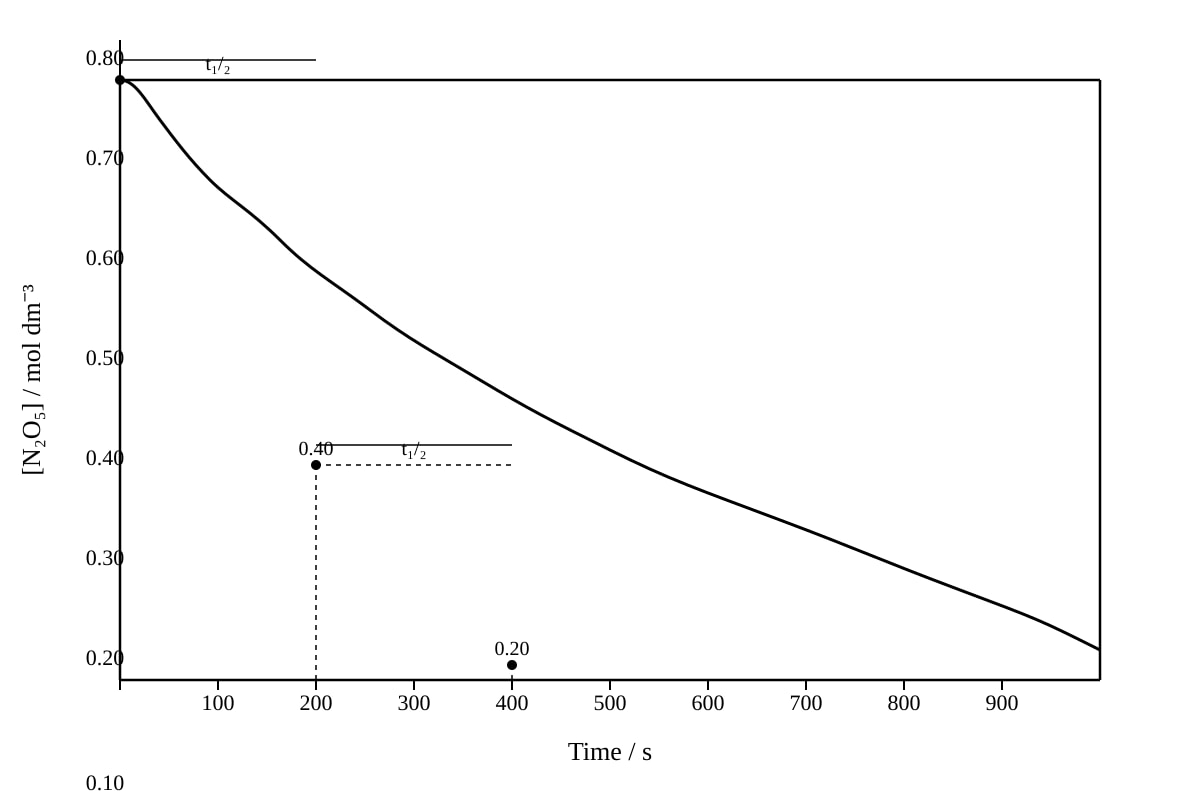
The following graph shows the concentration of N2O5N_2O_5 over time:

<image_placeholder> id: Q18-fig1 type: graph linked_question: Q18 description: A graph showing concentration of N₂O₅ (y-axis) versus time (x-axis). The curve starts at 0.80 mol dm⁻³ at t = 0 and decreases exponentially, approaching zero. The curve is smooth and decreasing with a decreasing gradient over time. labels: "[N₂O₅] / mol dm⁻³" (y-axis), "Time / s" (x-axis) values: Initial [N₂O₅] = 0.80 mol dm⁻³ at t = 0 s; [N₂O₅] ≈ 0.40 mol dm⁻³ at t ≈ 200 s; [N₂O₅] ≈ 0.20 mol dm⁻³ at t ≈ 400 s must_show: Smooth decreasing exponential curve, clearly labelled axes with units, initial concentration marked, curve showing constant half-life behaviour </image_placeholder>

(a) Using the graph, determine the half-life of N2O5N_2O_5. Show your working on the graph. [2]
(b) Using your answer in (a), state the order of reaction with respect to N2O5N_2O_5. Explain your reasoning. [2]
(c) From the graph, determine the rate of reaction at t=0t = 0 s. Explain how you obtained your answer. [2]


19. For the equilibrium:

CO(g)+2H2(g)CH3OH(g)ΔH=91 kJ mol1CO(g) + 2H_2(g) \rightleftharpoons CH_3OH(g) \quad \Delta H = -91 \text{ kJ mol}^{-1}

(a) Write the expression for KcK_c. [1]
(b) At a certain temperature, Kc=10.5 mol2dm6K_c = 10.5 \text{ mol}^{-2} \text{dm}^6. A 2.0 dm3\text{dm}^3 vessel contains 0.50 mol of COCO, 1.0 mol of H2H_2, and 0.80 mol of CH3OHCH_3OH. Determine whether the system is at equilibrium. If not, state the direction in which the reaction will proceed. Show all working. [4]


20. Two experiments were carried out to study the effect of temperature on the rate of a reaction between sodium thiosulfate and hydrochloric acid:

Na2S2O3(aq)+2HCl(aq)2NaCl(aq)+H2O(l)+SO2(g)+S(s)Na_2S_2O_3(aq) + 2HCl(aq) \rightarrow 2NaCl(aq) + H_2O(l) + SO_2(g) + S(s)

In Experiment I, the reaction was carried out at 30 °C and the cross beneath the flask became obscured after 60 seconds. In Experiment II, the same reaction was carried out at 50 °c.

(a) Explain why the time taken for the cross to become obscured is shorter at 50 °C. Use collision theory in your answer. [3]
(b) Sketch a graph to show the distribution of molecular kinetic energies at two different temperatures (30 °C and 50 °C). Label the activation energy and explain how the graph supports your answer in (a). [3]


Answers

<!-- TuitionGoWhere generation metadata: stage=3-0; model=openrouter/owl-alpha; model_label=Owl Alpha; generated=2026-06-06; Sources: Stage 2-1 real exam-derived templates and Stage 2-2 exam-enriched syllabus. -->

A-Level Chemistry H1 Quiz - Kinetics Equilibrium

Answer Key


Section A: Multiple Choice

1. (b) First order [2]

Explanation:
When the concentration of X is doubled and the rate also doubles, the rate is directly proportional to the concentration of X. This means Rate[X]1\text{Rate} \propto [X]^1, so the order with respect to X is 1 (first order).

  • If it were zero order, the rate would not change.
  • If it were second order, the rate would quadruple (2² = 4).
  • If it were third order, the rate would increase eightfold (2³ = 8).

2. (c) Decreasing the temperature [2]

Explanation:
The forward reaction is exothermic (ΔH=197 kJ mol1\Delta H = -197 \text{ kJ mol}^{-1}). According to Le Chatelier's principle, decreasing the temperature favours the exothermic (forward) reaction, producing more SO3SO_3 and thus increasing KcK_c.

  • (a) Increasing temperature would favour the reverse (endothermic) reaction, decreasing KcK_c.
  • (b) A catalyst does not affect KcK_c; it only speeds up the rate at which equilibrium is reached.
  • (d) Increasing pressure shifts the equilibrium position to the right (fewer moles of gas), but KcK_c itself does not change because KcK_c depends only on temperature.

3. (c) A catalyst provides an alternative reaction pathway with a lower activation energy. [2]

Explanation:
A catalyst works by providing an alternative reaction mechanism with a lower activation energy (EaE_a). This means more molecules have energy equal to or greater than EaE_a, so more collisions are successful per unit time, increasing the rate.

  • (a) Incorrect: KcK_c depends only on temperature, not on the presence of a catalyst.
  • (b) Incorrect: A catalyst increases the rates of both forward and reverse reactions equally.
  • (d) Incorrect: ΔH\Delta H depends only on the energy levels of reactants and products, not on the pathway.

4. (b) mol2dm6s1\text{mol}^{-2} \text{dm}^6 \text{s}^{-1} [2]

Explanation:
The overall order = 2 + 1 = 3.
General rule: units of k=mol(1n)dm3(n1)s1k = \text{mol}^{(1-n)} \text{dm}^{3(n-1)} \text{s}^{-1} where nn = overall order.
For n=3n = 3: units = mol(13)dm3(31)s1=mol2dm6s1\text{mol}^{(1-3)} \text{dm}^{3(3-1)} \text{s}^{-1} = \text{mol}^{-2} \text{dm}^6 \text{s}^{-1}.

Working:
Rate has units mol dm3s1\text{mol dm}^{-3} \text{s}^{-1}.
[A]2[B][A]^2[B] has units (mol dm3)3=mol3dm9(\text{mol dm}^{-3})^3 = \text{mol}^3 \text{dm}^{-9}.
So k=Rate[A]2[B]=mol dm3s1mol3dm9=mol2dm6s1k = \frac{\text{Rate}}{[A]^2[B]} = \frac{\text{mol dm}^{-3} \text{s}^{-1}}{\text{mol}^3 \text{dm}^{-9}} = \text{mol}^{-2} \text{dm}^6 \text{s}^{-1}.


5. (c) Both the forward and reverse rates increase by the same factor. [2]

Explanation:
A catalyst lowers the activation energy for both the forward and reverse reactions by the same amount. Therefore, both rates increase by the same factor, and the equilibrium position and KcK_c remain unchanged.

  • (a) Incorrect: ΔH\Delta H is a state function and is not affected by a catalyst.
  • (b) Incorrect: The equilibrium position does not shift; equilibrium is simply reached faster.
  • (d) Incorrect: KcK_c depends only on temperature.

Section B: Structured Questions

6. (a) Rate of reaction [2]
The rate of reaction is defined as the change in concentration of a reactant (or product) per unit time.
Acceptable answer: "Rate of reaction is the change in concentration of a reactant or product divided by the change in time."
Units: mol dm3s1\text{mol dm}^{-3} \text{s}^{-1}.

(b) Order of reaction [2]
The order of reaction with respect to a particular reactant is the power to which the concentration of that reactant is raised in the rate equation.
Acceptable answer: "The order of reaction is the exponent (power) of a reactant's concentration term in the rate law. It indicates how the rate depends on the concentration of that reactant."

Common mistake: Students sometimes confuse "order of reaction" with "molecularity." Order is determined experimentally; molecularity refers to the number of species involved in an elementary step.


7. (a) Order = 1 (first order) [2]
When [H2O2][H_2O_2] doubles from 0.10 to 0.20, the rate doubles from 1.20×1041.20 \times 10^{-4} to 2.40×1042.40 \times 10^{-4}.
When [H2O2][H_2O_2] doubles from 0.20 to 0.40, the rate doubles from 2.40×1042.40 \times 10^{-4} to 4.80×1044.80 \times 10^{-4}.
Since rate is directly proportional to concentration, the reaction is first order with respect to H2O2H_2O_2.

(b) Rate equation: [1]
Rate=k[H2O2]\text{Rate} = k[H_2O_2]

(c) Rate constant: [2]
Using data from Experiment 1:
k=Rate[H2O2]=1.20×1040.10=1.20×10³k = \frac{\text{Rate}}{[H_2O_2]} = \frac{1.20 \times 10^{-4}}{0.10} = 1.20 \times 10^{-3}
Units: mol dm3s1mol dm3=s1\frac{\text{mol dm}^{-3} \text{s}^{-1}}{\text{mol dm}^{-3}} = \text{s}^{-1}
k=1.20×10³ s1\boxed{k = 1.20 \times 10^{-3} \text{ s}^{-1}}

Marking: 1 mark for correct substitution, 1 mark for correct answer with units.


8. (a) [1]
Kc=[NH3]2[N2][H2]3K_c = \frac{[NH_3]^2}{[N_2][H_2]^3}

(b)(i) Increasing pressure [2]
Increasing the pressure shifts the equilibrium to the side with fewer moles of gas. The forward reaction produces 2 moles of NH3NH_3 from 4 moles of reactant gas (1 N2N_2 + 3 H2H_2), so the equilibrium shifts to the right, increasing the yield of NH3NH_3.
[1 mark for direction, 1 mark for explanation referencing moles of gas]

(b)(ii) Increasing temperature [2]
The forward reaction is exothermic (ΔH=92 kJ mol1\Delta H = -92 \text{ kJ mol}^{-1}). Increasing the temperature favours the endothermic (reverse) reaction, so the equilibrium shifts to the left, decreasing the yield of NH3NH_3.
[1 mark for direction, 1 mark for explanation referencing exothermic/endothermic]


9. [3]
Kc=[NOCl]2[NO]2[Cl2]K_c = \frac{[NOCl]^2}{[NO]^2[Cl_2]}
Kc=(0.10)2(0.050)2×(0.025)K_c = \frac{(0.10)^2}{(0.050)^2 \times (0.025)}
Kc=0.0100.0025×0.025=0.0106.25×105=160K_c = \frac{0.010}{0.0025 \times 0.025} = \frac{0.010}{6.25 \times 10^{-5}} = 160

Units: (mol dm3)2(mol dm3)2×(mol dm3)=mol1dm3\frac{(\text{mol dm}^{-3})^2}{(\text{mol dm}^{-3})^2 \times (\text{mol dm}^{-3})} = \text{mol}^{-1} \text{dm}^3

Kc=160 mol1dm3\boxed{K_c = 160 \text{ mol}^{-1} \text{dm}^3}

Marking: 1 mark for correct expression, 1 mark for correct substitution, 1 mark for correct answer with units.


10. (a) Exothermic [1]
The products are at a lower energy level than the reactants, so energy is released. ΔH\Delta H is negative.

(b) [2]

  • The activation energy for the uncatalysed reaction (EaE_a) is the vertical distance from the reactant energy level to the peak of the solid curve.
  • The activation energy for the catalysed reaction is the vertical distance from the reactant energy level to the peak of the dashed curve (lower peak).
    [1 mark for each correctly labelled EaE_a]

(c) [2]
The catalyst provides an alternative reaction pathway with a lower activation energy. At the same temperature, more molecules now have energy equal to or greater than the (reduced) activation energy. This means a greater proportion of collisions are successful, so the rate of reaction increases.
[1 mark for lower EaE_a, 1 mark for more molecules exceeding EaE_a / more successful collisions]


11. [2]
For a first-order reaction:
t1/2=ln2k=0.6933.46×103t_{1/2} = \frac{\ln 2}{k} = \frac{0.693}{3.46 \times 10^{-3}}
t1/2=200 s\boxed{t_{1/2} = 200 \text{ s}}

Marking: 1 mark for correct formula, 1 mark for correct answer.


12. (a) [1]
Qc=[HI]2[H2][I2]=(0.80)2(0.10)(0.20)=0.640.020=32Q_c = \frac{[HI]^2}{[H_2][I_2]} = \frac{(0.80)^2}{(0.10)(0.20)} = \frac{0.64}{0.020} = 32

(b) [2]
Qc=32<Kc=50.0Q_c = 32 < K_c = 50.0, so the reaction will proceed in the forward direction (to the right) to reach equilibrium.
This is because the system needs to produce more HIHI (increase numerator) and consume H2H_2 and I2I_2 (decrease denominator) until Qc=KcQ_c = K_c.
[1 mark for correct direction, 1 mark for correct reason]


13. [3]
When temperature increases:

  1. The average kinetic energy of molecules increases.
  2. Molecules move faster, so they collide more frequently (more collisions per unit time).
  3. More importantly, a greater proportion of molecules have energy equal to or greater than the activation energy (EaE_a).
  4. This means a greater proportion of collisions are successful (have sufficient energy to break bonds and initiate reaction).
  5. Therefore, the rate of reaction increases.

Marking: 1 mark for increased kinetic energy / faster molecular motion, 1 mark for greater proportion of molecules exceeding EaE_a, 1 mark for more successful collisions per unit time.


14. (a) Order with respect to A = 1 [1]
Comparing Experiments 1 and 2: [B] is constant, [A] doubles from 0.10 to 0.20, rate doubles from 2.0×1032.0 \times 10^{-3} to 4.0×1034.0 \times 10^{-3}. Since rate ∝ [A], order = 1.

(b) Order with respect to B = 2 [1]
Comparing Experiments 2 and 3: [A] is constant at 0.20, [B] doubles from 0.10 to 0.20, rate increases from 4.0×1034.0 \times 10^{-3} to 1.6×1021.6 \times 10^{-2} (factor of 4). Since 22=42^2 = 4, order = 2.

(c) Rate equation: [1]
Rate=k[A][B]2\text{Rate} = k[A][B]^2

(d) Rate constant: [2]
Using Experiment 1:
k=Rate[A][B]2=2.0×10³(0.10)(0.10)2=2.0×1031.0×103=2.0k = \frac{\text{Rate}}{[A][B]^2} = \frac{2.0 \times 10^{-3}}{(0.10)(0.10)^2} = \frac{2.0 \times 10^{-3}}{1.0 \times 10^{-3}} = 2.0

Units: mol dm3s1(mol dm3)(mol dm3)2=mol dm3s1mol3dm9=mol2dm6s1\frac{\text{mol dm}^{-3} \text{s}^{-1}}{(\text{mol dm}^{-3})(\text{mol dm}^{-3})^2} = \frac{\text{mol dm}^{-3} \text{s}^{-1}}{\text{mol}^3 \text{dm}^{-9}} = \text{mol}^{-2} \text{dm}^6 \text{s}^{-1}

k=2.0 mol2dm6s1\boxed{k = 2.0 \text{ mol}^{-2} \text{dm}^6 \text{s}^{-1}}

Marking: 1 mark for correct substitution, 1 mark for correct answer with units.


15. [3]
Adding solid Fe(NO3)3Fe(NO_3)_3 increases the concentration of Fe3+Fe^{3+} ions (since Fe(NO3)3Fe(NO_3)_3 dissociates completely). According to Le Chatelier's principle, the equilibrium shifts to the right (forward direction) to partially reduce the increased [Fe3+][Fe^{3+}]. This produces more [FeSCN]2+[FeSCN]^{2+}, so the orange-red colour of the solution becomes darker / more intense.
[1 mark for shift to the right, 1 mark for explanation using Le Chatelier's principle, 1 mark for darker orange-red colour]


Section C: Free Response

16. (a) [1]
Overall order = 1 + 1 = 2 (second order)

(b) [4]
Procedure:

  1. Prepare solutions of CH3CH2BrCH_3CH_2Br and NaOHNaOH at known concentrations.
  2. Mix the two solutions in a flask and start a timer immediately.
  3. Measure the rate by monitoring the decrease in concentration of one reactant (e.g., by titrating aliquots of the reaction mixture with acid at timed intervals to determine [OH][OH^-] remaining) or by monitoring the increase in a product.
  4. To determine the order with respect to CH3CH2BrCH_3CH_2Br: keep [OH][OH^-] constant and vary [CH3CH2Br][CH_3CH_2Br]. Plot a graph of initial rate vs. [CH3CH2Br][CH_3CH_2Br]. If the graph is a straight line through the origin, the order is 1.
  5. To determine the order with respect to OHOH^-: keep [CH3CH2Br][CH_3CH_2Br] constant and vary [OH][OH^-]. Plot a graph of initial rate vs. [OH][OH^-]. If the graph is a straight line through the origin, the order is 1.

Marking: 1 mark for method of measuring rate, 1 mark for varying one concentration while keeping the other constant, 1 mark for determining order from rate-concentration relationship, 1 mark for clear experimental detail.


17. (a) [3]
Although a lower temperature would give a higher equilibrium yield of NH3NH_3 (since the forward reaction is exothermic), a very low temperature would make the reaction extremely slow. At 450 °C, a reasonable rate of reaction is achieved while still maintaining a moderate yield. This represents a compromise between kinetic (rate) and thermodynamic (yield) considerations.
[1 mark for acknowledging lower temperature gives higher yield, 1 mark for rate being too slow at low temperature, 1 mark for compromise between rate and yield]

(b) [2]
Increasing the pressure to 200 atm shifts the equilibrium to the right (toward fewer moles of gas: 4 mol → 2 mol), increasing the yield of NH3NH_3.
[1 mark for shift to the right, 1 mark for explanation referencing moles of gas]

(c) [2]
The iron catalyst increases the rate at which equilibrium is reached by providing an alternative pathway with a lower activation energy. It does not affect the yield of NH3NH_3 because it speeds up both the forward and reverse reactions equally, so the equilibrium position and KcK_c remain unchanged.
[1 mark for increasing rate / lowering EaE_a, 1 mark for not affecting yield because both rates increase equally]


18. (a) [2]
From the graph:

  • Initial [N2O5]=0.80 mol dm3[N_2O_5] = 0.80 \text{ mol dm}^{-3}
  • Half of initial = 0.40 mol dm30.40 \text{ mol dm}^{-3}
  • Time taken to reach 0.40 mol dm30.40 \text{ mol dm}^{-3} ≈ 200 s
  • From 0.400.40 to 0.20 mol dm30.20 \text{ mol dm}^{-3} also takes ≈ 200 s

The half-life is constant (≈ 200 s), confirming first-order kinetics.
t1/2200 s\boxed{t_{1/2} \approx 200 \text{ s}}

Marking: 1 mark for reading from graph, 1 mark for showing half-life is constant.

(b) [2]
The reaction is first order with respect to N2O5N_2O_5. For a first-order reaction, the half-life is constant (independent of initial concentration). Since the time for the concentration to halve is the same regardless of the starting concentration, the reaction is first order.
[1 mark for stating first order, 1 mark for reasoning based on constant half-life]

(c) [2]
The rate at t=0t = 0 is the initial rate, which is equal to the gradient of the tangent to the curve at t=0t = 0.
Draw a tangent to the curve at the origin. The gradient = Δ[N2O5]Δt\frac{\Delta [N_2O_5]}{\Delta t}.
From the graph, the tangent passes through approximately (0, 0.80) and (400, 0), so:
Rate=0.80400=2.0×10³ mol dm3s1\text{Rate} = \frac{0.80}{400} = 2.0 \times 10^{-3} \text{ mol dm}^{-3} \text{s}^{-1}
[1 mark for drawing tangent at t = 0, 1 mark for calculating gradient]


19. (a) [1]
Kc=[CH3OH][CO][H2]2K_c = \frac{[CH_3OH]}{[CO][H_2]^2}

(b) [4]
First, calculate concentrations in the 2.0 dm3\text{dm}^3 vessel:
[CO]=0.502.0=0.25 mol dm3[CO] = \frac{0.50}{2.0} = 0.25 \text{ mol dm}^{-3}
[H2]=1.02.0=0.50 mol dm3[H_2] = \frac{1.0}{2.0} = 0.50 \text{ mol dm}^{-3}
[CH3OH]=0.802.0=0.40 mol dm3[CH_3OH] = \frac{0.80}{2.0} = 0.40 \text{ mol dm}^{-3}

Calculate QcQ_c:
Qc=[CH3OH][CO][H2]2=0.40(0.25)(0.50)2=0.400.0625=6.4Q_c = \frac{[CH_3OH]}{[CO][H_2]^2} = \frac{0.40}{(0.25)(0.50)^2} = \frac{0.40}{0.0625} = 6.4

Compare QcQ_c with KcK_c:
Qc=6.4<Kc=10.5Q_c = 6.4 < K_c = 10.5

Since Qc<KcQ_c < K_c, the system is not at equilibrium. The reaction will proceed in the forward direction (to the right) to produce more CH3OHCH_3OH until Qc=KcQ_c = K_c.

Marking: 1 mark for correct concentrations, 1 mark for correct QcQ_c expression and substitution, 1 mark for correct QcQ_c value, 1 mark for correct direction with reason.


20. (a) [3]
At 50 °C, the molecules have higher average kinetic energy than at 30 °C. This means:

  1. Molecules move faster, resulting in more frequent collisions.
  2. More importantly, a greater proportion of molecules possess energy equal to or greater than the activation energy (EaE_a).
  3. Therefore, there are more successful (effective) collisions per unit time, so the rate of reaction is faster and the cross becomes obscured in a shorter time.
    [1 mark for higher kinetic energy, 1 mark for greater proportion exceeding EaE_a, 1 mark for more successful collisions / faster rate]

(b) [3]
<image_placeholder> id: Q20-fig1 type: graph linked_question: Q20 description: Maxwell-Boltzmann distribution curve showing molecular kinetic energy distribution at two temperatures. The curve for 50 °C (T2) is broader and flatter with a peak shifted to the right compared to the curve for 30 °C (T1). Both curves start at the origin. A vertical line marks the activation energy (Ea). The area under each curve to the right of Ea represents the proportion of molecules with sufficient energy to react. labels: "Number of molecules / Fraction of molecules" (y-axis), "Kinetic energy" (x-axis), "E_a" (vertical line), "T₁ = 30 °C" (narrower, taller peak), "T₂ = 50 °C" (broader, flatter peak shifted right) values: Ea marked at a fixed position on the x-axis; T1 peak at lower kinetic energy than T2 peak; shaded area to right of Ea is larger for T2 than T1 must_show: Two distinct curves labelled T1 and T2, E_a vertical line, shaded area to right of E_a for both curves (larger for T2), axes labelled with units </image_placeholder>

The graph shows that at the higher temperature (50 °C), the curve is broader and the peak shifts to higher kinetic energy. The area under the curve to the right of EaE_a (representing molecules with sufficient energy to react) is significantly larger at 50 °C than at 30 °C. This confirms that more molecules have energy ≥ EaE_a at the higher temperature, resulting in more successful collisions and a faster reaction rate.
[1 mark for correct shape of two curves, 1 mark for correct labelling of EaE_a and temperatures, 1 mark for explaining larger area beyond EaE_a at higher temperature]