From Real Exams Quiz
A Level H1 Chemistry Kinetics Equilibrium Quiz
Free A Level H1 Chemistry Kinetics Equilibrium quiz, HY3 Exam version, with questions, answers, and A Level-style practice for Singapore students.
These static practice materials are generated from the site's syllabus and paper-generation workflow, with source and model context shown so students and parents can evaluate the material before use.
Questions
A-Level Chemistry H1 Quiz - Kinetics Equilibrium
Name: ___________________________
Class: ___________________________
Date: ___________________________
Score: _______ / 40
Duration: 60 minutes
Total Marks: 40
Instructions:
- Answer all 20 questions.
- Section A: Short Answer (1–7)
- Section B: Structured & Calculation (8–14)
- Section C: Data Interpretation & Extended Reasoning (15–20)
- Show all working for calculation questions. Use appropriate units and chemical notation.
Section A: Short Answer (Questions 1–7)
1. State what is meant by the term rate of reaction. [1]
2. Write the rate equation for a reaction where the rate is directly proportional to the concentration of A and independent of the concentration of B, given rate constant k. [1]
3. Write an equilibrium expression, Kc, for the reaction:
N2(g)+3H2(g)⇌2NH3(g) [1]
4. State Le Chatelier’s Principle. [1]
5. What is meant by the term activation energy, Ea? [1]
6. State the order of reaction with respect to a reactant if doubling its concentration doubles the rate. [1]
7. Explain why a catalyst increases the rate of a reaction. [1]
Section B: Structured & Calculation (Questions 8–14)
8. For the reaction A+B→products, the following initial rates were obtained:
| Experiment | [A] / mol dm⁻³ | [B] / mol dm⁻³ | Initial rate / mol dm⁻³ s⁻¹ |
|---|---|---|---|
| 1 | 0.10 | 0.10 | 2.0×10⁻⁴ |
| 2 | 0.20 | 0.10 | 4.0×10⁻⁴ |
| 3 | 0.10 | 0.20 | 2.0×10⁻⁴ |
(a) Deduce the order with respect to A. [1]
(b) Deduce the order with respect to B. [1]
(c) Write the rate equation. [1]
9. The decomposition of N2O5 is first order with rate constant k=5.0×10⁻⁴ s−1. Calculate the half-life of N2O5. [2]
10. For the equilibrium:
H2(g)+I2(g)⇌2HI(g)
At equilibrium, [H2]=0.20 mol dm−3, [I2]=0.20 mol dm−3, [HI]=0.60 mol dm−3. Calculate Kc. [2]
11. State and explain the effect on the equilibrium position of the reaction
N2(g)+3H2(g)⇌2NH3(g)ΔH=−92 kJ mol−1
when (a) temperature is increased, and (b) pressure is increased. [2]
12. The rate constant for a reaction at 300 K is 1.2×10⁻³ s−1 and at 310 K is 2.4×10⁻³ s−1. Suggest why the rate constant doubles with a 10 K increase. [2]
13. For the reaction 2NO2(g)⇌2NO(g)+O2(g), write the Kc expression. [1]
Hence state the units of Kc. [1]
14. A first-order reaction has a half-life of 120 s. Calculate the fraction of reactant remaining after 360 s. [2]
Section C: Data Interpretation & Extended Reasoning (Questions 15–20)
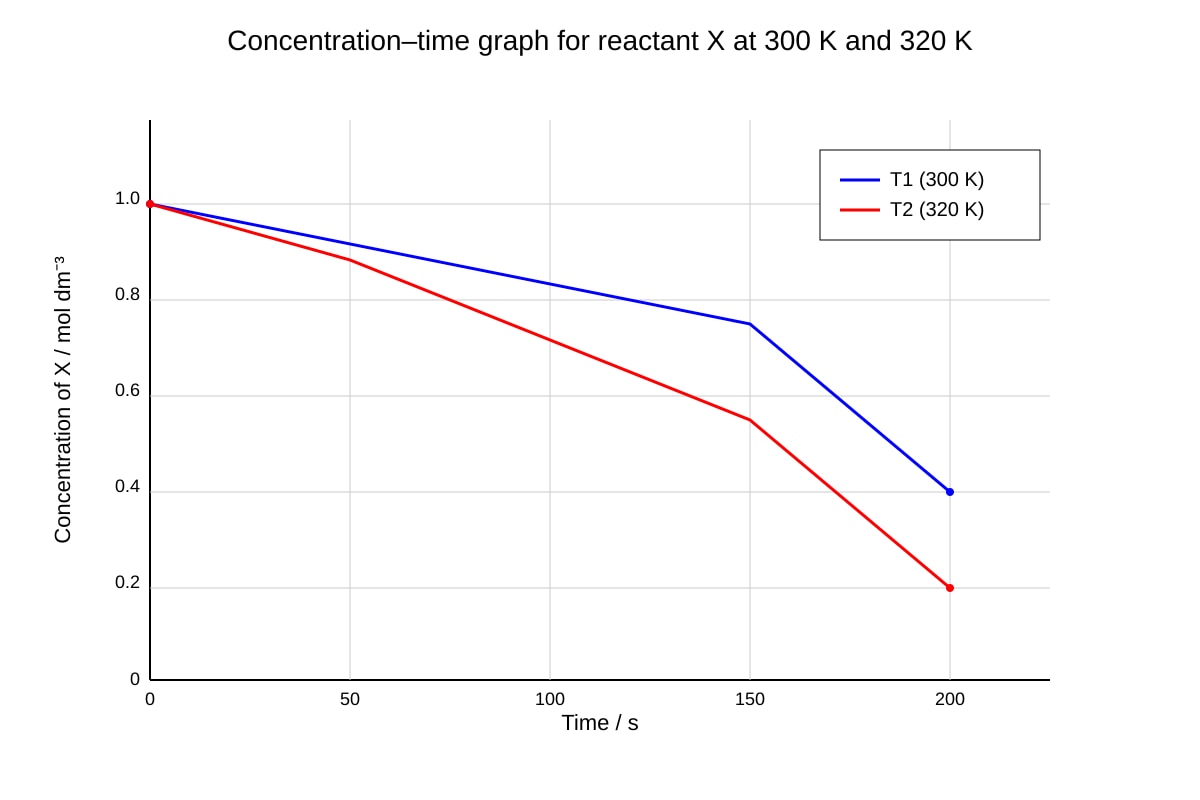
15. The graph below shows concentration–time curves for a reactant in two experiments at different temperatures.
Image pending generation: graph for Q15.
(a) Which curve represents the higher temperature? [1]
(b) Explain your answer using collision theory. [2]
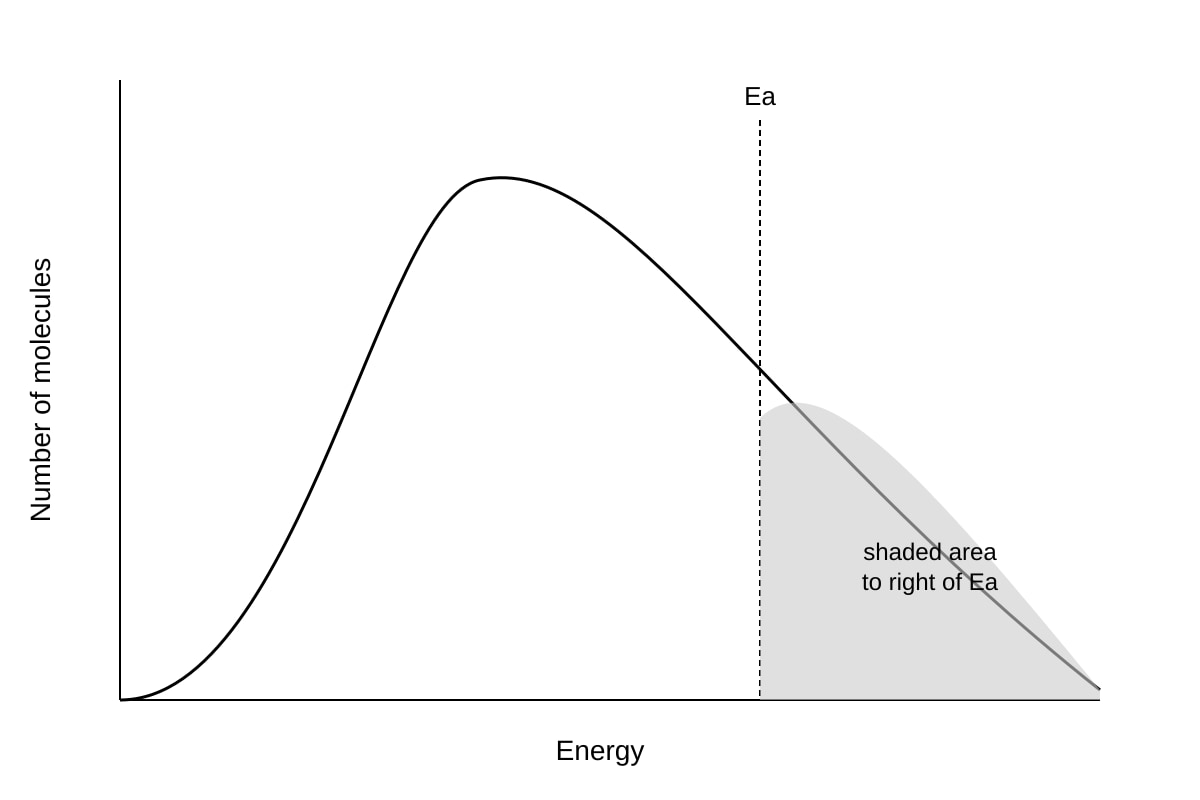
16. The Boltzmann distribution of molecular energies is shown below.
Image pending generation: graph for Q16.
(a) State the effect on the shaded area when a catalyst is added. [1]
(b) Explain how the catalyst changes the distribution. [2]
17. The reaction CO(g)+NO2(g)⇌CO2(g)+NO(g) is exothermic.
(a) State the effect of increasing temperature on Kc. [1]
(b) Explain your answer in terms of equilibrium position. [2]
18. In the industrial contact process, 2SO2(g)+O2(g)⇌2SO3(g)ΔH=−197 kJ mol−1.
(a) State two conditions used to maximise SO3 yield. [2]
(b) Explain why a compromise is needed between rate and equilibrium yield. [2]
19. The table shows initial rates for P+Q→R:
| [P] | [Q] | Rate |
|---|---|---|
| 0.05 | 0.05 | 1.0×10⁻⁵ |
| 0.10 | 0.05 | 4.0×10⁻⁵ |
| 0.05 | 0.10 | 2.0×10⁻⁵ |
(a) Determine order w.r.t. P and Q. [2]
(b) Calculate k with units. [2]
20. Explain, using kinetic and equilibrium principles, why increasing pressure increases the yield of NH3 in the Haber process but does not change the rate constant. [3]
Answers
A-Level Chemistry H1 Quiz - Kinetics Equilibrium: Answer Key
Total Marks: 40
Topic: Kinetics & Equilibrium
Section A: Short Answer
1. [1 mark]
Rate of reaction is the change in concentration of a reactant or product per unit time.
Teaching note: Usually expressed as mol dm−3 s−1. It measures how fast a reaction proceeds.
2. [1 mark]
rate=k[A]1[B]0=k[A]
Teaching note: Order 0 in B means concentration of B does not affect rate; [B]0=1.
3. [1 mark]
Kc=[N2][H2]3[NH3]2
Teaching note: Products over reactants, each raised to stoichiometric coefficient. Solids/liquids omitted (all gases here).
4. [1 mark]
Le Chatelier’s Principle: When a system at equilibrium is subjected to a change in condition (concentration, pressure, temperature), the equilibrium shifts to oppose the change.
Common mistake: Saying “cancels out” instead of “opposes”.
5. [1 mark]
Activation energy is the minimum energy required for a collision between reactant molecules to result in a successful reaction.
Teaching note: Represented as Ea on energy profile diagrams.
6. [1 mark]
First order.
Reasoning: Rate ∝ [reactant]1; doubling concentration doubles rate.
7. [1 mark]
A catalyst provides an alternative reaction pathway with lower activation energy, increasing the fraction of molecules with sufficient energy to react.
Teaching note: Catalyst is not consumed; does not affect equilibrium.
Section B: Structured & Calculation
8. [3 marks total]
(a) Order w.r.t. A = 1 (Exp1→2: [A] doubles, rate doubles). [1]
(b) Order w.r.t. B = 0 (Exp1→3: [B] doubles, rate unchanged). [1]
(c) rate=k[A]1[B]0=k[A]. [1]
9. [2 marks]
For first order: t1/2=kln2
=5.0×10⁻⁴ s−10.693=1.386×10³ s≈1.4×10³ s (or 1386 s). [2]
Marking: 1 for formula, 1 for correct value.
10. [2 marks]
Kc=[H2][I2][HI]2=(0.20)(0.20)(0.60)2=0.040.36=9.0 [2]
Units: none (cancels). Mark: 1 for expression, 1 for value.
11. [2 marks]
(a) Increasing temperature shifts equilibrium left (towards reactants) because forward reaction is exothermic; system opposes by absorbing heat. [1]
(b) Increasing pressure shifts equilibrium right (towards fewer moles: 4 → 2) to reduce pressure. [1]
12. [2 marks]
Rate constant increases with temperature because molecules have more kinetic energy; more collisions exceed Ea (collision theory). [2]
Note: Exact doubling not required to explain; link T to k via Arrhenius concept.
13. [2 marks]
(a) Kc=[NO2]2[NO]2[O2] [1]
(b) Units: (mol dm−3)2(mol dm−3)2(mol dm−3)=mol dm−3 [1]
14. [2 marks]
360 s = 3 half-lives. Fraction remaining = (1/2)3=1/8=0.125. [2]
Method: n=t/t1/2=360/120=3.
Section C: Data Interpretation & Extended Reasoning
15. [3 marks]
(a) T2 (320 K) – steeper fall. [1]
(b) Higher temperature gives molecules greater average kinetic energy; larger fraction exceeds Ea; more frequent successful collisions; faster rate. [2]
16. [3 marks]
(a) Shaded area increases (more molecules beyond Ea). [1]
(b) Catalyst lowers Ea (line moves left); same distribution shape but more molecules now have energy > new Ea. [2]
17. [3 marks]
(a) Kc decreases. [1]
(b) Exothermic forward reaction; increasing T shifts equilibrium left (to absorb heat), reducing product concentration; Kc (products/reactants) falls. [2]
18. [4 marks]
(a) Lower temperature (favours exothermic), higher pressure (fewer moles: 3→2). [2]
(b) Low T slows rate (fewer collisions); high P costly/equipment-limited; compromise (e.g. 450°C, 2 atm) gives acceptable rate and yield. [2]
19. [4 marks]
(a) P: Exp1→2 [P]×2, rate×4 → order 2. Q: Exp1→3 [Q]×2, rate×2 → order 1. [2]
(b) rate=k[P]2[Q]; using Exp1: 1.0×10−5=k(0.05)2(0.05)=k(1.25×10⁻⁴); k=8.0×10⁻² dm6 mol−2 s−1. [2]
20. [3 marks]
Increasing pressure increases concentration of gases; more collisions per unit time → higher rate (kinetic). Equilibrium shifts to side with fewer moles (right, 4→2) → more NH₃ (Le Chatelier). Rate constant k depends only on temperature, not pressure, so unchanged. [3]
Free quiz and exam paper access
Enter your details to view this paper
Your access is remembered on this device.