From Real Exams Quiz
A Level H1 Chemistry Atomic Structure Bonding Quiz
Free A Level H1 Chemistry Atomic Structure Bonding quiz, LongCat Exam version, with questions, answers, and A Level-style practice for Singapore students.
These static practice materials are generated from the site's syllabus and paper-generation workflow, with source and model context shown so students and parents can evaluate the material before use.
Questions
Free quiz and exam paper access
Enter your details to view this paper
Your access is remembered on this device.
Answers
A-Level Chemistry H1 Quiz - Atomic Structure Bonding
Answer Key
Section A: Multiple Choice Questions
1. A [1]
Explanation: The atomic number (12) gives the number of protons. The mass number (24) gives protons + neutrons, so neutrons = 24 − 12 = 12. The 2+ charge means 2 electrons have been lost, so electrons = 12 − 2 = 10.
2. B and C (both and are acceptable; if only one answer is allowed, B is the best single choice) [1]
Explanation: has 10 electrons. has 9 + 1 = 10 electrons. has 8 + 2 = 10 electrons. has 11 electrons. has 12 − 2 = 10 electrons. All three anions/cations with 10 electrons are isoelectronic with Ne. If the question expects a single answer, is the most commonly cited example.
3. B [1]
Explanation: There is a large jump between the 2nd and 3rd ionisation energies (1145 → 4912 kJ mol). This indicates that the third electron is being removed from an inner shell, meaning the element has 2 valence electrons and is in Group 2.
4. D [1]
Explanation: has a tetrahedral arrangement that is asymmetrical due to the different atoms bonded to carbon (3 Cl and 1 H), so the bond dipoles do not cancel. (trigonal planar), (tetrahedral, symmetrical), and (linear) all have symmetrical shapes where bond dipoles cancel.
5. B [1]
Explanation: Sodium chloride is an ionic compound with a giant lattice structure. The strong electrostatic attractions between and ions require large amounts of energy to overcome, resulting in a high melting point.
Section B: Structured Questions
6. (a) Isotopes are atoms of the same element (same number of protons) that have different numbers of neutrons (and hence different mass numbers). [2]
Marking: 1 mark for "same element/same number of protons"; 1 mark for "different number of neutrons/different mass number."
(b) Let the percentage abundance of be %. Then is %.
The percentage abundance of is 75%. [2]
Marking: 1 mark for correct equation setup; 1 mark for correct answer (75%).
7. (a) (i) : [1]
(ii) : [1]
Note: has configuration . When forming , the 4s electrons are removed first, leaving .
(b) The 4s orbital has a lower energy than the 3d orbital in the ground state of a transition metal atom. According to the Aufbau principle, electrons fill orbitals in order of increasing energy. Therefore, the 4s orbital is filled before the 3d orbital. [2]
Marking: 1 mark for stating 4s is lower in energy than 3d; 1 mark for reference to Aufbau principle or filling in order of increasing energy.
8. (a) First ionisation energy is the energy required to remove one mole of electrons from one mole of gaseous atoms to form one mole of gaseous 1+ ions. [2]
Marking: Must include: "one mole of electrons," "one mole of gaseous atoms," "one mole of gaseous unipositive ions." 1 mark for each correct component.
(b) Across Period 3, the nuclear charge (number of protons) increases while the electrons are being added to the same principal energy level (n = 3). The increased nuclear charge results in a stronger attraction between the nucleus and the outer electrons, making it harder to remove an electron. Therefore, the first ionisation energy generally increases. [2]
Marking: 1 mark for increasing nuclear charge; 1 mark for electrons in same shell/stronger attraction.
(c) In , the outermost electron is in a 3s orbital. In , the outermost electron is in a 3p orbital. The 3p orbital is at a higher energy level than the 3s orbital and is also partially shielded by the 3s electrons. Therefore, the 3p electron in Al is easier to remove, resulting in a lower first ionisation energy. [2]
Marking: 1 mark for 3p being higher energy than 3s; 1 mark for shielding effect.
(d) In , the 3p orbitals contain 3 electrons, with one electron in each orbital (all unpaired). In , the 3p orbitals contain 4 electrons, meaning one orbital has a pair of electrons. The electron-electron repulsion between the paired electrons makes it easier to remove one of them, so S has a lower first ionisation energy than P. [2]
Marking: 1 mark for paired electrons in S; 1 mark for electron-electron repulsion explanation.
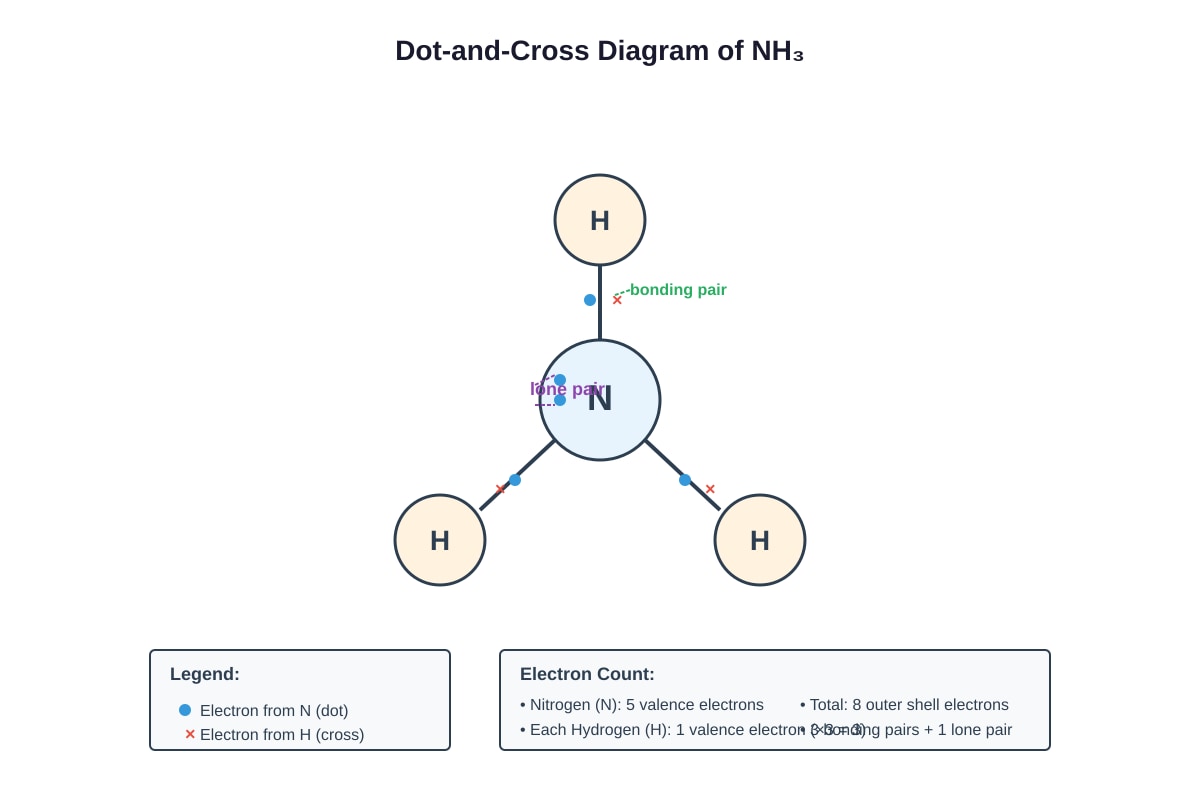
9. (a) Dot-and-cross diagram of : [2]
Generated diagram for Q9.
Marking: 1 mark for correct number of electrons (8 total); 1 mark for correct arrangement (3 bonds + 1 lone pair on N).
(b) Shape: Trigonal pyramidal [1]
Explanation: The nitrogen atom has 4 regions of electron density (3 bonding pairs + 1 lone pair). These arrange themselves tetrahedrally to minimise repulsion. The lone pair-bonding pair repulsion is greater than bonding pair-bonding pair repulsion, so the H-N-H bond angle is compressed from 109.5° to approximately 107°. The shape (considering only atoms) is trigonal pyramidal. [2]
Marking: 1 mark for shape name; 1 mark for explanation involving 4 electron pairs, lone pair repulsion, and bond angle compression.
(c) The N-H bonds are polar because nitrogen is more electronegative than hydrogen. The molecule has a trigonal pyramidal shape which is asymmetrical, so the bond dipoles do not cancel out. This results in a net dipole moment, making the molecule polar. [2]
Marking: 1 mark for polar bonds (electronegativity difference); 1 mark for asymmetrical shape preventing dipole cancellation.
10. (a) Electronegativity is the ability of an atom to attract the bonding pair of electrons in a covalent bond towards itself. [2]
Marking: 1 mark for "attract bonding pair"; 1 mark for "towards itself/in a covalent bond."
(b) The electronegativity of O (3.5) is greater than that of H (2.1). The difference of 1.4 means the bonding pair of electrons is attracted more strongly towards the oxygen atom. This creates a partial negative charge () on oxygen and a partial positive charge () on hydrogen, making the O-H bond polar. [2]
Marking: 1 mark for identifying the electronegativity difference; 1 mark for explaining unequal electron distribution/partial charges.
(c) has a linear shape (O=C=O). Although each C=O bond is polar, the two bond dipoles are equal in magnitude but opposite in direction. They therefore cancel each other out, resulting in no net dipole moment. The molecule is non-polar overall. [2]
Marking: 1 mark for linear shape; 1 mark for bond dipoles cancelling.
11. (a) has ionic bonding. Magnesium (a metal) loses two electrons to form and oxygen (a non-metal) gains two electrons to form . The oppositely charged ions are held together by strong electrostatic forces of attraction in a giant ionic lattice. [2]
Marking: 1 mark for ionic bonding; 1 mark for description of ion formation/electrostatic attraction.
(b) has covalent bonding. Each oxygen atom shares two pairs of electrons with the carbon atom, forming two double bonds (O=C=O). The molecule is simple molecular (discrete molecules). [2]
Marking: 1 mark for covalent bonding; 1 mark for double bonds/simple molecular structure.
(c) has a giant ionic lattice structure with strong electrostatic forces between and ions. A large amount of energy is required to overcome these strong forces, hence the very high melting point. exists as simple molecules with weak intermolecular forces (van der Waals forces) between molecules. Little energy is needed to overcome these weak forces, hence the very low sublimation point. [3]
Marking: 1 mark for ionic lattice in MgO; 1 mark for strong electrostatic forces requiring large energy; 1 mark for weak intermolecular forces in CO2.
12. (a) Van der Waals forces (or London dispersion forces / instantaneous dipole-induced dipole forces). [1]
(b) From to , the molecular size and the number of electrons increase. This leads to stronger van der Waals forces between molecules because larger electron clouds are more easily polarised, creating stronger instantaneous dipoles. More energy is required to overcome these stronger forces, so the boiling point increases. [2]
Marking: 1 mark for increasing molecular size/electrons; 1 mark for stronger van der Waals forces.
(c) In , the O-H bonds are highly polar due to the high electronegativity of oxygen. The small size of the oxygen atom and the presence of two lone pairs allow for hydrogen bonding between water molecules. Hydrogen bonds are much stronger than van der Waals forces, so significantly more energy is required to separate the molecules, resulting in an anomalously high boiling point. [3]
Marking: 1 mark for identifying hydrogen bonding; 1 mark for explaining why H-bonding occurs (high electronegativity of O, lone pairs); 1 mark for comparing strength to van der Waals forces.
13. (a) Metallic bonding. [1]
(b) In metallic bonding, the outer electrons of copper atoms are delocalised and form a "sea" of mobile electrons. When a voltage is applied, these delocalised electrons are free to move and carry charge through the metal, allowing copper to conduct electricity. [2]
Marking: 1 mark for delocalised/mobile electrons; 1 mark for explaining charge transport.
(c) Copper has a high melting point because there are strong electrostatic attractions between the positive copper ions and the sea of delocalised electrons. A large amount of energy is required to overcome these metallic bonds. [2]
Marking: 1 mark for strong electrostatic attraction between Cu ions and delocalised electrons; 1 mark for large energy required.
14. (a) < < (or < < < if HF is included) [1]
Note: : 109.5° (4 bonding pairs, 0 lone pairs); : ~107° (3 bonding pairs, 1 lone pair); : ~104.5° (2 bonding pairs, 2 lone pairs); is diatomic so bond angle is not applicable in the same way.
(b) As the number of lone pairs on the central atom increases, the bond angle decreases. Lone pair-lone pair repulsion > lone pair-bonding pair repulsion > bonding pair-bonding pair repulsion. In , there are no lone pairs, so the bond angle is the ideal tetrahedral angle of 109.5°. In , one lone pair compresses the bond angle to ~107°. In , two lone pairs cause even greater compression, reducing the bond angle to ~104.5°. [3]
Marking: 1 mark for stating the relationship between lone pairs and bond angle; 1 mark for explaining relative repulsion strengths; 1 mark for applying to specific molecules.
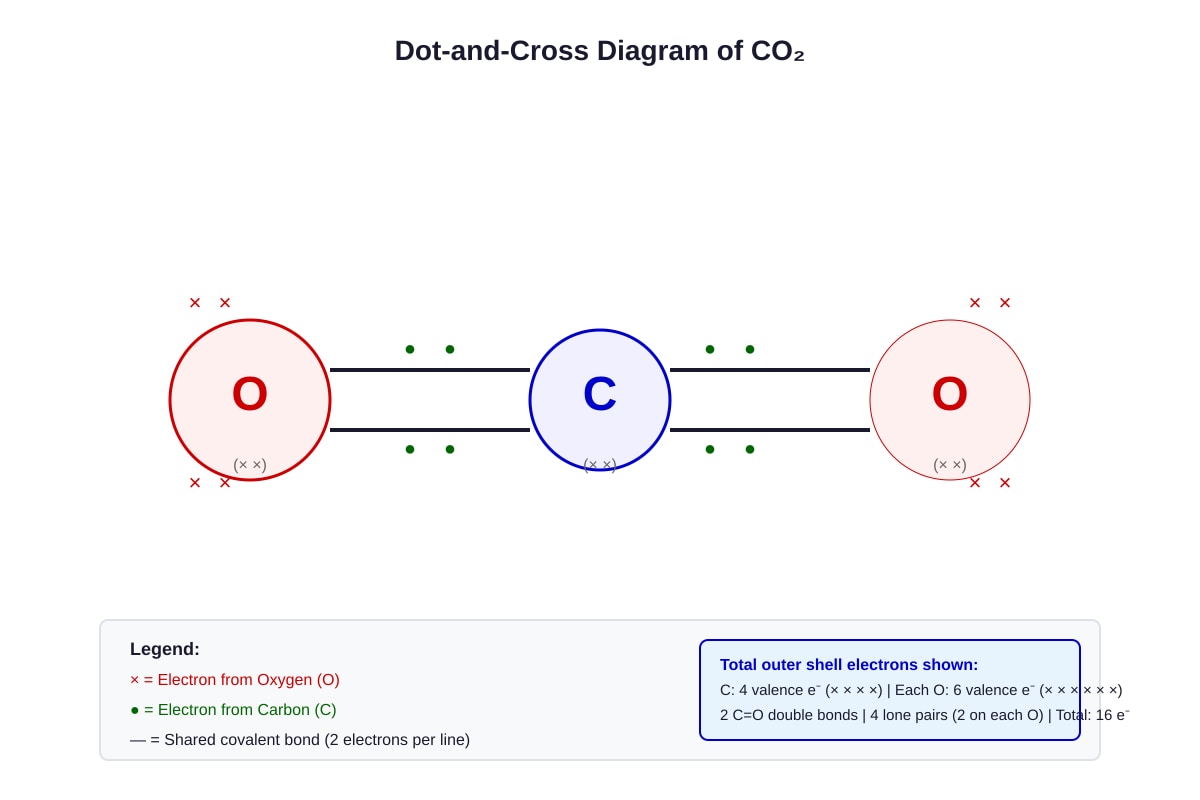
15. (a) Dot-and-cross diagram of : [2]
Generated diagram for Q15.
Marking: 1 mark for correct number of electrons (16 total); 1 mark for correct arrangement (2 double bonds, lone pairs on each O).
(b) Linear. [1]
(c) Although each C=O bond is polar (oxygen is more electronegative than carbon), the molecule has a linear shape. The two bond dipoles are equal in magnitude but point in opposite directions. They therefore cancel each other out, resulting in no net dipole moment. [2]
Marking: 1 mark for linear shape; 1 mark for bond dipoles cancelling.
Section C: Data-Based and Extended Questions
16. (a)
- A: Ionic bonding, giant ionic lattice (high mp/bp, conducts when molten, soluble in water)
- B: Covalent bonding, simple molecular (low mp/bp, does not conduct, soluble in water — likely a polar molecular substance like ethanol)
- C: Covalent bonding, giant covalent/macromolecular structure (very high mp/bp, does not conduct, insoluble — like SiO₂) [3]
Marking: 1 mark for each correct identification.
(b) In the solid state, the ions are held in fixed positions in the lattice and cannot move, so they cannot carry charge. When molten, the ions are free to move and can carry electrical charge, allowing the substance to conduct electricity. [2]
Marking: 1 mark for fixed ions in solid; 1 mark for mobile ions in liquid.
(c) Substance C has a giant covalent (macromolecular) structure with strong covalent bonds throughout the lattice. A large amount of energy is required to break these strong covalent bonds, resulting in a very high melting point. [2]
Marking: 1 mark for giant covalent structure; 1 mark for strong covalent bonds requiring large energy.
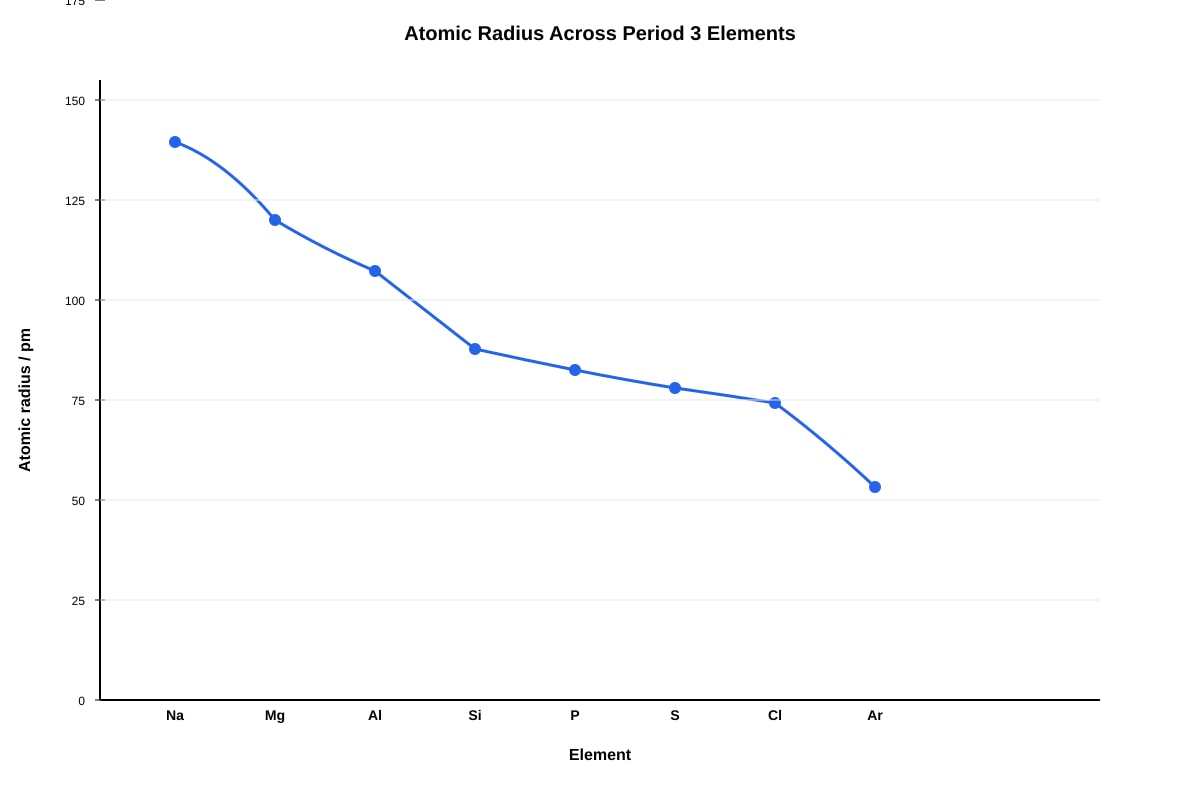
17. (a) The atomic radius decreases across Period 3 from Na to Ar. [1]
(b) Across Period 3, the number of protons (nuclear charge) increases, but the electrons are being added to the same principal energy level (n = 3). The increased nuclear charge exerts a stronger pull on the electron cloud, drawing the electrons closer to the nucleus. Although electrons are also being added, they go into the same shell and do not provide significant additional shielding. Therefore, the atomic radius decreases. [3]
Marking: 1 mark for increasing nuclear charge; 1 mark for electrons in same shell; 1 mark for stronger pull/shielding explanation.
18. (a) A dative covalent bond (also called a coordinate bond) is a covalent bond in which both electrons in the shared pair are provided by the same atom. [2]
Marking: 1 mark for defining as a covalent bond; 1 mark for both electrons from the same atom.
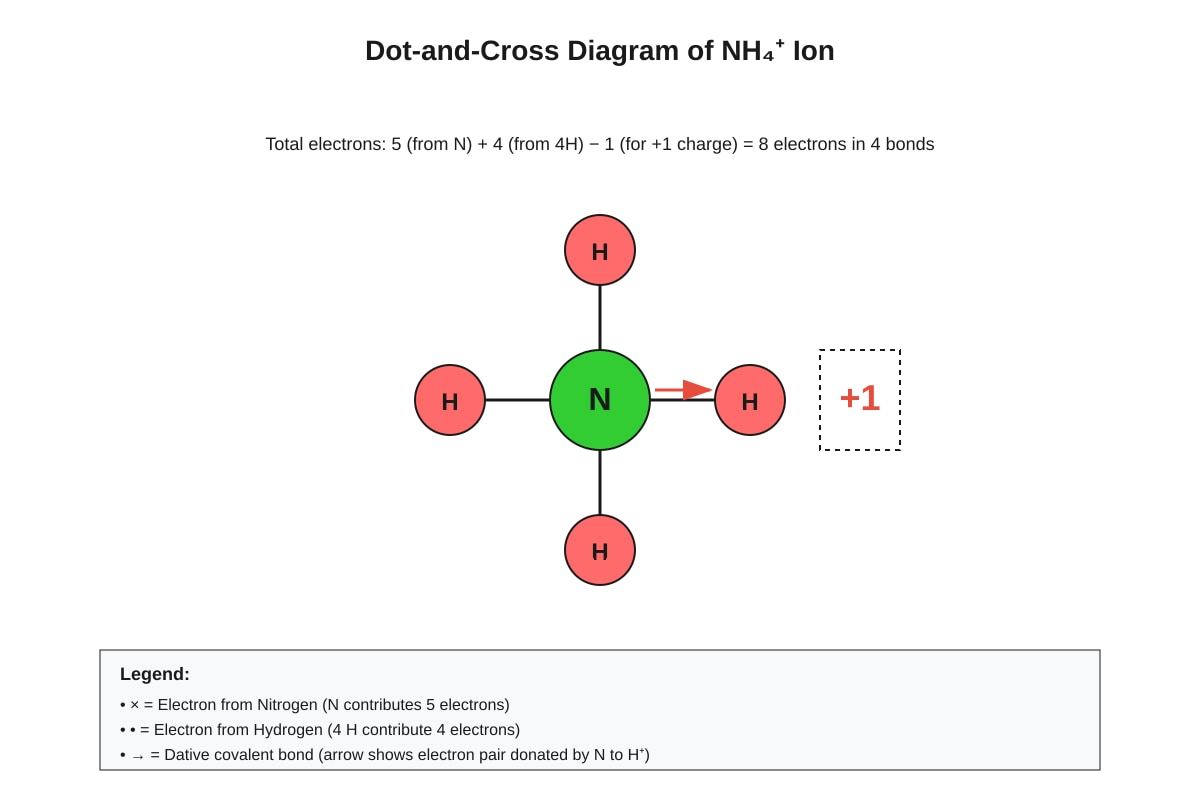
(b) Dot-and-cross diagram of : [3]
Generated diagram for Q18.
Marking: 1 mark for correct total electrons (8); 1 mark for four N-H bonds; 1 mark for clearly indicating the dative bond (arrow from N to H).
19. (a) is a simple molecular substance with weak van der Waals forces between molecules. Little energy is needed to overcome these weak forces, so it is a liquid at room temperature. is an ionic compound with a giant lattice structure. The strong electrostatic forces between and ions require a large amount of energy to overcome, so it is a solid at room temperature. [3]
Marking: 1 mark for simple molecular/weak van der Waals in SiCl4; 1 mark for ionic lattice/strong electrostatic forces in NaCl; 1 mark for linking to energy required.
(b) [1]
(c) When dissolves in water, it dissociates into mobile and ions. These free-moving ions can carry electrical charge through the solution, allowing it to conduct electricity. [2]
Marking: 1 mark for dissociation into ions; 1 mark for mobile ions carrying charge.
20. (a) As the electronegativity difference decreases from HF to HI, the bond energy also decreases. [1]
(b) The H-F bond is the strongest because fluorine has a very small atomic radius, so the bonding pair of electrons is held very close to both nuclei. This results in a very strong electrostatic attraction between the bonding electrons and the nuclei, giving a high bond energy. The high electronegativity difference also contributes to the bond strength. [2]
Marking: 1 mark for small atomic radius of F; 1 mark for strong electrostatic attraction/short bond length.
(c) The high polarity of the H-F bond leads to hydrogen bonding between HF molecules. These intermolecular hydrogen bonds are stronger than van der Waals forces, so HF has a higher boiling point than expected for its molecular mass. HF also has a relatively high solubility in water due to hydrogen bonding with water molecules. [2]
Marking: 1 mark for hydrogen bonding; 1 mark for effect on boiling point/solubility.
Total: 40 marks