From Real Exams Quiz
A Level H1 Chemistry Atomic Structure Bonding Quiz
Free A Level H1 Chemistry Atomic Structure Bonding quiz, HY3 Exam version, with questions, answers, and A Level-style practice for Singapore students.
These static practice materials are generated from the site's syllabus and paper-generation workflow, with source and model context shown so students and parents can evaluate the material before use.
Questions
A-Level Chemistry H1 Quiz - Atomic Structure Bonding
Name: ___________________________
Class: ___________________________
Date: ___________________________
Score: _______ / 40
Duration: 60 minutes
Total Marks: 40
Topic: Atomic Structure Bonding (atomic-structure-bonding)
Instructions:
- Answer all 20 questions.
- Section A: Short structured questions (1–8).
- Section B: Data interpretation and bonding diagrams (9–14).
- Section C: Calculations and extended reasoning (15–20).
- Show all working for calculation questions. Use chemical notation where required.
Section A: Short Structured Questions (1–8)
1. State what is meant by the term isotope. [1]
2. Give the number of protons, neutrons and electrons in a neutral atom of 2040Ca. [1]
Protons: ______ Neutrons: ______ Electrons: ______
3. Write the full electronic configuration of a chlorine atom, atomic number 17. [1]
4. State the meaning of the term first ionisation energy. [1]
5. State the type of bonding present in magnesium oxide, MgO. [1]
6. Draw a dot-and-cross diagram to show the bonding in the molecule H2O. Show only outer shell electrons. [2]
7. Using VSEPR theory, predict the shape and bond angle of the molecule BF3. [2]
Shape: __________________ Bond angle: _________
8. State the strongest type of intermolecular force present between NH3 molecules. [1]
Section B: Data Interpretation and Bonding Diagrams (9–14)
9. The first five successive ionisation energies of an element E are given below:
| Ionisation | 1st | 2nd | 3rd | 4th | 5th |
|---|---|---|---|---|---|
| IE / kJ mol⁻¹ | 496 | 4562 | 6912 | 9543 | 13353 |
Deduce the group of element E in the Periodic Table and explain your reasoning. [3]
Group: ______
Explanation: ___________________________________________________________
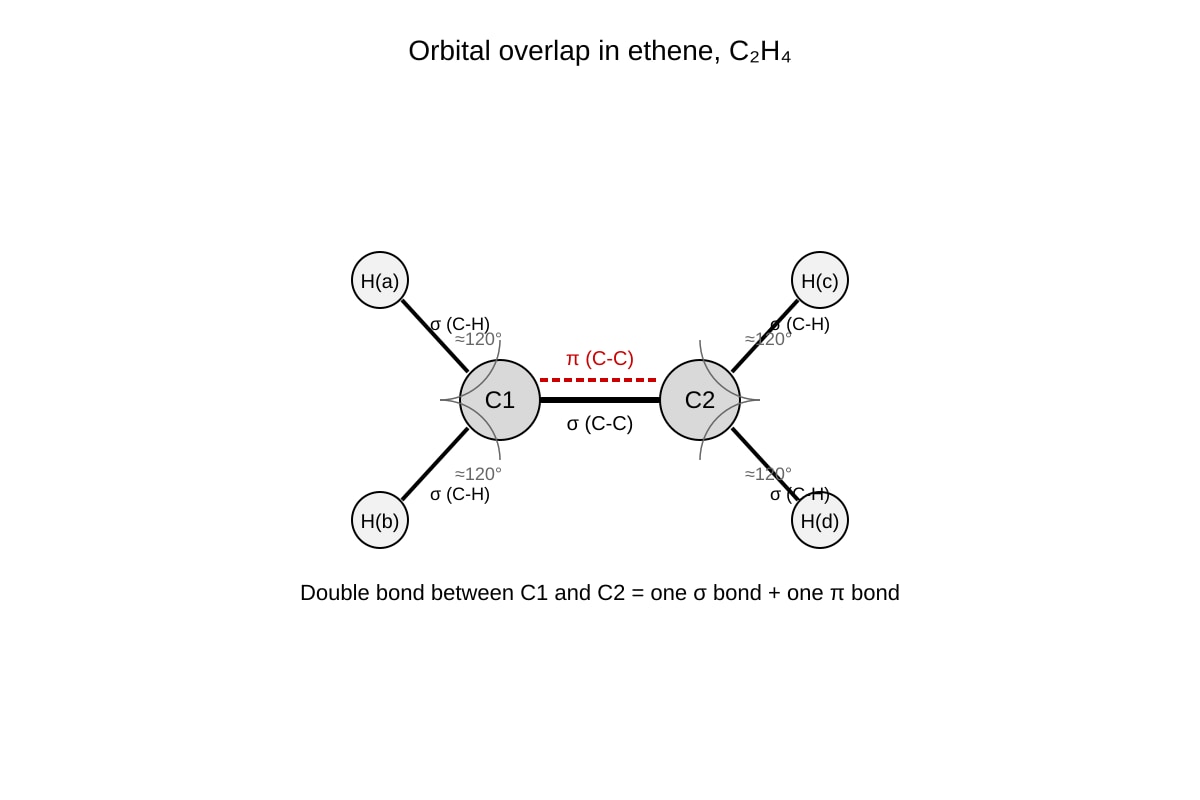
10. The diagram below shows the orbital overlap in a molecule of ethene, C2H4.
Image pending generation: diagram for Q10.
State the type of bond formed by the side-by-side overlap of p orbitals in this molecule. [1]
11. Predict the shape and bond angle of the SF6 molecule using VSEPR theory. Explain your answer. [3]
Shape: __________________ Bond angle: _________
Explanation: ___________________________________________________________
12. Explain why a H2O molecule is polar whereas a CO2 molecule is non-polar, despite both containing polar bonds. [3]
13. The table shows the melting points of four substances.
| Substance | NaCl | I2 | SiO2 | Mg |
|---|---|---|---|---|
| Melting point / °C | 801 | 114 | 1713 | 650 |
Identify the type of structure and bonding for each that accounts for the trend. [4]
NaCl: ________________________
I2: ________________________
SiO2: ________________________
Mg: ________________________
14. Deduce the electronic configuration of the Fe2+ ion (atomic number of Fe = 26) using the s, p, d notation. [2]
Section C: Calculations and Extended Reasoning (15–20)
15. Calculate the relative atomic mass of element X given the following isotopic abundances:
63X: 69.2%, 65X: 30.8%. [2]
16. The successive ionisation energies of element Y show a large jump after the 3rd ionisation. Deduce the number of electrons in the outer shell of Y and state its group. Hence write the formula of its oxide. [3]
Outer shell electrons: ______ Group: ______ Oxide formula: ______
17. A sample of neon contains the isotopes 20Ne (90.5%) and 22Ne (9.5%). Calculate the relative atomic mass of this neon sample to 1 decimal place. [2]
18. Explain, in terms of electrostatic attractions, why the lattice energy of MgO is more exothermic than that of NaF. [3]
19. A molecule of PCl5 has trigonal bipyramidal shape. State the bond angles in the equatorial and axial positions and explain using VSEPR theory how this minimises repulsion. [4]
Equatorial: _________ Axial: _________
Explanation: ___________________________________________________________
20. A student claims that "CO2 has a higher boiling point than H2O because it has more electrons." Using your knowledge of intermolecular forces, evaluate this claim. [4]
Answers
A-Level Chemistry H1 Quiz - Atomic Structure Bonding (Answer Key)
Total Marks: 40
Topic: Atomic Structure Bonding
Section A Answers (1–8)
1. [1 mark]
Isotopes are atoms of the same element with the same number of protons but different numbers of neutrons.
Teaching note: Same proton number = same element; different nucleon number due to neutron difference.
2. [1 mark]
Protons: 20, Neutrons: 20 (40 − 20), Electrons: 20 (neutral atom).
Marking: 1 mark for all three correct.
3. [1 mark]
1s22s22p63s23p5
Teaching note: Fill orbitals in order; Cl has 17 electrons.
4. [1 mark]
The first ionisation energy is the energy required to remove one mole of electrons from one mole of gaseous atoms to form one mole of gaseous 1+ ions.
Teaching note: Must mention gaseous state and per mole.
5. [1 mark]
Ionic bonding.
Teaching note: MgO is metal + non-metal → transfer of electrons.
6. [2 marks]
O in centre with two H atoms; O has 6 outer e⁻, each H has 1. Two shared pairs.
Marking: 1 mark for correct shared pairs, 1 mark for showing O with 2 lone pairs.
Common mistake: Forgetting lone pairs on oxygen.
7. [2 marks]
Shape: trigonal planar; Bond angle: 120°.
Teaching note: B has 3 bonding pairs, 0 lone pairs → repulsion equal → 120°.
8. [1 mark]
Hydrogen bonding.
Teaching note: NH₃ has N bonded to H, N is highly electronegative.
Section B Answers (9–14)
9. [3 marks]
Group: 1
Explanation: Large jump between 1st (496) and 2nd (4562) IE shows only 1 electron in outer shell; after removal, next electron is from stable inner shell.
Marking: 1 for group, 2 for reasoning with reference to jump.
10. [1 mark]
Pi (π) bond.
Teaching note: Side-by-side p orbital overlap forms π bond; sigma from end-on.
11. [3 marks]
Shape: octahedral; Bond angle: 90°.
Explanation: S has 6 bonding pairs, 0 lone pairs → 6 electron domains repel equally → octahedral.
Marking: 1 shape, 1 angle, 1 explanation.
12. [3 marks]
H₂O is bent (104.5°) due to 2 lone pairs, bond dipoles do not cancel → polar. CO₂ is linear (180°), bond dipoles equal and opposite cancel → non-polar.
Marking: 1 for H₂O polarity reason, 1 for CO₂ symmetry, 1 for dipole cancellation.
13. [4 marks]
NaCl: ionic lattice; I₂: simple molecular; SiO₂: giant covalent; Mg: metallic.
Marking: 1 each. Relate to MP: ionic/covalent high, molecular low.
14. [2 marks]
Fe: 1s22s22p63s23p63d64s2; Fe²⁺ loses 4s first → 1s22s22p63s23p63d6.
Marking: 1 for removal order, 1 for final config.
Section C Answers (15–20)
15. [2 marks]
Ar=(63×0.692)+(65×0.308)=43.596+20.02=63.616≈63.6
Working: Multiply mass by decimal abundance, sum.
Answer: 63.6
16. [3 marks]
Outer shell: 3 electrons; Group: 13; Oxide: Y2O3 (Y is 3+, O is 2−).
Marking: 1+1+1.
17. [2 marks]
Ar=(20×0.905)+(22×0.095)=18.1+2.09=20.19≈20.2
Answer: 20.2
18. [3 marks]
MgO: Mg²⁺ and O²⁻ (charges ±2); NaF: Na⁺ and F⁻ (±1). Higher charge → stronger electrostatic attraction → more exothermic lattice energy. Also smaller ionic radii in MgO.
Marking: 1 charge compare, 1 attraction link, 1 conclusion.
19. [4 marks]
Equatorial: 120°; Axial: 90°.
Explanation: 5 bonding pairs; 3 equatorial minimise 120° repulsions, 2 axial at 90° to minimise total repulsion (axial-equatorial > equatorial-equatorial).
Marking: 1+1+2.
20. [4 marks]
Claim is false. CO₂ is non-polar, only London forces; H₂O has hydrogen bonding (stronger) → higher BP despite fewer electrons. Evaluate: electron count alone insufficient; intermolecular force type dominates.
Marking: 1 identify error, 1 H-bond in water, 1 CO₂ forces, 1 conclusion.
Free quiz and exam paper access
Enter your details to view this paper
Your access is remembered on this device.