From Real Exams Quiz
A Level H1 Chemistry Atomic Structure Bonding Quiz
Free A Level H1 Chemistry Atomic Structure Bonding quiz, DeepSeek Exam version, with questions, answers, and A Level-style practice for Singapore students.
These static practice materials are generated from the site's syllabus and paper-generation workflow, with source and model context shown so students and parents can evaluate the material before use.
Questions
Free quiz and exam paper access
Enter your details to view this paper
Your access is remembered on this device.
Answers
A-Level Chemistry H1 Quiz - Atomic Structure Bonding
ANSWER KEY AND MARKING SCHEME
Total Marks: 40
Section A: Short Answer (10 marks)
1. State the number of protons, neutrons, and electrons in the ion (^{27}_{13}\text{Al}^{3+}). [2]
| Particle | Number |
|---|---|
| Protons | 13 ✓ (0.5) |
| Neutrons | 14 ✓ (0.5) |
| Electrons | 10 ✓ (1) |
Marking notes:
- Protons = atomic number = 13 [0.5 mark]
- Neutrons = mass number − atomic number = 27 − 13 = 14 [0.5 mark]
- Electrons = protons − charge = 13 − 3 = 10 [1 mark]
- Award full marks for all three correct, even if table not used.
2. Define the term isotope. [1]
Answer: Isotopes are atoms of the same element with the same number of protons (same atomic number) but different numbers of neutrons (different mass numbers). ✓
Marking notes:
- Must mention "same element" or "same atomic number/protons" AND "different mass number/neutrons" [1 mark]
- Accept: "Atoms with same number of protons but different number of neutrons"
3. Write the electronic configuration of a sulfur atom (atomic number 16). [2]
(a) s, p, d notation [1]
Answer: 1s² 2s² 2p⁶ 3s² 3p⁴ ✓
(b) orbital box diagram notation (show only the valence electrons) [1]
Answer:
3s: [↑↓] 3p: [↑↓][↑ ][↑ ]
✓ (1 mark for correct valence configuration with correct pairing)
Marking notes:
- (a) Accept any clear notation showing correct subshell filling [1 mark]
- (b) Must show 3s² 3p⁴ with Hund's rule applied (two unpaired electrons in 3p) [1 mark]
- Accept arrow notation or half-arrow notation
4. Explain why the first ionisation energy of magnesium is higher than that of sodium. [2]
Answer: Magnesium has a greater nuclear charge (12 protons vs 11 protons in sodium) ✓, and the outer electron is in the same principal quantum shell (3s). The increased nuclear charge exerts a stronger attractive force on the outer electron ✓, so more energy is required to remove it.
Marking notes:
- Must mention greater nuclear charge / more protons in Mg [1 mark]
- Must mention same shell / similar shielding [1 mark]
- Accept: "Mg has smaller atomic radius, so outer electron is held more tightly"
5. State the shape and bond angle of the ammonia molecule, NH₃, and explain your answer using VSEPR theory. [3]
Shape: Trigonal pyramidal ✓ (1)
Bond angle: 107° ✓ (1)
Explanation: There are 4 electron pairs around the central nitrogen atom (3 bonding pairs and 1 lone pair). ✓ The electron pairs repel to positions of minimum repulsion, giving a tetrahedral electron-pair geometry. However, the lone pair exerts greater repulsion than bonding pairs, compressing the H−N−H bond angle from 109.5° to approximately 107°. The molecular shape (considering atoms only) is trigonal pyramidal. ✓
Marking notes:
- Shape: "Trigonal pyramidal" or "pyramidal" [1 mark]
- Bond angle: 107° (accept 106°–108°) [1 mark]
- Explanation: Must mention 4 electron pairs (3 bonding + 1 lone pair) AND lone pair repulsion effect [1 mark]
Section B: Structured Questions (18 marks)
6. Table analysis [5 marks total]
(a) Identify which two species are isotopes of each other. Explain your reasoning. [2]
Answer: None of the species are isotopes of each other. ✓ Isotopes must have the same atomic number (same element) but different mass numbers. All four species have different atomic numbers (9, 12, 17, 20), so they are different elements. ✓
Marking notes:
- Correct identification that no isotopes exist [1 mark]
- Correct reasoning: different atomic numbers = different elements [1 mark]
- If student incorrectly identifies a pair, award 0 marks unless partial reasoning shown
(b) Identify which species is a cation and which is an anion. Give the charge on each ion. [2]
Answer:
- Cation: Species X (atomic number 12, 10 electrons) → Mg²⁺ ✓ (charge = 2+) [1 mark]
- Anion: Species W (atomic number 9, 10 electrons) → F⁻ ✓ (charge = 1−) [1 mark]
Marking notes:
- Must identify X as cation with 2+ charge [1 mark]
- Must identify W as anion with 1− charge [1 mark]
- Species Y and Z are also anions (Cl⁻ and Ca²⁺ is actually a cation with 18 electrons — note: Ca²⁺ has 18 electrons, so Z is also a cation). Accept identification of Y as anion (Cl⁻) and Z as cation (Ca²⁺) as alternative correct answers.
(c) Write the full electronic configuration of species X. [1]
Answer: 1s² 2s² 2p⁶ ✓
Marking notes:
- Species X is Mg²⁺ (12 protons, 10 electrons) → same electronic configuration as Ne
- Accept: 1s² 2s² 2p⁶ or [Ne]
7. Boron trifluoride and ammonia reaction [9 marks total]
(a) Draw a dot-and-cross diagram to show the bonding in BF₃. Show outer electrons only. [2]
Answer:
- Boron: 3 outer electrons (dots or crosses)
- Each fluorine: 7 outer electrons (crosses or dots)
- Three B−F single bonds shown
- Each fluorine has 3 lone pairs
- Boron has only 6 electrons in outer shell (electron-deficient)
Marking notes:
- Correct electron count for B (3) and F (7 each) [1 mark]
- Correct bonding showing 3 B−F bonds and lone pairs on F, with B having incomplete octet [1 mark]
(b) State the shape of the BF₃ molecule and explain your answer. [2]
Answer:
- Shape: Trigonal planar ✓ [1 mark]
- Explanation: There are 3 bonding pairs and 0 lone pairs around the central boron atom. The electron pairs repel to positions of minimum repulsion, giving bond angles of 120°. ✓ [1 mark]
(c) Draw a dot-and-cross diagram of the F₃BNH₃ molecule, clearly showing the type of bond formed between the nitrogen and boron atoms. [3]
Answer:
- BF₃ portion as in (a)
- NH₃ portion: N with 5 outer electrons, 3 H atoms each sharing 1 electron
- N has one lone pair
- Arrow from N lone pair to B showing dative/coordinate bond ✓
- All atoms now have complete octets (B has 8 electrons)
Marking notes:
- Correct BF₃ structure [1 mark]
- Correct NH₃ structure with lone pair on N [1 mark]
- Arrow notation showing dative bond from N to B [1 mark]
(d) Name the type of bond formed between N and B in F₃BNH₃ and explain how it is formed. [2]
Answer:
- Type: Coordinate covalent bond / dative covalent bond ✓ [1 mark]
- Explanation: The nitrogen atom donates its lone pair of electrons to the electron-deficient boron atom (which has an empty orbital). Both electrons in the bond come from the nitrogen atom. ✓ [1 mark]
Marking notes:
- Must name "coordinate" or "dative" covalent bond [1 mark]
- Must explain that both electrons come from N (the donor atom) [1 mark]
8. Boiling points of hydrides [4 marks total]
(a) Explain why the boiling point of H₂O is significantly higher than that of HF, even though both molecules can form hydrogen bonds. [2]
Answer: Each H₂O molecule can form two hydrogen bonds per molecule (using both H atoms and both lone pairs on O) ✓, while each HF molecule can form on average fewer hydrogen bonds (one H atom but three lone pairs on F, though limited by geometry). The more extensive hydrogen bonding network in water requires more energy to overcome, resulting in a higher boiling point. ✓
Marking notes:
- Must mention that water forms more hydrogen bonds per molecule [1 mark]
- Must link to energy required to overcome intermolecular forces [1 mark]
- Accept: "Water has two H atoms and two lone pairs, allowing more extensive hydrogen bonding"
(b) Explain why the boiling point of CH₄ is much lower than that of NH₃. [2]
Answer: CH₄ is a non-polar molecule with only weak instantaneous dipole-induced dipole (van der Waals) forces between molecules. ✓ NH₃ can form hydrogen bonds between molecules (due to N−H bonds and lone pair on N), which are much stronger intermolecular forces. ✓ More energy is required to overcome hydrogen bonds, so NH₃ has a higher boiling point.
Marking notes:
- Must identify van der Waals forces in CH₄ [1 mark]
- Must identify hydrogen bonding in NH₃ [1 mark]
Section C: Data Interpretation and Application (12 marks)
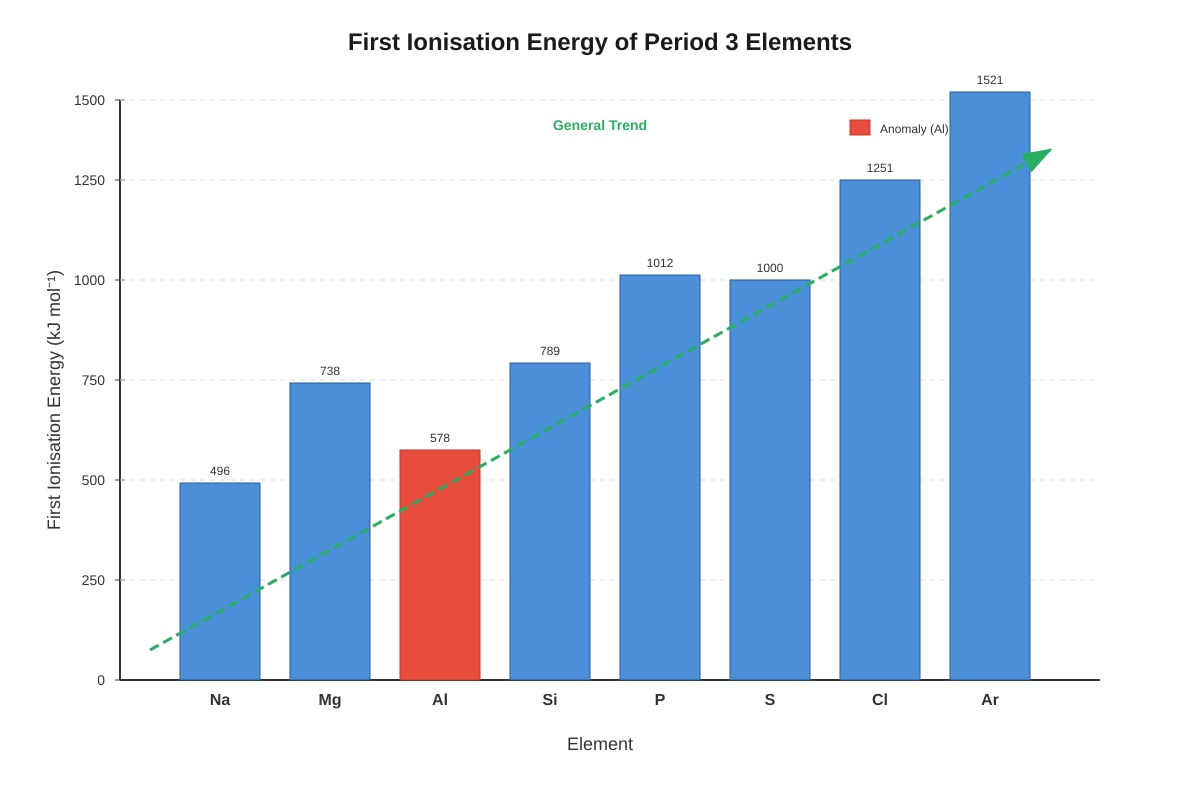
9. First ionisation energies of Period 3 [6 marks total]
(a) Explain the general trend in first ionisation energy across Period 3. [2]
Answer: The first ionisation energy generally increases across Period 3. ✓ This is because the nuclear charge increases (more protons), while the shielding effect remains approximately constant (electrons added to the same principal quantum shell). The increased effective nuclear charge attracts the outer electrons more strongly, requiring more energy to remove them. ✓
Marking notes:
- Must mention increasing nuclear charge [1 mark]
- Must mention constant shielding / same shell [1 mark]
(b) Explain why the first ionisation energy of aluminium is lower than that of magnesium, despite the general trend. [2]
Answer: Aluminium has its outer electron in a 3p orbital, while magnesium's outer electron is in a 3s orbital. ✓ The 3p orbital is slightly higher in energy and further from the nucleus than the 3s orbital. Additionally, the 3p electron is shielded by the 3s electrons. Therefore, less energy is required to remove the 3p electron from Al. ✓
Marking notes:
- Must mention 3p vs 3s orbital difference [1 mark]
- Must mention energy/shielding effect [1 mark]
(c) Explain why the first ionisation energy of sulfur is lower than that of phosphorus. [2]
Answer: In phosphorus, the three 3p electrons occupy separate p orbitals (Hund's rule). In sulfur, one of the 3p orbitals contains a pair of electrons. ✓ The paired electrons experience inter-electron repulsion, making it easier to remove one of them. Therefore, sulfur has a lower first ionisation energy than phosphorus. ✓
Marking notes:
- Must mention electron pairing in sulfur's 3p orbital [1 mark]
- Must mention inter-electron repulsion [1 mark]
10. Magnesium oxide and silicon dioxide [6 marks total]
(a) State the type of structure and bonding present in magnesium oxide. [2]
Answer: Giant ionic lattice structure ✓ with ionic bonding between Mg²⁺ and O²⁻ ions. ✓
Marking notes:
- "Giant ionic" or "ionic lattice" [1 mark]
- Ionic bonding [1 mark]
(b) State the type of structure and bonding present in silicon dioxide. [2]
Answer: Giant covalent network structure (or giant molecular structure) ✓ with covalent bonds between silicon and oxygen atoms. ✓
Marking notes:
- "Giant covalent" or "network covalent" [1 mark]
- Covalent bonding [1 mark]
(c) Explain why both compounds have high melting points, and suggest why MgO has a higher melting point than SiO₂. [2]
Answer: Both have strong bonds throughout their giant structures (ionic bonds in MgO, covalent bonds in SiO₂), requiring a large amount of energy to break. ✓ MgO has a higher melting point because the ionic bonds between Mg²⁺ and O²⁻ ions are stronger than the covalent bonds in SiO₂, due to the higher charge density and stronger electrostatic attraction between the doubly charged ions. ✓
Marking notes:
- Must mention strong bonds in giant structures [1 mark]
- Must explain why MgO bonds are stronger (higher charge / stronger electrostatic attraction) [1 mark]
11. Isotope abundance calculation [2 marks]
Answer: Let abundance of (^{35}\text{Cl}) = x%, abundance of (^{37}\text{Cl}) = (100 − x)%.
Relative atomic mass = (35 × x + 37 × (100 − x)) / 100 = 35.5 ✓
35x + 3700 − 37x = 3550
−2x = −150
x = 75%
Abundance of (^{35}\text{Cl}) = 75%, (^{37}\text{Cl}) = 25%. ✓
Marking notes:
- Correct setup of equation [1 mark]
- Correct answer for both isotopes [1 mark]
12. Lewis structure and shape of CO₃²⁻ [2 marks]
Answer: Lewis structure: Carbon central atom with one double bond to one O and single bonds to two O⁻ atoms, with resonance. ✓
Shape: Trigonal planar ✓
Marking notes:
- Correct Lewis structure (with resonance or delocalised electrons) [1 mark]
- Correct shape [1 mark]
13. Bond angle comparison: H₂O vs NH₃ [2 marks]
Answer: Both have 4 electron pairs around the central atom (tetrahedral electron-pair geometry). NH₃ has 3 bonding pairs and 1 lone pair, while H₂O has 2 bonding pairs and 2 lone pairs. ✓ Lone pairs exert greater repulsion than bonding pairs. The two lone pairs in H₂O compress the bond angle more (104.5°) than the single lone pair in NH₃ (107°). ✓
Marking notes:
- Must mention number of lone pairs in each molecule [1 mark]
- Must explain greater repulsion from more lone pairs [1 mark]
14. Atomic radius trend across Period 3 [2 marks]
Answer: Atomic radius decreases from sodium to chlorine. ✓ This is because the nuclear charge increases (more protons), while the shielding effect remains approximately constant (electrons added to the same principal quantum shell). The increased effective nuclear charge pulls the outer electrons closer to the nucleus. ✓
Marking notes:
- Correct trend stated [1 mark]
- Explanation with nuclear charge and shielding [1 mark]
15. Bonding and conductivity of sodium chloride [2 marks]
Answer: Sodium chloride has giant ionic lattice structure with ionic bonding between Na⁺ and Cl⁻ ions. ✓ In the solid state, ions are held in fixed positions and cannot move, so it does not conduct electricity. When molten, the ions are free to move and carry charge, so it conducts electricity. ✓
Marking notes:
- Correct bonding description [1 mark]
- Explanation of conductivity in terms of mobile ions [1 mark]
Section D: Extended Application (10 marks)
16. Diamond and graphite [6 marks total]
(a) Describe the structure and bonding in diamond. [2]
Answer: Diamond has a giant covalent network structure. ✓ Each carbon atom is covalently bonded to four other carbon atoms in a tetrahedral arrangement, forming a rigid three-dimensional lattice. ✓
Marking notes:
- Giant covalent structure [1 mark]
- Tetrahedral arrangement with 4 bonds per carbon [1 mark]
(b) Describe the structure and bonding in graphite. [2]
Answer: Graphite has a giant covalent layered structure. ✓ Each carbon atom is covalently bonded to three other carbon atoms in hexagonal rings within layers. The layers are held together by weak van der Waals forces. ✓
Marking notes:
- Layered structure with hexagonal rings [1 mark]
- Weak forces between layers [1 mark]
(c) Explain why graphite conducts electricity but diamond does not. [2]
Answer: In graphite, each carbon atom uses only three of its four valence electrons for covalent bonding, leaving one delocalised electron per carbon atom. ✓ These delocalised electrons are free to move along the layers, allowing electrical conductivity. In diamond, all four valence electrons are used in covalent bonds, so there are no free electrons. ✓
Marking notes:
- Delocalised electrons in graphite [1 mark]
- No free electrons in diamond [1 mark]
17. Resonance in nitrate ion [4 marks total]
(a) Draw all possible resonance structures for the nitrate ion. [2]
Answer: Three resonance structures, each with one N=O double bond and two N−O⁻ single bonds, with the double bond rotating among the three oxygen atoms. ✓✓
Marking notes:
- Three correct structures shown [2 marks]
- Award 1 mark for two correct structures
(b) Explain what is meant by the term resonance and how it accounts for the actual structure of the nitrate ion. [2]
Answer: Resonance occurs when two or more valid Lewis structures can be drawn for a molecule or ion, differing only in the distribution of electrons. ✓ The actual structure is a hybrid of the resonance structures, with delocalised electrons. In the nitrate ion, all N−O bonds are equivalent, with bond lengths and strengths intermediate between single and double bonds. ✓
Marking notes:
- Definition of resonance [1 mark]
- Explanation of equivalent bonds in nitrate [1 mark]
18. Electronegativity and polarity [4 marks total]
(a) State the most polar bond from the following pairs: C−H, N−H, O−H, F−H. Explain your choice. [2]
Answer: F−H is the most polar bond. ✓ This is because fluorine has the highest electronegativity (4.0) and hydrogen has an electronegativity of 2.1, giving the largest electronegativity difference (1.9). ✓
Marking notes:
- Correct bond identified [1 mark]
- Explanation using electronegativity difference [1 mark]
(b) Explain why CO₂ is a non-polar molecule despite having polar bonds. [2]
Answer: CO₂ is a linear molecule with two polar C=O bonds. ✓ The bond dipoles are equal in magnitude and point in opposite directions, so they cancel each other out. The overall molecule has no net dipole moment. ✓
Marking notes:
- Linear shape and polar bonds [1 mark]
- Dipole cancellation [1 mark]
19. Second ionisation energy of sodium [2 marks]
Answer: The first ionisation energy of sodium involves removing an electron from the 3s orbital (outermost shell). The second ionisation energy involves removing an electron from the 2p orbital, which is in an inner principal quantum shell (n=2). ✓ This electron is closer to the nucleus, experiences a much greater effective nuclear charge, and is not shielded by inner electrons. Therefore, much more energy is required. ✓
Marking notes:
- Must mention removal from inner shell [1 mark]
- Must mention greater effective nuclear charge / less shielding [1 mark]
20. Aluminium chloride dimer [3 marks total]
(a) Draw the structure of the Al₂Cl₆ dimer, showing the bonding clearly. [2]
Answer: Structure showing two Al atoms bridged by two Cl atoms, with each Al also bonded to two terminal Cl atoms. ✓ The bridging Cl atoms each form two covalent bonds (one normal, one dative/coordinate) to the Al atoms. ✓
Marking notes:
- Correct structure with bridging and terminal Cl atoms [1 mark]
- Correct bonding shown (including dative bonds) [1 mark]
(b) Name the type of bond that holds the two AlCl₃ units together in the dimer. [1]
Answer: Coordinate covalent bond / dative covalent bond ✓
Marking notes:
- Must name "coordinate" or "dative" covalent bond [1 mark]
END OF ANSWER KEY