From Real Exams Quiz

A Level H1 Chemistry Acids Bases Salts Quiz

Free Exam-Derived Owl Alpha A Level H1 Chemistry Acids Bases Salts quiz with questions and answers for Singapore students. This page is rendered as a direct URL so the questions and answers can be discovered without pressing in-page buttons.

These static practice materials are generated from the site's syllabus and paper-generation workflow, with source and model context shown so students and parents can evaluate the material before use.

A Level H1 Chemistry From Real Exams Generated by Owl Alpha Updated 2026-06-07

Questions

<!-- TuitionGoWhere generation metadata: stage=3-0; model=openrouter/owl-alpha; model_label=Owl Alpha; generated=2026-06-06; Sources: Stage 2-1 real exam-derived templates and Stage 2-2 exam-enriched syllabus. -->

A-Level Chemistry H1 Quiz - Acids Bases Salts

Name: _______________________ Class: _______________________

Date: _______________________ Score: ________ / 50

Duration: 60 minutes

Instructions:

  • Answer all questions in the spaces provided.
  • Show all working for calculation questions. Answers without working may not receive full marks.
  • Use appropriate units and significant figures where applicable.
  • A Periodic Table and data booklet are provided separately.

Section A: Multiple Choice (Questions 1–5)

Choose the most appropriate answer for each question. Each question carries 1 mark.


1. Which of the following best defines a Brønsted–Lowry acid?

A. A substance that donates a proton (H+H^+)
B. A substance that accepts a proton (H+H^+)
C. A substance that produces H+H^+ ions in aqueous solution
D. A substance with a pH greater than 7


2. The pH of a 0.05 mol dm30.05 \text{ mol dm}^{-3} solution of a strong monoprotic acid is closest to:

A. 0.3
B. 1.0
C. 1.3
D. 2.0


3. Which of the following salts will produce a solution with pH > 7 when dissolved in water?

A. Ammonium chloride, NH4ClNH_4Cl
B. Sodium chloride, NaClNaCl
C. Sodium ethanoate, CH3COONaCH_3COONa
D. Potassium nitrate, KNO3KNO_3


4. A buffer solution is prepared by mixing 25 cm325 \text{ cm}^3 of 0.10 mol dm30.10 \text{ mol dm}^{-3} CH3COOHCH_3COOH with 25 cm325 \text{ cm}^3 of 0.10 mol dm30.10 \text{ mol dm}^{-3} CH3COONaCH_3COONa. Which statement about this buffer is correct?

A. The pH of the buffer is exactly 7.
B. The buffer resists pH change only when acid is added.
C. The buffer contains a weak acid and its conjugate base.
D. Adding a small amount of NaOHNaOH will not change the pH at all.


5. The ionic product of water, KwK_w, at 25C25^\circ\text{C} is 1.0×10¹⁴ mol2 dm61.0 \times 10^{-14} \text{ mol}^2 \text{ dm}^{-6}. What is the pH of pure water at 50C50^\circ\text{C} if Kw=5.5×10¹⁴ mol2 dm6K_w = 5.5 \times 10^{-14} \text{ mol}^2 \text{ dm}^{-6} at this temperature?

A. 6.63
B. 7.00
C. 7.37
D. 13.26


Section B: Structured Questions (Questions 6–15)

Answer all questions. Show all working where applicable.


6. Define the following terms:

(a) A weak acid. [2]


(b) A buffer solution. [2]


7. Ethanoic acid (CH3COOHCH_3COOH) is a weak acid with Ka=1.74×10⁵ mol dm3K_a = 1.74 \times 10^{-5} \text{ mol dm}^{-3} at 25C25^\circ\text{C}.

(a) Write an expression for the acid dissociation constant, KaK_a, of ethanoic acid. [1]


(b) Calculate the pH of a 0.20 mol dm30.20 \text{ mol dm}^{-3} solution of ethanoic acid at 25C25^\circ\text{C}. Give your answer to 2 decimal places. [3]


8. A student titrates 25.0 cm325.0 \text{ cm}^3 of 0.100 mol dm30.100 \text{ mol dm}^{-3} hydrochloric acid with 0.100 mol dm30.100 \text{ mol dm}^{-3} sodium hydroxide.

(a) Write the balanced equation for the reaction. [1]


(b) Calculate the volume of sodium hydroxide required to reach the equivalence point. [2]


(c) State the pH at the equivalence point and explain your answer. [2]


9. A buffer solution is made by mixing 50.0 cm350.0 \text{ cm}^3 of 0.200 mol dm30.200 \text{ mol dm}^{-3} ethanoic acid with 50.0 cm350.0 \text{ cm}^3 of 0.100 mol dm30.100 \text{ mol dm}^{-3} sodium ethanoate.

(a) Calculate the concentration of ethanoic acid and sodium ethanoate in the buffer after mixing. [2]


(b) Using your answer in (a), calculate the pH of this buffer. (KaK_a of ethanoic acid =1.74×10⁵ mol dm3= 1.74 \times 10^{-5} \text{ mol dm}^{-3}) [3]


10. Explain why the pH of a buffer solution remains approximately constant when a small amount of dilute hydrochloric acid is added. Your answer should refer to the equilibrium involved. [3]


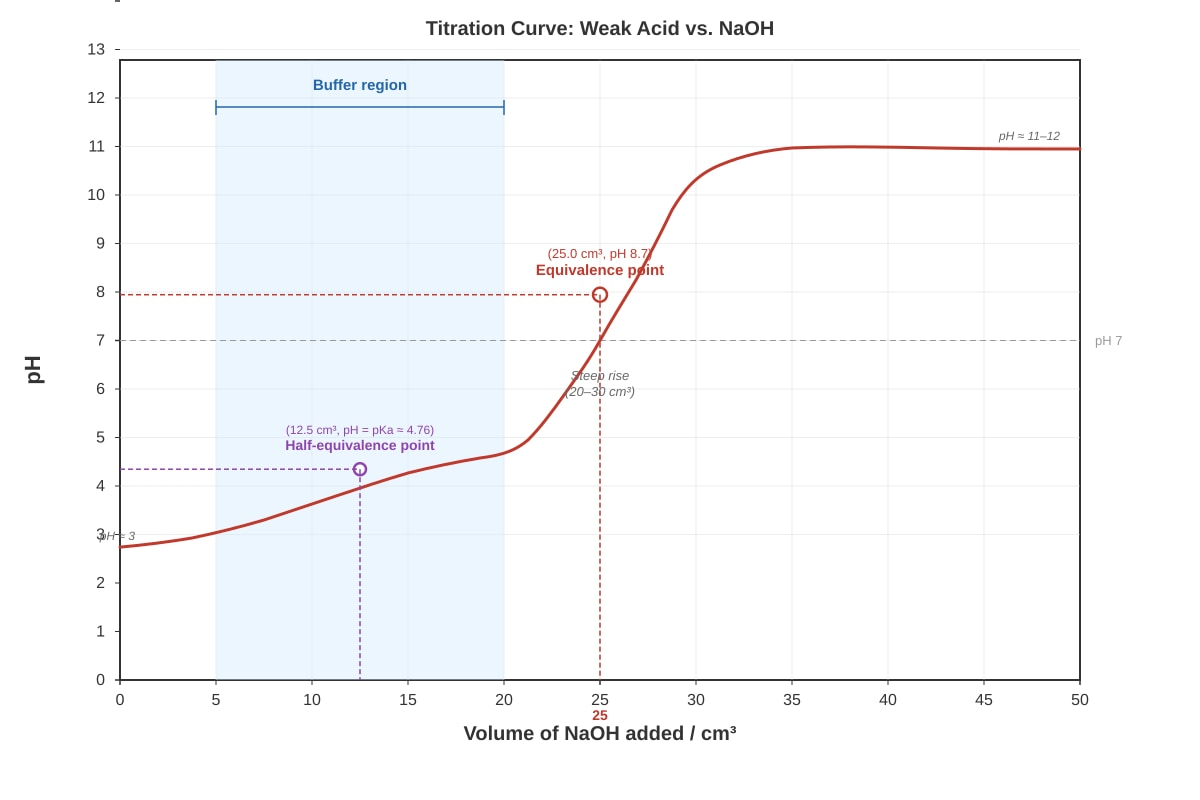
11. The titration curve below shows the pH change when 25.0 cm325.0 \text{ cm}^3 of a weak acid is titrated with 0.100 mol dm30.100 \text{ mol dm}^{-3} sodium hydroxide.

<image_placeholder> id: Q11-fig1 type: graph linked_question: Q11 description: Titration curve showing pH (y-axis, 0–14) against volume of NaOH added in cm³ (x-axis, 0–50). Curve starts at pH ~3, rises gradually, then has a steep vertical rise between 20–30 cm³, passing through pH 7 at ~25 cm³ (equivalence point), then levels off around pH 11–12. The buffer region (flat portion before the steep rise) is visible between ~5–20 cm³. The half-equivalence point (where pH = pKa) is marked at ~12.5 cm³, pH ~4.76. labels: y-axis: "pH", x-axis: "Volume of NaOH added / cm³", equivalence point at 25 cm³, half-equivalence point at 12.5 cm³, buffer region shaded between 5–20 cm³ values: initial pH ≈ 3, equivalence point at 25 cm³ NaOH, pH at equivalence ≈ 8.7, half-equivalence pH ≈ 4.76, steep rise from 20–30 cm³ must_show: y-axis labelled "pH" with scale 0–14, x-axis labelled "Volume of NaOH added / cm³" with scale 0–50, equivalence point clearly marked at 25 cm³, buffer region visible as a relatively flat portion before the steep rise, curve starting at low pH (~3) and ending at high pH (~11–12) </image_placeholder>

(a) From the curve, estimate the pH at the equivalence point. [1]


(b) Explain why the pH at the equivalence point is greater than 7. [2]


(c) State the volume of sodium hydroxide at which the half-equivalence point occurs. What is the significance of this point? [2]


12. A solution of ammonia (NH3NH_3) has a concentration of 0.10 mol dm30.10 \text{ mol dm}^{-3}. The KbK_b of ammonia is 1.8×10⁵ mol dm31.8 \times 10^{-5} \text{ mol dm}^{-3}.

(a) Write an expression for the base dissociation constant, KbK_b, of ammonia. [1]


(b) Calculate the pH of this ammonia solution. Give your answer to 2 decimal places. [4]


13. Describe an experiment to determine the concentration of a solution of hydrochloric acid using a standard solution of sodium hydroxide. Include the apparatus, procedure, and how you would identify the end point. [4]


14. Sodium carbonate (Na2CO3Na_2CO_3) is a salt that dissolves in water to form a basic solution.

(a) Write the equation for the hydrolysis of the carbonate ion (CO32CO_3^{2-}) in water. [1]


(b) Explain why the solution is basic, with reference to the relative strengths of the acid and base involved. [2]


15. A solution contains a mixture of 0.10 mol dm30.10 \text{ mol dm}^{-3} HClHCl and 0.10 mol dm30.10 \text{ mol dm}^{-3} CH3COOHCH_3COOH (Ka=1.74×10⁵ mol dm3K_a = 1.74 \times 10^{-5} \text{ mol dm}^{-3}).

(a) Explain why the pH of this mixture is determined almost entirely by the HClHCl and not by the ethanoic acid. [2]


(b) Calculate the pH of this mixture. [2]


Section C: Application & Data Interpretation (Questions 16–20)

Answer all questions. Show all working where applicable.


16. A student investigates the effectiveness of two buffer solutions. Buffer A contains 0.10 mol dm30.10 \text{ mol dm}^{-3} CH3COOHCH_3COOH and 0.10 mol dm30.10 \text{ mol dm}^{-3} CH3COONaCH_3COONa. Buffer B contains 0.20 mol dm30.20 \text{ mol dm}^{-3} CH3COOHCH_3COOH and 0.20 mol dm30.20 \text{ mol dm}^{-3} CH3COONaCH_3COONa.

The student adds 5.0 cm35.0 \text{ cm}^3 of 0.10 mol dm30.10 \text{ mol dm}^{-3} HClHCl to 100 cm3100 \text{ cm}^3 of each buffer and measures the pH change.

(a) Without calculation, predict which buffer (A or B) will show the smaller pH change. Explain your reasoning. [2]


(b) Calculate the pH of Buffer A before and after the addition of HClHCl. (Ka=1.74×10⁵ mol dm3K_a = 1.74 \times 10^{-5} \text{ mol dm}^{-3}) [5]


17. The table below shows the KaK_a values of three weak acids at 25C25^\circ\text{C}.

AcidFormulaKaK_a / mol dm3\text{mol dm}^{-3}
Methanoic acidHCOOHHCOOH1.6×1041.6 \times 10^{-4}
Ethanoic acidCH3COOHCH_3COOH1.74×1051.74 \times 10^{-5}
Carbonic acidH2CO3H_2CO_34.3×1074.3 \times 10^{-7}

(a) Arrange the three acids in order of decreasing acid strength. [1]


(b) Calculate the pH of a 0.050 mol dm30.050 \text{ mol dm}^{-3} solution of methanoic acid. Give your answer to 2 decimal places. [3]


(c) Explain the relationship between KaK_a value and acid strength. [1]


18. A solution of sodium hydroxide has a pH of 13.0 at 25C25^\circ\text{C}.

(a) Calculate the concentration of OHOH^- ions in this solution. [2]


(b) This NaOHNaOH solution is used to titrate 25.0 cm325.0 \text{ cm}^3 of a solution of sulfuric acid (H2SO4H_2SO_4). The volume of NaOHNaOH required to reach the equivalence point is 35.0 cm335.0 \text{ cm}^3. Calculate the concentration of the sulfuric acid. [4]


19. A student prepares a buffer by dissolving 8.20 g8.20 \text{ g} of sodium ethanoate (CH3COONaCH_3COONa, Mr=82.0M_r = 82.0) in 250 cm3250 \text{ cm}^3 of 0.100 mol dm30.100 \text{ mol dm}^{-3} ethanoic acid.

(a) Calculate the number of moles of sodium ethanoate dissolved. [1]


(b) Calculate the pH of the resulting buffer solution. (Ka=1.74×10⁵ mol dm3K_a = 1.74 \times 10^{-5} \text{ mol dm}^{-3}) [3]


20. The indicator methyl orange has a pKInpK_{In} of 3.7. It is red in acidic solution and yellow in alkaline solution.

(a) Explain why methyl orange is not suitable for the titration of a weak acid with a strong base. [2]


(b) Suggest a more suitable indicator for this titration and explain your choice. [2]


End of Quiz

Total Marks: 50

Answers

<!-- TuitionGoWhere generation metadata: stage=3-0; model=openrouter/owl-alpha; model_label=Owl Alpha; generated=2026-06-06; Sources: Stage 2-1 real exam-derived templates and Stage 2-2 exam-enriched syllabus. -->

A-Level Chemistry H1 Quiz - Acids Bases Salts

Answer Key & Teaching Notes


Section A: Multiple Choice

1. Answer: A

Explanation: A Brønsted–Lowry acid is defined as a proton (H+H^+) donor. Option C describes an Arrhenius acid, which is a related but narrower definition. Option B describes a Brønsted–Lowry base, and Option D describes an alkaline substance. At A-Level, the Brønsted–Lowry definition is the one most commonly tested.

Common mistake: Students confuse Arrhenius and Brønsted–Lowry definitions. While all Brønsted–Lowry acids produce H+H^+ in water, the defining feature is proton donation, not merely producing H+H^+ ions.


2. Answer: C

Explanation: For a strong monoprotic acid, [H+]=0.05 mol dm3[H^+] = 0.05 \text{ mol dm}^{-3} (complete dissociation). Therefore:

pH=log10[H+]=log10(0.05)=log10(5×10²)=2log105=20.70=1.30\text{pH} = -\log_{10}[H^+] = -\log_{10}(0.05) = -\log_{10}(5 \times 10^{-2}) = 2 - \log_{10}5 = 2 - 0.70 = 1.30

Common mistake: Students may incorrectly calculate log10(0.05)\log_{10}(0.05) as 0.3 (confusing log10\log_{10} with ln\ln), or forget that strong acids fully dissociate so [H+][H^+] equals the acid concentration.


3. Answer: C

Explanation: Sodium ethanoate is the salt of a weak acid (ethanoic acid) and a strong base (sodium hydroxide). The ethanoate ion (CH3COOCH_3COO^-) undergoes hydrolysis in water:

CH3COO+H2OCH3COOH+OHCH_3COO^- + H_2O \rightleftharpoons CH_3COOH + OH^-

This produces OHOH^- ions, making the solution basic (pH > 7).

  • NH4ClNH_4Cl: salt of weak base + strong acid → acidic (pH < 7)
  • NaClNaCl: salt of strong acid + strong base → neutral (pH = 7)
  • KNO3KNO_3: salt of strong acid + strong base → neutral (pH = 7)

Teaching note: The rule is: "the stronger wins." If the parent acid is weaker than the parent base is strong, the solution is basic, and vice versa.


4. Answer: C

Explanation: A buffer solution consists of a weak acid and its conjugate base (or a weak base and its conjugate acid). Here, CH3COOHCH_3COOH is the weak acid and CH3COOCH_3COO^- (from CH3COONaCH_3COONa) is the conjugate base.

  • A is incorrect: the pH of an ethanoate buffer is approximately 4.76 (equal to pKapK_a), not 7.
  • B is incorrect: buffers resist pH change when either acid OR base is added.
  • D is incorrect: the pH changes slightly but not dramatically. The buffer minimises the change; it does not eliminate it entirely.

5. Answer: A

Explanation: In pure water, [H+]=[OH][H^+] = [OH^-], so:

Kw=[H+][OH]=[H+]2K_w = [H^+][OH^-] = [H^+]^2

[H+]=Kw=5.5×1014=2.345×10⁷ mol dm3[H^+] = \sqrt{K_w} = \sqrt{5.5 \times 10^{-14}} = 2.345 \times 10^{-7} \text{ mol dm}^{-3}

pH=log10(2.345×10⁷)=7log10(2.345)=70.37=6.63\text{pH} = -\log_{10}(2.345 \times 10^{-7}) = 7 - \log_{10}(2.345) = 7 - 0.37 = 6.63

Teaching note: Pure water is always neutral ([H+]=[OH][H^+] = [OH^-]), but the pH is only 7.00 at 25C25^\circ\text{C} where Kw=1.0×10¹⁴K_w = 1.0 \times 10^{-14}. At higher temperatures, KwK_w increases, so pH of pure water decreases below 7 — but it is still neutral.

Common mistake: Students think pH 7 always means neutral. Neutrality means [H+]=[OH][H^+] = [OH^-], which depends on temperature through KwK_w.


Section B: Structured Questions

6. (a) [2 marks]

A weak acid is an acid that partially dissociates (ionises) in aqueous solution, establishing an equilibrium between the undissociated acid and its ions.

Mark allocation:

  • 1 mark for "partially dissociates" or "partially ionises"
  • 1 mark for reference to equilibrium / not fully dissociated

Common mistake: Writing "dilute acid" instead of "weak acid." Dilute refers to concentration; weak refers to the degree of dissociation. A concentrated weak acid is still weak.

(b) [2 marks]

A buffer solution is a solution that resists changes in pH when small amounts of acid or base are added (or when it is diluted). It typically contains a weak acid and its conjugate base (or a weak base and its conjugate acid).

Mark allocation:

  • 1 mark for "resists pH change" / "minimises pH change"
  • 1 mark for "on addition of small amounts of acid or base" AND reference to weak acid-conjugate base (or weak base-conjugate acid)

7. (a) [1 mark]

Ka=[CH3COO][H+][CH3COOH]K_a = \frac{[CH_3COO^-][H^+]}{[CH_3COOH]}

Note: Water is omitted from the expression because it is the solvent and its concentration is essentially constant.

(b) [3 marks]

For a weak acid, assuming xx is small compared to initial concentration:

Ka=[H+]2[CH3COOH]initialK_a = \frac{[H^+]^2}{[CH_3COOH]_{\text{initial}}}

[H+]2=Ka×[CH3COOH]=1.74×105×0.20=3.48×10⁶[H^+]^2 = K_a \times [CH_3COOH] = 1.74 \times 10^{-5} \times 0.20 = 3.48 \times 10^{-6}

[H+]=3.48×106=1.865×10³ mol dm3[H^+] = \sqrt{3.48 \times 10^{-6}} = 1.865 \times 10^{-3} \text{ mol dm}^{-3}

pH=log10(1.865×10³)=2.73\text{pH} = -\log_{10}(1.865 \times 10^{-3}) = 2.73

Mark allocation:

  • 1 mark for correct KaK_a expression or substitution
  • 1 mark for correct [H+][H^+] calculation
  • 1 mark for correct pH to 2 d.p.

Common mistake: Forgetting to take the square root, or using [H+]=Ka×[HA][H^+] = K_a \times [HA] instead of [H+]=Ka×[HA][H^+] = \sqrt{K_a \times [HA]}. The approximation [H+]=KaC[H^+] = \sqrt{K_a \cdot C} is valid when the degree of dissociation is small (< 5%).


8. (a) [1 mark]

HCl+NaOHNaCl+H2OHCl + NaOH \rightarrow NaCl + H_2O

or in ionic form: H++OHH2OH^+ + OH^- \rightarrow H_2O

(b) [2 marks]

n(HCl)=0.100×25.01000=2.50×10³ moln(HCl) = 0.100 \times \frac{25.0}{1000} = 2.50 \times 10^{-3} \text{ mol}

Since the mole ratio is 1:1:

n(NaOH)=2.50×10³ moln(NaOH) = 2.50 \times 10^{-3} \text{ mol}

V(NaOH)=2.50×1030.100=2.50×10² dm3=25.0 cm3V(NaOH) = \frac{2.50 \times 10^{-3}}{0.100} = 2.50 \times 10^{-2} \text{ dm}^3 = 25.0 \text{ cm}^3

Mark allocation:

  • 1 mark for moles of HCl calculated correctly
  • 1 mark for correct volume of NaOH

(c) [2 marks]

The pH at the equivalence point is 7.

Explanation: HClHCl is a strong acid and NaOHNaOH is a strong base. The salt formed (NaClNaCl) is derived from a strong acid and strong base, so it does not hydrolyse. The solution is neutral at pH 7.

Mark allocation:

  • 1 mark for stating pH = 7
  • 1 mark for correct explanation (strong acid + strong base → neutral salt)

9. (a) [2 marks]

Total volume after mixing =50.0+50.0=100.0 cm3= 50.0 + 50.0 = 100.0 \text{ cm}^3

[CH3COOH]=0.200×50.0100.0=0.100 mol dm3[CH_3COOH] = \frac{0.200 \times 50.0}{100.0} = 0.100 \text{ mol dm}^{-3}

[CH3COONa]=0.100×50.0100.0=0.050 mol dm3[CH_3COONa] = \frac{0.100 \times 50.0}{100.0} = 0.050 \text{ mol dm}^{-3}

Mark allocation:

  • 1 mark for each correct concentration

(b) [3 marks]

Using the Henderson–Hasselbalch equation:

pH=pKa+log10[salt][acid]\text{pH} = pK_a + \log_{10}\frac{[\text{salt}]}{[\text{acid}]}

pKa=log10(1.74×10⁵)=4.76pK_a = -\log_{10}(1.74 \times 10^{-5}) = 4.76

pH=4.76+log10(0.0500.100)=4.76+log10(0.50)=4.760.30=4.46\text{pH} = 4.76 + \log_{10}\left(\frac{0.050}{0.100}\right) = 4.76 + \log_{10}(0.50) = 4.76 - 0.30 = 4.46

Alternative method using KaK_a expression:

Ka=[CH3COO][H+][CH3COOH]K_a = \frac{[CH_3COO^-][H^+]}{[CH_3COOH]}

1.74×105=0.050×[H+]0.1001.74 \times 10^{-5} = \frac{0.050 \times [H^+]}{0.100}

[H+]=1.74×105×0.1000.050=3.48×10⁵ mol dm3[H^+] = \frac{1.74 \times 10^{-5} \times 0.100}{0.050} = 3.48 \times 10^{-5} \text{ mol dm}^{-3}

pH=log10(3.48×10⁵)=4.46\text{pH} = -\log_{10}(3.48 \times 10^{-5}) = 4.46

Mark allocation:

  • 1 mark for correct pKapK_a or KaK_a expression
  • 1 mark for correct substitution
  • 1 mark for correct final pH

10. [3 marks]

When a small amount of HClHCl is added to a buffer containing CH3COOHCH_3COOH and CH3COOCH_3COO^-:

The added H+H^+ ions react with the conjugate base (CH3COOCH_3COO^-):

CH3COO+H+CH3COOHCH_3COO^- + H^+ \rightarrow CH_3COOH

This shifts the equilibrium CH3COOHCH3COO+H+CH_3COOH \rightleftharpoons CH_3COO^- + H^+ to the left (Le Chatelier's principle). The added H+H^+ is consumed by the CH3COOCH_3COO^- ions, converting them into CH3COOHCH_3COOH. Since the ratio [CH3COO][CH3COOH]\frac{[CH_3COO^-]}{[CH_3COOH]} changes only slightly, the pH remains approximately constant.

Mark allocation:

  • 1 mark for stating that added H+H^+ reacts with the conjugate base (CH3COOCH_3COO^-)
  • 1 mark for reference to equilibrium shifting left / Le Chatelier's principle
  • 1 mark for explaining that the ratio changes minimally, so pH is approximately constant

11. (a) [1 mark]

From the titration curve, the pH at the equivalence point is approximately 8.7 (accept 8.5–9.0).

(b) [2 marks]

The pH at the equivalence point is greater than 7 because the salt formed is the salt of a weak acid and a strong base (e.g., sodium ethanoate). The conjugate base of the weak acid undergoes hydrolysis:

CH3COO+H2OCH3COOH+OHCH_3COO^- + H_2O \rightleftharpoons CH_3COOH + OH^-

This produces OHOH^- ions, making the solution slightly alkaline.

Mark allocation:

  • 1 mark for identifying the salt as being from a weak acid + strong base
  • 1 mark for explaining hydrolysis producing OHOH^- ions

(c) [2 marks]

The half-equivalence point occurs at 12.5 cm³ (half the volume at the equivalence point).

Significance: At the half-equivalence point, exactly half the weak acid has been neutralised, so [acid]=[conjugate base][\text{acid}] = [\text{conjugate base}]. From the Henderson–Hasselbalch equation:

pH=pKa+log10(1)=pKa\text{pH} = pK_a + \log_{10}(1) = pK_a

Therefore, pH = pKapK_a at this point, allowing the KaK_a of the weak acid to be determined directly from the titration curve.

Mark allocation:

  • 1 mark for correct volume (12.5 cm³)
  • 1 mark for stating that pH = pKapK_a at this point

12. (a) [1 mark]

Kb=[NH4+][OH][NH3]K_b = \frac{[NH_4^+][OH^-]}{[NH_3]}

(b) [4 marks]

Kb=[OH]2[NH3]initialK_b = \frac{[OH^-]^2}{[NH_3]_{\text{initial}}}

[OH]2=Kb×[NH3]=1.8×105×0.10=1.8×10⁶[OH^-]^2 = K_b \times [NH_3] = 1.8 \times 10^{-5} \times 0.10 = 1.8 \times 10^{-6}

[OH]=1.8×106=1.342×10³ mol dm3[OH^-] = \sqrt{1.8 \times 10^{-6}} = 1.342 \times 10^{-3} \text{ mol dm}^{-3}

pOH=log10(1.342×10³)=2.87\text{pOH} = -\log_{10}(1.342 \times 10^{-3}) = 2.87

pH=14.002.87=11.13\text{pH} = 14.00 - 2.87 = 11.13

Alternative (direct pH calculation):

[H+]=Kw[OH]=1.0×10141.342×103=7.45×10¹²[H^+] = \frac{K_w}{[OH^-]} = \frac{1.0 \times 10^{-14}}{1.342 \times 10^{-3}} = 7.45 \times 10^{-12}

pH=log10(7.45×10¹²)=11.13\text{pH} = -\log_{10}(7.45 \times 10^{-12}) = 11.13

Mark allocation:

  • 1 mark for correct KbK_b expression / substitution
  • 1 mark for correct [OH][OH^-]
  • 1 mark for correct pOH
  • 1 mark for correct final pH to 2 d.p.

13. [4 marks]

Apparatus: Burette, pipette (25.0 cm325.0 \text{ cm}^3), pipette filler, conical flask, white tile, standard NaOHNaOH solution, HClHCl solution of unknown concentration, indicator (e.g., phenolphthalein or methyl orange).

Procedure:

  1. Use a pipette to measure 25.0 cm325.0 \text{ cm}^3 of the HClHCl solution into a conical flask.
  2. Add a few drops of indicator.
  3. Fill the burette with the standard NaOHNaOH solution and record the initial reading.
  4. Add NaOHNaOH from the burette to the conical flask, swirling continuously.
  5. As the end point approaches, add NaOHNaOH dropwise until the indicator changes colour permanently (e.g., phenolphthalein turns from colourless to pale pink).
  6. Record the final burette reading and calculate the volume of NaOHNaOH used.
  7. Repeat the titration to obtain concordant results (within 0.10 cm30.10 \text{ cm}^3).

Calculation: Use n=cV1000n = \frac{cV}{1000} and the stoichiometric ratio to find the concentration of HClHCl.

Mark allocation:

  • 1 mark for correct apparatus (burette, pipette, conical flask, indicator)
  • 1 mark for correct procedure (pipetting acid, titrating with base)
  • 1 mark for identifying the end point via indicator colour change
  • 1 mark for mentioning repetition / concordant results

14. (a) [1 mark]

CO32+H2OHCO3+OHCO_3^{2-} + H_2O \rightleftharpoons HCO_3^- + OH^-

(b) [2 marks]

The carbonate ion (CO32CO_3^{2-}) is the conjugate base of the weak acid HCO3HCO_3^- (which is itself the conjugate base of the weak acid H2CO3H_2CO_3). Since CO32CO_3^{2-} is a relatively strong conjugate base (from a weak acid), it reacts with water (hydrolysis) to produce OHOH^- ions. The Na+Na^+ ion does not hydrolyse because it comes from the strong base NaOHNaOH. The net production of OHOH^- ions makes the solution basic.

Mark allocation:

  • 1 mark for identifying that CO32CO_3^{2-} is the conjugate base of a weak acid
  • 1 mark for explaining that hydrolysis produces OHOH^- ions, making the solution basic

15. (a) [2 marks]

HClHCl is a strong acid and dissociates completely, contributing 0.10 mol dm30.10 \text{ mol dm}^{-3} of H+H^+ ions. Ethanoic acid is a weak acid with Ka=1.74×10⁵K_a = 1.74 \times 10^{-5}, so it contributes only a very small amount of H+H^+ (approximately 1.74×105×0.101.3×103 mol dm3\sqrt{1.74 \times 10^{-5} \times 0.10} \approx 1.3 \times 10^{-3} \text{ mol dm}^{-3}). The H+H^+ from HClHCl is approximately 77 times greater than that from ethanoic acid. Additionally, the high [H+][H^+] from HClHCl suppresses the dissociation of ethanoic acid (common ion effect), making its contribution even smaller.

Mark allocation:

  • 1 mark for identifying HClHCl as strong (complete dissociation) and CH3COOHCH_3COOH as weak
  • 1 mark for explaining the common ion effect / that H+H^+ from HClHCl suppresses CH3COOHCH_3COOH dissociation

(b) [2 marks]

Since the contribution from ethanoic acid is negligible:

[H+]0.10 mol dm3 (from HCl)[H^+] \approx 0.10 \text{ mol dm}^{-3} \text{ (from HCl)}

pH=log10(0.10)=1.00\text{pH} = -\log_{10}(0.10) = 1.00

Mark allocation:

  • 1 mark for stating [H+]=0.10 mol dm3[H^+] = 0.10 \text{ mol dm}^{-3}
  • 1 mark for pH = 1.00

Section C: Application & Data Interpretation

16. (a) [2 marks]

Buffer B will show the smaller pH change.

Explanation: Buffer B has a higher total concentration of buffer components (0.20 mol dm30.20 \text{ mol dm}^{-3} each of acid and salt) compared to Buffer A (0.10 mol dm30.10 \text{ mol dm}^{-3} each). A buffer with higher concentrations of both components has a greater buffer capacity — it can neutralise more added acid or base before the pH changes significantly.

Mark allocation:

  • 1 mark for identifying Buffer B
  • 1 mark for explaining buffer capacity in terms of higher concentrations

(b) [5 marks]

Before addition of HCl:

[CH3COOH]=[CH3COONa]=0.10 mol dm3[CH_3COOH] = [CH_3COONa] = 0.10 \text{ mol dm}^{-3}

pH=pKa+log10(0.100.10)=4.76+log10(1)=4.76\text{pH} = pK_a + \log_{10}\left(\frac{0.10}{0.10}\right) = 4.76 + \log_{10}(1) = 4.76

After addition of HCl:

Moles of HCl added =0.10×5.01000=5.0×10⁴ mol= 0.10 \times \frac{5.0}{1000} = 5.0 \times 10^{-4} \text{ mol}

Initial moles in 100 cm3100 \text{ cm}^3:

  • n(CH3COOH)=0.10×1001000=0.010 moln(CH_3COOH) = 0.10 \times \frac{100}{1000} = 0.010 \text{ mol}
  • n(CH3COO)=0.10×1001000=0.010 moln(CH_3COO^-) = 0.10 \times \frac{100}{1000} = 0.010 \text{ mol}

The added H+H^+ reacts with CH3COOCH_3COO^-:

  • New n(CH3COO)=0.0105.0×104=0.0095 moln(CH_3COO^-) = 0.010 - 5.0 \times 10^{-4} = 0.0095 \text{ mol}
  • New n(CH3COOH)=0.010+5.0×104=0.0105 moln(CH_3COOH) = 0.010 + 5.0 \times 10^{-4} = 0.0105 \text{ mol}

Since total volume is the same for both species (approximately 105cm3105 \text{cm}^3, but the ratio is unchanged):

pH=4.76+log10(0.00950.0105)=4.76+log10(0.9048)=4.760.043=4.72\text{pH} = 4.76 + \log_{10}\left(\frac{0.0095}{0.0105}\right) = 4.76 + \log_{10}(0.9048) = 4.76 - 0.043 = 4.72

Change in pH =4.764.72=0.04= 4.76 - 4.72 = 0.04 (very small change, demonstrating buffer action)

Mark allocation:

  • 1 mark for correct initial pH
  • 1 mark for calculating moles of HCl added
  • 1 mark for correct new moles of acid and salt
  • 1 mark for correct final pH
  • 1 mark for correct calculation showing small pH change

17. (a) [1 mark]

Decreasing acid strength: Methanoic acid > Ethanoic acid > Carbonic acid

(or HCOOH>CH3COOH>H2CO3HCOOH > CH_3COOH > H_2CO_3)

(b) [3 marks]

[H+]2=Ka×[HCOOH]=1.6×104×0.050=8.0×10⁶[H^+]^2 = K_a \times [HCOOH] = 1.6 \times 10^{-4} \times 0.050 = 8.0 \times 10^{-6}

[H+]=8.0×106=2.828×10³ mol dm3[H^+] = \sqrt{8.0 \times 10^{-6}} = 2.828 \times 10^{-3} \text{ mol dm}^{-3}

pH=log10(2.828×10³)=2.55\text{pH} = -\log_{10}(2.828 \times 10^{-3}) = 2.55

Mark allocation:

  • 1 mark for correct substitution into KaK_a expression
  • 1 mark for correct [H+][H^+]
  • 1 mark for correct pH to 2 d.p.

(c) [1 mark]

The larger the KaK_a value, the greater the degree of dissociation of the acid in water, and hence the stronger the acid. KaK_a is a quantitative measure of acid strength: a higher KaK_a means the equilibrium lies further to the right (more dissociation), producing more H+H^+ ions.


18. (a) [2 marks]

pOH=14.0013.0=1.0\text{pOH} = 14.00 - 13.0 = 1.0

[OH]=10pOH=101.0=0.10 mol dm3[OH^-] = 10^{-\text{pOH}} = 10^{-1.0} = 0.10 \text{ mol dm}^{-3}

Mark allocation:

  • 1 mark for correct pOH
  • 1 mark for correct [OH][OH^-]

(b) [4 marks]

n(NaOH)=0.10×35.01000=3.50×10³ moln(NaOH) = 0.10 \times \frac{35.0}{1000} = 3.50 \times 10^{-3} \text{ mol}

The balanced equation is:

H2SO4+2NaOHNa2SO4+2H2OH_2SO_4 + 2NaOH \rightarrow Na_2SO_4 + 2H_2O

Mole ratio: n(H2SO4):n(NaOH)=1:2n(H_2SO_4) : n(NaOH) = 1 : 2

n(H2SO4)=3.50×1032=1.75×10³ moln(H_2SO_4) = \frac{3.50 \times 10^{-3}}{2} = 1.75 \times 10^{-3} \text{ mol}

[H2SO4]=1.75×10325.0/1000=1.75×1030.0250=0.070 mol dm3[H_2SO_4] = \frac{1.75 \times 10^{-3}}{25.0/1000} = \frac{1.75 \times 10^{-3}}{0.0250} = 0.070 \text{ mol dm}^{-3}

Mark allocation:

  • 1 mark for moles of NaOH
  • 1 mark for correct stoichiometric ratio (1:2)
  • 1 mark for moles of H2SO4H_2SO_4
  • 1 mark for correct concentration

19. (a) [1 mark]

n(CH3COONa)=8.2082.0=0.100 moln(CH_3COONa) = \frac{8.20}{82.0} = 0.100 \text{ mol}

(b) [3 marks]

[CH3COONa]=0.1000.250=0.400 mol dm3[CH_3COONa] = \frac{0.100}{0.250} = 0.400 \text{ mol dm}^{-3}

[CH3COOH]=0.100 mol dm3[CH_3COOH] = 0.100 \text{ mol dm}^{-3}

Using the Henderson–Hasselbalch equation:

pH=pKa+log10([salt][acid])=4.76+log10(0.4000.100)\text{pH} = pK_a + \log_{10}\left(\frac{[\text{salt}]}{[\text{acid}]}\right) = 4.76 + \log_{10}\left(\frac{0.400}{0.100}\right)

pH=4.76+log10(4.00)=4.76+0.60=5.36\text{pH} = 4.76 + \log_{10}(4.00) = 4.76 + 0.60 = 5.36

Mark allocation:

  • 1 mark for correct concentration of salt
  • 1 mark for correct substitution into Henderson–Hasselbalch equation
  • 1 mark for correct final pH

20. (a) [2 marks]

Methyl orange changes colour over the pH range approximately 3.1–4.4 (red to yellow). For a weak acid–strong base titration, the equivalence point occurs at a pH greater than 7 (typically pH 8–9) because the salt formed is basic. Methyl orange would change colour well before the equivalence point is reached, leading to a significant titration error (underestimation of the volume of base needed).

Mark allocation:

  • 1 mark for stating that the equivalence point pH > 7 for weak acid–strong base
  • 1 mark for explaining that methyl orange changes colour in acidic range, causing premature end point

(b) [2 marks]

Phenolphthalein is a more suitable indicator.

Explanation: Phenolphthalein changes colour over the pH range approximately 8.2–10.0 (colourless to pink). This range falls within the steep portion of the titration curve for a weak acid–strong base titration, which occurs around pH 7–10. The colour change therefore coincides with the equivalence point, giving an accurate result.

Mark allocation:

  • 1 mark for suggesting phenolphthalein
  • 1 mark for explaining that its pH range matches the equivalence point region

End of Answer Key

Total Marks: 50