AI Generated Exam Paper
A Level H1 Chemistry Practice Paper 5
Free A Level H1 Chemistry Practice Paper 5, LongCat AI version, with questions, answers, and A Level-style practice for Singapore students.
These static practice materials are generated from the site's syllabus and paper-generation workflow, with source and model context shown so students and parents can evaluate the material before use.
Questions
Free quiz and exam paper access
Enter your details to view this paper
Your access is remembered on this device.
Answers
TuitionGoWhere Practice Paper — Chemistry H1 A-Level
Answer Key & Marking Scheme
Paper: Practice Paper — Acids, Bases & Salts Total Marks: 60
Section A
Question 1 [2]
Answer: A strong acid is an acid that completely dissociates (or ionises) in aqueous solution.
Marking notes:
- Award [1] for "completely dissociates" or "fully ionises".
- Award [1] for specifying "in aqueous solution" / "in water".
- Do not accept "dissociates" alone (without "completely") — this could describe a weak acid too.
- Common mistake: Students confuse "strong" with "concentrated". Strength refers to the extent of dissociation, not concentration.
Question 2 [3]
(a) [1]
Answer:
Marking notes:
- Award [1] for correct ionic equation with state symbols.
- Accept but not full molecular equation.
- State symbols are required for full credit.
(b) [2]
Answer:
From the 1:1 stoichiometry:
Marking notes:
- [1] for correct moles of HCl ( mol).
- [1] for correct volume of NaOH ().
- Award full marks if answer is correct even if working is not shown.
- Common mistake: Forgetting to convert to (or vice versa).
Question 3 [3]
Answer: Sodium chloride is formed from a strong acid (HCl) and a strong base (NaOH). Neither the nor the ions hydrolyse (react with water), so the solution is neutral (pH = 7).
Sodium ethanoate is formed from a weak acid (ethanoic acid) and a strong base (NaOH). The ethanoate ion () is the conjugate base of a weak acid and undergoes hydrolysis:
This produces ions, making the solution alkaline (pH > 7).
Marking notes:
- [1] for identifying NaCl as from strong acid + strong base and that neither ion hydrolyses.
- [1] for identifying sodium ethanoate as from weak acid + strong base and that the conjugate base hydrolyses.
- [1] for the correct hydrolysis equation with equilibrium arrow and products showing formation.
- Common mistake: Students write the hydrolysis of the sodium ion instead of the ethanoate ion.
Question 4 [3]
(a) [1]
Answer: A diprotic acid is an acid that can donate two protons (hydrogen ions, ) per molecule.
Marking notes:
- Award [1] for "two protons per molecule" or equivalent.
- Accept "donates 2 H⁺ ions per molecule".
(b) [2]
Answer: Sulfuric acid dissociates to give 2 moles of per mole of :
Marking notes:
- [1] for correctly doubling the concentration to get .
- [1] for correct pH = 1.00.
- Common mistake: Forgetting that is diprotic and using (which would give pH = 1.30).
Question 5 [6]
(a) [1]
Answer:
[1] for correct answer.
(b) [1]
Answer:
[1] for correct answer.
(c) [2]
Answer: The reaction is:
Moles of ethanoic acid remaining:
Moles of sodium ethanoate formed:
Marking notes:
- [1] for correct moles of ethanoic acid remaining ( mol).
- [1] for correct moles of sodium ethanoate formed ( mol).
(d) [2]
Answer: Total volume of solution
Using the Henderson–Hasselbalch equation:
Marking notes:
- [1] for correct p calculation and correct substitution into Henderson–Hasselbalch equation.
- [1] for correct final pH = 4.76.
- Since , pH = p. Award marks accordingly if student recognises this directly.
- Common mistake: Using moles directly without converting to concentrations (this still gives the correct answer here since the ratio is the same, but students should be aware this only works when both species are in the same total volume).
Question 6 [6]
(a) [2]
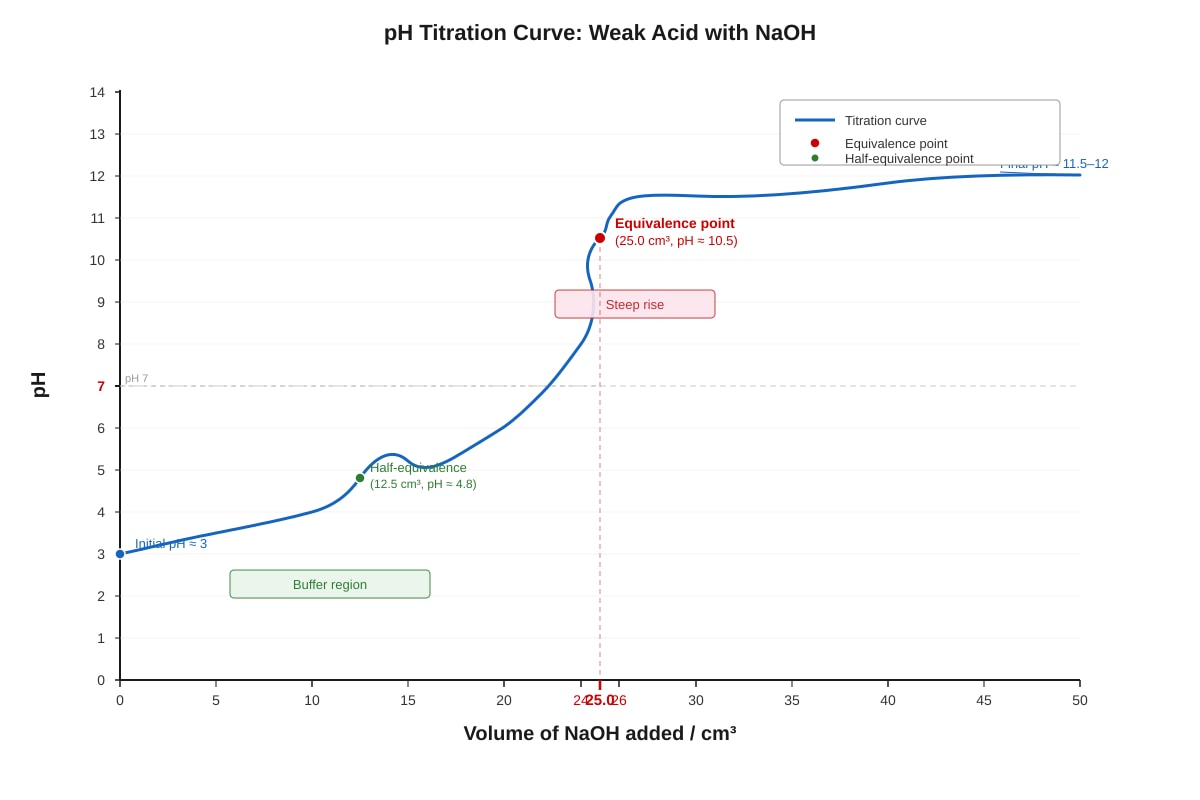
Answer: The initial pH is approximately 3, which is much higher than the pH ≈ 1 expected for a strong acid of similar concentration. A strong acid fully dissociates, giving a much lower initial pH. The gradual rise in pH at the start of the titration (the buffer region) also indicates the presence of undissociated weak acid and its conjugate base, which is not observed with a strong acid.
Marking notes:
- [1] for stating that the initial pH is too high for a strong acid.
- [1] for explaining that strong acids fully dissociate (giving lower pH) or for identifying the buffer region as evidence of weak acid behaviour.
(b) [2]
Answer: At the equivalence point, all the weak acid has been converted to its conjugate base (the sodium salt of the weak acid). The conjugate base hydrolyses in water:
This produces ions, making the solution slightly alkaline, so the pH is greater than 7.
Marking notes:
- [1] for identifying that the salt formed (conjugate base of weak acid) hydrolyses.
- [1] for explaining that hydrolysis produces ions, giving pH > 7.
(c) [2]
Answer: Phenolphthalein is the suitable indicator. The equivalence point pH is approximately 8.5, which falls within the pH range of phenolphthalein (8.2 – 10.0). The colour change of phenolphthalein (colourless → pink) will occur within the steep portion of the titration curve, giving a sharp end-point close to the true equivalence point.
Marking notes:
- [1] for correctly choosing phenolphthalein.
- [1] for justifying that the equivalence point pH (≈ 8.5) falls within the indicator's range.
- Common mistake: Choosing methyl orange, which changes colour in the acidic range and would give a premature end-point for a weak acid–strong base titration.
Question 7 [3]
Answer: For a weak acid, using the approximation :
Marking notes:
- [1] for correct substitution into the formula .
- [1] for correct value ( mol dm⁻³).
- [1] for correct pH = 3.24.
- Common mistake: Using (without the square root), which gives an incorrect answer.
- Note: The approximation is valid because is small ().
Question 8 [2]
Answer: Concentration refers to the amount of acid (in moles) dissolved per unit volume of solution. It is expressed in and can be changed by dilution or evaporation.
Strength refers to the extent to which an acid dissociates in water. A strong acid fully dissociates, while a weak acid only partially dissociates. Strength is an intrinsic property of the acid and is quantified by the acid dissociation constant .
Marking notes:
- [1] for a correct definition of concentration.
- [1] for a correct definition of strength (with reference to extent of dissociation).
- Common mistake: Students use "concentrated" and "strong" interchangeably. A concentrated weak acid is still weak; a dilute strong acid is still strong.
Question 9 [2]
Answer: The solution will be acidic (pH < 7).
Ammonium chloride is a salt formed from a weak base () and a strong acid (HCl). The ammonium ion () is the conjugate acid of a weak base and undergoes hydrolysis:
This produces (or ) ions, making the solution acidic.
Marking notes:
- [1] for predicting acidic pH.
- [1] for correct explanation with hydrolysis equation showing production.
- Accept in place of .
Question 10 [1]
Answer: A buffer solution is a solution that resists changes in pH when small amounts of acid or base are added (or when it is diluted).
Marking notes:
- Award [1] for the key idea of "resists pH change" on addition of small amounts of acid/base.
- Accept equivalent phrasing such as "maintains a relatively constant pH".
Question 11 [2]
Answer: In this buffer, acts as the base (proton acceptor) and acts as the acid (proton donor).
When a small amount of dilute acid is added, the added ions react with the carbonate ions:
The carbonate ion removes the added by converting it to hydrogencarbonate, so the pH remains relatively unchanged.
Marking notes:
- [1] for identifying that reacts with added .
- [1] for the correct equation showing the removal of ions.
- Common mistake: Students write the reaction of with acid (which would be relevant for added base, not acid).
Question 12 [2]
Answer: The ethanoic acid solution has the higher concentration.
HCl is a strong acid and fully dissociates, so . Ethanoic acid is a weak acid and only partially dissociates, so . For both solutions to have the same pH (same ), the ethanoic acid must have a much higher total concentration to compensate for its low degree of dissociation.
Marking notes:
- [1] for identifying ethanoic acid as having the higher concentration.
- [1] for explaining that weak acids only partially dissociate, so a higher total concentration is needed to achieve the same .
Section B
Question 13 [12]
(a) [2]
Answer: Sodium chloride is formed from a strong acid (HCl) and a strong base (NaOH). Both ions ( and ) are spectators and do not react with water (hydrolyse). Therefore, the concentrations of and remain equal, and the solution is neutral (pH = 7).
Marking notes:
- [1] for identifying NaCl as from strong acid + strong base.
- [1] for stating that neither ion hydrolyses / both are spectators.
(b) [3]
Answer: Sodium ethanoate is formed from a weak acid (ethanoic acid) and a strong base (NaOH). The ethanoate ion () is the conjugate base of a weak acid. It hydrolyses (reacts with water):
This produces hydroxide ions (), increasing , so the solution is alkaline (pH > 7).
Marking notes:
- [1] for identifying the salt as from weak acid + strong base.
- [1] for identifying the ethanoate ion as the conjugate base that hydrolyses.
- [1] for the correct hydrolysis equation showing as a product.
(c) [3]
Answer: Ammonium chloride is formed from a weak base (ammonia, ) and a strong acid (HCl). The ammonium ion () is the conjugate acid of a weak base. It hydrolyses:
This produces ions, increasing , so the solution is acidic (pH < 7).
Marking notes:
- [1] for identifying the salt as from weak base + strong acid.
- [1] for identifying the ammonium ion as the conjugate acid that hydrolyses.
- [1] for the correct hydrolysis equation showing / as a product.
(d) [2]
Answer: The carbonate ion () is the conjugate base of the weak acid , while the ethanoate ion () is the conjugate base of ethanoic acid (). Carbonate is the conjugate base of a weaker acid (, ) compared to ethanoic acid (). Since is a stronger base than , it hydrolyses to a greater extent, producing more ions and hence a higher pH.
Marking notes:
- [1] for recognising that is a stronger base (conjugate base of a weaker acid) than .
- [1] for linking this to greater hydrolysis and higher pH.
- Alternative: Award marks for stating that has a higher charge density and is therefore a stronger base.
(e) [2]
Answer: Potassium sulfate is formed from a strong acid () and a strong base (KOH). Both ions ( and ) are spectator ions and do not hydrolyse in water. Therefore, the solution is neutral (pH = 7).
Marking notes:
- [1] for identifying as from strong acid + strong base.
- [1] for stating that neither ion hydrolyses / solution is neutral.
Question 14 [10]
(a) [1]
Answer:
Marking notes:
- Award [1] for correct expression. State symbols not required.
(b)(i) [3]
Answer:
Marking notes:
- [1] for correct substitution into .
- [1] for correct mol dm⁻³.
- [1] for correct pH = 3.16.
- Award error carried forward (ECF) if student uses wrong but calculates pH correctly from their value.
(b)(ii) [2]
Answer:
Marking notes:
- [1] for correct formula .
- [1] for correct answer (0.693% or ).
- Award ECF from (b)(i).
(c)(i) [2]
Answer: The pH increases (but by less than 1 unit). When the solution is diluted, the concentration decreases. For a weak acid, , so reducing by a factor of 10 reduces by a factor of , which increases the pH by .
Marking notes:
- [1] for stating that pH increases.
- [1] for explaining that dilution reduces by a factor of (not 10), so pH increases by 0.5.
(c)(ii) [2]
Answer: The degree of dissociation increases. On dilution, the equilibrium shifts to the right (Le Chatelier's principle — more water molecules available to accept protons), so a greater fraction of the acid molecules dissociate. Since , reducing increases .
Marking notes:
- [1] for stating that increases.
- [1] for correct explanation (Le Chatelier's principle or the relationship ).
Question 15 [8]
(a) [2]
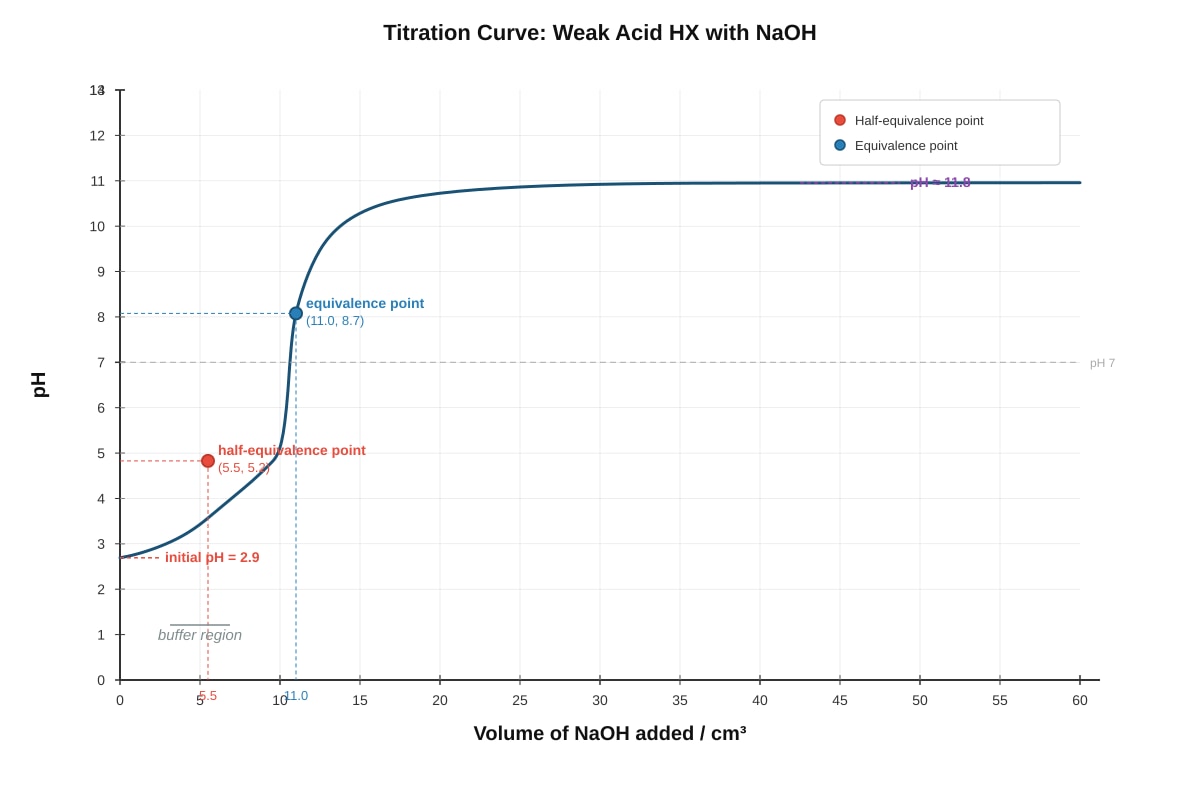
Answer: From the graph, the equivalence point occurs at of NaOH.
Since HX is monobasic (1:1 ratio):
Marking notes:
- [1] for reading the equivalence volume (11.0 cm³) from the graph.
- [1] for correct concentration of HX = .
(b) [2]
Answer: At the half-equivalence point, , so:
Therefore:
Marking notes:
- [1] for recognising that at half-equivalence, pH = p.
- [1] for correct mol dm⁻³.
(c) [2]
Answer: At the half-equivalence point, exactly half the acid HX has been neutralised by NaOH, so the moles of HX remaining equals the moles of (conjugate base) formed. Since both species are in the same solution (same volume), .
Substituting into the Henderson–Hasselbalch equation:
Marking notes:
- [1] for explaining that at half-equivalence, .
- [1] for showing that , so pH = p.
(d) [2]
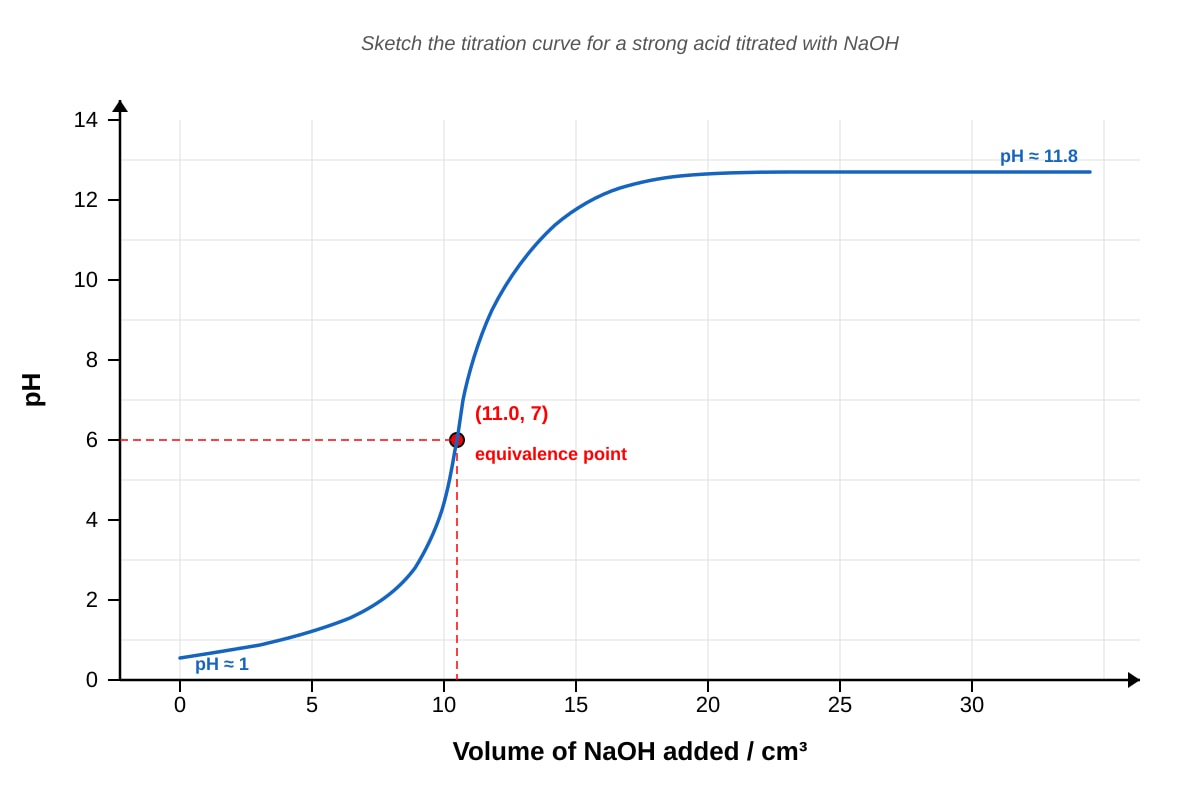
Answer: The sketch should show:
- Starting pH ≈ 1 (much lower than the weak acid's pH of 2.9)
- A very short/non-existent buffer region
- A very steep vertical rise through pH = 7 at 11.0 cm³ (equivalence point)
- Levelling off at a similar high pH (≈ 11.8)
Key differences from the weak acid curve:
- Lower initial pH
- Equivalence point at pH = 7 (not pH > 7)
- Steeper rise at equivalence point
- No buffer region before equivalence
Marking notes:
- [1] for showing a lower initial pH (around 1) and equivalence point at pH 7.
- [1] for showing the equivalence point at the same volume (11.0 cm³) and a steep rise.
End of Answer Key
Section A Total: 30 marks Section B Total: 30 marks Grand Total: 60 marks