AI Generated Exam Paper
A Level H1 Chemistry Practice Paper 5
Free A Level H1 Chemistry Practice Paper 5, HY3 AI version, with questions, answers, and A Level-style practice for Singapore students.
These static practice materials are generated from the site's syllabus and paper-generation workflow, with source and model context shown so students and parents can evaluate the material before use.
Questions
TuitionGoWhere Practice Paper - Chemistry H1 A-Level
TuitionGoWhere Practice Paper (AI) — Version 5
Subject: Chemistry H1
Level: A-Level
Paper: Practice Paper (Topic: Acids, Bases & Salts)
Duration: 1 hour 15 minutes
Total Marks: 60
Name: ___________________________
Class: ___________________________
Date: ___________________________
Instructions:
- This practice paper contains 20 questions on the topic of Acids, Bases & Salts, aligned with the H1 Chemistry (Syllabus 8873) Theories of Acids and Bases.
- Answer all questions in the spaces provided.
- Show all working clearly. Use appropriate units and chemical notation.
- A Data Booklet is not required; necessary constants are given in the questions.
- This is an AI-generated syllabus-first practice paper (Version 5 of 5). It is not derived from official past-year papers.
Section A: Definitions and Foundations (Questions 1–5) [12 marks]
1. What is meant by the term weak acid? Illustrate your answer with a balanced equation including state symbols. [2]
2. State the Brønsted–Lowry definition of a base. [1]
3. Write the conjugate acid–base pair in the following equilibrium:
NH3(aq)+H2O(l)⇌NH4+(aq)+OH−(aq) [2]
4. Define the acid dissociation constant, Ka, for a weak acid HA. [1]
5. A solution has [H+(aq)]=2.0×10⁻³ mol dm−3. Calculate its pH. [2]
Section B: Calculations and Equilibrium (Questions 6–12) [24 marks]
6. A buffer solution contains 0.12 mol dm−3 propanoic acid (CH3CH2COOH) and 0.08 mol dm−3 sodium propanoate. Given Ka=1.3×10⁻⁵ mol dm−3, calculate the pH of the buffer. [3]
7. Carbonic acid in rainwater dissociates as follows:
H2CO3(aq)⇌HCO3−(aq)+H+(aq)
Write the expression for Ka of carbonic acid. [1]
8. 25.0 cm3 of 0.100 mol dm−3 ethanoic acid is titrated with 0.100 mol dm−3 NaOH. Calculate the pH at the point where 12.5 cm3 of NaOH has been added. (Ka of ethanoic acid =1.8×10⁻⁵ mol dm−3) [3]
9. Explain why Ka1>Ka2 for a diprotic acid such as H2S. [2]
10. Calculate the concentration of H+(aq) in a 0.050 mol dm−3 solution of a strong acid HNO₃. [1]
11. A student adds 0.010 mol of solid NaOH to 1.0 dm3 of a buffer containing 0.20 mol dm−3 benzoic acid (Ka=6.3×10⁻⁵ mol dm−3) and 0.30 mol dm−3 sodium benzoate. Calculate the new pH. [4]
12. The Kw at 25∘C is 1.0×10⁻¹⁴ mol2 dm−6. Calculate the pH of a 0.01 mol dm−3 solution of KOH. [2]
Section C: Structured Reasoning and Applications (Questions 13–20) [24 marks]
13. Calcium hydroxide is added to fermentation tanks to prevent the production of lactic acid from slowing down. Explain why high acidity reduces enzyme effectiveness. [2]
14. State and explain which indicator, methyl orange (pH range 3.1–4.4) or phenolphthalein (pH range 8.3–10.0), is suitable for the titration of strong acid with strong base. [2]
15. Ocean acidification is caused by absorption of CO₂ forming carbonic acid. Describe the role of the CO32−/HCO3− buffer system in seawater. [3]
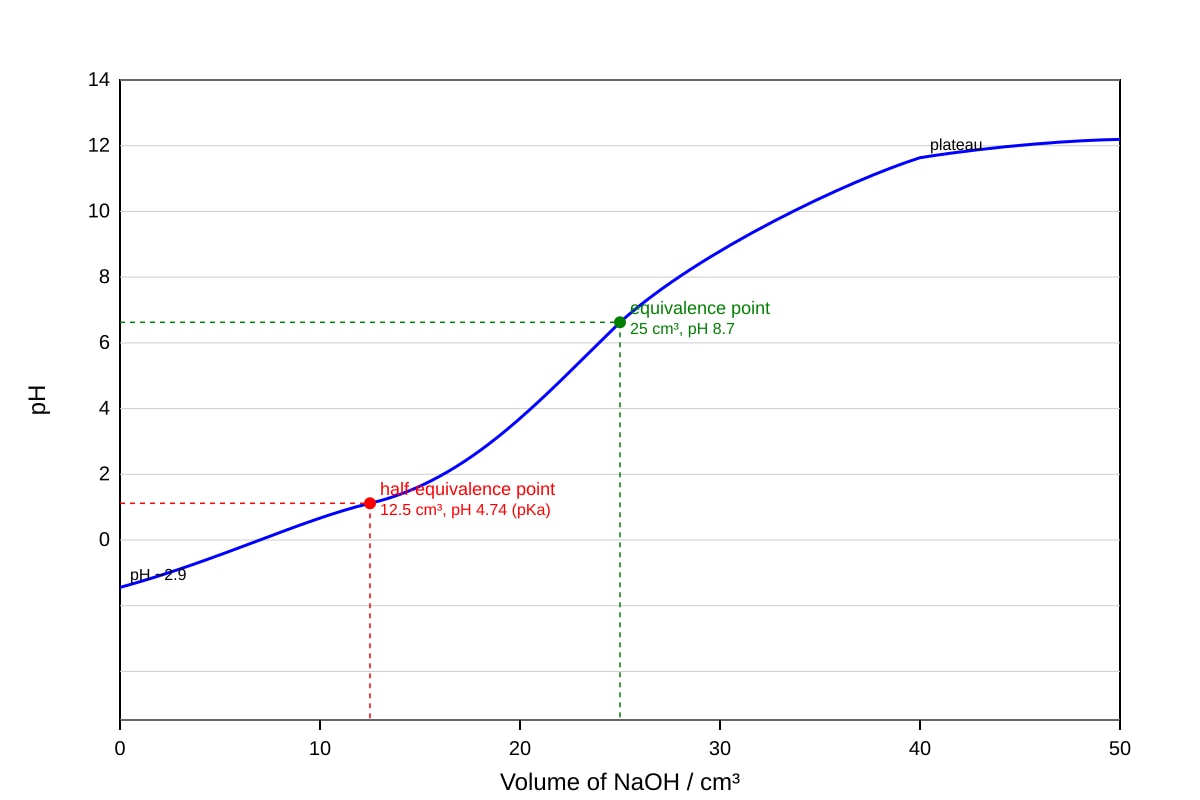
16. A titration curve for a weak acid–strong base titration is shown below.
Image pending generation: graph for Q16.
Using the graph, state the pKa of the weak acid and explain how the graph shows it. [2]
17. Write equations for the two dissociation steps of sulphuric acid, H2SO4, in water and state which step is stronger. [3]
18. A sample of coffee powder is analysed; 2.00 g of powder contains 0.036 g of chlorogenic acid (a weak acid, molar mass 354 g mol−1). Calculate the percentage by mass of chlorogenic acid. [2]
19. Compare the buffering action of a solution containing NH4Cl and NH3 with that of a solution containing HCl and NaCl. [3]
20. A student measures pH of 0.10 mol dm−3 HCl as 1.0 and 0.10 mol dm−3 CH₃COOH as 2.9. Explain the difference in terms of dissociation. [3]
Answers
TuitionGoWhere Practice Paper — Answer Key (Version 5)
Subject: Chemistry H1 | Level: A-Level | Topic: Acids, Bases & Salts | Total Marks: 60
Section A: Definitions and Foundations (Q1–5) [12 marks]
Q1 [2 marks]
- A weak acid is one that only partially dissociates (ionises) in water. [1]
- Equation: CH3COOH(aq)⇌CH3COO−(aq)+H+(aq) (or any weak acid with reversible arrow and state symbols). [1]
- Teaching note: Strength refers to extent of dissociation, not concentration. Use ⇌, not →. Common mistake: writing "dilute" instead of "weak".
Q2 [1 mark]
- A Brønsted–Lowry base is a proton (H+) acceptor. [1]
- Teaching note: Contrast with Arrhenius base (produces OH⁻ in water).
Q3 [2 marks]
- Conjugate acid–base pairs: NH3/NH4+ and H2O/OH−. [2, 1 each]
- Teaching note: Pair differs by one H+.
Q4 [1 mark]
- Ka=[HA(aq)][H+(aq)][A−(aq)] for HA⇌H++A−. [1]
- Teaching note: Equilibrium constant for acid dissociation; excludes water.
Q5 [2 marks]
- pH=−log10[H+]=−log10(2.0×10⁻³)=2.70 (to 2 d.p.) [2]
- Working: −log(2.0×10⁻³)=3−log2.0=3−0.301=2.699≈2.70.
- Marking: 1 for correct formula, 1 for correct value.
Section B: Calculations and Equilibrium (Q6–12) [24 marks]
Q6 [3 marks]
- Use pH=pKa+log[HA][A−]
- pKa=−log(1.3×10⁻⁵)=4.89 [1]
- pH=4.89+log(0.08/0.12)=4.89+log(0.667)=4.89−0.176=4.71 [2]
- Teaching note: [A⁻] = sodium propanoate, [HA] = propanoic acid.
Q7 [1 mark]
- Ka=[H2CO3(aq)][HCO3−(aq)][H+(aq)] [1]
Q8 [3 marks]
- Moles acid initial: 0.100×25/1000=2.50×10−3 mol [1]
- Moles NaOH added: 0.100×12.5/1000=1.25×10−3 mol [1]
- Half neutralised → [CH3COOH]=[CH3COO−], so pH=pKa=−log(1.8×10⁻⁵)=4.74 [1]
- Teaching note: At half-equivalence, buffer pH = pKa.
Q9 [2 marks]
- First dissociation gives HS−; second removes H+ from negative ion. [1]
- Negative charge on HS− repels H+ more, making second loss harder → Ka1>Ka2. [1]
Q10 [1 mark]
- Strong acid fully dissociates: [H+]=0.050 mol dm−3 [1]
Q11 [4 marks]
- Initial: acid = 0.20, salt = 0.30 mol dm⁻³ (in 1 dm³, moles same) [1]
- NaOH reacts: HA+OH−→A−+H2O; new acid = 0.20 - 0.010 = 0.19, new salt = 0.30 + 0.010 = 0.31 [1]
- pKa=−log(6.3×10⁻⁵)=4.20 [1]
- pH=4.20+log(0.31/0.19)=4.20+0.213=4.41 [1]
Q12 [2 marks]
- [OH−]=0.01 mol dm−3; [H+]=Kw/[OH−]=10−14/0.01=10−12 [1]
- pH=12.0 [1]
Section C: Structured Reasoning and Applications (Q13–20) [24 marks]
Q13 [2 marks]
- Enzymes have optimal pH; low pH (high H+) disrupts H-bonds/ionic bonds in tertiary structure. [1]
- Denaturation changes active site shape; substrate cannot bind. [1]
Q14 [2 marks]
- Phenolphthalein suitable. [1]
- Strong acid–strong base equivalence pH ~7; phenolphthalein changes 8.3–10.0 near steep rise end; methyl orange changes too early (pH 3–4). [1]
Q15 [3 marks]
- CO32−+H+⇌HCO3− consumes excess H+ from carbonic acid. [1]
- HCO3−+H+⇌H2CO3 further buffers. [1]
- System resists pH drop, protecting marine organisms. [1]
Q16 [2 marks]
- pKa = 4.74 (from half-equivalence point). [1]
- At half-equivalence, [HA]=[A−], so pH=pKa shown at 12.5 cm³. [1]
- Image features needed: curve with marked half-equivalence at pH 4.74.
Q17 [3 marks]
- H2SO4(aq)⇌HSO4−(aq)+H+(aq) [1]
- HSO4−(aq)⇌SO42−(aq)+H+(aq) [1]
- First step stronger (neutral molecule to negative ion easier than negative to more negative). [1]
Q18 [2 marks]
- Mass % = (0.036/2.00)×100=1.8% [2]
- Teaching note: Molar mass not needed for mass %.
Q19 [3 marks]
- NH4Cl/NH3 is a buffer: NH3 absorbs H+, NH4+ absorbs OH−. [2]
- HCl/NaCl not buffer (strong acid + neutral salt, no weak conjugate pair). [1]
Q20 [3 marks]
- HCl strong acid: full dissociation → [H+]=0.10, pH 1.0. [1]
- CH₃COOH weak: partial dissociation → [H+]<0.10, pH 2.9. [1]
- Difference due to extent of ionisation. [1]
Free quiz and exam paper access
Enter your details to view this paper
Your access is remembered on this device.