AI Generated Exam Paper

A Level H1 Chemistry Practice Paper 4

Free AI-Generated Owl Alpha A Level H1 Chemistry Practice Paper 4 practice paper with questions and answers for Singapore students. This page is rendered as a direct URL so the questions and answers can be discovered without pressing in-page buttons.

These static practice materials are generated from the site's syllabus and paper-generation workflow, with source and model context shown so students and parents can evaluate the material before use.

A Level H1 Chemistry AI Generated Generated by Owl Alpha Updated 2026-06-07

Questions

<!-- TuitionGoWhere generation metadata: stage=5-2; model=openrouter/owl-alpha; model_label=Owl Alpha; generated=2026-06-06; Sources: Stage 4-0 LLM templates, syllabus context, and Stage 2 evidence where available. -->

TuitionGoWhere Practice Paper - Chemistry H1 A-Level

TuitionGoWhere Practice Paper (AI)

Subject: Chemistry Level: A-Level H1 Paper: Practice Paper — Acids, Bases & Salts Duration: 1 hour 30 minutes Total Marks: 60

Name: ___________________________ Class: ___________________________ Date: ___________________________


Instructions

  • Answer all questions in the spaces provided.
  • Write your answers in dark blue or black pen.
  • You may use a pencil for any diagrams or graphs.
  • Show all working for calculation questions — marks are awarded for correct method as well as final answers.
  • The number of marks for each question is shown in brackets [ ].
  • A Periodic Table and Data Booklet with relevant constants are provided separately.
  • This paper consists of Section A and Section B.

Section A: Short Answer Questions [25 marks]

Answer all questions 1–10 in the spaces provided.


1. Define the term strong acid.


[1]


2. Explain what is meant by the pH of a solution, making reference to the concentration of hydrogen ions.


[2]


3. A solution of hydrochloric acid has a concentration of 0.025 mol dm⁻³. Calculate the pH of this solution.


[2]


4. Write an expression for the acid dissociation constant, KaK_a, for the following equilibrium:

CH3COOH(aq)CH3COO(aq)+H+(aq)CH_3COOH(aq) \rightleftharpoons CH_3COO^-(aq) + H^+(aq)


[1]


5. A 0.10 mol dm⁻³ solution of a weak acid HX has a pH of 3.20. Calculate the value of KaK_a for HX, stating its units.


[3]


6. State two differences between a strong acid and a weak acid of the same concentration.

Difference 1: ________________________________________________________________


Difference 2: ________________________________________________________________


[2]


7. Sodium carbonate (Na2CO3Na_2CO_3) is a salt. When dissolved in water, the resulting solution has a pH greater than 7. Explain, with the aid of an equation, why the solution is alkaline.


[3]


8. Describe a chemical test you would carry out to distinguish between a solution of sodium chloride and a solution of sodium carbonate. Include the reagent used, the observations for each solution, and the relevant equation.

Reagent: __________________________________________________________________

Observation with NaCl: _______________________________________________________

Observation with Na₂CO₃: _____________________________________________________

Equation: __________________________________________________________________

[3]


9. Calculate the concentration of hydroxide ions, [OH][OH^-], in a solution of sodium hydroxide with pH 12.8 at 25 °C. (Kw=1.0×10¹⁴K_w = 1.0 \times 10^{-14} mol² dm⁻⁶)


[2]


10. A student titrates 25.0 cm³ of 0.100 mol dm⁻³ sulfuric acid (H2SO4H_2SO_4) against potassium hydroxide solution. The equation for the reaction is:

H2SO4(aq)+2KOH(aq)K2SO4(aq)+2H2O(l)H_2SO_4(aq) + 2KOH(aq) \rightarrow K_2SO_4(aq) + 2H_2O(l)

Calculate the volume of 0.150 mol dm⁻³ KOH solution required to neutralise the sulfuric acid.


[4]


Section B: Structured and Data-Response Questions [35 marks]

Answer all questions 11–15 in the spaces provided.


11. Ethanoic acid (CH3COOHCH_3COOH) is a weak acid with Ka=1.74×10⁵K_a = 1.74 \times 10^{-5} mol dm⁻³ at 25 °C.

(a) Write the expression for KaK_a for ethanoic acid and state its units.


Units: _______________________________

[2]

(b) A solution is prepared by dissolving ethanoic acid in water to give a concentration of 0.200 mol dm⁻³. Calculate the pH of this solution. Assume the dissociation is small enough that [CH3COOH]eq0.200[CH_3COOH]_{eq} \approx 0.200 mol dm⁻³.


[3]

(c) Sodium ethanoate (CH3COONaCH_3COONa) is added to the solution in (b) to form a buffer. Explain how this buffer solution resists changes in pH when a small amount of dilute hydrochloric acid is added.


[3]

(d) Calculate the pH of the buffer solution formed when 0.200 mol dm⁻³ ethanoic acid is mixed with an equal volume of 0.200 mol dm⁻³ sodium ethanoate.


[2]

[Total: 10 marks]


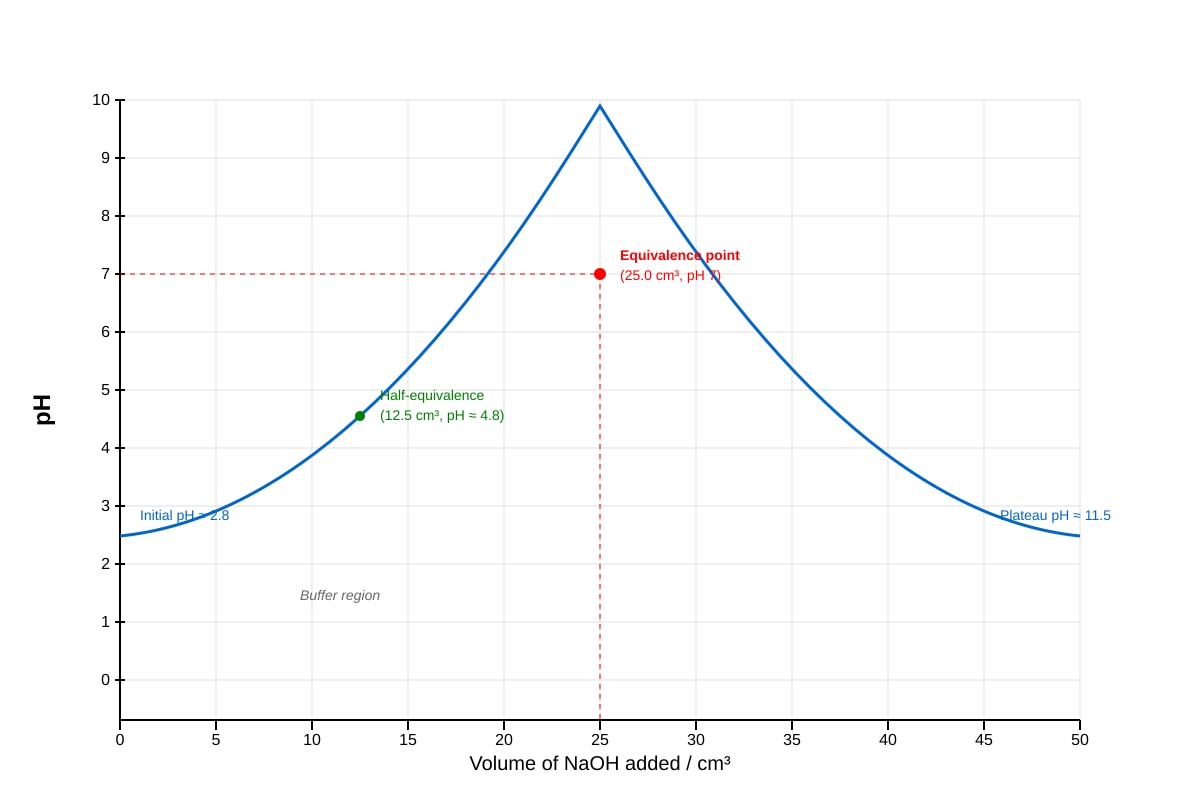
12. The graph below shows the pH change when 0.100 mol dm⁻³ sodium hydroxide is added gradually to 25.0 cm³ of 0.100 mol dm⁻³ of a monoprotic acid HA.

<image_placeholder> id: Q12-fig1 type: graph linked_question: Q12 description: A pH titration curve showing pH (y-axis, range 0–14) on the vertical axis against volume of NaOH added in cm³ (x-axis, range 0–50 cm³) on the horizontal axis. The curve starts at approximately pH 2.8 at 0 cm³, rises gradually, then has a steep vertical rise between 24 and 26 cm³, passing through pH 7 at 25.0 cm³ (the equivalence point), and levels off around pH 11.5 at 40 cm³. The curve should show a characteristic weak acid–strong base sigmoid shape with a buffer region before the equivalence point. labels: y-axis: "pH", x-axis: "Volume of NaOH added / cm³", equivalence point marked at (25.0, 7), initial pH ≈ 2.8, plateau pH ≈ 11.5 values: Initial pH ≈ 2.8, equivalence point at 25.0 cm³ NaOH, pH at equivalence ≈ 7, half-equivalence point at 12.5 cm³ where pH ≈ 4.8 must_show: The sigmoid curve shape, the equivalence point clearly at 25.0 cm³, the initial pH around 2.8, the buffer region (relatively flat section before the steep rise), and the final plateau around pH 11.5. Axes must be labelled with units. </image_placeholder>

(a) From the shape of the curve, deduce whether HA is a strong acid or a weak acid. Explain your reasoning.


[2]

(b) Using the graph, determine the pH at the equivalence point. What volume of NaOH was required to reach the equivalence point?

pH at equivalence point: ____________________________________________________

Volume of NaOH: ___________________________________________________________

[2]

(c) Estimate the pKapK_a of the acid HA from the graph. Explain how you obtained your estimate.


[2]

(d) An indicator is needed for this titration. The following table lists three common indicators and their pH ranges:

IndicatorpH RangeColour Change
Methyl orange3.1 – 4.4Red → Yellow
Bromothymol blue6.0 – 7.6Yellow → Blue
Phenolphthalein8.2 – 10.0Colourless → Pink

Select the most suitable indicator for this titration. Explain your choice.


[2]

(e) At the equivalence point, the salt formed is NaA. Predict whether the solution at the equivalence point is acidic, neutral, or alkaline. Explain your answer.


[2]

[Total: 10 marks]


13. Ammonia (NH3NH_3) is a weak base. At 25 °C, a 0.100 mol dm⁻³ solution of ammonia has a pH of 11.12.

(a) Write the equation for the reaction of ammonia with water, and the expression for the base dissociation constant KbK_b.

Equation: __________________________________________________________________

KbK_b expression: ___________________________________________________________

[2]

(b) Calculate the value of KbK_b for ammonia at 25 °C.


[3]

(c) Ammonium chloride (NH4ClNH_4Cl) is a salt formed from a weak base and a strong acid. Predict the pH of an aqueous solution of ammonium chloride (less than 7, equal to 7, or greater than 7). Explain your answer with the aid of an equation.

Prediction: ________________________________________________________________

Explanation: _______________________________________________________________


Equation: __________________________________________________________________

[3]

(d) A buffer solution can be prepared by mixing ammonia solution with ammonium chloride. State one use of such a buffer in a biological or industrial context.


[1]

[Total: 9 marks]


14. A student wishes to determine the concentration of a solution of nitric acid (HNO3HNO_3) by titration with standard potassium hydroxide solution.

(a) Describe, step by step, how the student would prepare 250.0 cm³ of a standard solution of potassium hydroxide from a solid sample of KOH. Include the apparatus used and any calculations needed.


[4]

(b) The student carried out the titration and obtained the following results:

TitrationRough123
Final burette reading / cm³24.8024.3524.4024.35
Initial burette reading / cm³0.000.000.000.00
Volume of KOH used / cm³24.8024.3524.4024.35

The volume of nitric acid used in each titration was 25.0 cm³ and the concentration of the KOH solution was 0.098 mol dm⁻³.

(i) Calculate the best (concordant) average titre.


[1]

(ii) Calculate the concentration of the nitric acid in mol dm⁻³.


[3]

(iii) State one precaution the student should take during the titration to ensure a reliable result.


[1]

[Total: 9 marks]


15. Solubility equilibria are important in understanding the behaviour of sparingly soluble salts.

(a) Write an expression for the solubility product, KspK_{sp}, of lead(II) iodide (PbI2PbI_2).


[1]

(b) The KspK_{sp} of PbI2PbI_2 at 25 °C is 8.49×1098.49 \times 10^{-9} mol³ dm⁻⁹. Calculate the solubility of PbI2PbI_2 in water at 25 °C, in mol dm⁻³.


[3]

(c) Predict and explain what would happen to the solubility of PbI2PbI_2 if solid potassium iodide (KIKI) were added to the saturated solution.


[2]

(d) Barium sulfate (BaSO4BaSO_4) is used as a contrast agent in medical imaging ("barium meal"). Explain why BaSO4BaSO_4 is safe to ingest despite barium ions (Ba2+Ba^{2+}) being toxic. Refer to the concept of solubility product in your answer.


[3]

[Total: 9 marks]


End of Paper

Section A: 25 marks | Section B: 35 marks | Total: 60 marks

Answers

<!-- TuitionGoWhere generation metadata: stage=5-2; model=openrouter/owl-alpha; model_label=Owl Alpha; generated=2026-06-06; Sources: Stage 4-0 LLM templates, syllabus context, and Stage 2 evidence where available. -->

TuitionGoWhere Practice Paper — Chemistry H1 A-Level

Answer Key: Acids, Bases & Salts


Section A: Short Answer Questions


1. [1 mark]

A strong acid is an acid that completely dissociates (ionises) in aqueous solution.

Teaching note: The key word is "completely." Every molecule of the acid donates its proton to water. Examples include HCl, HNO₃, and H₂SO₄. This is different from concentration — a strong acid can be dilute or concentrated.

Mark scheme: 1 mark for "completely dissociates/ionises in water."


2. [2 marks]

The pH of a solution is defined as the negative logarithm (base 10) of the hydrogen ion concentration:

pH=log10[H+]pH = -\log_{10}[H^+]

where [H+][H^+] is the concentration of hydrogen ions in mol dm⁻³. A higher [H+][H^+] gives a lower pH (more acidic), and a lower [H+][H^+] gives a higher pH (more alkaline).

Teaching note: pH is a logarithmic scale, so a change of 1 pH unit represents a tenfold change in [H+][H^+]. At 25 °C, pH < 7 is acidic, pH = 7 is neutral, and pH > 7 is alkaline.

Mark scheme: 1 mark for the definition/formula; 1 mark for the reference to [H+][H^+] concentration and its relationship to acidity/alkalinity.


3. [2 marks]

Hydrochloric acid is a strong acid, so it dissociates completely:

HCl(aq)H+(aq)+Cl(aq)HCl(aq) \rightarrow H^+(aq) + Cl^-(aq)

Therefore [H+]=0.025[H^+] = 0.025 mol dm⁻³.

pH=log10(0.025)=log10(2.5×10²)pH = -\log_{10}(0.025) = -\log_{10}(2.5 \times 10^{-2}) =(log102.5+log10102)= -(\log_{10}2.5 + \log_{10}10^{-2}) =(0.3982)=1.60= -(0.398 - 2) = 1.60

Teaching note: For strong monoprotic acids, [H+][H^+] equals the acid concentration directly. Students should remember that log10(2.5×10²)=log102.5+log10102=0.3982=1.602\log_{10}(2.5 \times 10^{-2}) = \log_{10}2.5 + \log_{10}10^{-2} = 0.398 - 2 = -1.602, so pH=1.60pH = 1.60.

Mark scheme: 1 mark for correct [H+][H^+]; 1 mark for correct pH = 1.60.


4. [1 mark]

Ka=[CH3COO][H+][CH3COOH]K_a = \frac{[CH_3COO^-][H^+]}{[CH_3COOH]}

Teaching note: The KaK_a expression follows the equilibrium expression: products over reactants, each raised to the power of their stoichiometric coefficients. Water is omitted because it is the solvent (its concentration is essentially constant). Pure liquids and solids are also omitted from equilibrium expressions.

Mark scheme: 1 mark for the correct expression. No units required for this question.


5. [3 marks]

Given: concentration = 0.10 mol dm⁻³, pH = 3.20

Step 1: Calculate [H+][H^+] from pH:

[H+]=103.20=6.31×10⁴ mol dm3[H^+] = 10^{-3.20} = 6.31 \times 10^{-4} \text{ mol dm}^{-3}

Step 2: For the dissociation HXH++XHX \rightleftharpoons H^+ + X^-, at equilibrium:

[H+]=[X]=6.31×10⁴ mol dm3[H^+] = [X^-] = 6.31 \times 10^{-4} \text{ mol dm}^{-3} [HX]=0.106.31×1040.10 mol dm3[HX] = 0.10 - 6.31 \times 10^{-4} \approx 0.10 \text{ mol dm}^{-3}

Step 3: Substitute into the KaK_a expression:

Ka=[H+][X][HX]=(6.31×10⁴)20.10K_a = \frac{[H^+][X^-]}{[HX]} = \frac{(6.31 \times 10^{-4})^2}{0.10} =3.98×1070.10=3.98×10⁶ mol dm3= \frac{3.98 \times 10^{-7}}{0.10} = 3.98 \times 10^{-6} \text{ mol dm}^{-3}

Common mistake: Students often forget to square [H+][H^+] or use the initial concentration of acid instead of the equilibrium concentration. Also, some forget to include units (mol dm⁻³).

Mark scheme: 1 mark for correct [H+][H^+] calculation; 1 mark for correct substitution; 1 mark for correct KaK_a value with units (3.98×1063.98 \times 10^{-6} mol dm⁻³, accept 4.0×1064.0 \times 10^{-6} mol dm⁻³).


6. [2 marks]

Difference 1: A strong acid has a lower pH than a weak acid of the same concentration, because the strong acid dissociates completely, producing a higher [H+][H^+].

Difference 2: A strong acid reacts more vigorously (faster rate of reaction) with reactive metals or carbonates than a weak acid of the same concentration, due to the higher [H+][H^+].

Acceptable alternatives:

  • A strong acid solution is a better conductor of electricity (higher ion concentration).
  • A strong acid has a higher degree of ionisation/dissociation than a weak acid.

Common mistake: Students often confuse "strong/weak" with "concentrated/dilute." Strength refers to the degree of dissociation, not the amount of acid dissolved.

Mark scheme: 1 mark for each valid difference. Answers must compare the same concentration.


7. [3 marks]

Sodium carbonate is a salt formed from a strong base (NaOH) and a weak acid (H2CO3H_2CO_3). When dissolved in water, the carbonate ion (CO32CO_3^{2-}) undergoes hydrolysis (reaction with water):

CO32(aq)+H2O(l)HCO3(aq)+OH(aq)CO_3^{2-}(aq) + H_2O(l) \rightleftharpoons HCO_3^-(aq) + OH^-(aq)

The production of hydroxide ions (OHOH^-) increases the [OH][OH^-] in solution, making the solution alkaline (pH > 7).

Teaching note: This is a key concept: salts of strong bases and weak acids produce alkaline solutions because the conjugate base of the weak acid reacts with water to produce OHOH^- ions. The parent acid (H2CO3H_2CO_3) is weak, so its conjugate base (CO32CO_3^{2-}) is relatively strong and accepts protons from water.

Mark scheme: 1 mark for identifying that CO32CO_3^{2-} undergoes hydrolysis; 1 mark for the correct equation; 1 mark for stating that OHOH^- ions are produced, making the solution alkaline.


8. [3 marks]

Reagent: Dilute nitric acid (or dilute hydrochloric acid).

Observation with NaCl: No visible change (no effervescence/bubbles).

Observation with Na₂CO₃: Effervescence/bubbles of gas produced; the gas evolved turns limewater milky.

Equation:

Na2CO3(aq)+2HNO3(aq)2NaNO3(aq)+H2O(l)+CO2(g)Na_2CO_3(aq) + 2HNO_3(aq) \rightarrow 2NaNO_3(aq) + H_2O(l) + CO_2(g)

or in ionic form:

CO32(aq)+2H+(aq)H2O(l)+CO2(g)CO_3^{2-}(aq) + 2H^+(aq) \rightarrow H_2O(l) + CO_2(g)

Teaching note: Carbonates react with acids to produce carbon dioxide gas. This is a standard test for the carbonate ion. Sodium chloride does not react with dilute acid because HCl and HNO₃ are both strong acids and no gas, precipitate, or weak electrolyte is formed.

Mark scheme: 1 mark for correct reagent (dilute acid); 1 mark for correct observations (no change with NaCl, effervescence with Na₂CO₃); 1 mark for correct equation.


9. [2 marks]

Step 1: Calculate [H+][H^+] from pH:

[H+]=1012.8=1.58×10¹³ mol dm3[H^+] = 10^{-12.8} = 1.58 \times 10^{-13} \text{ mol dm}^{-3}

Step 2: Use the ionic product of water:

Kw=[H+][OH]=1.0×10¹⁴K_w = [H^+][OH^-] = 1.0 \times 10^{-14}

[OH]=Kw[H+]=1.0×10141.58×1013[OH^-] = \frac{K_w}{[H^+]} = \frac{1.0 \times 10^{-14}}{1.58 \times 10^{-13}}

[OH]=6.33×10² mol dm3[OH^-] = 6.33 \times 10^{-2} \text{ mol dm}^{-3}

Alternative method: pOH=14.012.8=1.2pOH = 14.0 - 12.8 = 1.2, so [OH]=101.2=0.063[OH^-] = 10^{-1.2} = 0.063 mol dm⁻³.

Common mistake: Students sometimes confuse KwK_w with KaK_a or forget that KwK_w applies at 25 °C. Also, some students calculate [H+][H^+] instead of [OH][OH^-].

Mark scheme: 1 mark for correct method using KwK_w; 1 mark for correct answer (6.3×1026.3 \times 10^{-2} mol dm⁻³ or 0.063 mol dm⁻³).


10. [4 marks]

Step 1: Calculate moles of H2SO4H_2SO_4:

n(H2SO4)=c×V=0.100×25.01000=2.50×10³ moln(H_2SO_4) = c \times V = 0.100 \times \frac{25.0}{1000} = 2.50 \times 10^{-3} \text{ mol}

Step 2: Use the stoichiometric ratio from the equation:

H2SO4+2KOHK2SO4+2H2OH_2SO_4 + 2KOH \rightarrow K_2SO_4 + 2H_2O

The mole ratio is H2SO4:KOH=1:2H_2SO_4 : KOH = 1 : 2.

n(KOH)=2×2.50×103=5.00×10³ moln(KOH) = 2 \times 2.50 \times 10^{-3} = 5.00 \times 10^{-3} \text{ mol}

Step 3: Calculate the volume of KOH solution:

V(KOH)=nc=5.00×1030.150=0.0333 dm3=33.3 cm3V(KOH) = \frac{n}{c} = \frac{5.00 \times 10^{-3}}{0.150} = 0.0333 \text{ dm}^3 = 33.3 \text{ cm}^3

Common mistake: Students often forget that H2SO4H_2SO_4 is diprotic and use a 1:1 ratio instead of 1:2. Also, unit conversion errors (cm³ to dm³) are common.

Mark scheme: 1 mark for moles of H2SO4H_2SO_4; 1 mark for correct mole ratio application; 1 mark for moles of KOH; 1 mark for correct volume = 33.3 cm³.


Section B: Structured and Data-Response Questions


11. [10 marks total]

(a) [2 marks]

Ka=[CH3COO][H+][CH3COOH]K_a = \frac{[CH_3COO^-][H^+]}{[CH_3COOH]}

Units of KaK_a: mol dm⁻³

Teaching note: The units of KaK_a are derived from the expression: (moldm3×moldm3)/(moldm3)=moldm3(mol \, dm^{-3} \times mol \, dm^{-3}) / (mol \, dm^{-3}) = mol \, dm^{-3}.

Mark scheme: 1 mark for correct expression; 1 mark for correct units (mol dm⁻³).

(b) [3 marks]

Step 1: Set up the equilibrium expression. Since dissociation is small, [CH3COOH]eq0.200[CH_3COOH]_{eq} \approx 0.200 mol dm⁻³.

Ka=[H+]2[CH3COOH]K_a = \frac{[H^+]^2}{[CH_3COOH]}

Step 2: Rearrange and solve for [H+][H^+]:

[H+]2=Ka×[CH3COOH]=1.74×105×0.200=3.48×10⁶[H^+]^2 = K_a \times [CH_3COOH] = 1.74 \times 10^{-5} \times 0.200 = 3.48 \times 10^{-6}

[H+]=3.48×106=1.865×10³ mol dm3[H^+] = \sqrt{3.48 \times 10^{-6}} = 1.865 \times 10^{-3} \text{ mol dm}^{-3}

Step 3: Calculate pH:

pH=log10(1.865×10³)=2.73pH = -\log_{10}(1.865 \times 10^{-3}) = 2.73

Common mistake: Students may forget to take the square root or may use the full quadratic formula unnecessarily (the approximation is valid here since dissociation is small).

Mark scheme: 1 mark for correct setup of KaK_a expression; 1 mark for correct [H+][H^+]; 1 mark for correct pH = 2.73.

(c) [3 marks]

When a small amount of dilute HCl is added to the buffer:

  1. The added H+H^+ ions react with the conjugate base (CH3COOCH_3COO^-) in the buffer:

H+(aq)+CH3COO(aq)CH3COOH(aq)H^+(aq) + CH_3COO^-(aq) \rightarrow CH_3COOH(aq)

  1. The conjugate base "mops up" the added H+H^+, converting it back to the weak acid.

  2. Since the [H+][H^+] does not increase significantly, the pH remains almost unchanged.

  3. The buffer works because it contains significant amounts of both the weak acid and its conjugate base.

Teaching note: The key concept is that the buffer resists pH change by consuming added acid (via the conjugate base) or added base (via the weak acid). Students should identify which component reacts with the added substance.

Mark scheme: 1 mark for stating that H+H^+ reacts with CH3COOCH_3COO^-; 1 mark for the equation; 1 mark for explaining that [H+][H^+] remains nearly constant so pH is maintained.

(d) [2 marks]

When equal volumes of 0.200 mol dm⁻³ CH3COOHCH_3COOH and 0.200 mol dm⁻³ CH3COONaCH_3COONa are mixed, the concentrations of both are halved (due to doubling of volume):

[CH3COOH]=0.100 mol dm3[CH_3COOH] = 0.100 \text{ mol dm}^{-3} [CH3COO]=0.100 mol dm3[CH_3COO^-] = 0.100 \text{ mol dm}^{-3}

Using the Henderson-Hasselbalch equation:

pH=pKa+log10([CH3COO][CH3COOH])pH = pK_a + \log_{10}\left(\frac{[CH_3COO^-]}{[CH_3COOH]}\right)

pKa=log10(1.74×10⁵)=4.76pK_a = -\log_{10}(1.74 \times 10^{-5}) = 4.76

pH=4.76+log10(0.1000.100)=4.76+log10(1)=4.76+0=4.76pH = 4.76 + \log_{10}\left(\frac{0.100}{0.100}\right) = 4.76 + \log_{10}(1) = 4.76 + 0 = 4.76

Teaching note: When [acid]=[salt][acid] = [salt], pH=pKapH = pK_a. This is a useful result to remember. The Henderson-Hasselbalch equation is not always provided in exams, so students should know how to derive it from the KaK_a expression.

Mark scheme: 1 mark for correct pKapK_a or correct ratio; 1 mark for correct pH = 4.76.


12. [10 marks total]

(a) [2 marks]

HA is a weak acid.

Reasoning: The initial pH is approximately 2.8, which is higher than the expected pH of 1.0 for a 0.100 mol dm⁻³ strong monoprotic acid. A strong acid at this concentration would have [H+]=0.100[H^+] = 0.100 mol dm⁻³, giving pH = 1.0. The higher initial pH indicates that HA does not fully dissociate, which is characteristic of a weak acid.

Additionally, the titration curve shows a buffer region (a relatively flat section before the steep rise), which is characteristic of a weak acid–strong base titration.

Mark scheme: 1 mark for identifying weak acid; 1 mark for correct reasoning (higher initial pH than expected for strong acid, or reference to buffer region).

(b) [2 marks]

From the graph:

  • pH at equivalence point: approximately 8.7–9.0 (the pH at the midpoint of the steep rise)
  • Volume of NaOH at equivalence point: 25.0 cm³

Teaching note: The equivalence point for a weak acid–strong base titration occurs at pH > 7 because the salt formed (NaA) is the conjugate base of a weak acid, which hydrolyses to produce an alkaline solution.

Mark scheme: 1 mark for correct volume (25.0 cm³); 1 mark for correct pH range (8.5–9.5).

(c) [2 marks]

The pKapK_a can be estimated from the graph at the half-equivalence point (where half the volume of NaOH needed to reach the equivalence point has been added).

At the half-equivalence point, volume of NaOH = 12.5 cm³, and at this point [HA]=[A][HA] = [A^-], so pH=pKapH = pK_a.

From the graph, at 12.5 cm³, the pH is approximately 4.8.

Therefore, pKa4.8pK_a \approx 4.8 and Ka1.6×105K_a \approx 1.6 \times 10^{-5} mol dm⁻³.

Mark scheme: 1 mark for identifying the half-equivalence point; 1 mark for reading the pH ≈ 4.8 from the graph.

(d) [2 marks]

Phenolphthalein is the most suitable indicator.

Explanation: The equivalence point occurs at approximately pH 8.7–9.0. Phenolphthalein changes colour in the pH range 8.2–10.0, which encompasses the equivalence point. Methyl orange (3.1–4.4) and bromothymol blue (6.0–7.6) change colour well before the equivalence point would be reached, leading to significant titration error.

Mark scheme: 1 mark for selecting phenolphthalein; 1 mark for correct explanation referencing the pH range of the indicator matching the equivalence point pH.

(e) [2 marks]

The solution at the equivalence point is alkaline (pH > 7).

Explanation: At the equivalence point, all the weak acid HA has been neutralised to form the salt NaA. The anion AA^- is the conjugate base of the weak acid HA. It undergoes hydrolysis with water:

A(aq)+H2O(l)HA(aq)+OH(aq)A^-(aq) + H_2O(l) \rightleftharpoons HA(aq) + OH^-(aq)

The production of OHOH^- ions makes the solution alkaline.

Mark scheme: 1 mark for predicting alkaline; 1 mark for correct explanation involving hydrolysis of AA^- producing OHOH^-.


13. [9 marks total]

(a) [2 marks]

Equation:

NH3(aq)+H2O(l)NH4+(aq)+OH(aq)NH_3(aq) + H_2O(l) \rightleftharpoons NH_4^+(aq) + OH^-(aq)

KbK_b expression:

Kb=[NH4+][OH][NH3]K_b = \frac{[NH_4^+][OH^-]}{[NH_3]}

Mark scheme: 1 mark for correct equation (with reversible arrow); 1 mark for correct KbK_b expression.

(b) [3 marks]

Given: concentration = 0.100 mol dm⁻³, pH = 11.12

Step 1: Calculate [H+][H^+] and then [OH][OH^-]:

[H+]=1011.12=7.59×10¹² mol dm3[H^+] = 10^{-11.12} = 7.59 \times 10^{-12} \text{ mol dm}^{-3}

[OH]=Kw[H+]=1.0×10147.59×1012=1.318×10³ mol dm3[OH^-] = \frac{K_w}{[H^+]} = \frac{1.0 \times 10^{-14}}{7.59 \times 10^{-12}} = 1.318 \times 10^{-3} \text{ mol dm}^{-3}

Step 2: At equilibrium: [NH4+]=[OH]=1.318×10³[NH_4^+] = [OH^-] = 1.318 \times 10^{-3} mol dm⁻³

[NH3]eq=0.1001.318×1030.100 mol dm3[NH_3]_{eq} = 0.100 - 1.318 \times 10^{-3} \approx 0.100 \text{ mol dm}^{-3}

Step 3: Calculate KbK_b:

Kb=(1.318×10³)20.100=1.737×1060.100=1.74×10⁵ mol dm3K_b = \frac{(1.318 \times 10^{-3})^2}{0.100} = \frac{1.737 \times 10^{-6}}{0.100} = 1.74 \times 10^{-5} \text{ mol dm}^{-3}

Mark scheme: 1 mark for correct [OH][OH^-]; 1 mark for correct substitution; 1 mark for correct Kb=1.74×10⁵K_b = 1.74 \times 10^{-5} mol dm⁻³.

(c) [3 marks]

Prediction: pH < 7 (acidic)

Explanation: Ammonium chloride is formed from a weak base (NH3NH_3) and a strong acid (HCl). The ammonium ion (NH4+NH_4^+) is the conjugate acid of the weak base. It undergoes hydrolysis with water:

NH4+(aq)+H2O(l)NH3(aq)+H3O+(aq)NH_4^+(aq) + H_2O(l) \rightleftharpoons NH_3(aq) + H_3O^+(aq)

The production of H3O+H_3O^+ (or H+H^+) ions makes the solution acidic (pH < 7).

Mark scheme: 1 mark for correct prediction (pH < 7); 1 mark for identifying NH4+NH_4^+ as the conjugate acid that hydrolyses; 1 mark for the correct equation.

(d) [1 mark]

Use: Maintaining pH in biological systems (e.g., in buffer solutions for enzyme assays, or in maintaining the pH of blood in laboratory simulations).

Acceptable alternatives: Used in household cleaning products, in textile dyeing processes, or in qualitative analysis (e.g., in the identification of metal ions using aqueous ammonia in the presence of ammonium chloride to prevent precipitation of metal hydroxides).

Mark scheme: 1 mark for any valid biological or industrial use of an ammonia/ammonium chloride buffer.


14. [9 marks total]

(a) [4 marks]

Step 1: Calculate the mass of KOH needed.

Moles of KOH required = 0.098×0.250=0.02450.098 \times 0.250 = 0.0245 mol (or any reasonable concentration — the method is what matters).

Mass = moles × molar mass = 0.0245×56.1=1.370.0245 \times 56.1 = 1.37 g

Step 2: Weigh out the calculated mass of KOH using an electronic balance. Place a weighing boat on the balance, tare it, and add KOH pellets until the required mass is obtained.

Step 3: Transfer the KOH into a beaker and add approximately 100 cm³ of distilled water. Stir with a glass stirring rod until the KOH has completely dissolved.

Step 4: Transfer the solution into a 250.0 cm³ volumetric flask using a funnel. Rinse the beaker and stirring rod with distilled water and add the washings to the flask.

Step 5: Add distilled water to the flask until the meniscus reaches the 250.0 cm³ mark on the neck of the flask. Use a dropping pipette for the final additions.

Step 6: Stopper the flask and invert several times to ensure the solution is thoroughly mixed.

Mark scheme: 1 mark for correct mass calculation; 1 mark for correct apparatus (balance, beaker, volumetric flask); 1 mark for correct transfer and rinsing procedure; 1 mark for making up to the mark and mixing.

(b)(i) [1 mark]

Titrations 2 and 3 are concordant (within 0.10 cm³ of each other).

Average titre = 24.35+24.352=24.35\frac{24.35 + 24.35}{2} = 24.35 cm³

Mark scheme: 1 mark for correct average = 24.35 cm³.

(b)(ii) [3 marks]

Step 1: Moles of KOH used:

n(KOH)=0.098×24.351000=2.386×10³ moln(KOH) = 0.098 \times \frac{24.35}{1000} = 2.386 \times 10^{-3} \text{ mol}

Step 2: From the equation HNO3+KOHKNO3+H2OHNO_3 + KOH \rightarrow KNO_3 + H_2O, the mole ratio is 1:1.

n(HNO3)=n(KOH)=2.386×10³ moln(HNO_3) = n(KOH) = 2.386 \times 10^{-3} \text{ mol}

Step 3: Concentration of HNO3HNO_3:

c(HNO3)=nV=2.386×10325.0/1000=2.386×1030.0250=0.0954 mol dm3c(HNO_3) = \frac{n}{V} = \frac{2.386 \times 10^{-3}}{25.0/1000} = \frac{2.386 \times 10^{-3}}{0.0250} = 0.0954 \text{ mol dm}^{-3}

Mark scheme: 1 mark for moles of KOH; 1 mark for correct mole ratio; 1 mark for correct concentration = 0.0954 mol dm⁻³.

(b)(iii) [1 mark]

Acceptable answers:

  • Rinse the burette with the KOH solution (not just distilled water) before filling.
  • Swirl the conical flask continuously during the titration.
  • Read the burette at eye level to avoid parallax error.
  • Add the KOH solution dropwise near the endpoint.
  • Ensure the jet of the burette is filled (no air bubbles).

Mark scheme: 1 mark for any valid precaution.


15. [9 marks total]

(a) [1 mark]

For the equilibrium: PbI2(s)Pb2+(aq)+2I(aq)PbI_2(s) \rightleftharpoons Pb^{2+}(aq) + 2I^-(aq)

Ksp=[Pb2+][I]2K_{sp} = [Pb^{2+}][I^-]^2

Mark scheme: 1 mark for correct expression.

(b) [3 marks]

Step 1: Let the solubility of PbI2PbI_2 = ss mol dm⁻³.

From the stoichiometry of dissolution:

  • [Pb2+]=s[Pb^{2+}] = s
  • [I]=2s[I^-] = 2s

Step 2: Substitute into the KspK_{sp} expression:

Ksp=[Pb2+][I]2=s×(2s)2=4s3K_{sp} = [Pb^{2+}][I^-]^2 = s \times (2s)^2 = 4s^3

Step 3: Solve for ss:

4s3=8.49×1094s^3 = 8.49 \times 10^{-9}

s3=2.1225×10⁹s^3 = 2.1225 \times 10^{-9}

s=2.1225×1093=1.28×10³ mol dm3s = \sqrt[3]{2.1225 \times 10^{-9}} = 1.28 \times 10^{-3} \text{ mol dm}^{-3}

Common mistake: Students often forget that [I]=2s[I^-] = 2s (not ss) and therefore write Ksp=s3K_{sp} = s^3 instead of Ksp=4s3K_{sp} = 4s^3. This is a very common error with salts that produce ions in a 1:2 ratio.

Mark scheme: 1 mark for correct relationship between ion concentrations and ss; 1 mark for correct substitution into KspK_{sp} expression; 1 mark for correct answer (1.28×1031.28 \times 10^{-3} mol dm⁻³).

(c) [2 marks]

The solubility of PbI2PbI_2 would decrease.

Explanation: Adding KI increases the concentration of II^- ions in solution. According to Le Chatelier's principle, the equilibrium:

PbI2(s)Pb2+(aq)+2I(aq)PbI_2(s) \rightleftharpoons Pb^{2+}(aq) + 2I^-(aq)

shifts to the left (towards the solid) to counteract the increase in [I][I^-]. This is the common ion effect. As a result, less PbI2PbI_2 dissolves, and its solubility decreases.

Mark scheme: 1 mark for predicting decreased solubility; 1 mark for correct explanation using Le Chatelier's principle / common ion effect.

(d) [3 marks]

Although Ba2+Ba^{2+} ions are toxic, BaSO4BaSO_4 is safe to ingest because it is extremely sparingly soluble in water.

The solubility product KspK_{sp} of BaSO4BaSO_4 is very small (1.08×10101.08 \times 10^{-10} mol² dm⁻⁶ at 25 °C). This means that only a negligibly tiny concentration of Ba2+Ba^{2+} ions dissolves in the gastrointestinal tract:

BaSO4(s)Ba2+(aq)+SO42(aq)BaSO_4(s) \rightleftharpoons Ba^{2+}(aq) + SO_4^{2-}(aq)

The concentration of dissolved Ba2+Ba^{2+} is so low that it does not reach toxic levels in the body. The solid BaSO4BaSO_4 passes through the digestive system without releasing harmful amounts of barium ions.

Mark scheme: 1 mark for stating that BaSO4BaSO_4 is sparingly soluble / has a very small KspK_{sp}; 1 mark for explaining that the concentration of dissolved Ba2+Ba^{2+} is negligibly small; 1 mark for concluding that the amount is too small to be toxic.


End of Answer Key

Section A: 25 marks | Section B: 35 marks | Total: 60 marks