AI Generated Exam Paper
A Level H1 Chemistry Practice Paper 3
Free A Level H1 Chemistry Practice Paper 3, HY3 AI version, with questions, answers, and A Level-style practice for Singapore students.
These static practice materials are generated from the site's syllabus and paper-generation workflow, with source and model context shown so students and parents can evaluate the material before use.
Questions
TuitionGoWhere Practice Paper - Chemistry H1 A-Level
TuitionGoWhere Practice Paper (AI) — Version 3 of 5
Subject: Chemistry H1
Level: A-Level
Paper: Practice Paper (Topic: Acids, Bases & Salts)
Duration: 1 hour 15 minutes
Total Marks: 60
Name: ________________________
Class: ________________________
Date: ________________________
Instructions:
- This practice paper contains 20 questions on the topic of Acids, Bases & Salts.
- Answer all questions in the spaces provided.
- Show all working clearly. Use appropriate units and chemical notation.
- Calculators may be used.
- This is syllabus-first AI-generated content (Version 3) and is not derived from official past-year papers.
Section A: Foundations of Acid–Base Theory (Questions 1–5) — 10 marks
1. What is meant by the term weak acid? Illustrate your answer with a balanced equation including state symbols. [2]
2. State the Brønsted–Lowry definition of a base. [1]
3. Write the conjugate acid–base pair in the reaction:
NH3(aq)+H2O(l)⇌NH4+(aq)+OH−(aq) [2]
4. Give one example of a strong base and write its dissociation equation in water. [2]
5. Explain, using a suitable equation, why sodium carbonate solution has a pH greater than 7. [3]
Section B: pH, Ka and Calculations (Questions 6–12) — 20 marks
6. Calculate the pH of a 0.050 mol dm−3 solution of HCl. [2]
7. Calculate the pH of a 0.020 mol dm−3 solution of NaOH.
(Kw=1.0×10⁻¹⁴ mol2 dm−6) [3]
8. A buffer solution contains 0.10 mol dm−3 ethanoic acid and 0.15 mol dm−3 sodium ethanoate.
Ka of ethanoic acid =1.8×10⁻⁵ mol dm−3. Calculate the pH. [3]
9. Carbonic acid, H2CO3, dissociates in rainwater. Write the first dissociation equation with state symbols and deduce the Ka expression. [3]
10. A 25.0 cm3 sample of benzoic acid was titrated with 0.0100 mol dm−3 NaOH. 20.0 cm3 of NaOH was required for neutralisation. Calculate the concentration of benzoic acid. [3]
11. Explain why Ka1>Ka2 for a diprotic acid such as H2CO3. [2]
12. 0.0010 mol dm−3 of a weak acid HA has pH = 4.00. Calculate Ka of HA. [4]
Section C: Applications, Buffers and Data Interpretation (Questions 13–20) — 30 marks
13. Calcium hydroxide is added to fermentation tanks to prevent lactic acid from slowing enzyme action. Why does high acidity reduce enzyme effectiveness? [2]
14. The CO32−/HCO3− system acts as a buffer in the ocean. Explain how this buffer resists a decrease in pH when H+ is added. [3]
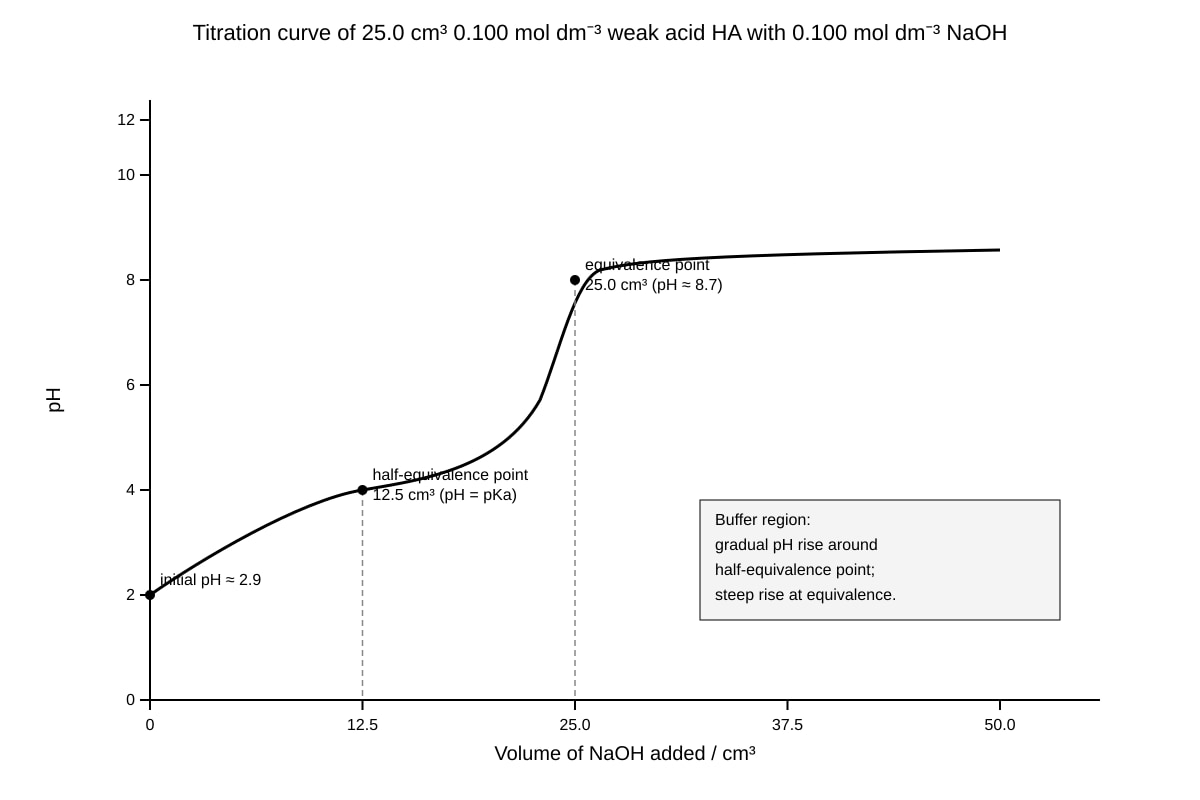
Image pending generation: graph for Q15.
15. Using the titration curve above, state the pH at the half-equivalence point and deduce the Ka of HA. [3]
16. A student prepares a buffer by mixing 50.0 cm3 of 0.20 mol dm−3 HNO2 (Ka=4.5×10⁻⁴) with 50.0 cm3 of 0.10 mol dm−3 NaNO2. Calculate the pH. [4]
17. State two properties of an indicator that make it suitable for a titration between strong acid and strong base. [2]
18. A soil sample is tested and found to have pH 4.5. Suggest a substance that could be added to raise the pH and explain its action in terms of acid–base theory. [3]
19. The table below shows Ka values for three acids.
| Acid | Ka / mol dm−3 |
|---|---|
| HF | 6.8×10⁻⁴ |
| CH3COOH | 1.8×10⁻⁵ |
| HClO | 3.0×10⁻⁸ |
Arrange the acids in order of increasing strength and explain your answer. [3]
20. A pharmaceutical solution contains 0.025 mol dm−3 of a weak base B with Kb=2.0×10⁻⁵. Calculate the pH of the solution. [5]
Answers
TuitionGoWhere Practice Paper — Answer Key (Version 3)
Subject: Chemistry H1 A-Level
Topic: Acids, Bases & Salts
Total Marks: 60
Section A: Foundations of Acid–Base Theory (10 marks)
1. [2 marks]
- Definition: A weak acid is one that only partially dissociates/ionises in water. [1]
- Equation: CH3COOH(aq)⇌CH3COO−(aq)+H+(aq) (or any valid weak acid with reversible arrow and state symbols). [1]
Teaching note: Strength refers to extent of dissociation, not concentration. Use ⇌, not →.
2. [1 mark]
A Brønsted–Lowry base is a proton (H+) acceptor.
Teaching note: Contrast with Arrhenius base (produces OH− in water).
3. [2 marks]
Conjugate acid–base pairs: NH4+/NH3 and H2O/OH−. [1+1]
Teaching note: Pair differs by one H+.
4. [2 marks]
Example: NaOH. Equation: NaOH(s)→Na+(aq)+OH−(aq) (or KOH, Ca(OH)2). [1 for example, 1 for equation]
5. [3 marks]
CO32−(aq)+H2O(l)⇌HCO3−(aq)+OH−(aq) [1]
Carbonate ion is a base (accepts H+ from water) [1], producing OH− so pH > 7 [1].
Section B: pH, Ka and Calculations (20 marks)
6. [2 marks]
HCl is strong: [H+]=0.050 mol dm−3
pH=−log(0.050)=1.30 [2 for correct value, allow 1.30–1.31]
7. [3 marks]
[OH−]=0.020 mol dm−3 [1]
[H+]=Kw/[OH−]=1.0×10−14/0.020=5.0×10−13 [1]
pH=−log(5.0×10⁻¹³)=12.30 [1]
8. [3 marks]
pKa=−log(1.8×10⁻⁵)=4.74 [1]
pH=pKa+log([A−]/[HA])=4.74+log(0.15/0.10) [1]
=4.74+0.18=4.92 [1]
9. [3 marks]
H2CO3(aq)⇌HCO3−(aq)+H+(aq) [1 for eq, 1 for states]
Ka=[H2CO3][HCO3−][H+] [1]
10. [3 marks]
n(NaOH)=0.0100×(20.0/1000)=2.00×10−4 mol [1]
1:1 ratio, so n(acid)=2.00×10⁻⁴ mol [1]
c=n/V=2.00×10−4/(25.0/1000)=0.00800 mol dm−3 [1]
11. [2 marks]
After first dissociation, the species carries negative charge (HCO3−) [1]; removing another H+ from a negative ion is harder due to electrostatic attraction [1].
12. [4 marks]
[H+]=10−4.00=1.0×10⁻⁴ mol dm−3 [1]
For HA ⇌ H+ + A−, at equilibrium [H+]=[A−]=1.0×10⁻⁴, [HA]≈0.0010 [1]
Ka=(1.0×10⁻⁴)2/0.0010=1.0×10−5 mol dm−3 [2]
Section C: Applications, Buffers and Data Interpretation (30 marks)
13. [2 marks]
High acidity (low pH) denatures enzymes [1]; H+ disrupts H-bonds/ionic bonds, changing active site shape so substrate cannot bind [1].
14. [3 marks]
CO32−+H+→HCO3− [1]; added H+ consumed by carbonate ion [1]; equilibrium shifts to remove excess acid, minimising pH drop [1].
15. [3 marks]
At half-equivalence, pH = pKa (from graph, approx 4.7) [1]; thus pKa = 4.7 [1]; Ka=10−4.7≈2.0×10⁻⁵ mol dm−3 [1].
Image needed: curve with half-equivalence labelled at 12.5 cm³.
16. [4 marks]
Moles HNO2=0.20×0.050=0.010 mol; moles NO2−=0.10×0.050=0.0050 mol [1]
Total vol = 0.100 dm³; [HNO2]=0.10, [NO2−]=0.050 [1]
pKa=−log(4.5×10⁻⁴)=3.35 [1]
pH = 3.35 + log(0.050/0.10) = 3.35 – 0.30 = 3.05 [1]
17. [2 marks]
Any two: sharp colour change at equivalence (~pH 7) [1]; colour change range within pH 4–10 / visible [1].
18. [3 marks]
Substance: calcium hydroxide / lime [1]; it is a base, neutralises H+ in soil [1]; raises pH by consuming acid (Brønsted–Lowry) [1].
19. [3 marks]
Order: HClO<CH3COOH<HF [1]; larger Ka = stronger acid [1]; HClO smallest Ka thus weakest [1].
20. [5 marks]
[OH−]=Kb×c=2.0×10−5×0.025=5.0×10−7=7.07×10⁻⁴ [2]
pOH = −log(7.07×10⁻⁴)=3.15 [1]
pH = 14 – 3.15 = 10.85 [2]
Free quiz and exam paper access
Enter your details to view this paper
Your access is remembered on this device.