AI Generated Exam Paper
A Level H1 Chemistry Practice Paper 3
Free A Level H1 Chemistry Practice Paper 3, DeepSeek AI version, with questions, answers, and A Level-style practice for Singapore students.
These static practice materials are generated from the site's syllabus and paper-generation workflow, with source and model context shown so students and parents can evaluate the material before use.
Questions
Free quiz and exam paper access
Enter your details to view this paper
Your access is remembered on this device.
Answers
TuitionGoWhere Practice Paper - Chemistry H1 A-Level – Answer Key and Marking Scheme
Paper: Practice Paper – Version 3 Total Marks: 80
Section A: Multiple Choice (15 marks)
| Question | Answer | Explanation |
|---|---|---|
| 1 | B | A Brønsted-Lowry base is a proton (H⁺) acceptor. A is the definition of an acid. C is the Arrhenius definition. D is a Lewis base. |
| 2 | B | Ethanoic acid is a weak acid, so it partially dissociates. [H⁺] < 0.10 mol dm⁻³, so pH > 1.0 but still acidic (< 7.0). |
| 3 | B | An acidic buffer requires a weak acid and its conjugate base (salt). CH₃COOH is a weak acid; CH₃COONa provides the conjugate base CH₃COO⁻. A and D are strong acid/base combinations. C is an alkaline buffer. |
| 4 | B | pKa = –log₁₀(Ka) = –log₁₀(6.3 × 10⁻⁵) = 4.20 |
| 5 | A | Strong acid-weak base titration has equivalence point pH < 7. Methyl orange (3.1–4.4) changes colour in the acidic range and is suitable. |
| 6 | C | Green on universal indicator corresponds to neutral/very weakly acidic or alkaline, approximately pH 7–8. |
| 7 | D | A conjugate acid-base pair differs by one H⁺. H₂SO₄ and SO₄²⁻ differ by two H⁺, so they are not a conjugate pair. The conjugate base of H₂SO₄ is HSO₄⁻. |
| 8 | B | At 298 K, Kw = [H⁺][OH⁻] = 1.0 × 10⁻¹⁴ mol² dm⁻⁶. |
| 9 | C | pOH = –log₁₀(1.0 × 10⁻³) = 3. pH = 14 – pOH = 14 – 3 = 11. |
| 10 | B | H₂SO₄ + 2KOH → K₂SO₄ + 2H₂O. The salt is potassium sulfate, K₂SO₄. |
| 11 | C | Al₂O₃ is amphoteric (reacts with both acids and bases). Na₂O and MgO are basic; SO₂ is acidic. |
| 12 | B | New concentration = (1.0 × 10.0) / 100.0 = 0.10 mol dm⁻³. pH = –log₁₀(0.10) = 1. |
| 13 | B | The second dissociation of H₂SO₄ is partial: HSO₄⁻ ⇌ H⁺ + SO₄²⁻. The first dissociation is complete (→). |
| 14 | B | H₂O donates a proton to NH₃, forming OH⁻. A Brønsted-Lowry acid is a proton donor. |
| 15 | A | When [HA] = [A⁻], the Henderson-Hasselbalch equation gives pH = pKa + log(1) = pKa. |
Section B: Structured Questions (45 marks)
Question 16 (8 marks)
(a) A weak acid is an acid that partially dissociates/ionises in water, establishing an equilibrium between the undissociated acid molecules and its ions. [1]
(b) HCOOH(aq) ⇌ HCOO⁻(aq) + H⁺(aq) [1] Mark: Award [1] for correct equation with equilibrium arrow and state symbols.
(c) Ka = [HCOO⁻][H⁺] / [HCOOH] [1] Mark: Accept any correct format. Do not penalise if [H₂O] is omitted (correct).
(d)
- Assumption: Degree of dissociation is small, so [HCOOH]eq ≈ 0.050 mol dm⁻³ [1]
- Ka = [H⁺]² / [HCOOH]
- [H⁺] = √(Ka × [HCOOH]) = √(1.8 × 10⁻⁴ × 0.050) = √(9.0 × 10⁻⁶) = 3.0 × 10⁻³ mol dm⁻³ [1]
- pH = –log₁₀(3.0 × 10⁻³) = 2.52 [1] Mark: [1] for assumption, [1] for correct [H⁺] calculation, [1] for correct pH. Accept 2.5 or 2.52.
(e) HCl is a strong acid and dissociates completely, so [H⁺] = 0.050 mol dm⁻³, giving pH = 1.30. [1] Methanoic acid is a weak acid and only partially dissociates, so [H⁺] < 0.050 mol dm⁻³, giving a higher pH. [1] Mark: Must mention complete vs partial dissociation.
Question 17 (9 marks)
(a) Completed table:
| Titration | 1 | 2 | 3 | 4 |
|---|---|---|---|---|
| Volume used / cm³ | 24.50 | 24.30 | 23.60 | 23.30 |
| [1] |
(b) Titrations 2, 3, and 4 should be used. [1] Titration 1 is a rough titration (or is inconsistent with the others). The other three titres are concordant (within 0.20 cm³ of each other). [1]
(c) Average titre = (24.30 + 23.60 + 23.30) / 3 = 23.73 cm³ [1] Accept 23.7 cm³.
(d)
- n(H₂SO₄) = c × V = 0.100 × (23.73/1000) = 0.002373 mol [1]
- From equation: 2NaOH + H₂SO₄ → Na₂SO₄ + 2H₂O
- Mole ratio NaOH : H₂SO₄ = 2 : 1
- n(NaOH) = 2 × 0.002373 = 0.004746 mol [1]
- c(NaOH) = n / V = 0.004746 / (25.0/1000) = 0.190 mol dm⁻³ [1] Mark: [1] for moles of H₂SO₄, [1] for mole ratio, [1] for final concentration. Accept 0.19 mol dm⁻³.
(e) Rinsing with distilled water does not affect the accuracy of the titre. [1] The number of moles of NaOH in the conical flask is unchanged. Adding water does not change the amount of NaOH present, so the volume of acid required to neutralise it remains the same. [1]
Question 18 (10 marks)
(a)
- n(CH₃COONa) = mass / Mr = 4.10 / 82.0 = 0.0500 mol [1]
- c(CH₃COONa) = n / V = 0.0500 / (500/1000) = 0.100 mol dm⁻³ [1]
(b)
- [CH₃COOH] = 0.200 mol dm⁻³; [CH₃COO⁻] = 0.100 mol dm⁻³ [1]
- [H⁺] = Ka × [CH₃COOH] / [CH₃COO⁻] = (1.8 × 10⁻⁵) × (0.200 / 0.100) = 3.6 × 10⁻⁵ mol dm⁻³ [1]
- pH = –log₁₀(3.6 × 10⁻⁵) = 4.44 [1] Mark: [1] for correct concentrations, [1] for correct [H⁺], [1] for correct pH.
(c)
- The buffer contains a reservoir of CH₃COO⁻ ions (conjugate base). [1]
- When H⁺ is added: CH₃COO⁻(aq) + H⁺(aq) → CH₃COOH(aq) [1]
- The added H⁺ ions are removed by reaction with the ethanoate ions, forming undissociated ethanoic acid. The [H⁺] and therefore pH remains approximately constant. [1]
(d) The student is incorrect. [1] Dilution changes both [CH₃COOH] and [CH₃COO⁻] by the same factor. The ratio [CH₃COOH]/[CH₃COO⁻] remains constant, so [H⁺] and pH remain unchanged. [1]
Question 19 (10 marks)
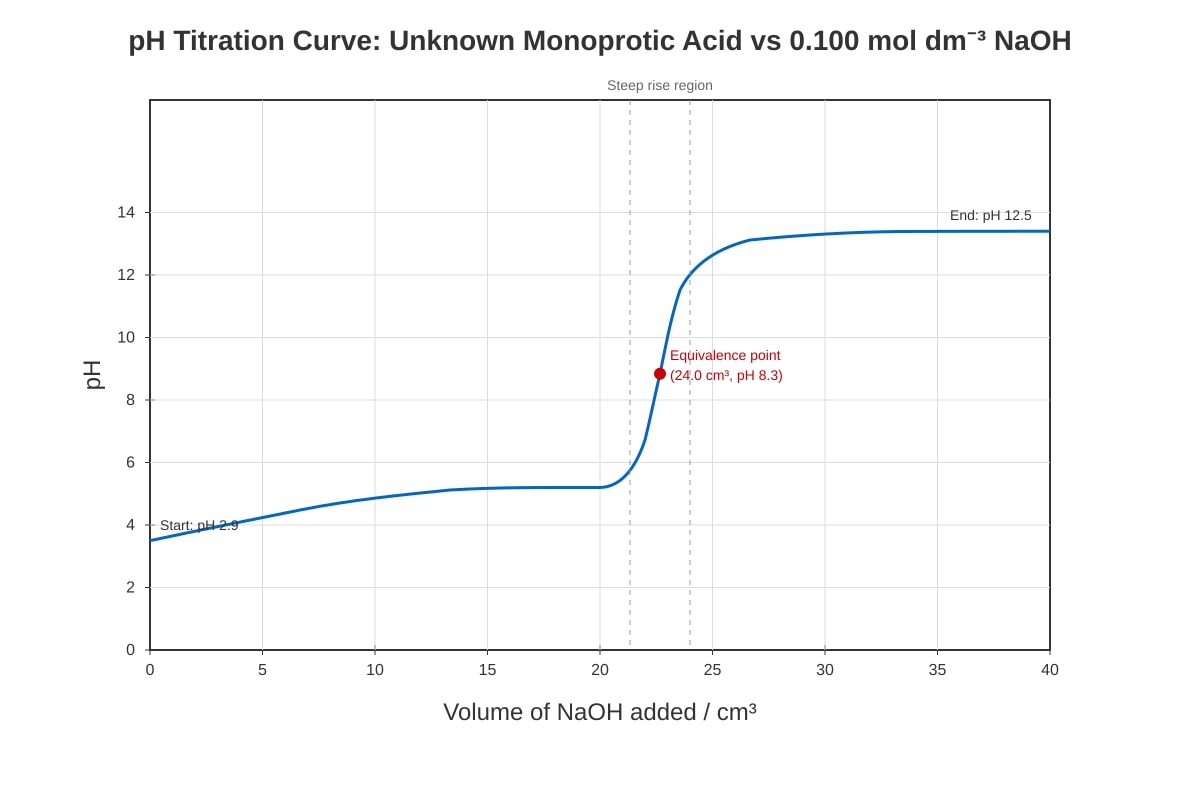
(a) The acid is a weak acid. [1] Evidence: The initial pH is 2.9 (not 1.0 as expected for a strong acid of similar concentration). The equivalence point pH is 8.3 (>7), characteristic of a weak acid-strong base titration. [1]
(b)
- At equivalence point: n(NaOH) = 0.100 × (24.0/1000) = 0.00240 mol [1]
- n(acid) = n(NaOH) = 0.00240 mol (monoprotic acid, 1:1 ratio)
- c(acid) = n / V = 0.00240 / (25.0/1000) = 0.0960 mol dm⁻³ [1]
(c) At the equivalence point, all the weak acid has been converted to its conjugate base (salt). [1] The conjugate base undergoes hydrolysis: A⁻(aq) + H₂O(l) ⇌ HA(aq) + OH⁻(aq), producing OH⁻ ions and making the solution alkaline (pH > 7). [1]
(d) Phenolphthalein (pH range 8.3–10.0) is suitable. [1] The equivalence point pH (8.3) falls within the colour change range of phenolphthalein, so a sharp colour change will be observed at the end point. [1]
(e) Sketch should show:
- Initial pH similar (~2.9) [½]
- Buffer region before equivalence [½]
- Equivalence point at pH < 7 (around 5–6) [½]
- Curve less steep than strong base titration [½] Mark: Award marks for correct shape and labelled equivalence point.
Question 20 (8 marks)
(a) CaO(s) + H₂O(l) → Ca(OH)₂(aq/s) [1] Accept Ca(OH)₂(s) or (aq).
(b) Calcium hydroxide is a base because it accepts protons (H⁺) / neutralises acids / produces OH⁻ ions in water. [1]
(c)
- n(CaO) = mass / Mr = 2800 / 56.1 = 49.91 mol [1]
- From equation: 1 mol CaO produces 1 mol Ca(OH)₂
- n(Ca(OH)₂) = 49.91 mol [1]
- Mass Ca(OH)₂ = n × Mr = 49.91 × 74.1 = 3698 g ≈ 3.70 kg [1] Mark: [1] for moles of CaO, [1] for mole ratio, [1] for final mass with units. Accept 3.7 kg.
(d)
- pH = –log₁₀[H⁺] [1]
- [H⁺] = 10⁻⁴·⁵ = 3.16 × 10⁻⁵ mol dm⁻³ [1] Accept 3.2 × 10⁻⁵ mol dm⁻³.
(e) Calcium hydroxide neutralises H⁺ ions in the soil: OH⁻(aq) + H⁺(aq) → H₂O(l), reducing [H⁺] and increasing pH. [1]
Section C: Free Response Questions (20 marks)
Question 21 (20 marks)
(a) A strong acid is one that completely dissociates in water (e.g., HCl → H⁺ + Cl⁻). [1] A concentrated acid contains a large amount of acid dissolved per unit volume of water. [1] Example: 0.1 mol dm⁻³ HCl is a dilute solution of a strong acid; 10 mol dm⁻³ HCl is a concentrated solution of a strong acid. Strength refers to degree of dissociation; concentration refers to amount of solute. [1]
(b)(i) CO₂(aq) + H₂O(l) ⇌ H₂CO₃(aq) [1]
(b)(ii) H₂CO₃(aq) ⇌ H⁺(aq) + HCO₃⁻(aq) [1]
(b)(iii)
- The buffer contains H₂CO₃ (weak acid) and HCO₃⁻ (conjugate base). [1]
- When excess H⁺ enters the blood: HCO₃⁻(aq) + H⁺(aq) → H₂CO₃(aq) [1]
- The added H⁺ ions are removed by reaction with hydrogencarbonate ions, forming carbonic acid. The [H⁺] remains approximately constant, maintaining pH around 7.4. [1]
(c)(i)
- Total volume = 75.0 cm³
- [C₂H₅COOH] = (0.100 × 50.0/1000) / (75.0/1000) = 0.0667 mol dm⁻³ [1]
- [C₂H₅COO⁻] = (0.100 × 25.0/1000) / (75.0/1000) = 0.0333 mol dm⁻³ [1]
- [H⁺] = Ka × [acid]/[salt] = (1.3 × 10⁻⁵) × (0.0667/0.0333) = 2.6 × 10⁻⁵ mol dm⁻³ [1]
- pH = –log₁₀(2.6 × 10⁻⁵) = 4.59 [1]
(c)(ii)
- Moles of HCl added = 0.100 × (5.0/1000) = 0.00050 mol [1]
- HCl reacts with C₂H₅COO⁻: C₂H₅COO⁻ + H⁺ → C₂H₅COOH
- New moles: C₂H₅COOH = 0.00500 + 0.00050 = 0.00550 mol [1]
- New moles: C₂H₅COO⁻ = 0.00250 – 0.00050 = 0.00200 mol [1]
- New total volume = 80.0 cm³
- [H⁺] = Ka × (n_acid/n_salt) = (1.3 × 10⁻⁵) × (0.00550/0.00200) = 3.575 × 10⁻⁵ mol dm⁻³ [1]
- pH = –log₁₀(3.575 × 10⁻⁵) = 4.45 [1] Note: Since ratio of moles is used, volume cancels out.
(d) A buffer requires a weak acid and its conjugate base in significant concentrations. [1] HCl is a strong acid (completely dissociated); Cl⁻ is a very weak conjugate base with negligible tendency to accept protons. [1] When H⁺ is added, there is no species present to remove it. When OH⁻ is added, there is insufficient weak acid to neutralise it. The mixture cannot resist pH changes. [1]
Question 22 (20 marks)
(a)(i) Le Chatelier's principle states that if a system at dynamic equilibrium is subjected to a change in conditions, the position of equilibrium shifts to counteract (oppose) the change. [1]
(a)(ii)
- The forward reaction is exothermic (ΔH = –197 kJ mol⁻¹). A low temperature favours the exothermic forward reaction, increasing the equilibrium yield of SO₃. [1]
- However, at low temperatures, the rate of reaction is too slow to be economically viable. [1]
- A compromise temperature of 450°C is used, which gives a reasonable yield at an acceptable rate. A catalyst (V₂O₅) is also used to increase the rate. [1]
(a)(iii)
- Increasing pressure shifts the equilibrium to the right (favours SO₃ production). [1]
- There are 3 moles of gas on the left (2SO₂ + O₂) and 2 moles on the right (2SO₃). Increasing pressure favours the side with fewer gas molecules, increasing the yield of SO₃. [1]
(b)(i) SO₂(g) + H₂O(l) → H₂SO₃(aq) OR SO₂(g) + H₂O(l) ⇌ H⁺(aq) + HSO₃⁻(aq) [1]
(b)(ii)
- Limestone is calcium carbonate, CaCO₃. [1]
- Acid rain contains H⁺ ions which react with CaCO₃: CaCO₃(s) + 2H⁺(aq) → Ca²⁺(aq) + CO₂(g) + H₂O(l) [1]
- The solid calcium carbonate dissolves, causing erosion and damage to the building. [1]
(c)(i)
- [H⁺] = 10⁻pH [1]
- [H⁺] = 10⁻⁴·² = 6.31 × 10⁻⁵ mol dm⁻³ [1] Accept 6.3 × 10⁻⁵ mol dm⁻³.
(c)(ii)
- H₂SO₄ is diprotic: H₂SO₄ → 2H⁺ + SO₄²⁻
- [H₂SO₄] = [H⁺] / 2 = (6.31 × 10⁻⁵) / 2 = 3.16 × 10⁻⁵ mol dm⁻³ [1] Mark: [1] for correct division by 2, [1] for correct answer with units.
(c)(iii) Pure water absorbs carbon dioxide from the atmosphere. [1] CO₂ dissolves and reacts: CO₂ + H₂O ⇌ H₂CO₃ ⇌ H⁺ + HCO₃⁻, producing H⁺ ions and lowering the pH below 7.0 (typically around 5.6). [1]
(d)
- Add excess copper(II) oxide (black solid) to warm dilute sulfuric acid and stir. [1]
- CuO(s) + H₂SO₄(aq) → CuSO₄(aq) + H₂O(l) [1]
- Filter the mixture to remove unreacted CuO. [½]
- Heat the filtrate (copper(II) sulfate solution) to evaporate some water until crystallisation point is reached. [½]
- Allow the solution to cool slowly; blue CuSO₄·5H₂O crystals will form. [½]
- Filter the crystals, wash with a little cold distilled water, and dry between filter papers. [½]
END OF ANSWER KEY