AI Generated Exam Paper
A Level H1 Chemistry Practice Paper 2
Free A Level H1 Chemistry Practice Paper 2, DeepSeek AI version, with questions, answers, and A Level-style practice for Singapore students.
These static practice materials are generated from the site's syllabus and paper-generation workflow, with source and model context shown so students and parents can evaluate the material before use.
Questions
Free quiz and exam paper access
Enter your details to view this paper
Your access is remembered on this device.
Answers
TuitionGoWhere Practice Paper - Chemistry H1 A-Level: Answer Key
Paper: Practice Paper 2 (Version 2 of 5) Total Marks: 80
Section A: Structured Questions (30 marks)
Question 1: Acids and Bases Fundamentals (6 marks)
(a) A Brønsted-Lowry acid is a proton (H⁺) donor. [1]
(b) HCl(g) + NH₃(g) → NH₄Cl(s) [1] Acid: HCl (proton donor) [1] Base: NH₃ (proton acceptor) [1] Accept NH₄⁺ and Cl⁻ as products with state symbol (s).
(c) The dissociation of water is endothermic: H₂O(l) ⇌ H⁺(aq) + OH⁻(aq) [1] At higher temperature, the equilibrium shifts right, increasing [H⁺] and [OH⁻] equally. Since pH = –log[H⁺], a higher [H⁺] results in a lower pH. [1] Accept: Kw increases with temperature; pH of neutrality decreases.
Question 2: Weak Acid Equilibria (8 marks)
(a)(i) Ka = [CH₃COO⁻][H⁺] / [CH₃COOH] [1]
(a)(ii) Assumption: [H⁺] ≈ [CH₃COO⁻] and dissociation is negligible, so [CH₃COOH]eq ≈ 0.15 mol dm⁻³. [1] Ka = [H⁺]² / [CH₃COOH] [H⁺] = √(Ka × [CH₃COOH]) = √(1.8 × 10⁻⁵ × 0.15) = √(2.7 × 10⁻⁶) = 1.64 × 10⁻³ mol dm⁻³ [1] pH = –log₁₀(1.64 × 10⁻³) = 2.78 [1]
(a)(iii) After tenfold dilution, [CH₃COOH] = 0.015 mol dm⁻³. [H⁺] = √(1.8 × 10⁻⁵ × 0.015) = √(2.7 × 10⁻⁷) = 5.20 × 10⁻⁴ mol dm⁻³; pH = 3.28. [1] The pH increases by 3.28 – 2.78 = 0.50 units, which is less than 1 unit. This is because the weak acid dissociates to a greater extent upon dilution (higher degree of dissociation), partially offsetting the decrease in concentration. [1]
(b) Methanoic acid is the stronger acid because it has a larger Ka value (1.8 × 10⁻⁴ vs 1.8 × 10⁻⁵). [1] A larger Ka indicates greater dissociation, producing a higher [H⁺] at the same concentration. [1]
Question 3: Acid-Base Titrations (8 marks)
(a) HCl(aq) + NaOH(aq) → NaCl(aq) + H₂O(l) [1]
(b) n(HCl) = 0.10 × 25.0/1000 = 0.00250 mol [1] n(NaOH) required = 0.00250 mol (1:1 ratio) V(NaOH) = n/c = 0.00250 / 0.10 = 0.0250 dm³ = 25.0 cm³ [1]
(c)(i) The volume of NaOH required is the same (25.0 cm³). [1] Both HCl and CH₃COOH are monoprotic acids at the same concentration and volume, so they contain the same number of moles of acid. Each requires the same number of moles of NaOH for complete neutralisation. [1]
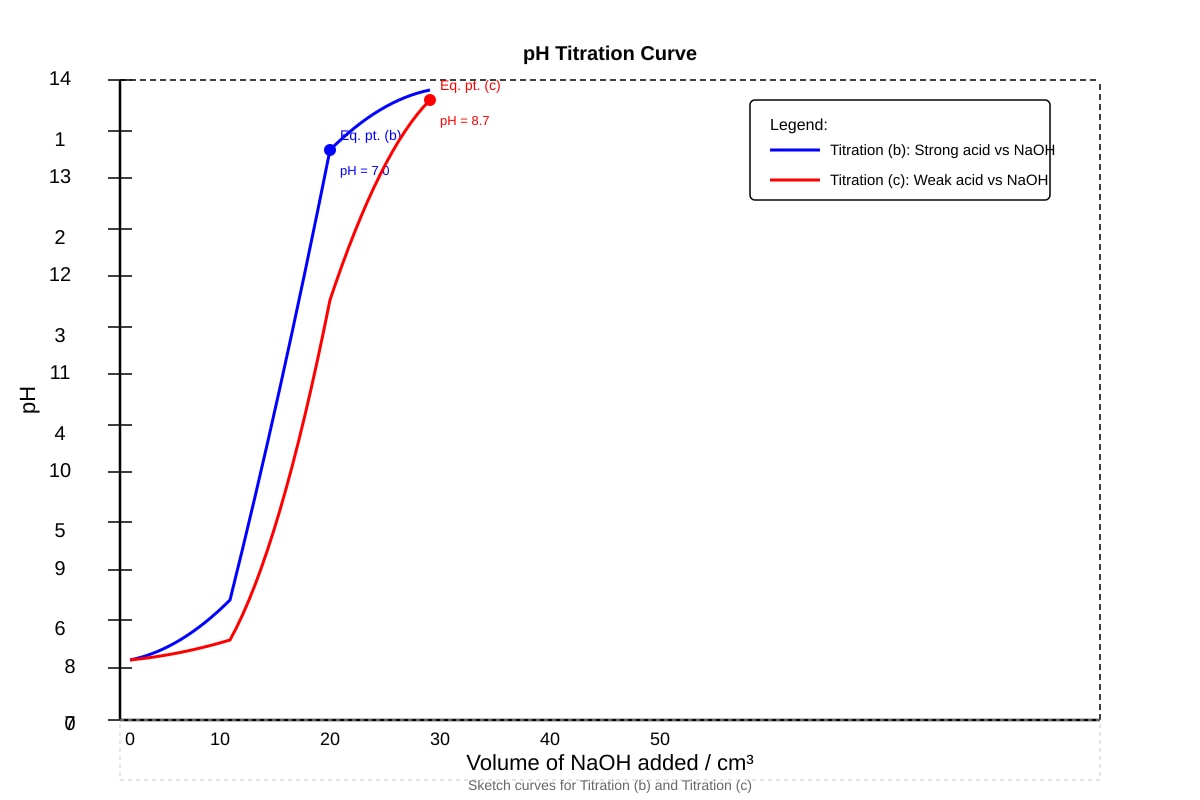
(c)(ii) Sketch showing:
- HCl/NaOH curve: starts at pH ~1, sharp rise at 25.0 cm³, equivalence point pH 7, ends at pH ~13. [1]
- CH₃COOH/NaOH curve: starts at pH ~3, gradual rise with buffer region, equivalence point at 25.0 cm³ with pH ~8.5, ends at pH ~13. [1]
- Both curves correctly labelled; equivalence points indicated. [1]
Question 4: Salt Hydrolysis and pH (8 marks)
(a)(i) CH₃COO⁻(aq) + H₂O(l) ⇌ CH₃COOH(aq) + OH⁻(aq) [1]
(a)(ii) Kb = Kw / Ka = 1.0 × 10⁻¹⁴ / 1.8 × 10⁻⁵ = 5.56 × 10⁻¹⁰ mol dm⁻³ [1] [OH⁻] = √(Kb × [CH₃COO⁻]) = √(5.56 × 10⁻¹⁰ × 0.20) = √(1.11 × 10⁻¹⁰) = 1.05 × 10⁻⁵ mol dm⁻³ [1] pOH = –log₁₀(1.05 × 10⁻⁵) = 4.98 [1] pH = 14 – 4.98 = 9.02 [1]
(b) NH₄Cl dissociates: NH₄Cl(s) → NH₄⁺(aq) + Cl⁻(aq) [1] NH₄⁺ is the conjugate acid of the weak base NH₃ and undergoes hydrolysis: NH₄⁺(aq) + H₂O(l) ⇌ NH₃(aq) + H₃O⁺(aq) [1] This produces H₃O⁺ ions, making the solution acidic. Cl⁻ is the conjugate base of strong HCl and does not hydrolyse. [1]
Section B: Data-Based and Applied Questions (30 marks)
Question 5: Buffer Solutions in Biological Systems (10 marks)
(a) pH = pKa + log([HCO₃⁻]/[H₂CO₃]) pKa = –log(4.3 × 10⁻⁷) = 6.37 [1] 7.40 = 6.37 + log([HCO₃⁻]/[H₂CO₃]) log([HCO₃⁻]/[H₂CO₃]) = 1.03 [HCO₃⁻]/[H₂CO₃] = 10¹·⁰³ = 10.7 ≈ 11:1 [1]
(b) Lactic acid (HLac) dissociates: HLac → H⁺ + Lac⁻ [1] Added H⁺ reacts with HCO₃⁻: H⁺(aq) + HCO₃⁻(aq) → H₂CO₃(aq) [1] The equilibrium H₂CO₃ ⇌ H⁺ + HCO₃⁻ shifts left, consuming added H⁺. The ratio [HCO₃⁻]/[H₂CO₃] changes only slightly, so pH remains nearly constant. [1]
(c) 7.10 = 6.37 + log([HCO₃⁻]/[H₂CO₃]) log([HCO₃⁻]/[H₂CO₃]) = 0.73 [1] [HCO₃⁻]/[H₂CO₃] = 10⁰·⁷³ = 5.37 ≈ 5.4:1 [1]
(d) Sodium hydrogencarbonate provides additional HCO₃⁻ ions: NaHCO₃ → Na⁺ + HCO₃⁻ [1] The added HCO₃⁻ shifts the equilibrium H⁺ + HCO₃⁻ ⇌ H₂CO₃ to the right, consuming excess H⁺ ions. [1] This increases the [HCO₃⁻]/[H₂CO₃] ratio, raising the blood pH back toward the normal 7.40. [1]
Question 6: Acid Rain and Environmental Chemistry (10 marks)
(a)(i) H₂SO₃(aq) ⇌ H⁺(aq) + HSO₃⁻(aq) [1] HSO₃⁻(aq) ⇌ H⁺(aq) + SO₃²⁻(aq) [1]
(a)(ii) Ka₁ = [H⁺][HSO₃⁻] / [H₂SO₃] Assume [H⁺] ≈ [HSO₃⁻] and dissociation is small: [H₂SO₃]eq ≈ 0.010 mol dm⁻³ [1] [H⁺] = √(Ka₁ × [H₂SO₃]) = √(1.5 × 10⁻² × 0.010) = √(1.5 × 10⁻⁴) = 1.22 × 10⁻² mol dm⁻³ [1] pH = –log₁₀(1.22 × 10⁻²) = 1.91 [1]
(b)(i) CO₂(g) + H₂O(l) ⇌ H₂CO₃(aq) [1]
(b)(ii) [H⁺] = 10⁻⁵·⁶ = 2.51 × 10⁻⁶ mol dm⁻³ [1]
(c) [H⁺] at pH 4.2 = 10⁻⁴·² = 6.31 × 10⁻⁵ mol dm⁻³ [1] [H⁺] at pH 5.6 = 2.51 × 10⁻⁶ mol dm⁻³ [1] Factor = 6.31 × 10⁻⁵ / 2.51 × 10⁻⁶ = 25.1 ≈ 25 [1] Accept: difference of 1.4 pH units → factor of 10¹·⁴ = 25.
Question 7: Industrial Acid-Base Processes (10 marks)
(a) Le Chatelier's principle states that if a system at dynamic equilibrium is subjected to a change, the equilibrium position shifts to oppose the change. [1]
(b) SO₃(g) + H₂O(l) → H₂SO₄(aq) [1]
(c)(i) n(H₂SO₄) required = 2.0 × 500/1000 = 1.0 mol [1] V(conc) = n/c = 1.0 / 18 = 0.0556 dm³ = 55.6 cm³ [1]
(c)(ii) Always add acid to water, never water to acid. [1] The dilution of concentrated sulfuric acid is highly exothermic. Adding water to acid can cause localised boiling and splashing of corrosive acid. [1] Add the concentrated acid slowly to a large volume of water with constant stirring to dissipate heat safely. [1]
(d) H₂SO₄ → 2H⁺ + SO₄²⁻ [H⁺] = 2 × 0.050 = 0.10 mol dm⁻³ [1] pH = –log₁₀(0.10) = 1.00 [1] Accept: pH = 1.0. Note: Second dissociation is not fully complete for HSO₄⁻, but at this level, complete dissociation is assumed. [1]
Section C: Free-Response Questions (20 marks)
Question 8: Acids, Bases, and Buffer Systems (20 marks)
(a) A strong acid is one that completely dissociates in water (e.g., HCl → H⁺ + Cl⁻). [1] A concentrated acid contains a large amount of acid per unit volume (e.g., 12 mol dm⁻³ HCl). [1] Strength refers to the degree of dissociation; concentration refers to the amount of solute. [1] Example: 0.1 mol dm⁻³ HCl is a dilute solution of a strong acid; 5 mol dm⁻³ ethanoic acid is a concentrated solution of a weak acid. [1]
(b)(i) n(CH₃COONa) = 4.10 / 82.0 = 0.0500 mol [1] [CH₃COONa] = 0.0500 / (250/1000) = 0.200 mol dm⁻³ [1]
(b)(ii) [H⁺] = Ka × [CH₃COOH] / [CH₃COO⁻] = (1.8 × 10⁻⁵) × 0.20 / 0.20 = 1.8 × 10⁻⁵ mol dm⁻³ [1] pH = –log₁₀(1.8 × 10⁻⁵) = 4.74 [1] Note: When [acid] = [salt], pH = pKa. [1]
(b)(iii) n(H⁺) added = 1.0 × 1.0/1000 = 0.0010 mol [1] In 100 cm³ buffer: n(CH₃COOH) = 0.20 × 100/1000 = 0.020 mol; n(CH₃COO⁻) = 0.20 × 100/1000 = 0.020 mol [1] Added H⁺ reacts: CH₃COO⁻ + H⁺ → CH₃COOH New n(CH₃COOH) = 0.020 + 0.0010 = 0.021 mol; new n(CH₃COO⁻) = 0.020 – 0.0010 = 0.019 mol [1] Assumption: volume change negligible; concentrations proportional to moles. [1] [H⁺] = Ka × n(CH₃COOH)/n(CH₃COO⁻) = (1.8 × 10⁻⁵) × 0.021/0.019 = 1.99 × 10⁻⁵ mol dm⁻³ pH = –log₁₀(1.99 × 10⁻⁵) = 4.70 [1]
(c) Many biochemical reactions are enzyme-catalysed, and enzymes function optimally only within a narrow pH range. [1] For example, blood pH must be maintained at 7.40 ± 0.05; deviation can cause acidosis or alkalosis, impairing oxygen transport and metabolic function. [1] Buffer systems (e.g., H₂CO₃/HCO₃⁻, H₂PO₄⁻/HPO₄²⁻) resist pH changes, maintaining homeostasis. [1]
(d) The claim is incorrect. [1] Adding more solid sodium ethanoate increases [CH₃COO⁻]. [1] According to [H⁺] = Ka × [CH₃COOH]/[CH₃COO⁻], increasing the denominator decreases [H⁺], so pH increases (becomes more basic, not more acidic). [1]
Question 9: Acid-Base Equilibria and Applications (20 marks)
(a)(i) HCOOH(aq) ⇌ HCOO⁻(aq) + H⁺(aq) [1] Ka = [HCOO⁻][H⁺] / [HCOOH] [1]
(a)(ii) [H⁺] = 10⁻²·³⁸ = 4.17 × 10⁻³ mol dm⁻³ [1] [HCOO⁻] = [H⁺] = 4.17 × 10⁻³ mol dm⁻³; [HCOOH]eq ≈ 0.10 mol dm⁻³ [1] Ka = (4.17 × 10⁻³)² / 0.10 = 1.74 × 10⁻⁴ mol dm⁻³ [1]
(a)(iii) % dissociation = ([H⁺] / [HCOOH]initial) × 100 = (4.17 × 10⁻³ / 0.10) × 100 = 4.17% ≈ 4.2% [2]
(b)(i) At half-equivalence, [HCOOH] = [HCOO⁻]. [1] From Ka expression: [H⁺] = Ka = 1.74 × 10⁻⁴ mol dm⁻³ [1] pH = pKa = –log₁₀(1.74 × 10⁻⁴) = 3.76 [1]
(b)(ii) The titration is a weak acid–strong base titration. The equivalence point pH is >7 (approximately 8–9). [1] Phenolphthalein changes colour over pH 8.3–10.0, which encompasses the equivalence point pH, giving a sharp endpoint. [1] Methyl orange changes colour over pH 3.1–4.4, which is before the equivalence point; the colour change would be gradual and the endpoint unclear. [1]
(c)(i) As an acid: ⁺H₃NCH₂COO⁻ + H₂O ⇌ H₂NCH₂COO⁻ + H₃O⁺ (donates proton from –NH₃⁺) [1] As a base: ⁺H₃NCH₂COO⁻ + H₂O ⇌ ⁺H₃NCH₂COOH + OH⁻ (accepts proton at –COO⁻) [1]
(c)(ii) At the isoelectric point, glycine exists predominantly as the zwitterion, which can act as both a weak acid and a weak base. [1] Addition of small amounts of H⁺ or OH⁻ can be absorbed by the zwitterion, minimising pH change. [1]
(d) Conductivity order: HCl ≈ NaCl > CH₃COOH (at same concentration). [1] HCl is fully dissociated into H⁺ and Cl⁻ ions; NaCl is fully dissociated into Na⁺ and Cl⁻ ions. Both have high ionic concentrations. [1] CH₃COOH is a weak acid, only partially dissociated, so the concentration of ions (H⁺ and CH₃COO⁻) is much lower, resulting in lower conductivity. [1]
END OF ANSWER KEY