AI Generated Exam Paper
A Level H1 Chemistry Practice Paper 1
Free A Level H1 Chemistry Practice Paper 1, LongCat AI version, with questions, answers, and A Level-style practice for Singapore students.
These static practice materials are generated from the site's syllabus and paper-generation workflow, with source and model context shown so students and parents can evaluate the material before use.
Questions
Free quiz and exam paper access
Enter your details to view this paper
Your access is remembered on this device.
Answers
TuitionGoWhere Practice Paper — Chemistry H1 A-Level
Answer Key: Acids, Bases & Salts (Version 1 of 5)
Section A: Short-Answer Questions
1. Define the term strong acid. [2]
A strong acid is an acid that completely dissociates (ionises) in aqueous solution.
Marking:
- [1] for "completely dissociates" or "fully ionises"
- [1] for specifying "in aqueous solution" or "in water"
Common mistakes:
- Saying "releases all its H⁺ ions" without mentioning aqueous solution — acceptable but incomplete.
- Confusing "strong" with "concentrated" — a strong acid can be dilute.
2. A solution of hydrochloric acid has a pH of 1.20. Calculate the concentration of ions in this solution. [2]
Working:
Marking:
- [1] for correct formula/rearrangement:
- [1] for correct answer: 0.063 mol dm⁻³ (to 2 s.f.)
Common mistakes:
- Giving the answer as 0.06 mol dm⁻³ (1 s.f.) — penalise 1 mark.
- Forgetting the negative sign in the formula.
3. Explain why ethanoic acid () is described as a weak acid. Illustrate your answer with an equation. [2]
Ethanoic acid is a weak acid because it only partially dissociates in aqueous solution. The dissociation is incomplete and reaches an equilibrium.
Marking:
- [1] for stating "partially dissociates" or "does not fully ionise"
- [1] for correct equation with reversible arrow (⇌) and correct state symbols
Common mistakes:
- Writing a single arrow (→) instead of ⇌ — lose the equation mark.
- Omitting state symbols — may lose the equation mark depending on scheme.
- Saying "dilute" instead of "weak" — these are different concepts (concentration vs. degree of dissociation).
4. State the conjugate base of each of the following:
(a) [1]
Answer: (hydrogensulfate ion)
Explanation: A conjugate base is formed when an acid donates a proton (). loses one to become .
(b) [1]
Answer: (ammonia)
Explanation: loses a proton to become .
Common mistakes:
- Writing for (a) — this is the conjugate base of , not directly in a single deprotonation step.
- Writing for (b) — incorrect; removing one from gives .
5. A student adds 25.0 cm³ of 0.100 mol dm⁻³ to 25.0 cm³ of 0.100 mol dm⁻³ . Calculate the pH of the resulting solution at 25 °C. [2]
Working:
Moles of = mol
Moles of = mol
Moles of = Moles of → exact neutralisation.
The products are (a neutral salt from strong acid + strong base) and water.
Marking:
- [1] for showing that moles are equal / exact neutralisation
- [1] for final answer: pH = 7
Common mistakes:
- Calculating a new concentration and trying to find pH from that — unnecessary since the salt is neutral.
- Forgetting that does not hydrolyse.
6. Distinguish between the terms concentration and strength as applied to acids. [2]
Concentration refers to the amount of acid dissolved per unit volume of solution (measured in mol dm⁻³). It describes how much acid is present.
Strength refers to the extent of dissociation of the acid in aqueous solution. A strong acid completely dissociates; a weak acid partially dissociates.
A weak acid can be concentrated (high amount dissolved, but still partially dissociated), and a strong acid can be dilute (low amount dissolved, but fully dissociated).
Marking:
- [1] for correct definition of concentration (amount per unit volume)
- [1] for correct definition of strength (extent of dissociation)
Common mistakes:
- Using "concentrated" and "strong" interchangeably — these are fundamentally different concepts.
- Saying "strength means how many H⁺ ions" without mentioning dissociation.
7. Write an expression for the acid dissociation constant, , for the weak acid . [2]
Marking:
- [1] for correct balanced equation with reversible arrow
- [1] for correct expression (products over reactant, no pure liquids/solids)
Common mistakes:
- Including in the expression — water is the solvent and is omitted.
- Writing a single arrow instead of ⇌.
8. A solution contains 0.050 mol dm⁻³ . Calculate the pH of this solution at 25 °C. [2]
Working:
is a strong base, so it fully dissociates:
Marking:
- [1] for correct calculation or correct identification
- [1] for final answer: pH = 12.70
Alternative method: mol dm⁻³
Common mistakes:
- Forgetting that is a strong base and assuming partial dissociation.
- Using directly — this gives , not .
9. Explain what is meant by a buffer solution. Give one example of a buffer system. [3]
A buffer solution is a solution that resists changes in pH when small amounts of acid or base are added, or when it is diluted.
A buffer typically consists of a weak acid and its conjugate base (or a weak base and its conjugate acid).
Example: A mixture of ethanoic acid () and sodium ethanoate (), where is the weak acid and (from the salt) is the conjugate base.
Marking:
- [1] for definition: resists pH change on addition of small amounts of acid/base
- [1] for stating it contains a weak acid and its conjugate base (or weak base and its conjugate acid)
- [1] for a valid example
Common mistakes:
- Saying "keeps pH constant" — buffers resist changes, they don't keep pH absolutely constant.
- Giving a strong acid + its salt as an example — strong acids do not form buffers.
10. Describe how you would prepare a buffer solution with a pH of approximately 4.8 using ethanoic acid and sodium ethanoate. Explain how this buffer would resist changes in pH when a small amount of dilute is added. [4]
Preparation:
Using the Henderson-Hasselbalch equation:
To prepare the buffer, mix ethanoic acid and sodium ethanoate solutions such that the concentration of sodium ethanoate is approximately 1.15 times that of ethanoic acid. For example, mix equal volumes of 0.10 mol dm⁻³ ethanoic acid and 0.115 mol dm⁻³ sodium ethanoate.
Resistance to added :
When a small amount of is added, the ions react with the weak acid component of the buffer:
The is consumed by converting into . Since both and are large compared to the amount of added, their ratio changes very little, and so the pH remains approximately constant.
Marking:
- [1] for using Henderson-Hasselbalch to find the ratio (or equivalent reasoning)
- [1] for describing a practical method to prepare the buffer
- [1] for stating that reacts with
- [1] for explaining that the ratio changes little, so pH is approximately constant
Section B: Structured and Data-Response Questions
11. A student investigates the properties of three solutions: Solution A (0.10 mol dm⁻³ ), Solution B (0.10 mol dm⁻³ ), and Solution C (0.10 mol dm⁻³ ).
(a) Arrange the three solutions in order of increasing pH. Explain your reasoning. [3]
Answer: Solution A < Solution B < Solution C
Explanation:
- Solution A (): is a strong acid that fully dissociates, so mol dm⁻³. . This has the lowest pH.
- Solution B (): Ethanoic acid is a weak acid that only partially dissociates, so mol dm⁻³. (approximately 2.9 for 0.10 mol dm⁻³). This has an intermediate pH.
- Solution C (): is a strong base, so mol dm⁻³, , . This has the highest pH.
Marking:
- [1] for correct order: A < B < C
- [1] for explaining HCl is strong (fully dissociated) → lowest pH
- [1] for explaining CH₃COOH is weak (partially dissociated) → intermediate pH, and NaOH is a strong base → highest pH
(b) The student measures the electrical conductivity of each solution. Explain which solution would show the highest conductivity and why. [3]
Answer: Solutions A and C would both show high conductivity, but Solution A and Solution C would have similar and higher conductivity than Solution B.
Explanation: Electrical conductivity depends on the concentration of ions in solution.
- Solution A (): Fully dissociates into and → total ion concentration = 0.20 mol dm⁻³ (0.10 M + 0.10 M )
- Solution C (): Fully dissociates into and → total ion concentration = 0.20 mol dm⁻³ (0.10 M + 0.10 M )
- Solution B (): Only partially dissociates (α ≈ 1.3% for 0.10 M) → very low ion concentration → lowest conductivity
Both Solutions A and C have the same total ion concentration (0.20 mol dm⁻³) and would show similar, high conductivity. Solution B has significantly fewer ions and the lowest conductivity.
Marking:
- [1] for identifying Solution B as having the lowest conductivity (weak acid, few ions)
- [1] for explaining that Solutions A and C fully dissociate giving high ion concentrations
- [1] for linking conductivity to ion concentration
(c) The student adds excess magnesium ribbon to equal volumes of Solutions A and B. Compare the initial rates of reaction and the total volumes of gas produced. Explain your answer. [4]
Reactions:
Initial rate of reaction:
- Solution A () reacts faster initially because is higher (0.10 mol dm⁻³ from full dissociation).
- Solution B () reacts slower initially because is much lower (only from partial dissociation, approximately 0.0013 mol dm⁻³).
- The rate of reaction depends on ; higher → more frequent successful collisions → faster rate.
Total volume of gas produced:
- Both solutions have the same total moles of acid (same volume, same concentration: 0.10 mol dm⁻³).
- Since both are monoprotic acids (each mole of acid provides 1 mol ultimately), and magnesium is in excess, the total moles of produced are the same.
- For Solution B, as is consumed, the equilibrium shifts right, dissociating more acid until all the acid has reacted.
- Therefore, the total volume of gas produced is the same for both solutions (measured at the same temperature and pressure).
Marking:
- [1] for stating Solution A has a faster initial rate
- [1] for explaining this is due to higher in Solution A (strong acid fully dissociated)
- [1] for stating total volumes of gas are the same
- [1] for explaining that total moles of acid are equal and all acid eventually reacts (equilibrium shifts in weak acid)
12. The following table shows the values for three weak acids at 25 °C.
| Acid | Formula | / mol dm⁻³ |
|---|---|---|
| Methanoic acid | ||
| Ethanoic acid | ||
| Carbonic acid |
(a) Identify the strongest acid from the table. Justify your answer. [2]
Answer: Methanoic acid () is the strongest acid.
Justification: The acid with the largest value is the strongest because a larger indicates a greater extent of dissociation in aqueous solution. Methanoic acid has , which is the largest of the three values.
Marking:
- [1] for identifying methanoic acid
- [1] for justification based on largest = greatest extent of dissociation
(b) Calculate the pH of a 0.20 mol dm⁻³ solution of methanoic acid. [3]
Working:
Let . Then and .
Since is small, , so approximate :
Check approximation: ✓ (valid)
Marking:
- [1] for correct expression
- [1] for correct substitution and solving for
- [1] for correct pH = 2.25
(c) A buffer solution is prepared by mixing 50.0 cm³ of 0.10 mol dm⁻³ ethanoic acid with 50.0 cm³ of 0.10 mol dm⁻³ sodium ethanoate. Calculate the pH of this buffer. ( of ethanoic acid = mol dm⁻³) [3]
Working:
When equal volumes are mixed, the concentrations are halved, but the ratio remains 1:1.
Using the Henderson-Hasselbalch equation:
Marking:
- [1] for correct calculation
- [1] for correct ratio = 1 (or correct new concentrations)
- [1] for correct pH = 4.74
(d) A small amount of is added to the buffer in (c). Explain, with reference to an equation, how the pH remains approximately constant. [2]
Answer:
When is added, the ions react with the conjugate base () in the buffer:
The added is consumed by converting into . Since both and are relatively large, their ratio changes only slightly, so the pH remains approximately constant.
Marking:
- [1] for correct equation showing reacting with
- [1] for explaining the ratio changes little, so pH is approximately constant
13. A student carries out a titration to determine the concentration of a solution of using 0.100 mol dm⁻³ sulfuric acid, .
(a) Write the balanced equation for the reaction between and . [1]
Marking:
- [1] for correct balanced equation with state symbols
(b) The student uses 25.0 cm³ of solution and finds that 22.4 cm³ of 0.100 mol dm⁻³ is required to reach the end-point. Calculate the concentration of the solution. [3]
Working:
Moles of used:
From the equation:
Mole ratio
Concentration of :
Marking:
- [1] for correct moles of
- [1] for using correct mole ratio (1:2) to find moles of
- [1] for correct concentration = 0.179 mol dm⁻³ (3 s.f.)
(c) The student considers using methyl orange or phenolphthalein as the indicator. State which indicator is more suitable for this titration and explain your choice. [2]
Answer: Methyl orange is more suitable.
Explanation: This is a strong acid () vs. strong base () titration. The equivalence point occurs at pH 7. Methyl orange changes colour in the pH range 3.1–4.4 (red to yellow), and phenolphthalein changes in the pH range 8.2–10.0 (colourless to pink).
For a strong acid–strong base titration, the pH changes very rapidly near the equivalence point (from about pH 3 to pH 11 over a very small volume). Methyl orange's colour change occurs on the steep part of the curve, giving a sharp end-point. Either indicator can work, but methyl orange is traditionally preferred for acid-into-base titrations as the colour change from yellow to red/orange is easier to detect at the end of the titration.
Marking:
- [1] for choosing methyl orange
- [1] for explanation referencing the pH range of the indicator and the steep pH change at equivalence
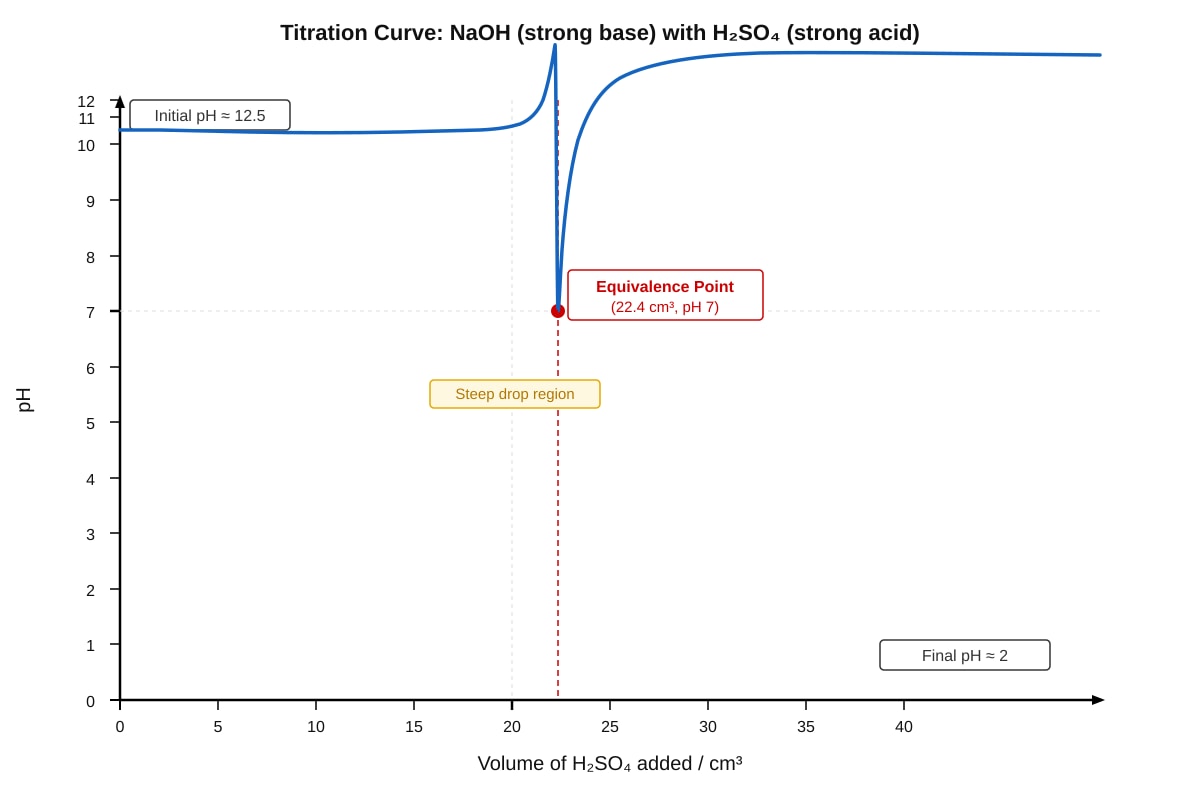
(d) Sketch a titration curve for this titration. [3]
Expected features of the sketch:
- x-axis: Volume of added / cm³ (0 to ~40)
- y-axis: pH (0 to 14)
- Starting pH: High (~12–13), since the solution initially contains (a strong base)
- Shape: Relatively flat at high pH, then a sharp steep drop near the equivalence point
- Equivalence point: At 22.4 cm³, pH = 7 (strong acid + strong base)
- After equivalence: Curve levels off at low pH (~1–2) as excess is added
- Steep region: Should span approximately pH 10 to pH 3 over a very small volume range
Marking:
- [1] for correct starting pH (high, ~12–13)
- [1] for correct equivalence point position (22.4 cm³, pH 7) and steep drop
- [1] for correct general S-shape / sigmoidal curve
Image placeholder reference: The <image_placeholder> tag for Q13-fig1 specifies a titration curve with axes labelled, equivalence point at (22.4, 7), initial pH ≈ 12.5, and final pH ≈ 2.
14. The pH of human blood is maintained at approximately 7.4 by the carbonic acid-hydrogencarbonate buffer system:
(a) Identify the weak acid and the conjugate base in this buffer system. [1]
Weak acid: (carbonic acid)
Conjugate base: (hydrogencarbonate ion)
Marking:
- [1] for both correct
(b) Explain how this buffer system responds when a small amount of acid (excess ) enters the blood. [2]
When excess enters the blood, it reacts with the conjugate base :
The equilibrium shifts to the left (according to Le Chatelier's principle), consuming the added ions. This prevents the pH from dropping significantly.
Marking:
- [1] for correct equation showing reacting with
- [1] for stating the equilibrium shifts left / is consumed
(c) Explain how this buffer system responds when a small amount of base (excess ) enters the blood. [2]
When excess enters the blood, it reacts with the weak acid :
Alternatively, reacts with from the equilibrium, and the equilibrium shifts to the right to replenish :
The equilibrium shifts right, producing more to replace what was consumed. This prevents the pH from rising significantly.
Marking:
- [1] for correct equation or explanation
- [1] for stating equilibrium shifts right / is replenished
(d) The of carbonic acid is mol dm⁻³. Calculate the ratio of to in blood at pH 7.4. [3]
Working:
Using the Henderson-Hasselbalch equation:
Marking:
- [1] for correct calculation
- [1] for correct substitution into Henderson-Hasselbalch equation
- [1] for correct ratio = 10.7 (or approximately 11:1)
(e) State one consequence for the body if the blood pH deviates significantly from 7.4. [1]
Answer (any one of):
- Enzymes may denature (lose their 3D structure and function), as enzymes are sensitive to pH changes.
- Acidosis (if pH drops below 7.35) or alkalosis (if pH rises above 7.45) can occur, which can be life-threatening.
- Oxygen transport by haemoglobin may be impaired.
Marking:
- [1] for any valid consequence
15. A student is given a solution of an unknown monoprotic weak acid, , with a concentration of 0.050 mol dm⁻³. The student measures the pH of the solution and finds it to be 3.02.
(a) Calculate the concentration of ions in the solution. [1]
Answer: mol dm⁻³
Marking:
- [1] for correct answer
(b) Calculate the acid dissociation constant, , for this weak acid. [3]
Working:
| Initial / mol dm⁻³ | 0.050 | 0 | 0 |
| Change / mol dm⁻³ | |||
| Equilibrium / mol dm⁻³ |
At equilibrium: mol dm⁻³
Marking:
- [1] for correct expression
- [1] for correct substitution of equilibrium concentrations
- [1] for correct answer: mol dm⁻³
(c) Calculate the p of this acid. [1]
Answer:
Marking:
- [1] for correct answer
(d) The student now prepares a buffer by mixing 100 cm³ of 0.050 mol dm⁻³ with 100 cm³ of 0.050 mol dm⁻³ . Calculate the pH of the resulting buffer solution. [2]
Working:
Equal volumes and equal concentrations are mixed, so:
(Each is halved, but the ratio remains 1:1.)
Using Henderson-Hasselbalch:
Answer: pH = 4.73
Marking:
- [1] for recognising the ratio
- [1] for correct pH = 4.73
(e) Explain why the pH of the buffer in (d) is different from the pH of the original 0.050 mol dm⁻³ solution. [2]
Answer:
The original 0.050 mol dm⁻³ solution had a pH of 3.02 because the weak acid only partially dissociates, producing a relatively low .
In the buffer solution, the addition of provides a high concentration of the conjugate base . According to Le Chatelier's principle, the presence of suppresses the dissociation of (shifts the equilibrium to the left), resulting in an even lower from the acid alone. However, the Henderson-Hasselbalch equation shows that the pH is now determined by the ratio , which is 1, giving pH = = 4.73.
The pH of the buffer (4.73) is higher than the pH of the original acid solution (3.02) because the conjugate base from shifts the equilibrium position, reducing and raising the pH.
Marking:
- [1] for explaining that the conjugate base suppresses dissociation of (Le Chatelier's principle)
- [1] for explaining that the pH is now determined by the ratio and equals , which is higher than the original pH
End of Answer Key
Section A Total: 20 marks Section B Total: 40 marks Total: 60 marks