AI Generated Exam Paper
A Level H1 Chemistry Practice Paper 1
Free A Level H1 Chemistry Practice Paper 1, HY3 AI version, with questions, answers, and A Level-style practice for Singapore students.
These static practice materials are generated from the site's syllabus and paper-generation workflow, with source and model context shown so students and parents can evaluate the material before use.
Questions
Free quiz and exam paper access
Enter your details to view this paper
Your access is remembered on this device.
Answers
TuitionGoWhere Practice Paper - Chemistry H1 A-Level (Answers)
Version 1 of 5 — Answer Key
Section A: Definitions and Concepts
1. [2 marks]
- A weak acid is one that only partially dissociates (ionises) in water. [1]
- Equation: (or any weak acid with reversible arrow and state symbols). [1]
- Teaching note: Strength refers to extent of dissociation, NOT concentration. Use ⇌ not →. Common trap: writing "dilute" instead of "weak".
2. [1 mark]
- A Brønsted–Lowry base is a proton (H⁺) acceptor.
- Teaching note: Contrast with Arrhenius base (produces OH⁻ in water).
3. [2 marks]
- Conjugate acid–base pairs: NH₄⁺/NH₃ and H₂O/OH⁻. [1+1]
- Teaching note: Pair differs by one H⁺. NH₃ gains H⁺ to become NH₄⁺; H₂O loses H⁺ to become OH⁻.
4. [1 mark]
- A strong base is one that completely dissociates in water (e.g., NaOH → Na⁺ + OH⁻).
5. [1 mark]
- pH = –log(0.010) = 2.00
- Teaching note: HCl is strong monoprotic, so [H⁺] = 0.010 mol dm⁻³.
6. [2 marks]
- High acidity (low pH) denatures enzymes by disrupting H-bonds and ionic bonds in tertiary structure. [1]
- Active site changes shape; substrate cannot bind; fermentation slows. Ca(OH)₂ neutralises acid, maintaining optimal pH. [1]
Section B: Calculations
7. [3 marks]
- (x = [H⁺])
- pH = –log(9.49×10⁻⁴) = 3.02 [1 for setup, 1 for x, 1 for pH]
8. [3 marks]
- n(NaOH) = 0.0200 × (20.0/1000) = 4.00×10⁻⁴ mol [1]
- C₆H₅COOH + NaOH → C₆H₅COO⁻Na⁺ + H₂O (1:1), so n(acid) = 4.00×10⁻⁴ mol [1]
- c(acid) = 4.00×10⁻⁴ / (25.0/1000) = 0.0160 mol dm⁻³ [1]
9. [3 marks]
- pH = pK_a + log([A⁻]/[HA])
- pK_a = –log(1.8×10⁻⁵) = 4.74
- pH = 4.74 + log(0.15/0.10) = 4.74 + 0.176 = 4.92 [1+1+1]
10. [2 marks]
- [H⁺] = 10^(-pH) = 10^(-3.40) = 3.98 × 10⁻⁴ mol dm⁻³ [1 for method, 1 for value]
11. [2 marks]
- H₂SO₄ → 2H⁺ + SO₄²⁻ (complete), [H⁺] = 2 × 0.0500 = 0.100 mol dm⁻³ [1]
- pH = –log(0.100) = 1.00 [1]
12. [1 mark]
13. [3 marks]
- [OH⁻] = 0.100 mol dm⁻³ [1]
- [H⁺] = K_w / [OH⁻] = 1.0×10⁻¹⁴ / 0.100 = 1.0×10⁻¹³ [1]
- pH = –log(1.0×10⁻¹³) = 13.00 [1]
Section C: Structured and Applied Reasoning
14. [5 marks] (a) [3]
- H₃PO₄(aq) ⇌ H₂PO₄⁻(aq) + H⁺(aq)
- H₂PO₄⁻(aq) ⇌ HPO₄²⁻(aq) + H⁺(aq)
- HPO₄²⁻(aq) ⇌ PO₄³⁻(aq) + H⁺(aq) (b) [2] Each successive removal of H⁺ is harder because the anion becomes more negative, increasing electrostatic attraction for H⁺; repulsion for loss of positive proton increases.
15. [4 marks] (a) [1] HCO₃⁻/CO₃²⁻ (or H₂CO₃/HCO₃⁻) (b) [3] Added CO₂ → H₂CO₃ → H⁺ + HCO₃⁻; CO₃²⁻ consumes H⁺: CO₃²⁻ + H⁺ → HCO₃⁻, limiting pH drop. Equilibrium shifts to absorb acid.
16. [3 marks]
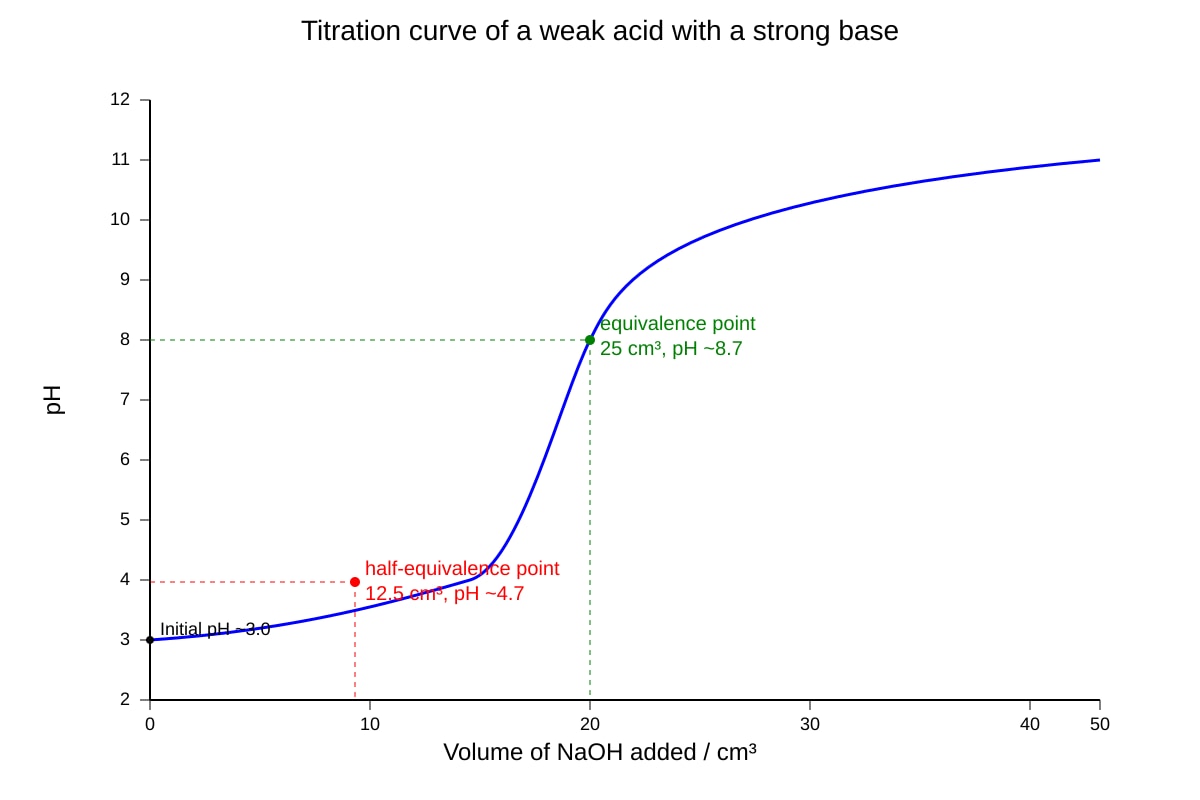
- pH at half-equivalence = 4.7 [1]
- At half-equivalence, [acid] = [salt], so pH = pK_a [1]; thus pK_a = 4.7 and K_a = 10^(-4.7) [1]
17. [3 marks]
- Phenolphthalein (or suitable indicator with range pH 8–10) [1]
- Equivalence point pH ~8.7 (weak acid–strong base) [1]; indicator must change in alkaline range [1]
18. [4 marks]
- NH₃ + H₂O ⇌ NH₄⁺ + OH⁻: added acid consumed by NH₃, added base by NH₄⁺. [2]
- HCO₃⁻ ⇌ H⁺ + CO₃²⁻: added acid consumed by CO₃²⁻, added base by HCO₃⁻. [2]
19. [3 marks] (a) [2] [H⁺] = 10^(-4.50) = 3.16×10⁻⁵ mol dm⁻³ (b) [1] Coral bleaching / shell dissolution in marine organisms.
20. [5 marks] (a) [1] Ethanoic < Benzoic < Formic (b) [2] Larger K_a means greater dissociation; formic highest K_a = strongest. (c) [2] Ethanoic acid (smallest K_a = weakest) gives lowest [H⁺], thus highest pH at equal concentration.