AI Generated Exam Paper
A Level H1 Chemistry Practice Paper 1
Free A Level H1 Chemistry Practice Paper 1, DeepSeek AI version, with questions, answers, and A Level-style practice for Singapore students.
These static practice materials are generated from the site's syllabus and paper-generation workflow, with source and model context shown so students and parents can evaluate the material before use.
Questions
Free quiz and exam paper access
Enter your details to view this paper
Your access is remembered on this device.
Answers
TuitionGoWhere Practice Paper - Chemistry H1 A-Level
Answer Key and Marking Scheme
Paper: Practice Paper 1 (Version 1 of 5) Subject: Chemistry H1 Level: A-Level Total Marks: 80
Section A: Structured Questions (30 marks)
Question 1: Methanoic Acid
(a) Define the term weak acid. [1]
- Answer: A weak acid is an acid that partially dissociates (or ionises) in water / aqueous solution. [1]
- Accept: An acid that exists in equilibrium with its ions in water.
- Reject: "Does not dissociate fully" without mention of partial dissociation.
(b) Write an equation, including state symbols, for the dissociation of methanoic acid in water. [1]
- Answer: HCOOH(aq) ⇌ HCOO⁻(aq) + H⁺(aq) [1]
- Mark: Equilibrium arrow (⇌) and correct state symbols required.
- Reject: Single arrow (→); missing or incorrect state symbols.
(c) Write the expression for the acid dissociation constant, Kₐ, of methanoic acid. [1]
- Answer: Kₐ = [HCOO⁻][H⁺] / [HCOOH] [1]
- Reject: Including [H₂O] in the expression.
(d) Calculate the Kₐ value of methanoic acid. [3]
- Answer:
- [H⁺] = 10⁻²·³⁸ = 4.17 × 10⁻³ mol dm⁻³ [1]
- [HCOO⁻] = [H⁺] = 4.17 × 10⁻³ mol dm⁻³ [1]
- [HCOOH] ≈ 0.100 – 4.17 × 10⁻³ ≈ 0.0958 mol dm⁻³
- Kₐ = (4.17 × 10⁻³)² / 0.0958 = 1.82 × 10⁻⁴ mol dm⁻³ [1]
- Accept: 1.8 × 10⁻⁴ mol dm⁻³ (2 s.f.)
- Marking notes: Award [1] for correct [H⁺], [1] for recognising [H⁺] = [HCOO⁻], [1] for correct Kₐ calculation with units.
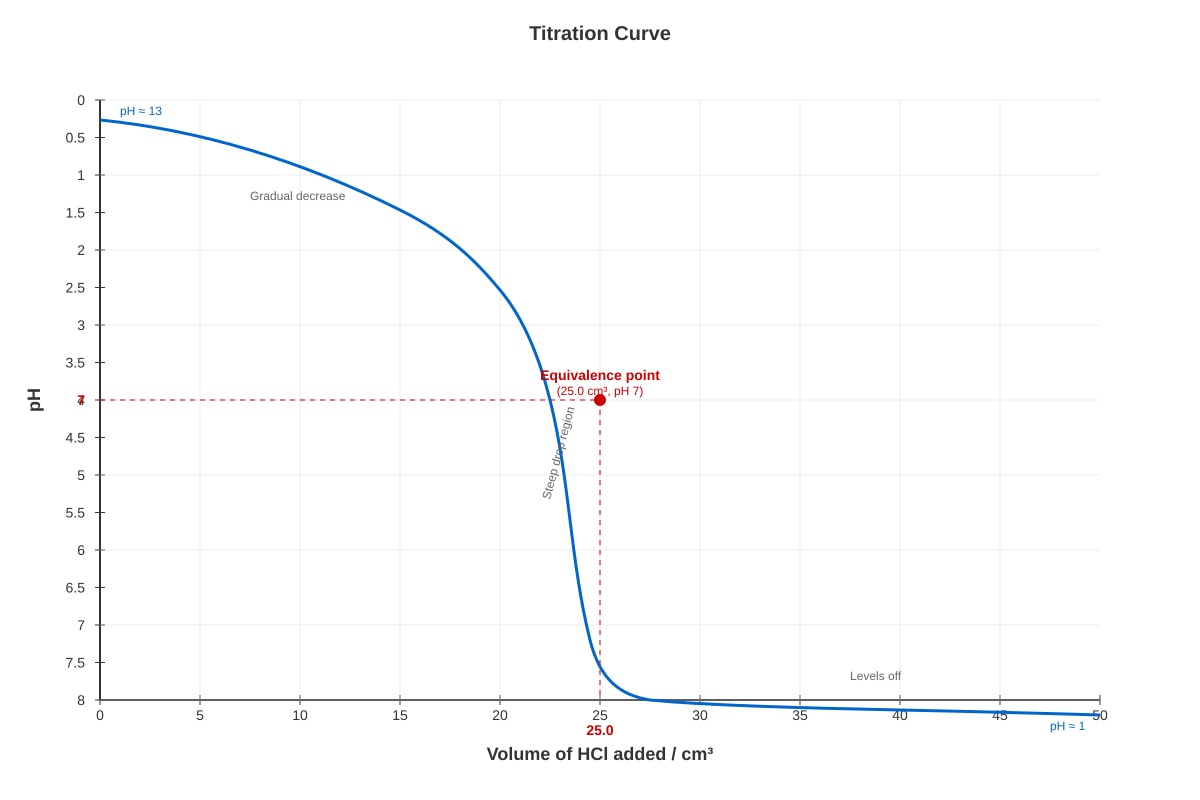
Question 2: Titration Curve
(a) State the type of acid-base titration represented by this curve. Explain your answer. [2]
- Answer: Strong acid – strong base titration. [1]
- Explanation: The equivalence point occurs at pH 7, which is characteristic of a strong acid-strong base titration where the salt formed does not undergo hydrolysis. [1]
- Accept: Reference to the steep pH change around the equivalence point and neutral pH at equivalence.
(b) Calculate the concentration of the sodium hydroxide solution. [2]
- Answer:
- n(HCl) = 0.100 × (25.0/1000) = 0.00250 mol [1]
- NaOH + HCl → NaCl + H₂O (1:1 ratio)
- n(NaOH) = 0.00250 mol
- c(NaOH) = 0.00250 / (25.0/1000) = 0.100 mol dm⁻³ [1]
- Award: [1] for moles of HCl, [1] for correct concentration with units.
(c) Name a suitable indicator for this titration. Explain your choice. [2]
- Answer: Any indicator with pH range spanning pH 7, e.g., bromothymol blue (pH range 6.0–7.6) or phenolphthalein (pH range 8.3–10.0) or methyl orange (pH range 3.1–4.4). [1]
- Explanation: The pH change at the equivalence point is very steep (from ~3 to ~11 over a few drops), so any indicator changing colour within this range is suitable. / The indicator's pH range falls within the steep portion of the titration curve. [1]
- Note: Accept any named indicator with correct pH range that covers the vertical portion of the curve. The steep change means several indicators are suitable.
Question 3: Calcium Hydroxide Neutralisation
(a) Write a balanced equation, including state symbols, for the neutralisation reaction between calcium hydroxide and hydrochloric acid. [2]
- Answer: Ca(OH)₂(s) + 2HCl(aq) → CaCl₂(aq) + 2H₂O(l) [2]
- Mark: [1] for correct formulae, [1] for correct balancing and state symbols.
- Accept: Ca(OH)₂(aq) if context implies dissolved.
(b) Calculate the number of moles of calcium hydroxide added. [1]
- Answer:
- Mᵣ of Ca(OH)₂ = 40.1 + 2(16.0 + 1.0) = 74.1
- n = m/Mᵣ = 3.70 / 74.1 = 0.0499 mol ≈ 0.0500 mol [1]
- Accept: 0.050 mol (2 s.f.)
(c) Calculate the volume of 0.500 mol dm⁻³ hydrochloric acid that can be neutralised. [2]
- Answer:
- From equation: 1 mol Ca(OH)₂ reacts with 2 mol HCl
- n(HCl) = 2 × 0.0500 = 0.100 mol [1]
- V = n/c = 0.100 / 0.500 = 0.200 dm³ = 200 cm³ [1]
- Award: [1] for correct mole ratio, [1] for correct volume with units.
Question 4: Buffer Solutions
(a) Explain what is meant by a buffer solution. [2]
- Answer: A buffer solution is a solution that resists changes in pH [1] when small amounts of acid or base are added (or on dilution). [1]
- Accept: Maintains approximately constant pH.
(b)(i) Calculate the concentration of ethanoic acid and ethanoate ions in the buffer solution after mixing. [2]
- Answer:
- Total volume = 100.0 cm³
- [CH₃COOH] = (0.200 × 50.0/1000) / (100.0/1000) = 0.100 mol dm⁻³ [1]
- [CH₃COO⁻] = (0.100 × 50.0/1000) / (100.0/1000) = 0.0500 mol dm⁻³ [1]
- Award: [1] for each correct concentration.
(b)(ii) Calculate the pH of this buffer solution. [2]
- Answer:
- [H⁺] = Kₐ × [CH₃COOH] / [CH₃COO⁻] = (1.8 × 10⁻⁵) × (0.100 / 0.0500) = 3.6 × 10⁻⁵ mol dm⁻³ [1]
- pH = –log₁₀(3.6 × 10⁻⁵) = 4.44 [1]
- Accept: 4.4 (2 s.f.)
(b)(iii) Explain, using equations where appropriate, how this buffer solution resists a change in pH when a small amount of sodium hydroxide is added. [3]
- Answer:
- The added OH⁻ ions react with CH₃COOH molecules: CH₃COOH + OH⁻ → CH₃COO⁻ + H₂O [1]
- The OH⁻ ions are consumed, so the pH does not increase significantly. [1]
- The ratio [CH₃COOH]/[CH₃COO⁻] changes only slightly, so [H⁺] and pH remain approximately constant. [1]
- Award: [1] for correct equation, [1] for explaining OH⁻ consumption, [1] for linking to constant [H⁺]/pH.
Section B: Data-Based and Application Questions (30 marks)
Question 5: Acid Rain and Carbonic Acid
(a) Write a balanced equation for the reaction of carbon dioxide with water to form carbonic acid. [1]
- Answer: CO₂(g) + H₂O(l) ⇌ H₂CO₃(aq) [1]
- Accept: CO₂(aq) + H₂O(l) ⇌ H₂CO₃(aq)
- Reject: Single arrow (→); missing state symbols.
(b) Write equations for the two stages of dissociation of carbonic acid in water. Include state symbols. [2]
- Answer:
- H₂CO₃(aq) ⇌ HCO₃⁻(aq) + H⁺(aq) [1]
- HCO₃⁻(aq) ⇌ CO₃²⁻(aq) + H⁺(aq) [1]
- Mark: One mark for each correct equation with equilibrium arrows and state symbols.
(c)(i) Write the expression for Kₐ₁ of carbonic acid. [1]
- Answer: Kₐ₁ = [HCO₃⁻][H⁺] / [H₂CO₃] [1]
(c)(ii) Calculate the pH of a 0.050 mol dm⁻³ solution of carbonic acid. [3]
- Answer:
- Kₐ₁ = [H⁺]² / [H₂CO₃] (since [H⁺] = [HCO₃⁻]) [1]
- [H⁺]² = Kₐ₁ × [H₂CO₃] = (4.3 × 10⁻⁷) × 0.050 = 2.15 × 10⁻⁸ [1]
- [H⁺] = √(2.15 × 10⁻⁸) = 1.47 × 10⁻⁴ mol dm⁻³
- pH = –log₁₀(1.47 × 10⁻⁴) = 3.83 [1]
- Accept: 3.8 (2 s.f.)
- Award: [1] for correct expression/setup, [1] for correct [H⁺] calculation, [1] for correct pH.
(d) Explain why a solution of H₂SO₃ of the same concentration as H₂CO₃ has a lower pH. [2]
- Answer: H₂SO₃ is a stronger acid than H₂CO₃ / has a larger Kₐ value. [1]
- Explanation: A stronger acid dissociates more in water, producing a higher concentration of H⁺ ions in solution. Higher [H⁺] results in a lower pH. [1]
- Accept: Reference to degree of dissociation or equilibrium position.
Question 6: Comparing Acid and Base Strengths
(a) Explain why solutions P and Q have different pH values despite having the same concentration. [2]
- Answer: HCl (solution P) is a strong acid that completely dissociates in water, producing 0.100 mol dm⁻³ of H⁺. [1]
- CH₃COOH (solution Q) is a weak acid that only partially dissociates, producing a much lower [H⁺] than 0.100 mol dm⁻³. Lower [H⁺] gives a higher pH. [1]
(b)(i) Sketch the pH titration curve for this titration. [3]
- Answer: Curve should show:
- Axes labelled: pH (y-axis, 0–14) and Volume of NaOH added / cm³ (x-axis). [1]
- Starting pH ~2.9, gradual rise, buffer region, steep rise around equivalence point. [1]
- Equivalence point at pH 8.7, clearly labelled. Curve levels off at high pH (~13). [1]
- Mark: Award marks for correct shape, correct starting pH, and correct equivalence point pH.
(b)(ii) Explain why the equivalence point is not at pH 7. [2]
- Answer: The salt formed is sodium ethanoate (CH₃COONa). [1]
- The ethanoate ion (CH₃COO⁻) undergoes hydrolysis: CH₃COO⁻ + H₂O ⇌ CH₃COOH + OH⁻, producing OH⁻ ions and making the solution alkaline at the equivalence point. [1]
(c)(i) Write an equation for the reaction of ammonia with water to produce hydroxide ions. [1]
- Answer: NH₃(aq) + H₂O(l) ⇌ NH₄⁺(aq) + OH⁻(aq) [1]
- Reject: Single arrow; missing state symbols.
(c)(ii) Write the expression for the base dissociation constant, K_b, of ammonia. [1]
- Answer: K_b = [NH₄⁺][OH⁻] / [NH₃] [1]
- Reject: Including [H₂O].
(c)(iii) Calculate the K_b value of ammonia using the pH of solution S. [3]
- Answer:
- pH = 11.1, so pOH = 14.0 – 11.1 = 2.9 [1]
- [OH⁻] = 10⁻²·⁹ = 1.26 × 10⁻³ mol dm⁻³ [1]
- [NH₄⁺] = [OH⁻] = 1.26 × 10⁻³ mol dm⁻³
- [NH₃] ≈ 0.100 – 1.26 × 10⁻³ ≈ 0.0987 mol dm⁻³
- K_b = (1.26 × 10⁻³)² / 0.0987 = 1.61 × 10⁻⁵ mol dm⁻³ [1]
- Accept: 1.6 × 10⁻⁵ mol dm⁻³ (2 s.f.)
- Award: [1] for pOH/[OH⁻], [1] for recognising [NH₄⁺] = [OH⁻], [1] for correct K_b with units.
Question 7: Metal Hydroxide Solubility
(a)(i) Write an equation for the formation of the white precipitate. [2]
- Answer: Al³⁺(aq) + 3OH⁻(aq) → Al(OH)₃(s) [2]
- Mark: [1] for correct formulae, [1] for correct balancing and state symbols.
(a)(ii) Name the type of behaviour exhibited by aluminium hydroxide in this reaction. [1]
- Answer: Amphoteric [1]
- Accept: Amphoteric behaviour / amphoterism.
(a)(iii) Write an equation for the reaction that occurs when excess sodium hydroxide is added. [2]
- Answer: Al(OH)₃(s) + OH⁻(aq) → [Al(OH)₄]⁻(aq) [2]
- Accept: Al(OH)₃(s) + NaOH(aq) → Na[Al(OH)₄](aq) or Al(OH)₃(s) + OH⁻(aq) → Al(OH)₄⁻(aq)
- Mark: [1] for correct reactants, [1] for correct product and balancing.
(b) Write an equation for the formation of the magnesium precipitate. [1]
- Answer: Mg²⁺(aq) + 2OH⁻(aq) → Mg(OH)₂(s) [1]
(c) Explain why aluminium hydroxide reacts with excess sodium hydroxide but magnesium hydroxide does not. [2]
- Answer: Aluminium hydroxide is amphoteric, meaning it can react with both acids and bases. [1]
- Magnesium hydroxide is basic only; it does not react with bases (NaOH). / Al³⁺ has high charge density and can accept electron pairs from OH⁻ to form a complex ion; Mg²⁺ has lower charge density and does not form such a complex. [1]
Section C: Free-Response Questions (20 marks)
Question 8: Sodium Carbonate and Buffer Systems
(a)(i) Calculate the concentration of the sodium carbonate solution. [3]
- Answer:
- Mᵣ of Na₂CO₃ = 2(23.0) + 12.0 + 3(16.0) = 106.0 [1]
- n(Na₂CO₃) = 2.65 / 106.0 = 0.0250 mol [1]
- c = n/V = 0.0250 / (250.0/1000) = 0.100 mol dm⁻³ [1]
- Award: [1] for Mᵣ, [1] for moles, [1] for concentration with units.
(a)(ii) Calculate the concentration of the hydrochloric acid. [3]
- Answer:
- n(Na₂CO₃) in 25.0 cm³ = 0.100 × (25.0/1000) = 0.00250 mol [1]
- From equation: 1 mol Na₂CO₃ reacts with 2 mol HCl
- n(HCl) = 2 × 0.00250 = 0.00500 mol [1]
- c(HCl) = 0.00500 / (20.00/1000) = 0.250 mol dm⁻³ [1]
- Award: [1] for moles of Na₂CO₃, [1] for mole ratio, [1] for concentration with units.
(b)(i) Write an equation to show the hydrolysis of the carbonate ion. [1]
- Answer: CO₃²⁻(aq) + H₂O(l) ⇌ HCO₃⁻(aq) + OH⁻(aq) [1]
- Reject: Single arrow.
(b)(ii) Explain why an aqueous solution of sodium carbonate has a pH greater than 7. [2]
- Answer: The carbonate ion (CO₃²⁻) undergoes hydrolysis, reacting with water to produce OH⁻ ions. [1]
- The presence of OH⁻ ions makes the solution alkaline, so pH > 7. [1]
(c)(i) Explain the meaning of the term buffer solution. [2]
- Answer: A buffer solution is a solution that resists changes in pH [1] when small amounts of acid or base are added (or on dilution). [1]
(c)(ii) Explain how a mixture of sodium carbonate and sodium hydrogencarbonate acts as a buffer solution. Include equations in your answer. [4]
- Answer:
- The solution contains CO₃²⁻ (base) and HCO₃⁻ (conjugate acid). [1]
- When acid (H⁺) is added: CO₃²⁻ + H⁺ → HCO₃⁻. The added H⁺ is consumed, so pH does not decrease significantly. [1]
- When base (OH⁻) is added: HCO₃⁻ + OH⁻ → CO₃²⁻ + H₂O. The added OH⁻ is consumed, so pH does not increase significantly. [1]
- The ratio [HCO₃⁻]/[CO₃²⁻] remains approximately constant, so [H⁺] and pH remain approximately constant. [1]
- Award: [1] for identifying the conjugate acid-base pair, [1] for equation with added acid, [1] for equation with added base, [1] for explaining constant pH.
(d) Explain why the student's claim about sodium chloride solution is incorrect. [3]
- Answer:
- NaCl is a salt of a strong acid (HCl) and a strong base (NaOH). [1]
- Neither Na⁺ nor Cl⁻ undergoes hydrolysis in water. Na⁺ is the cation of a strong base and does not react with water; Cl⁻ is the conjugate base of a strong acid and does not react with water. [1]
- Therefore, the solution contains only Na⁺, Cl⁻, H₂O, H⁺ (from water autoionisation), and OH⁻ (from water autoionisation). [H⁺] = [OH⁻], so pH = 7 (neutral). [1]
(e) Discuss the environmental impact of strongly alkaline industrial effluents and suggest a chemical method to treat such effluents before discharge. [2]
- Answer:
- Environmental impact: Alkaline effluents raise the pH of natural water bodies, harming aquatic life (e.g., fish, plants) that are sensitive to pH changes. / Can cause chemical burns to organisms. [1]
- Treatment method: Neutralise the effluent by adding a suitable acid (e.g., sulfuric acid or hydrochloric acid) until the pH is within acceptable limits (pH 6–8) before discharge. / Alternatively, bubble CO₂ through the effluent to form carbonates/hydrogencarbonates. [1]
Question 9: Ethanoic Acid – Weak Acid Behaviour and Buffer Systems
(a)(i) Define the term monoprotic acid. [1]
- Answer: A monoprotic acid is an acid that can donate only one proton (H⁺) per molecule in an acid-base reaction. [1]
(a)(ii) Calculate the pH of a 0.150 mol dm⁻³ solution of ethanoic acid. State any assumption made. [4]
- Answer:
- Assumption: The degree of dissociation is small, so [CH₃COOH] at equilibrium ≈ initial concentration (0.150 mol dm⁻³). [1]
- Kₐ = [H⁺]² / [CH₃COOH] (since [H⁺] = [CH₃COO⁻]) [1]
- [H⁺]² = (1.8 × 10⁻⁵) × 0.150 = 2.7 × 10⁻⁶ [1]
- [H⁺] = √(2.7 × 10⁻⁶) = 1.64 × 10⁻³ mol dm⁻³
- pH = –log₁₀(1.64 × 10⁻³) = 2.78 [1]
- Accept: 2.8 (2 s.f.)
- Award: [1] for stating assumption, [1] for correct Kₐ expression, [1] for correct [H⁺], [1] for correct pH.
(a)(iii) Calculate the percentage dissociation of ethanoic acid in this solution. [2]
- Answer:
- Percentage dissociation = ([H⁺] / initial [CH₃COOH]) × 100 [1]
- = (1.64 × 10⁻³ / 0.150) × 100 = 1.09% [1]
- Accept: 1.1% (2 s.f.)
(b)(i) Predict, with reasoning, whether the pH of the diluted solution will be greater than, less than, or equal to (pH of original solution + 1). [3]
- Answer:
- The pH will be less than (pH of original solution + 1). [1]
- For a strong acid, a 10-fold dilution increases pH by exactly 1 because [H⁺] decreases by a factor of 10. [1]
- For a weak acid, dilution shifts the equilibrium to the right (Le Chatelier's principle), increasing the degree of dissociation. So [H⁺] decreases by less than a factor of 10, and the pH increase is less than 1. [1]
(b)(ii) Calculate the pH of the diluted solution. [3]
- Answer:
- Diluted concentration = 0.150 / 10 = 0.0150 mol dm⁻³ [1]
- [H⁺]² = (1.8 × 10⁻⁵) × 0.0150 = 2.7 × 10⁻⁷ [1]
- [H⁺] = √(2.7 × 10⁻⁷) = 5.20 × 10⁻⁴ mol dm⁻³
- pH = –log₁₀(5.20 × 10⁻⁴) = 3.28 [1]
- Accept: 3.3 (2 s.f.)
- Check: Original pH = 2.78; diluted pH = 3.28; increase = 0.50, which is less than 1.0, consistent with (b)(i).
(c)(i) Name the ester formed. [1]
- Answer: Ethyl ethanoate [1]
(c)(ii) Write a balanced equation for this reaction. [1]
- Answer: CH₃COOH + C₂H₅OH ⇌ CH₃COOC₂H₅ + H₂O [1]
- Accept: With H⁺ catalyst shown above the arrow; structural formulae.
(c)(iii) Suggest two ways to increase the yield of the ester. [2]
- Answer: Any two from:
- Use an excess of one reactant (e.g., ethanol or ethanoic acid). [1]
- Remove the ester (or water) as it is formed (e.g., by distillation). [1]
- Use a dehydrating agent to remove water. [1]
- Increase the concentration of reactants. [1]
- Award: [1] for each valid method with brief explanation.
(d)(i) Write an equation for the reaction that occurs during the partial neutralisation. [1]
- Answer: CH₃COOH + NaOH → CH₃COONa + H₂O [1]
- Accept: CH₃COOH + OH⁻ → CH₃COO⁻ + H₂O
(d)(ii) Explain how the resulting solution can act as a buffer. [2]
- Answer:
- The solution contains both CH₃COOH (weak acid) and CH₃COO⁻ (its conjugate base from the salt). [1]
- Added acid (H⁺) reacts with CH₃COO⁻; added base (OH⁻) reacts with CH₃COOH. The pH remains approximately constant because the ratio [CH₃COOH]/[CH₃COO⁻] changes only slightly. [1]
END OF ANSWER KEY