From Real Exams Exam Paper
A Level H1 Chemistry Practice Paper 4
Free Exam-Derived Owl Alpha A Level H1 Chemistry Practice Paper 4 practice paper with questions and answers for Singapore students. This page is rendered as a direct URL so the questions and answers can be discovered without pressing in-page buttons.
These static practice materials are generated from the site's syllabus and paper-generation workflow, with source and model context shown so students and parents can evaluate the material before use.
Questions
TuitionGoWhere Practice Paper — Chemistry H1 A-Level
TuitionGoWhere Secondary School (AI)
| Subject: | Chemistry |
| Level: | A-Level H1 |
| Paper: | Practice Paper — Acids, Bases & Salts (Version 4 of 5) |
| Duration: | 60 minutes |
| Total Marks: | 50 |
| Name: | ______________________________ |
| Class: | ______________________________ |
| Date: | ______________________________ |
Instructions
- Answer all questions in the spaces provided.
- Write your answers in dark blue or black pen.
- You may use a pencil for any diagrams, graphs, or rough working.
- The number of marks for each question or part question is shown in brackets [ ].
- A Periodic Table with relative atomic masses is provided on the last page.
- Essential working must be shown for calculation questions to earn full marks.
Section A — Short Answer Questions [15 marks]
Questions 1–10
1. Define the term strong acid.
....................................................................................................................................................................................... .......................................................................................................................................................................................
[1]
2. State the conjugate base of .
.......................................................................................................................................................................................
[1]
3. A solution of ethanoic acid () has a pH of 3.2. Calculate the concentration of ions in this solution.
....................................................................................................................................................................................... .......................................................................................................................................................................................
[1]
4. Explain why a solution of sodium chloride () in water has a pH of approximately 7.
....................................................................................................................................................................................... .......................................................................................................................................................................................
[2]
5. Write an expression for the acid dissociation constant, , for the weak acid .
.......................................................................................................................................................................................
[1]
6. A student adds magnesium ribbon to separate dilute solutions of hydrochloric acid and ethanoic acid, both of the same concentration. State and explain one difference in the observations.
....................................................................................................................................................................................... ....................................................................................................................................................................................... .......................................................................................................................................................................................
[2]
7. Calculate the pH of a solution of sodium hydroxide, . Assume complete dissociation.
....................................................................................................................................................................................... .......................................................................................................................................................................................
[2]
8. Describe how you would prepare a standard solution of sodium carbonate () in the laboratory. Include key steps and apparatus.
....................................................................................................................................................................................... ....................................................................................................................................................................................... .......................................................................................................................................................................................
[2]
9. State one use of a named buffer solution in a biological or industrial context.
....................................................................................................................................................................................... .......................................................................................................................................................................................
[1]
10. A solution contains a mixture of and . Explain how this mixture resists changes in pH when a small amount of dilute hydrochloric acid is added.
....................................................................................................................................................................................... ....................................................................................................................................................................................... .......................................................................................................................................................................................
[2]
Section B — Structured & Calculation Questions [25 marks]
Questions 11–17
11. A sample of sulfuric acid, , is titrated with sodium hydroxide solution.
(a) Write a balanced equation for the reaction.
.......................................................................................................................................................................................
[1]
(b) Calculate the volume of solution required to reach the end-point.
....................................................................................................................................................................................... ....................................................................................................................................................................................... .......................................................................................................................................................................................
[3]
(c) Name a suitable indicator for this titration and state the colour change observed at the end-point.
Indicator: ............................................................................................................... Colour change: .......................................................................................................
[2]
12. The value for methanoic acid, , is at 25 °C.
(a) Write the expression for for methanoic acid.
.......................................................................................................................................................................................
[1]
(b) A solution of methanoic acid has a concentration of . Calculate the pH of this solution. Assume .
....................................................................................................................................................................................... ....................................................................................................................................................................................... .......................................................................................................................................................................................
[3]
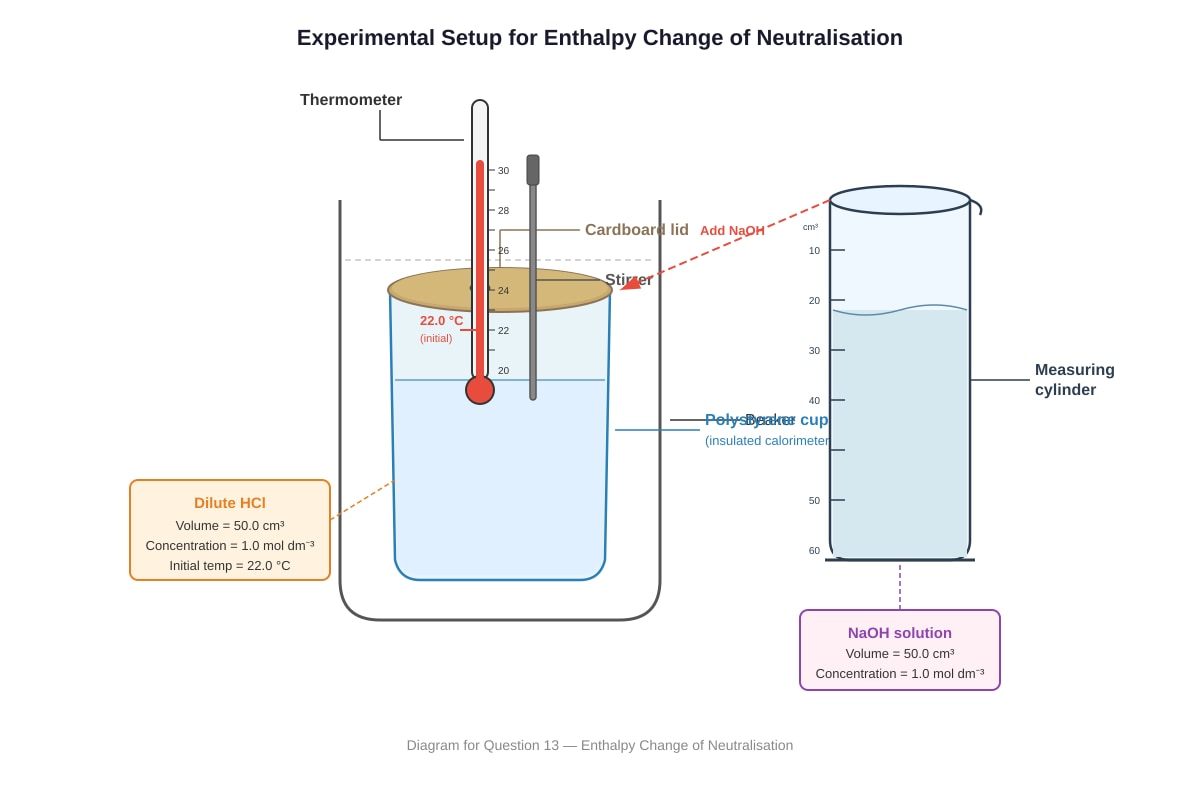
13. A student investigates the enthalpy change of neutralisation of hydrochloric acid with sodium hydroxide.
<image_placeholder> id: Q13-fig1 type: experimental_setup linked_question: Q13 description: A polystyrene cup (insulated calorimeter) placed inside a beaker, with a thermometer inserted through a cardboard lid. The cup contains dilute HCl solution. A separate measuring cylinder holds NaOH solution ready to be added. Labels needed on cup, thermometer, lid, and cylinder. labels: Polystyrene cup, Thermometer, Cardboard lid, Dilute HCl (in cup), NaOH solution (in measuring cylinder), Stirrer values: Initial temperature of HCl = 22.0 °C, Volume of HCl = 50.0 cm³, Concentration of HCl = 1.0 mol dm⁻³, Volume of NaOH = 50.0 cm³, Concentration of NaOH = 1.0 mol dm⁻³ must_show: Polystyrene cup inside beaker, thermometer through lid, two solutions clearly labelled with volumes and concentrations, stirrer visible </image_placeholder>
(a) State the assumption made about the specific heat capacity and density of the reaction mixture in this experiment.
.......................................................................................................................................................................................
[1]
(b) The temperature of the mixture rises to 28.6 °C. Calculate the heat energy released, , in joules. Use and assume the density of the solution is .
....................................................................................................................................................................................... .......................................................................................................................................................................................
[2]
(c) Calculate the enthalpy change of neutralisation, , in . Include the sign.
....................................................................................................................................................................................... ....................................................................................................................................................................................... .......................................................................................................................................................................................
[2]
(d) The literature value for the enthalpy change of neutralisation of a strong acid with a strong base is . Suggest one reason why your calculated value may differ from this.
.......................................................................................................................................................................................
[1]
14. The following data shows the pH of three solutions, each of concentration :
| Solution | pH |
|---|---|
| 1.0 | |
| 2.2 | |
| 13.0 |
(a) Explain the difference in pH between the and solutions.
....................................................................................................................................................................................... .......................................................................................................................................................................................
[2]
(b) Calculate the value of water at this temperature using the data provided.
....................................................................................................................................................................................... .......................................................................................................................................................................................
[2]
15. A buffer solution is prepared by mixing of with of .
(a) Calculate the number of moles of and initially present.
.......................................................................................................................................................................................
[1]
(b) Calculate the number of moles of and present in the buffer after reaction.
....................................................................................................................................................................................... .......................................................................................................................................................................................
[2]
(c) Given that of is 4.75, calculate the pH of the resulting buffer.
....................................................................................................................................................................................... .......................................................................................................................................................................................
[2]
16. A solution of phosphoric acid, , is a triprotic acid. The first dissociation is shown below:
(a) Explain what is meant by triprotic.
.......................................................................................................................................................................................
[1]
(b) State the relationship between , , and for phosphoric acid and explain your reasoning.
....................................................................................................................................................................................... .......................................................................................................................................................................................
[2]
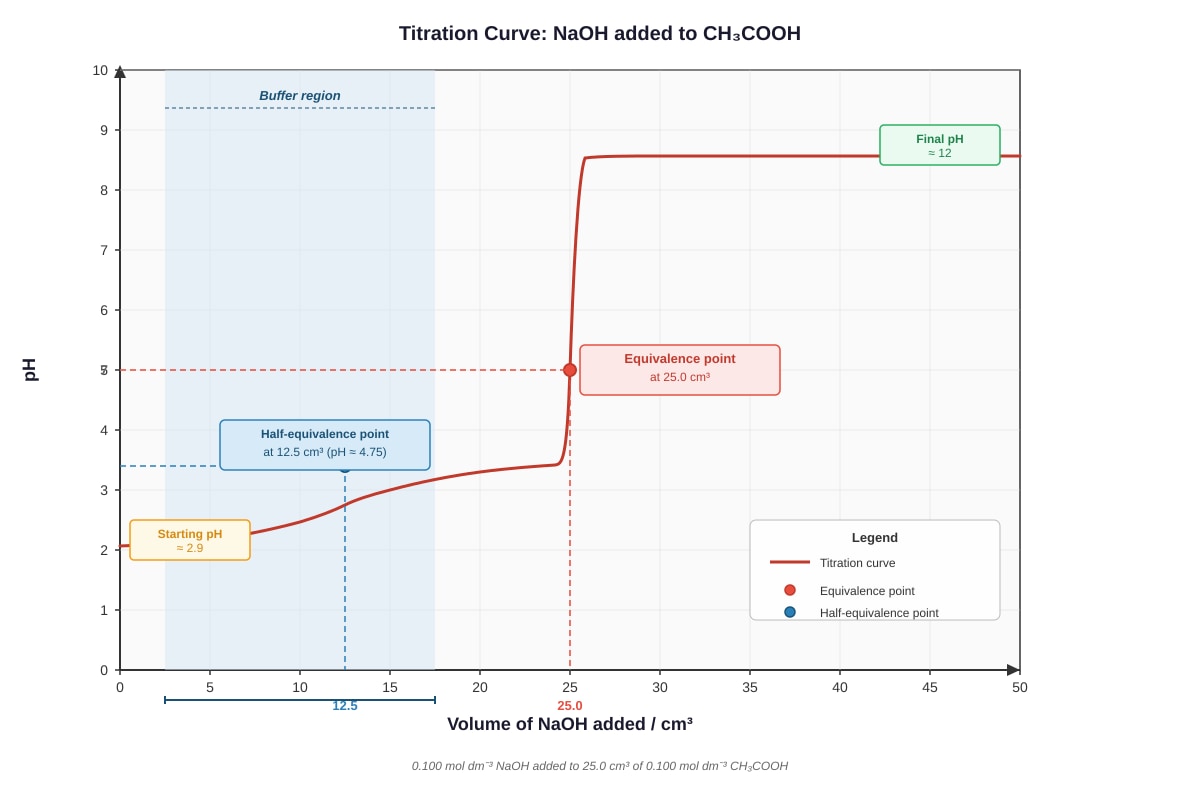
17. A student performs a titration curve experiment by adding to of .
<image_placeholder> id: Q17-fig1 type: graph linked_question: Q17 description: A titration curve showing pH (y-axis, range 0–14) versus volume of NaOH added in cm³ (x-axis, range 0–50). The curve starts at approximately pH 2.9, rises gradually, has a steep vertical section between 24–26 cm³ centred at 25.0 cm³, and levels off around pH 12. The equivalence point is at 25.0 cm³. A buffer region is visible between roughly 5–20 cm³ where the curve is flatter. The half-equivalence point at 12.5 cm³ should be indicated. labels: y-axis: pH (0 to 14), x-axis: Volume of NaOH added / cm³ (0 to 50), Equivalence point at 25.0 cm³, Buffer region (shaded or marked between ~5–20 cm³), Half-equivalence point at 12.5 cm³, Starting pH ≈ 2.9, Final pH ≈ 12 values: Equivalence point volume = 25.0 cm³, Starting pH = 2.9, pH at half-equivalence ≈ 4.75, Final pH ≈ 12 must_show: S-shaped curve with clear equivalence point, buffer region, half-equivalence point, correctly labelled axes with units, starting and final pH values </image_placeholder>
(a) From the graph, state the volume of at the equivalence point.
.......................................................................................................................................................................................
[1]
(b) Explain why the pH at the equivalence point is greater than 7.
....................................................................................................................................................................................... .......................................................................................................................................................................................
[2]
(c) Using the graph, estimate the pH at the half-equivalence point. State the significance of this pH value.
pH estimate: .......................................................................................................... Significance: .........................................................................................................
[2]
Section C — Data Interpretation & Extended Response [10 marks]
Questions 18–20
18. The table below gives values for three weak acids at 25 °C:
| Acid | Formula | / |
|---|---|---|
| Ethanoic acid | ||
| Hydrofluoric acid | ||
| Benzoic acid |
(a) Arrange the three acids in order of increasing acid strength. Explain your reasoning.
....................................................................................................................................................................................... .......................................................................................................................................................................................
[2]
(b) All three acids have the same concentration of . Calculate the pH of the hydrofluoric acid solution. Assume .
....................................................................................................................................................................................... ....................................................................................................................................................................................... .......................................................................................................................................................................................
[3]
(c) Predict and explain which of the three sodium salts (, , ) would produce the most alkaline solution when dissolved in water at the same concentration.
....................................................................................................................................................................................... .......................................................................................................................................................................................
[2]
19. A student wishes to determine the concentration of a solution of potassium hydroxide, , using titration with hydrochloric acid.
(a) Describe the procedure the student should follow, including the apparatus used, how the end-point is detected, and how the result is calculated.
....................................................................................................................................................................................... ....................................................................................................................................................................................... ....................................................................................................................................................................................... .......................................................................................................................................................................................
[4]
(b) The student obtained the following results:
| Titration | Rough | 1 | 2 | 3 |
|---|---|---|---|---|
| Final burette reading / | 24.80 | 24.10 | 24.05 | 24.15 |
| Initial burette reading / | 0.00 | 0.00 | 0.00 | 0.00 |
| Volume used / | 24.80 | 24.10 | 24.05 | 24.15 |
The volume of solution used was . Calculate the concentration of the solution.
....................................................................................................................................................................................... ....................................................................................................................................................................................... .......................................................................................................................................................................................
[3]
20. Explain, with reference to the relevant chemical equations, why the addition of ammonium chloride () to dilute ammonia solution () decreases the pH of the solution.
....................................................................................................................................................................................... ....................................................................................................................................................................................... ....................................................................................................................................................................................... .......................................................................................................................................................................................
[3]
End of Paper
Periodic Table Data (for reference):
| Element | Symbol | |
|---|---|---|
| H | H | 1.0 |
| C | C | 12.0 |
| N | N | 14.0 |
| O | O | 16.0 |
| F | F | 19.0 |
| Na | Na | 23.0 |
| Mg | Mg | 24.3 |
| S | S | 32.1 |
| Cl | Cl | 35.5 |
| K | K | 39.1 |
Answers
TuitionGoWhere Practice Paper — Chemistry H1 A-Level
Answer Key — Acids, Bases & Salts (Version 4 of 5)
Section A — Short Answer Questions
1. [1]
A strong acid is an acid that completely dissociates (ionises) in aqueous solution.
Teaching note: "Strong" refers to the extent of dissociation, not concentration. A dilute HCl solution is still a strong acid because every molecule dissociates. Common error: confusing "strong" with "concentrated."
2. [1]
Teaching note: A conjugate base is formed when an acid loses a proton (). . The conjugate base has one fewer and a charge reduced by 1.
3. [1]
Teaching note: This is a direct application of , rearranged to . Students should be comfortable using the or function on their calculator.
4. [2]
- is formed from a strong acid () and a strong base ().
- Neither the nor the ion undergoes hydrolysis (reaction with water), so the solution remains neutral at approximately pH 7.
Mark allocation: 1 mark for identifying the parent acid and base as strong; 1 mark for stating that neither ion hydrolyses / the solution is neutral.
Teaching note: Salts from strong acid + strong base give neutral solutions. Salts from strong acid + weak base give acidic solutions (cation hydrolysis). Salts from weak acid + strong base give alkaline solutions (anion hydrolysis).
5. [1]
Teaching note: is the equilibrium constant for the acid dissociation: . Pure liquids and solids are omitted; all species here are aqueous.
6. [2]
- The reaction with hydrochloric acid is faster (more vigorous / more rapid effervescence) than with ethanoic acid.
- This is because is a strong acid and fully dissociates, giving a higher concentration of ions in solution compared to the weak acid at the same concentration. The higher leads to more frequent effective collisions and hence a faster rate of reaction.
Mark allocation: 1 mark for the observation (faster/more vigorous with HCl); 1 mark for the explanation in terms of and strength of acid.
Teaching note: Both acids will eventually produce the same total volume of gas (same moles of acid, same moles of Mg in excess), but the initial rate differs. This is a classic comparison question.
7. [2]
is a strong base and dissociates completely:
Mark allocation: 1 mark for correct and pOH calculation; 1 mark for correct pH.
Teaching note: At 25 °C, . Students must remember to convert from pOH to pH for base solutions. Common error: giving pOH as the final answer.
8. [2]
- Calculate the required mass of needed for the desired volume and concentration. Weigh the solid accurately using an analytical balance.
- Dissolve the in a small volume of distilled water in a beaker and stir until fully dissolved.
- Transfer the solution quantitatively into a volumetric flask (e.g., ) using a funnel, rinsing the beaker and stirring rod with distilled water and adding the washings to the flask.
- Add distilled water until the bottom of the meniscus reaches the calibration mark on the neck of the flask. Stopper and invert several times to ensure homogeneity.
Mark allocation: 1 mark for correct weighing and dissolving; 1 mark for use of volumetric flask and making up to the mark.
Teaching note: A standard solution is one of known, precise concentration. The volumetric flask is the key apparatus. Common error: using a beaker or conical flask to prepare the solution (these do not give accurate volumes).
9. [1]
Example answer: Blood is buffered by the system to maintain blood pH at approximately 7.4.
Acceptable alternatives: Any valid named buffer with a correct context, e.g., phosphate buffer in cells, citrate buffer in food products, buffer in shampoo.
Teaching note: Buffer solutions are critical in biological systems where enzyme function depends on a narrow pH range.
10. [2]
- The added ions are removed by reaction with the ethanoate ions () in the buffer:
- This removes most of the added , so the change in (and hence pH) is very small.
Mark allocation: 1 mark for identifying the reaction of with ; 1 mark for explaining that this removes the added and minimises pH change.
Teaching note: A buffer contains significant amounts of both the weak acid and its conjugate base. When acid is added, the conjugate base mops it up. When base is added, the weak acid neutralises it.
Section B — Structured & Calculation Questions
11.
(a) [1]
Common error: Writing a 1:1 ratio. Sulfuric acid is diprotic — it requires 2 moles of NaOH per mole of .
(b) [3]
Moles of
From the equation, moles of required
Volume of
Mark allocation: 1 mark for moles of ; 1 mark for correct mole ratio and moles of ; 1 mark for correct volume (33.3 cm³).
(c) [2]
Indicator: phenolphthalein Colour change: colourless to pink (at the end-point)
Acceptable alternative: Methyl orange — yellow to orange/pink.
Teaching note: For a strong acid–strong base titration, the equivalence point is at pH 7, and both indicators work. Phenolphthalein is more commonly used in school labs. The colour change described should be the one observed during the titration (i.e., as seen when adding NaOH to acid, the solution goes from colourless to pink).
12.
(a) [1]
(b) [3]
For the dissociation:
Assuming and :
Mark allocation: 1 mark for correct substitution into expression; 1 mark for correct ; 1 mark for correct pH (2.55).
Teaching note: The approximation is valid when is small (less than ~5% dissociation). Always check: should be < 5%.
13.
(a) [1]
The specific heat capacity of the reaction mixture is assumed to be the same as that of water (), and the density is assumed to be .
(b) [2]
Total volume of solution
Mass of solution (using density )
Temperature change:
Mark allocation: 1 mark for correct mass and ; 1 mark for correct value.
(c) [2]
Moles of
Moles of
Moles of water formed (1:1 ratio)
Mark allocation: 1 mark for correct moles; 1 mark for correct with negative sign and correct units.
Teaching note: The negative sign indicates an exothermic reaction. Heat is released, so the system loses energy.
(d) [1]
Acceptable answers (any one):
- Heat was lost to the surroundings (the polystyrene cup is not a perfect insulator).
- The specific heat capacity of the solution may differ slightly from that of pure water.
- The temperature reading may not have captured the maximum temperature if readings were not taken quickly enough.
Teaching note: The calculated value (−55.4 kJ mol⁻¹) is less exothermic than the literature value (−57.6 kJ mol⁻¹), consistent with heat loss to the surroundings.
14.
(a) [2]
- is a strong acid and fully dissociates, so , giving pH = 1.0.
- is a weak acid and only partially dissociates, so , giving a higher pH of 2.2.
Mark allocation: 1 mark for identifying HCl as strong and as weak; 1 mark for linking this to the difference in and hence pH.
(b) [2]
From the data: pH = 13.0, so
From the data: pH = 1.0, so
Mark allocation: 1 mark for correct and values; 1 mark for correct .
Teaching note: at 25 °C. This is a fundamental constant that students must know.
15.
(a) [1]
Moles of
Moles of
(b) [2]
The reaction:
is the limiting reagent.
Moles of remaining
Moles of (from ) formed
Mark allocation: 1 mark for identifying limiting reagent and moles reacted; 1 mark for correct final moles of both species.
(c) [2]
Using the Henderson–Hasselbalch equation:
Mark allocation: 1 mark for correct substitution; 1 mark for correct pH = 4.75.
Teaching note: When the moles of weak acid equal the moles of conjugate base, . This is also the half-equivalence point in a titration.
16.
(a) [1]
A triprotic acid is an acid that can donate three protons (hydrogen ions, ) per molecule in aqueous solution.
(b) [2]
Explanation: Each successive proton is harder to remove because:
- After the first dissociation, the resulting species () carries a negative charge, making it increasingly difficult to remove the next positively charged proton () due to increasing electrostatic attraction.
- The negative charge on the conjugate base increases with each dissociation, holding the remaining proton more strongly.
Mark allocation: 1 mark for correct order; 1 mark for a valid explanation involving electrostatic attraction / increasing negative charge.
17.
(a) [1]
(b) [2]
- At the equivalence point, all the has been neutralised to form .
- The salt contains the ethanoate ion (), which is the conjugate base of a weak acid.
- undergoes hydrolysis with water:
- This produces ions, making the solution alkaline (pH > 7).
Mark allocation: 1 mark for identifying the salt formed and its nature; 1 mark for the hydrolysis equation and production of .
(c) [2]
pH estimate: approximately 4.75 (accept 4.7–4.8)
Significance: At the half-equivalence point, half the weak acid has been neutralised, so , and therefore . This allows the of the weak acid to be determined from the titration curve.
Mark allocation: 1 mark for correct pH estimate; 1 mark for correct significance.
Section C — Data Interpretation & Extended Response
18.
(a) [2]
Order of increasing acid strength:
Explanation: A larger value indicates a greater degree of dissociation, meaning a stronger acid. has the smallest () and is therefore the weakest; has the largest () and is the strongest.
Mark allocation: 1 mark for correct order; 1 mark for correct reasoning linking to acid strength.
(b) [3]
For : ,
Mark allocation: 1 mark for correct substitution; 1 mark for correct ; 1 mark for correct pH.
(c) [2]
would produce the most alkaline solution.
Explanation: The weaker the acid, the stronger its conjugate base. has the smallest (weakest acid), so is the strongest conjugate base and undergoes the most extensive hydrolysis, producing the highest concentration of ions and hence the highest pH.
Mark allocation: 1 mark for identifying ; 1 mark for correct reasoning linking weakest acid to strongest conjugate base.
19.
(a) [4]
- Rinse and fill the burette with the standard solution (). Record the initial burette reading.
- Using a pipette (and pipette filler), transfer of the solution into a clean conical flask.
- Add 2–3 drops of phenolphthalein indicator to the conical flask (the solution will turn pink).
- Add the from the burette dropwise while swirling the conical flask, until the pink colour just disappears (end-point). Record the final burette reading.
- Repeat the titration until concordant results (within ) are obtained.
- Calculate the concentration of using:
Mark allocation: 1 mark for use of burette and pipette; 1 mark for indicator and end-point detection; 1 mark for concordant titres; 1 mark for correct calculation method.
(b) [3]
Concordant titres: Titrations 1, 2, and 3 (all within ).
Mean titre
Mark allocation: 1 mark for correct mean titre; 1 mark for correct use of the equation; 1 mark for correct answer (0.0964 mol dm⁻³).
20. [3]
- Ammonia solution is a weak base:
- Adding introduces ions (the conjugate acid of ) into the solution.
- By Le Chatelier's principle, the increase in shifts the equilibrium to the left, reducing the concentration of ions.
- Since decreases, the pH of the solution decreases (becomes less alkaline).
Mark allocation: 1 mark for the ammonia equilibrium equation; 1 mark for identifying the common ion effect / Le Chatelier's principle; 1 mark for concluding that pH decreases.
Teaching note: This is the classic "common ion effect" applied to a buffer system. The mixture is itself a buffer. Adding more shifts the ratio, lowering the pH.
End of Answer Key
Mark Summary
| Section | Marks |
|---|---|
| A: Questions 1–10 | 15 |
| B: Questions 11–17 | 25 |
| C: Questions 18–20 | 10 |
| Total | 50 |