From Real Exams Exam Paper

A Level H1 Chemistry Practice Paper 3

Free Exam-Derived Owl Alpha A Level H1 Chemistry Practice Paper 3 practice paper with questions and answers for Singapore students. This page is rendered as a direct URL so the questions and answers can be discovered without pressing in-page buttons.

These static practice materials are generated from the site's syllabus and paper-generation workflow, with source and model context shown so students and parents can evaluate the material before use.

A Level H1 Chemistry From Real Exams Generated by Owl Alpha Updated 2026-06-07

Questions

<!-- TuitionGoWhere generation metadata: stage=3-1; model=openrouter/owl-alpha; model_label=Owl Alpha; generated=2026-06-06; Sources: Stage 2-1 real exam-derived templates and Stage 2-2 exam-enriched syllabus. -->

TuitionGoWhere Practice Paper — Chemistry H1 A-Level


TuitionGoWhere Secondary School (AI)

Subject:Chemistry
Level:A-Level H1
Paper:Practice Paper 2 — Structured & Free Response
Version:3 of 5
Duration:2 hours
Total Marks:80
Name:______________________________
Class:______________________________
Date:______________________________

Instructions

  • Write your answers in the spaces provided.
  • All questions are compulsory.
  • Show all working for calculation questions. Answers without working may not receive full marks.
  • Use appropriate units and significant figures where applicable.
  • A Periodic Table with relative atomic masses is provided on the last page of this paper.
  • The use of a scientific calculator is permitted.

Section A: Multiple Choice [10 marks]

Answer ALL questions. Each question carries 1 mark. Write your answers in the spaces provided.


1. Which of the following is a strong acid?

A. CH3COOHCH_3COOH
B. H2CO3H_2CO_3
C. HNO3HNO_3
D. H3PO4H_3PO_4

Answer: ______________


2. A solution has a pH of 2.3. What is the concentration of H+(aq)H^+(aq) in this solution?

A. 5.0×1035.0 \times 10^{-3} mol dm3^{-3}
B. 2.3×1012.3 \times 10^{-1} mol dm3^{-3}
C. 2.0×1022.0 \times 10^{-2} mol dm3^{-3}
D. 3.0×1033.0 \times 10^{-3} mol dm3^{-3}

Answer: ______________


3. Which salt, when dissolved in water, produces an acidic solution?

A. NaClNaCl
B. KNO3KNO_3
C. NH4ClNH_4Cl
D. Na2CO3Na_2CO_3

Answer: ______________


4. Which statement best describes a buffer solution?

A. A solution that always has a pH of exactly 7.
B. A solution that resists changes in pH when small amounts of acid or base are added.
C. A solution that contains only a strong acid and its conjugate base.
D. A solution that changes colour at the endpoint of a titration.

Answer: ______________


5. In the reaction NH3+H2ONH4++OHNH_3 + H_2O \rightleftharpoons NH_4^+ + OH^-, the NH3NH_3 acts as a

A. Brønsted–Lowry acid.
B. Brønsted–Lowry base.
C. Lewis acid only.
D. neutral species.

Answer: ______________


6. What volume of 0.100 mol dm3^{-3} NaOHNaOH is required to neutralise 25.0 cm3^3 of 0.200 mol dm3^{-3} H2SO4H_2SO_4?

A. 25.0 cm3^3
B. 50.0 cm3^3
C. 100.0 cm3^3
D. 12.5 cm3^3

Answer: ______________


7. Which of the following is the conjugate base of H2PO4H_2PO_4^-?

A. H3PO4H_3PO_4
B. HPO42HPO_4^{2-}
C. PO43PO_4^{3-}
D. H2PO4H_2PO_4

Answer: ______________


8. The pH of a 0.050 mol dm3^{-3} solution of a weak acid, HAHA, is 3.00. What is the approximate KaK_a of this acid?

A. 2.0×1052.0 \times 10^{-5}
B. 5.0×1065.0 \times 10^{-6}
C. 1.0×1031.0 \times 10^{-3}
D. 2.0×1032.0 \times 10^{-3}

Answer: ______________


9. During a titration of a strong acid with a strong base, the pH at the equivalence point is

A. less than 7.
B. exactly 7.
C. greater than 7.
D. dependent on the indicator used.

Answer: ______________


10. Which of the following salts will produce a neutral solution when dissolved in water?

A. NaFNaF
B. KBrKBr
C. Na2SO3Na_2SO_3
D. NH4NO3NH_4NO_3

Answer: ______________


Section B: Structured Questions [50 marks]

Answer ALL questions.


11. [6 marks]

(a) Define the term strong acid. [2]


(b) Write an equation to show the dissociation of hydrochloric acid in water. [1]


(c) A student claims that a 0.001 mol dm3^{-3} solution of a strong acid has a pH of 3.0, but a 0.001 mol dm3^{-3} solution of a weak acid also has a pH of 3.0. Explain why this claim is incorrect. [3]


12. [8 marks]

25.0 cm3^3 of 0.150 mol dm3^{-3} NaOHNaOH is titrated with 0.100 mol dm3^{-3} HClHCl.

(a) Write the balanced equation for the reaction. [1]


(b) Calculate the volume of HClHCl required to reach the equivalence point. [3]


(c) State a suitable indicator for this titration and explain your choice. [2]


(d) Calculate the pH of the solution after 50.0 cm3^3 of HClHCl has been added. [2]


13. [8 marks]

A buffer solution is prepared by mixing 50.0 cm3^3 of 0.200 mol dm3^{-3} CH3COOHCH_3COOH with 50.0 cm3^3 of 0.100 mol dm3^{-3} NaOHNaOH.

(a) Explain why the resulting mixture acts as a buffer solution. [3]


(b) Write an expression for the acid dissociation constant, KaK_a, of CH3COOHCH_3COOH. [1]


(c) Given that KaK_a of CH3COOHCH_3COOH is 1.7×1051.7 \times 10^{-5} mol dm3^{-3}, calculate the pH of this buffer solution. [4]


14. [10 marks]

The following data were collected during a titration of 25.0 cm3^3 of a solution of a weak monoprotic acid, HAHA, with 0.100 mol dm3^{-3} NaOHNaOH:

Volume of NaOH added / cm³pH
0.02.80
5.03.70
10.04.20
12.54.50
15.05.10
20.011.50
25.012.10
30.012.40

(a) From the data, estimate the pKapK_a of the weak acid HAHA. Explain your reasoning. [3]


(b) Calculate the concentration of the original HAHA solution. [3]


(c) Explain why the pH at the equivalence point is greater than 7. [2]


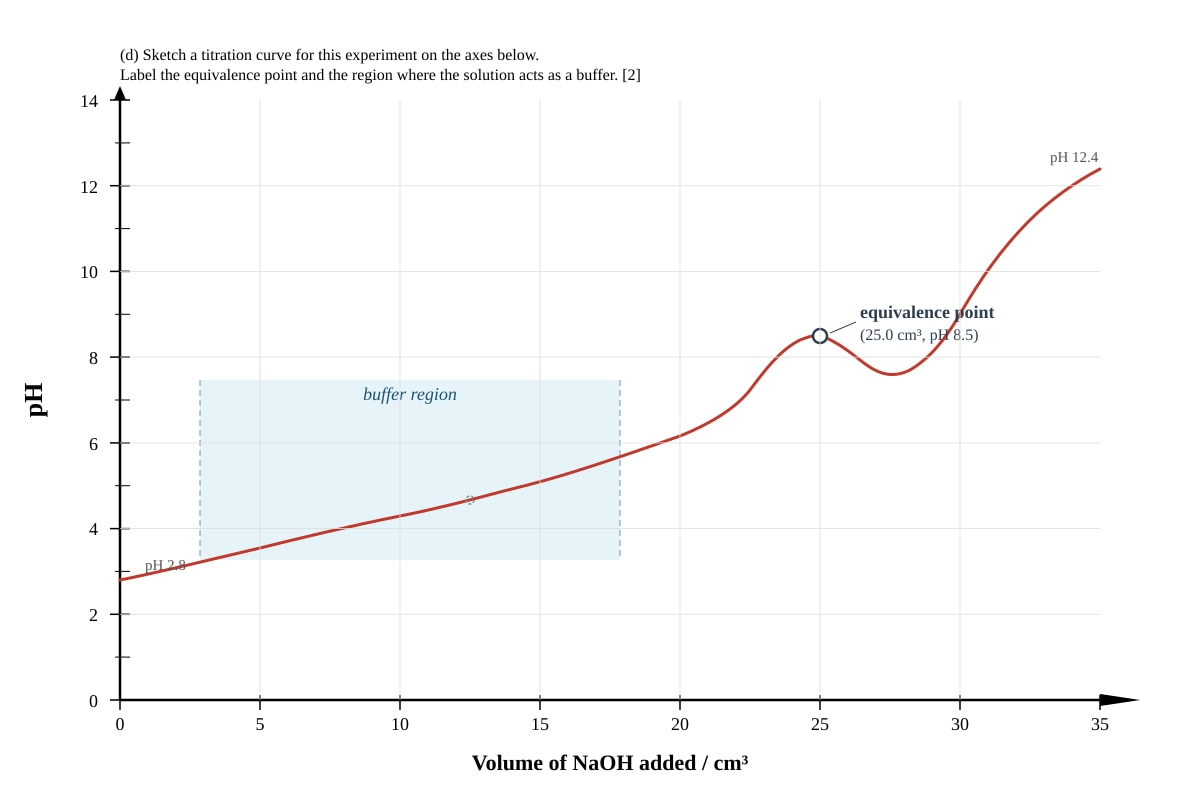
(d) Sketch a titration curve for this experiment on the axes below. Label the equivalence point and the region where the solution acts as a buffer. [2]

<image_placeholder> id: Q14-fig1 type: graph linked_question: Q14 description: A set of axes for sketching a titration curve. The x-axis is labelled "Volume of NaOH added / cm³" ranging from 0 to 35 cm³. The y-axis is labelled "pH" ranging from 0 to 14. The graph should show a weak acid-strong base titration curve starting at approximately pH 2.8, rising gradually through a buffer region, with a steep rise near 25.0 cm³, and levelling off around pH 12.4. labels: x-axis: "Volume of NaOH added / cm³", y-axis: "pH", equivalence point marked at (25.0, ~8.5), buffer region shaded between approximately 5–20 cm³ values: Starting pH ~2.8, equivalence point volume = 25.0 cm³, pH at equivalence ~8.5, final pH ~12.4 must_show: Axes with labels and scales, a curve showing the characteristic weak acid-strong base shape, equivalence point labelled, buffer region indicated </image_placeholder>


15. [8 marks]

(a) Define the term salt hydrolysis. [2]


(b) Classify each of the following salts as producing an acidic, basic, or aqueous solution when dissolved in water. Explain each answer in terms of the acid and base from which the salt is derived. [6]

(i) NH4NO3NH_4NO_3 [2]


(ii) K2CO3K_2CO_3 [2]


(iii) NaClNaCl [2]


16. [10 marks]

A solution is prepared by dissolving 0.365 g of HClHCl in water to make 500 cm3^3 of solution.

(a) Calculate the concentration of the HClHCl solution in mol dm3^{-3}. [2]


(b) Calculate the pH of this HClHCl solution. [1]


(c) 25.0 cm3^3 of this HClHCl solution is then mixed with 30.0 cm3^3 of 0.050 mol dm3^{-3} Ba(OH)2Ba(OH)_2. Calculate the pH of the resulting mixture. [5]


(d) Name the salt formed in the reaction in (c) and state whether its aqueous solution is acidic, basic, or neutral. [2]


Section C: Free Response [20 marks]

Answer ALL questions.


17. [10 marks]

Ethanoic acid, CH3COOHCH_3COOH, is a weak acid with Ka=1.7×10⁵K_a = 1.7 \times 10^{-5} mol dm3^{-3}.

(a) Write the expression for KaK_a for ethanoic acid. [1]


(b) Calculate the pH of a 0.100 mol dm3^{-3} solution of ethanoic acid. [4]


(c) A solution is prepared by mixing 50.0 cm3^3 of 0.100 mol dm3^{-3} CH3COOHCH_3COOH with 50.0 cm3^3 of 0.100 mol dm3^{-3} NaOHNaOH. Calculate the pH of the resulting solution. [5]


18. [10 marks]

A student investigates the properties of three solutions: Solution X (0.100 mol dm3^{-3} HClHCl), Solution Y (0.100 mol dm3^{-3} CH3COOHCH_3COOH), and Solution Z (0.100 mol dm3^{-3} NaOHNaOH).

(a) Arrange the three solutions in order of increasing pH. Explain your reasoning. [3]


(b) The student adds 1.0 g of magnesium ribbon to 50.0 cm3^3 of each solution. Compare and explain the rate of hydrogen gas production in Solutions X and Y. [4]


(c) The student performs a titration of Solution Y with Solution Z using phenolphthalein as indicator. Describe the colour change observed at the endpoint and explain why phenolphthalein is a suitable indicator for this titration. [3]


End of Paper


Periodic Table Data

ElementSymbolRelative Atomic Mass
HydrogenH1.0
CarbonC12.0
NitrogenN14.0
OxygenO16.0
SodiumNa23.0
MagnesiumMg24.3
ChlorineCl35.5
PotassiumK39.1
CalciumCa40.1
BariumBa137.3

Answers

<!-- TuitionGoWhere generation metadata: stage=3-1; model=openrouter/owl-alpha; model_label=Owl Alpha; generated=2026-06-06; Sources: Stage 2-1 real exam-derived templates and Stage 2-2 exam-enriched syllabus. -->

TuitionGoWhere Practice Paper — Chemistry H1 A-Level

Answer Key — Version 3 of 5


Section A: Multiple Choice [10 marks]

1. Answer: C [1]

HNO3HNO_3 (nitric acid) is a strong acid because it completely dissociates in aqueous solution. CH3COOHCH_3COOH, H2CO3H_2CO_3, and H3PO4H_3PO_4 are all weak acids (partial dissociation).

Common mistake: Students confuse the number of ionisable hydrogens with acid strength. H3PO4H_3PO_4 has three acidic protons but is still a weak acid because dissociation is incomplete.


2. Answer: A [1]

[H+]=10pH=102.3=5.01×10³[H^+] = 10^{-pH} = 10^{-2.3} = 5.01 \times 10^{-3} mol dm3^{-3}5.0×1035.0 \times 10^{-3} mol dm3^{-3}.

Common mistake: Students sometimes write the pH value itself as the concentration, or forget to use the inverse log function.


3. Answer: C [1]

NH4ClNH_4Cl is formed from a weak base (NH3NH_3) and a strong acid (HClHCl). The NH4+NH_4^+ ion undergoes hydrolysis to produce H+H^+ ions, making the solution acidic.

NaClNaCl and KNO3KNO_3 are salts of strong acids and strong bases → neutral. Na2CO3Na_2CO_3 is a salt of a strong base and weak acid → basic.


4. Answer: B [1]

A buffer solution resists changes in pH upon addition of small amounts of acid or base. It typically contains a weak acid and its conjugate base (or weak base and its conjugate acid).

Common mistake: Students think buffers always have pH 7. Buffers can be prepared at various pH values depending on the weak acid/base pair used.


5. Answer: B [1]

In this reaction, NH3NH_3 accepts a proton (H+H^+) from H2OH_2O to form NH4+NH_4^+. A Brønsted–Lowry base is defined as a proton acceptor.


6. Answer: C [1]

H2SO4+2NaOHNa2SO4+2H2OH_2SO_4 + 2NaOH \rightarrow Na_2SO_4 + 2H_2O

Moles of H2SO4H_2SO_4 = 0.200×25.01000=0.005000.200 \times \frac{25.0}{1000} = 0.00500 mol

Moles of NaOHNaOH needed = 2×0.00500=0.01002 \times 0.00500 = 0.0100 mol

Volume of NaOHNaOH = 0.01000.100=0.100\frac{0.0100}{0.100} = 0.100 dm3^3 = 100.0 cm3^3

Common mistake: Students forget that H2SO4H_2SO_4 is dibasic (1 mol reacts with 2 mol NaOHNaOH).


7. Answer: B [1]

The conjugate base is formed when an acid loses a proton. H2PO4H++HPO42H_2PO_4^- \rightarrow H^+ + HPO_4^{2-}. Therefore, HPO42HPO_4^{2-} is the conjugate base of H2PO4H_2PO_4^-.


8. Answer: A [1]

pH=3.00pH = 3.00, so [H+]=103.00=1.0×10³[H^+] = 10^{-3.00} = 1.0 \times 10^{-3} mol dm3^{-3}

For a weak acid: Ka[H+]2c=(1.0×10³)20.050=1.0×1060.050=2.0×10⁵K_a \approx \frac{[H^+]^2}{c} = \frac{(1.0 \times 10^{-3})^2}{0.050} = \frac{1.0 \times 10^{-6}}{0.050} = 2.0 \times 10^{-5} mol dm3^{-3}


9. Answer: B [1]

For a strong acid–strong base titration, the salt formed (e.g., NaClNaCl) does not hydrolyse. The equivalence point pH is exactly 7.

Common mistake: Students think the indicator determines the pH at the equivalence point. The indicator is chosen to change colour near the equivalence point pH, not to define it.


10. Answer: B [1]

KBrKBr is derived from a strong acid (HBrHBr) and a strong base (KOHKOH). Neither ion hydrolyses, so the solution is neutral (pH = 7).

NaFNaF → strong base + weak acid → basic. Na2SO3Na_2SO_3 → strong base + weak acid → basic. NH4NO3NH_4NO_3 → weak base + strong acid → acidic.


Section B: Structured Questions [50 marks]


11. [6 marks]

(a) [2]

A strong acid is an acid that completely dissociates (or ionises) in aqueous solution.

  • 1 mark: "completely dissociates" or "fully ionises"
  • 1 mark: reference to "in aqueous solution" or "in water"

Common mistake: Saying "dissociates a lot" or "mostly dissociates" — this is not sufficient. The key word is "completely."

(b) [1]

HCl(aq)H+(aq)+Cl(aq)HCl(aq) \rightarrow H^+(aq) + Cl^-(aq)

or equivalently: HCl(aq)+H2O(l)H3O+(aq)+Cl(aq)HCl(aq) + H_2O(l) \rightarrow H_3O^+(aq) + Cl^-(aq)

Award 1 mark for correct species and a single (complete) arrow. State symbols are not required at H1 level but are good practice.

(c) [3]

A strong acid completely dissociates, so [H+]=0.001[H^+] = 0.001 mol dm3^{-3} and pH=log(0.001)=3.0pH = -\log(0.001) = 3.0. ✓

However, a weak acid only partially dissociates. For a 0.001 mol dm3^{-3} weak acid, the [H+][H^+] will be less than 0.001 mol dm3^{-3} because not all acid molecules release H+H^+ ions. Therefore, the pH of the weak acid solution will be greater than 3.0 (i.e., less acidic).

  • 1 mark: Strong acid fully dissociates → [H+]=0.001[H^+] = 0.001 mol dm3^{-3} → pH = 3.0
  • 1 mark: Weak acid partially dissociates → [H+]<0.001[H^+] < 0.001 mol dm3^{-3}
  • 1 mark: Therefore pH of weak acid > 3.0, so the claim is incorrect

12. [8 marks]

(a) [1]

NaOH+HClNaCl+H2ONaOH + HCl \rightarrow NaCl + H_2O

(b) [3]

Moles of NaOHNaOH = 0.150×25.01000=3.75×1030.150 \times \frac{25.0}{1000} = 3.75 \times 10^{-3} mol [1]

From the equation, mole ratio NaOH:HCl=1:1NaOH : HCl = 1 : 1

Moles of HClHCl needed = 3.75×1033.75 \times 10^{-3} mol

Volume of HClHCl = 3.75×1030.100=3.75×10²\frac{3.75 \times 10^{-3}}{0.100} = 3.75 \times 10^{-2} dm3^3 = 37.5 cm3^3 [1]

Correct answer with units [1]

(c) [2]

A suitable indicator is methyl orange (or phenolphthalein). [1]

This is a strong acid–strong base titration, so the equivalence point is at pH 7. Both methyl orange (pH range 3.1–4.4) and phenolphthalein (pH range 8.2–10.0) undergo a sharp colour change within the vertical region of the titration curve. [1]

Note: Any indicator with a transition range that falls within the steep portion of the curve is acceptable. Full credit for a valid indicator with a correct explanation.

(d) [2]

Total volume after adding 50.0 cm3^3 HClHCl = 25.0+50.0=75.025.0 + 50.0 = 75.0 cm3^3

Moles of HClHCl added = 0.100×50.01000=5.00×1030.100 \times \frac{50.0}{1000} = 5.00 \times 10^{-3} mol

Moles of NaOHNaOH initially = 3.75×1033.75 \times 10^{-3} mol

Moles of excess HClHCl = 5.00×1033.75×103=1.25×1035.00 \times 10^{-3} - 3.75 \times 10^{-3} = 1.25 \times 10^{-3} mol [1]

[H+]=1.25×10375.0/1000=1.25×1030.075=0.01667[H^+] = \frac{1.25 \times 10^{-3}}{75.0 / 1000} = \frac{1.25 \times 10^{-3}}{0.075} = 0.01667 mol dm3^{-3}

pH=log(0.01667)=1.78pH = -\log(0.01667) = 1.78 [1]


13. [8 marks]

(a) [3]

NaOHNaOH reacts with CH3COOHCH_3COOH:

Moles of CH3COOHCH_3COOH initially = 0.200×50.01000=0.01000.200 \times \frac{50.0}{1000} = 0.0100 mol

Moles of NaOHNaOH added = 0.100×50.01000=0.005000.100 \times \frac{50.0}{1000} = 0.00500 mol

NaOHNaOH neutralises half the CH3COOHCH_3COOH, producing 0.005000.00500 mol of CH3COONaCH_3COONa (the conjugate base), with 0.005000.00500 mol of unreacted CH3COOHCH_3COOH remaining. [1]

The resulting mixture contains a weak acid (CH3COOHCH_3COOH) and its conjugate base (CH3COOCH_3COO^-) in comparable amounts. [1]

This combination constitutes a buffer solution because the weak acid can neutralise added base and the conjugate base can neutralise added acid, thereby resisting pH changes. [1]

(b) [1]

Ka=[H+][CH3COO][CH3COOH]K_a = \frac{[H^+][CH_3COO^-]}{[CH_3COOH]}

(c) [4]

Since the total volume is the same for both solutions (50.0 cm3^3 + 50.0 cm3^3 = 100.0 cm3^3), and moles of CH3COOHCH_3COOH remaining = moles of CH3COOCH_3COO^- formed = 0.00500 mol:

[CH3COOH]=[CH3COO]=0.005000.100=0.0500[CH_3COOH] = [CH_3COO^-] = \frac{0.00500}{0.100} = 0.0500 mol dm3^{-3} [1]

Using the Henderson–Hasselbalch equation:

pKa=log(1.7×10⁵)=4.77pK_a = -\log(1.7 \times 10^{-5}) = 4.77 [1]

pH=pKa+log[CH3COO][CH3COOH]=4.77+log0.05000.0500=4.77+log(1)=4.77+0=4.77pH = pK_a + \log\frac{[CH_3COO^-]}{[CH_3COOH]} = 4.77 + \log\frac{0.0500}{0.0500} = 4.77 + \log(1) = 4.77 + 0 = 4.77 [1]

Correct answer: pH = 4.77 [1]

Alternative method using KaK_a directly:

Ka=[H+][CH3COO][CH3COOH]K_a = \frac{[H^+][CH_3COO^-]}{[CH_3COOH]}

Since [CH3COO]=[CH3COOH][CH_3COO^-] = [CH_3COOH], [H+]=Ka=1.7×10⁵[H^+] = K_a = 1.7 \times 10^{-5} mol dm3^{-3}

pH=log(1.7×10⁵)=4.77pH = -\log(1.7 \times 10^{-5}) = 4.77


14. [10 marks]

(a) [3]

The pKapK_a of a weak acid equals the pH at the half-equivalence point — the point at which exactly half the acid has been neutralised. [1]

From the data, the equivalence point occurs between 20.0 and 25.0 cm3^3 (where the sharp pH rise occurs). The half-equivalence point is therefore at approximately 12.5 cm3^3. [1]

At 12.5 cm3^3, the pH = 4.50. Therefore, pKapK_a4.50 and KaK_a3.2×1053.2 \times 10^{-5} mol dm3^{-3}. [1]

Accept answers in the range pH 4.30–4.70 if justified with reference to the data.

(b) [3]

At the equivalence point, moles of NaOHNaOH = moles of HAHA.

From the titration curve, the equivalence point occurs at approximately 25.0 cm3^3 of 0.100 mol dm3^{-3} NaOHNaOH (the steepest part of the curve is centred around 25 cm³ based on the data jump from pH 5.10 at 15.0 cm³ to pH 11.50 at 20.0 cm³ — the equivalence point is at approximately 20.0 cm³ where the sharp rise occurs). [1]

Re-reading the data: The pH jumps from 5.10 (at 15.0 cm³) to 11.50 (at 20.0 cm³). The equivalence point is therefore at approximately 20.0 cm³.

Moles of NaOHNaOH at equivalence = 0.100×20.01000=2.00×1030.100 \times \frac{20.0}{1000} = 2.00 \times 10^{-3} mol [1]

Concentration of HAHA = 2.00×10325.0/1000=2.00×1030.0250=0.080\frac{2.00 \times 10^{-3}}{25.0 / 1000} = \frac{2.00 \times 10^{-3}}{0.0250} = 0.080 mol dm3^{-3} [1]

(c) [2]

At the equivalence point, all the weak acid HAHA has been converted to its conjugate base AA^- (as the salt NaANaA). [1]

The conjugate base AA^- undergoes hydrolysis:

A(aq)+H2O(l)HA(aq)+OH(aq)A^-(aq) + H_2O(l) \rightleftharpoons HA(aq) + OH^-(aq)

This produces OHOH^- ions, making the solution basic (pH > 7). [1]

(d) [2]

The sketch should show:

  • Starting pH ≈ 2.8 (at 0 cm³ NaOHNaOH) [½]
  • A gradually rising curve with a buffer region (relatively flat section) between approximately 5–15 cm³ [½]
  • A steep vertical rise centred at approximately 20.0 cm³ (the equivalence point) [½]
  • The curve levelling off at high pH (~12.4) after the equivalence point [½]
  • Equivalence point clearly labelled at approximately (20.0, ~8–9) [½ — included in above]
  • Buffer region indicated/shaded on the curve [½ — included in above]

Award marks for correct shape, correct starting pH, correct equivalence point location, and labelled features.


15. [8 marks]

(a) [2]

Salt hydrolysis is the reaction of the ions of a salt with water to produce H+H^+ or OHOH^- ions, resulting in a solution that is not neutral (i.e., pH ≠ 7). [1]

More specifically, it occurs when the cation or anion (or both) of the salt reacts with water to form a weak acid or weak base, thereby altering the pH of the solution. [1]

(b) [6]

(i) NH4NO3NH_4NO_3 — Acidic solution [2]

NH4NO3NH_4NO_3 is derived from a weak base (NH3NH_3) and a strong acid (HNO3HNO_3). [½]

The NH4+NH_4^+ ion (conjugate acid of the weak base) undergoes hydrolysis:

NH4+(aq)+H2O(l)NH3(aq)+H3O+(aq)NH_4^+(aq) + H_2O(l) \rightleftharpoons NH_3(aq) + H_3O^+(aq)

This produces H+H^+ ions, making the solution acidic (pH < 7). [½]

The NO3NO_3^- ion does not hydrolyse because it is the conjugate base of a strong acid. [½]

Award [1] for correct classification with explanation, [½] for identifying parent acid/base, [½] for hydrolysis equation or reasoning.

(ii) K2CO3K_2CO_3 — Basic solution [2]

K2CO3K_2CO_3 is derived from a strong base (KOHKOH) and a weak acid (H2CO3H_2CO_3). [½]

The CO32CO_3^{2-} ion (conjugate base of the weak acid) undergoes hydrolysis:

CO32(aq)+H2O(l)HCO3(aq)+OH(aq)CO_3^{2-}(aq) + H_2O(l) \rightleftharpoons HCO_3^-(aq) + OH^-(aq)

This produces OHOH^- ions, making the solution basic (pH > 7). [½]

The K+K^+ ion does not hydrolyse because it is the conjugate acid of a strong base. [½]

(iii) NaClNaCl — Neutral solution [2]

NaClNaCl is derived from a strong acid (HClHCl) and a strong base (NaOHNaOH). [½]

Neither Na+Na^+ nor ClCl^- undergoes hydrolysis because they are the conjugate acid of a strong base and the conjugate base of a strong acid, respectively. Both ions are too weak as acids/bases to react with water. [½]

Therefore, the solution remains neutral (pH = 7). [½]


16. [10 marks]

(a) [2]

Molar mass of HClHCl = 1.0+35.5=36.51.0 + 35.5 = 36.5 g mol1^{-1} [½]

Moles of HClHCl = 0.36536.5=0.0100\frac{0.365}{36.5} = 0.0100 mol [½]

Concentration = 0.0100500/1000=0.01000.500=0.0200\frac{0.0100}{500 / 1000} = \frac{0.0100}{0.500} = 0.0200 mol dm3^{-3} [1]

(b) [1]

HClHCl is a strong acid, so it completely dissociates:

[H+]=0.0200[H^+] = 0.0200 mol dm3^{-3}

pH=log(0.0200)=1.70pH = -\log(0.0200) = 1.70 [1]

(c) [5]

Moles of HClHCl = 0.0200×25.01000=5.00×1040.0200 \times \frac{25.0}{1000} = 5.00 \times 10^{-4} mol [1]

Moles of Ba(OH)2Ba(OH)_2 = 0.050×30.01000=1.50×1030.050 \times \frac{30.0}{1000} = 1.50 \times 10^{-3} mol [½]

Ba(OH)2Ba(OH)_2 dissociates to give 2 OHOH^- per formula unit:

Moles of OHOH^- = 2×1.50×103=3.00×1032 \times 1.50 \times 10^{-3} = 3.00 \times 10^{-3} mol [½]

The reaction is: H++OHH2OH^+ + OH^- \rightarrow H_2O

Moles of excess OHOH^- = 3.00×1035.00×104=2.50×1033.00 \times 10^{-3} - 5.00 \times 10^{-4} = 2.50 \times 10^{-3} mol [1]

Total volume = 25.0+30.0=55.025.0 + 30.0 = 55.0 cm3^3 = 0.05500.0550 dm3^3

[OH]=2.50×1030.0550=0.04545[OH^-] = \frac{2.50 \times 10^{-3}}{0.0550} = 0.04545 mol dm3^{-3} [½]

pOH=log(0.04545)=1.34pOH = -\log(0.04545) = 1.34

pH=14.001.34=12.66pH = 14.00 - 1.34 = 12.66 [1]

(d) [2]

The salt formed is barium chloride, BaCl2BaCl_2. [1]

BaCl2BaCl_2 is derived from a strong acid (HClHCl) and a strong base (Ba(OH)2Ba(OH)_2). Neither ion undergoes hydrolysis, so the aqueous solution is neutral. [1]


Section C: Free Response [20 marks]


17. [10 marks]

(a) [1]

Ka=[H+][CH3COO][CH3COOH]K_a = \frac{[H^+][CH_3COO^-]}{[CH_3COOH]}

(b) [4]

For the dissociation: CH3COOH(aq)H+(aq)+CH3COO(aq)CH_3COOH(aq) \rightleftharpoons H^+(aq) + CH_3COO^-(aq)

Let [H+]=x[H^+] = x mol dm3^{-3} at equilibrium.

CH3COOHCH_3COOHH+H^+CH3COOCH_3COO^-
Initial0.10000
Changex-x+x+x+x+x
Equilibrium0.100x0.100 - xxxxx

Ka=x20.100x=1.7×10⁵K_a = \frac{x^2}{0.100 - x} = 1.7 \times 10^{-5} [1]

Since KaK_a is small, x0.100x \ll 0.100, so 0.100x0.1000.100 - x \approx 0.100:

x2=1.7×105×0.100=1.7×10⁶x^2 = 1.7 \times 10^{-5} \times 0.100 = 1.7 \times 10^{-6} [1]

x=1.7×106=1.30×10³x = \sqrt{1.7 \times 10^{-6}} = 1.30 \times 10^{-3} mol dm3^{-3} [1]

pH=log(1.30×10³)=2.89pH = -\log(1.30 \times 10^{-3}) = 2.89 [1]

Validation: x/0.100=1.3%<5%x / 0.100 = 1.3\% < 5\%, so the approximation is valid.

(c) [5]

Moles of CH3COOHCH_3COOH = 0.100×50.01000=5.00×1030.100 \times \frac{50.0}{1000} = 5.00 \times 10^{-3} mol

Moles of NaOHNaOH = 0.100×50.01000=5.00×1030.100 \times \frac{50.0}{1000} = 5.00 \times 10^{-3} mol [1]

The acid and base react in a 1:1 ratio, so all the CH3COOHCH_3COOH is completely neutralised:

CH3COOH+NaOHCH3COONa+H2OCH_3COOH + NaOH \rightarrow CH_3COONa + H_2O

Moles of CH3COONaCH_3COONa formed = 5.00×1035.00 \times 10^{-3} mol [1]

Total volume = 50.0+50.0=100.050.0 + 50.0 = 100.0 cm3^3 = 0.1000.100 dm3^3

Concentration of CH3COONaCH_3COONa = 5.00×1030.100=0.0500\frac{5.00 \times 10^{-3}}{0.100} = 0.0500 mol dm1^{-1}

The salt CH3COONaCH_3COONa contains the conjugate base CH3COOCH_3COO^-, which hydrolyses:

CH3COO(aq)+H2O(l)CH3COOH(aq)+OH(aq)CH_3COO^-(aq) + H_2O(l) \rightleftharpoons CH_3COOH(aq) + OH^-(aq) [1]

Kb=KwKa=1.0×10141.7×105=5.88×10¹⁰K_b = \frac{K_w}{K_a} = \frac{1.0 \times 10^{-14}}{1.7 \times 10^{-5}} = 5.88 \times 10^{-10} mol dm3^{-3}

Let [OH]=y[OH^-] = y:

Kb=y20.0500=5.88×10¹⁰K_b = \frac{y^2}{0.0500} = 5.88 \times 10^{-10}

y2=5.88×1010×0.0500=2.94×10¹¹y^2 = 5.88 \times 10^{-10} \times 0.0500 = 2.94 \times 10^{-11}

y=2.94×1011=5.42×10⁶y = \sqrt{2.94 \times 10^{-11}} = 5.42 \times 10^{-6} mol dm3^{-3} [1]

pOH=log(5.42×10⁶)=5.27pOH = -\log(5.42 \times 10^{-6}) = 5.27

pH=14.005.27=8.73pH = 14.00 - 5.27 = 8.73 [1]


18. [10 marks]

(a) [3]

Order of increasing pH: Solution X < Solution Y < Solution Z [1]

Solution X (HClHCl): HClHCl is a strong acid and completely dissociates. [H+]=0.100[H^+] = 0.100 mol dm3^{-3}, so pH=1.0pH = 1.0. [½]

Solution Y (CH3COOHCH_3COOH): CH3COOHCH_3COOH is a weak acid and only partially dissociates. [H+]<0.100[H^+] < 0.100 mol dm3^{-3}, so pH>1.0pH > 1.0 (approximately 2.89 for 0.100 mol dm3^{-3}). [½]

Solution Z (NaOHNaOH): NaOHNaOH is a strong base. [OH]=0.100[OH^-] = 0.100 mol dm3^{-3}, pOH=1.0pOH = 1.0, so pH=13.0pH = 13.0. [½]

(b) [4]

The initial rate of hydrogen gas production is faster in Solution X (HClHCl) than in Solution Y (CH3COOHCH_3COOH). [1]

This is because HClHCl is a strong acid and completely dissociates, giving a much higher initial [H+][H^+] (0.100 mol dm3^{-3}) compared to the weak acid CH3COOHCH_3COOH (where [H+]1.3×10³[H^+] \approx 1.3 \times 10^{-3} mol dm3^{-3} for 0.100 mol dm3^{-3}). [1]

The rate of reaction between MgMg and acid depends on [H+][H^+]:

Mg(s)+2H+(aq)Mg2+(aq)+H2(g)Mg(s) + 2H^+(aq) \rightarrow Mg^{2+}(aq) + H_2(g) [1]

Since the [H+][H^+] in Solution X is much higher, the frequency of effective collisions between MgMg and H+H^+ ions is greater, resulting in a faster initial rate. [1]

Note: Both solutions contain the same total moles of acid (0.0050 mol in 50.0 cm3^3 of 0.100 mol dm3^{-3}), so the total volume of H2H_2 gas produced will be the same. However, the weak acid reacts more slowly because its [H+][H^+] is continuously replenished as the equilibrium shifts, but at any instant the [H+][H^+] is lower than in the strong acid.

(c) [3]

At the endpoint, the colour change is from colourless to pink (or pale pink). [1]

This is a weak acid–strong base titration. At the equivalence point, the solution contains the salt CH3COONaCH_3COONa, which hydrolyses to give a basic solution (pH > 7, approximately pH 8.7). [1]

Phenolphthalein changes colour in the pH range 8.2–10.0 (colourless → pink), which falls within the steep vertical portion of the titration curve for a weak acid–strong base titration. Therefore, the colour change occurs sharply and accurately indicates the endpoint. [1]

Common mistake: Students say "pink to colourless." The colour change is from colourless (in acidic/neutral solution) to pink (in basic solution) as base is added.


Mark Summary

SectionMarks
A: Multiple Choice (Q1–Q10)10
B: Structured (Q11–Q16)50
C: Free Response (Q17–Q18)20
Total80