From Real Exams Exam Paper
A Level H1 Chemistry Practice Paper 3
Free A Level H1 Chemistry Practice Paper 3, HY3 Exam version, with questions, answers, and A Level-style practice for Singapore students.
These static practice materials are generated from the site's syllabus and paper-generation workflow, with source and model context shown so students and parents can evaluate the material before use.
Questions
TuitionGoWhere Exam Practice (AI)
Practice Paper - Chemistry H1 A-Level (Version 3)
School: TuitionGoWhere Exam Practice (AI)
Subject: Chemistry H1
Level: A-Level
Paper: Practice Paper (Version 3 of 5)
Duration: 75 minutes
Total Marks: 60
Name: ___________________________
Class: ___________________________
Date: ___________________________
Instructions:
- Answer all questions in the spaces provided.
- Show all working clearly where calculation is required.
- Use the Data Booklet provided.
- Marks allocated are shown in brackets [ ].
- Section A: Short Answer & Structured (20 marks)
- Section B: Calculation & Proof (22 marks)
- Section C: Data Interpretation & Extended Response (18 marks)
Section A: Short Answer & Structured (Questions 1–10) [20 marks]
1. What is meant by the term weak acid? Illustrate your answer with an equation. [2]
2. State the Brønsted–Lowry definition of a base. [1]
3. Write the conjugate acid–base pair in the reaction:
NH3(aq)+H2O(l)⇌NH4+(aq)+OH−(aq) [2]
4. Calcium hydroxide is added to fermentation tanks to prevent the production of lactic acid from slowing down. Why does high acidity reduce the effectiveness of enzymes? [1]
5. State the expression for the ionic product of water, Kw, at 25 °C and give its value. [2]
6. A solution has pH = 3.0. State the concentration of H+(aq) in mol dm−3. [1]
7. Explain, using a suitable equation, how a buffer solution of ethanoic acid and sodium ethanoate resists changes in pH when a small amount of strong acid is added. [2]
8. Name a suitable indicator for the titration of a strong acid with a strong base, and state its pH range. [1]
9. State the role of the HCO3−/CO32− system in ocean water. [1]
10. Distinguish between a strong base and a weak base in terms of dissociation. [1]
Section B: Calculation & Proof (Questions 11–15) [22 marks]
11. A solution of benzoic acid, C6H5COOH, is titrated with 0.0200 mol dm−3 sodium hydroxide.
25.0 cm3 of benzoic acid required 18.5 cm3 of NaOH for complete neutralisation.
The equation is:
C6H5COOH(aq)+NaOH(aq)→C6H5COO−Na+(aq)+H2O(l)
Calculate the concentration of the benzoic acid solution. [3]
12. Calculate the pH of 0.010 mol dm−3 hydrochloric acid, HCl(aq), at 25 °C. [2]
13. Carbonic acid dissociates in rainwater as follows:
H2CO3(aq)⇌HCO3−(aq)+H+(aq)
Given Ka=4.3×10⁻⁷ mol dm−3 and the equilibrium concentration of H2CO3 is 1.0×10⁻⁵ mol dm−3, calculate the concentration of H+(aq). [3]
14. 20.0 cm3 of 0.0500 mol dm−3 NaOH is added to 30.0 cm3 of 0.0400 mol dm−3 HNO₃. Calculate the pH of the resulting mixture. [5]
15. A buffer contains 0.20 mol dm−3 ethanoic acid (Ka=1.8×10⁻⁵ mol dm−3) and 0.10 mol dm−3 sodium ethanoate. Calculate the pH of the buffer. [4]
16. A sample of coffee powder was extracted and titrated with 0.0100 mol dm−3 NaOH. 2.50 g of coffee powder gave an extract titrating with 12.0 cm3 NaOH. The active acid (chlorogenic acid, 1:1 with NaOH) has molar mass 354.3 g mol−1. Calculate the percentage by mass of chlorogenic acid in the coffee powder. [5]
Section C: Data Interpretation & Extended Response (Questions 17–20) [18 marks]
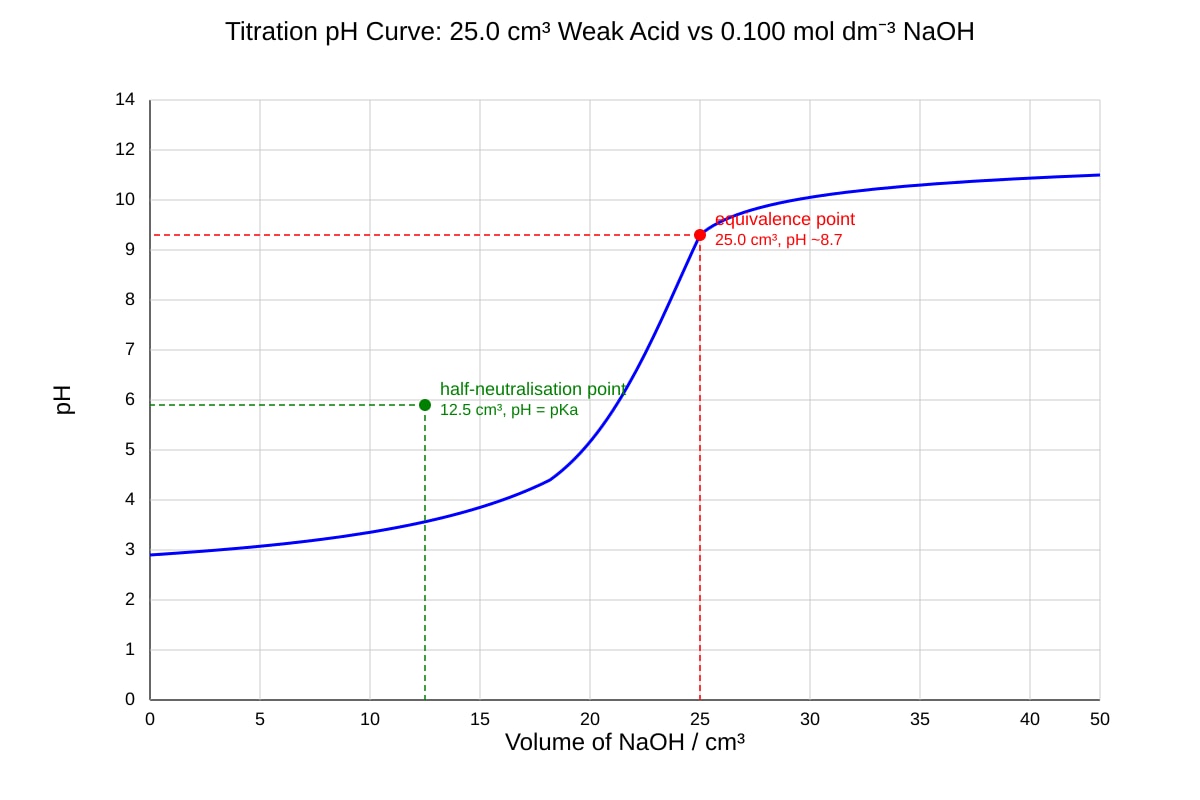
17. The graph below shows the pH curve for the titration of 25.0 cm3 of a weak acid with 0.100 mol dm−3 NaOH.
Image pending generation: graph for Q17.
(a) State the volume of NaOH at the equivalence point. [1]
(b) Using the graph, estimate the Ka of the weak acid. [2]
(c) Suggest a suitable indicator for this titration. [1]
18. Ocean acidification reduces pH of seawater. Explain, using the CO2/HCO3−/CO32− equilibrium, how increased atmospheric CO2 lowers ocean pH and how the carbonate buffer resists change. [5]
19. A student proposes that adding a strong base to a weak acid buffer will not change the pH. Evaluate this statement with reference to buffer capacity and the Henderson–Hasselbalch equation. [4]
20. The table shows Ka values for three acids at 25 °C.
| Acid | Ka / mol dm−3 |
|---|---|
| HA | 1.0×10⁻⁴ |
| HB | 4.5×10⁻⁶ |
| HC | 2.2×10⁻⁹ |
(a) Arrange the acids in order of increasing strength. [1]
(b) For acid HA at 0.010 mol dm−3, calculate [H+] assuming Ka=[HA][H+]2. [2]
(c) Explain why HB is a weaker acid than HA. [1]
End of Paper
Answers
TuitionGoWhere Exam Practice (AI) – Answer Key
Practice Paper - Chemistry H1 A-Level (Version 3)
Total Marks: 60
Section A (20 marks)
1. [2 marks]
A weak acid is one that only partially dissociates/ionises in water (1 mark).
Equation with reversible arrow and state symbols, e.g. CH3COOH(aq)⇌CH3COO−(aq)+H+(aq) (1 mark).
Teaching note: Weak ≠ dilute. Strength refers to extent of dissociation, not concentration. Common trap: using → instead of ⇌.
2. [1 mark]
A Brønsted–Lowry base is a proton (H+) acceptor.
Teaching note: Contrast with Arrhenius base (produces OH⁻ in water).
3. [2 marks]
Conjugate acid–base pairs: NH4+/NH3 (1 mark) and H2O/OH− (1 mark).
Teaching note: Pair differs by one H+.
4. [1 mark]
High acidity (low pH) denatures enzymes, changing the active site shape so substrate cannot bind.
Teaching note: Mechanism: H⁺ disrupts H-bonds/ionic bonds in tertiary structure.
5. [2 marks]
Kw=[H+(aq)][OH−(aq)] (1 mark); value =1.0×10⁻¹⁴ mol2 dm−6 at 25 °C (1 mark).
6. [1 mark]
[H+]=10−3.0=1.0×10⁻³ mol dm−3.
7. [2 marks]
Equation: CH3COO−(aq)+H+(aq)→CH3COOH(aq) (1 mark). Added strong acid is consumed by ethanoate ions, minimising pH drop (1 mark).
8. [1 mark]
Phenolphthalein (pH range 8.2–10.0) or methyl orange (3.1–4.4); accept any valid indicator with range.
9. [1 mark]
It acts as a buffer system that helps maintain ocean pH by neutralising added acid.
10. [1 mark]
Strong base fully dissociates in water; weak base only partially dissociates.
Section B (22 marks)
11. [3 marks]
n(NaOH)=0.0200×(18.5/1000)=3.70×10−4 mol (1)
1:1 ratio ⇒ n(acid)=3.70×10⁻⁴ mol (1)
c=3.70×10⁻⁴/(25.0/1000)=0.0148 mol dm−3 (1)
12. [2 marks]
HCl is strong ⇒ [H+]=0.010 mol dm−3 (1)
pH=−log10(0.010)=2.00 (1)
13. [3 marks]
Ka=[H2CO3][HCO3−][H+]; assume [HCO3−]=[H+] (1)
[H+]2=Ka×[H2CO3]=4.3×10−7×1.0×10−5=4.3×10⁻¹² (1)
[H+]=4.3×10−12=2.07×10⁻⁶ mol dm−3 (1)
14. [5 marks]
n(NaOH)=0.0500×0.0200=1.00×10⁻³ mol (1)
n(HNO3)=0.0400×0.0300=1.20×10⁻³ mol (1)
Excess HNO3=0.20×10⁻³ mol (1)
Total vol = 50.0 cm³ = 0.0500 dm³ ⇒ [H+]=0.20×10⁻³/0.0500=4.0×10−3 mol dm−3 (1)
pH=−log(4.0×10⁻³)=2.40 (1)
15. [4 marks]
[H+]=Ka×[salt][acid]=1.8×10−5×0.100.20=3.6×10⁻⁵ (2)
pH=−log(3.6×10⁻⁵)=4.44 (2)
16. [5 marks]
n(NaOH)=0.0100×0.0120=1.20×10⁻⁴ mol (1)
n(acid)=1.20×10⁻⁴ mol (1)
mass = 1.20×10−4×354.3=0.0425 g (1)
% = (0.0425/2.50)×100=1.70% (2)
Section C (18 marks)
17. [4 marks]
(a) 25.0 cm³ (1)
(b) At half-neutralisation pH = pKa ⇒ pKa ≈ from graph ~ (value read, e.g. 4.7) ⇒ Ka=10−4.7 (2)
(c) Phenolphthalein (1)
Image note: Graph must show equivalence at 25 cm³, pH ~8.7; half-point at 12.5 cm³.
18. [5 marks]
CO2+H2O⇌H2CO3⇌H++HCO3− (1); more CO₂ drives right, lowers pH (1).
CO32−+H+⇌HCO3− consumes H⁺ (1); buffer resists change (1); but capacity limited ⇒ acidification continues (1).
19. [4 marks]
Buffer resists small additions (1); Henderson–Hasselbalch: pH=pKa+log([acid][base]) (1); strong base converts acid to base, ratio changes (1); large addition exceeds capacity ⇒ pH rises sharply (1).
20. [4 marks]
(a) HC < HB < HA (1)
(b) [H+]2=1.0×10−4×0.010=1.0×10⁻⁶ ⇒ [H+]=1.0×10⁻³ mol dm−3 (2)
(c) Smaller Ka ⇒ less dissociation ⇒ weaker acid (1)
End of Answer Key
Free quiz and exam paper access
Enter your details to view this paper
Your access is remembered on this device.