From Real Exams Exam Paper

A Level H1 Chemistry Practice Paper 2

Free Exam-Derived Owl Alpha A Level H1 Chemistry Practice Paper 2 practice paper with questions and answers for Singapore students. This page is rendered as a direct URL so the questions and answers can be discovered without pressing in-page buttons.

These static practice materials are generated from the site's syllabus and paper-generation workflow, with source and model context shown so students and parents can evaluate the material before use.

A Level H1 Chemistry From Real Exams Generated by Owl Alpha Updated 2026-06-07

Questions

<!-- TuitionGoWhere generation metadata: stage=3-1; model=openrouter/owl-alpha; model_label=Owl Alpha; generated=2026-06-06; Sources: Stage 2-1 real exam-derived templates and Stage 2-2 exam-enriched syllabus. -->

A-Level Chemistry H1 Quiz - Acids Bases Salts

Name: _______________________
Class: _______________________
Date: _______________________
Score: _______ / 60

Duration: 60 minutes
Total Marks: 60


Instructions

  • Answer ALL questions in the spaces provided.
  • Show all working for calculation questions. Answers without working may not receive full credit.
  • Use appropriate units and significant figures where applicable.
  • A Periodic Table and Data Booklet are provided separately.
  • The use of a scientific calculator is permitted.

Section A: Multiple Choice Questions (10 marks)

Questions 1–10 carry 1 mark each. Choose the most appropriate answer for each question.


1. Which of the following best describes a weak acid?

A. An acid that has a low concentration in solution
B. An acid that partially dissociates in aqueous solution
C. An acid that does not produce H+\text{H}^+ ions in water
D. An acid that has a pH greater than 7


2. The pH of a 0.050 mol dm30.050 \text{ mol dm}^{-3} solution of a strong monoprotic acid is closest to:

A. 1.0
B. 1.3
C. 2.0
D. 2.3


3. Which of the following salts will produce an acidic solution when dissolved in water?

A. Na2CO3\text{Na}_2\text{CO}_3
B. NH4Cl\text{NH}_4\text{Cl}
C. KNO3\text{KNO}_3
D. CH3COONa\text{CH}_3\text{COONa}


4. The ionic product of water, KwK_w, at 25C25^\circ\text{C} is 1.0×10¹⁴ mol2 dm61.0 \times 10^{-14} \text{ mol}^2 \text{ dm}^{-6}. What is the pH of pure water at 25C25^\circ\text{C}?

A. 0
B. 7
C. 14
D. 1.0×1071.0 \times 10^{-7}


5. A buffer solution is prepared by mixing 50 cm350 \text{ cm}^3 of 0.10 mol dm30.10 \text{ mol dm}^{-3} ethanoic acid with 50 cm350 \text{ cm}^3 of 0.10 mol dm30.10 \text{ mol dm}^{-3} sodium ethanoate. Which statement about this buffer is correct?

A. The pH of the buffer is equal to the pKa\text{p}K_a of ethanoic acid.
B. The buffer has a pH greater than 7.
C. The buffer cannot resist changes in pH when a small amount of acid is added.
D. The concentration of CH3COOH\text{CH}_3\text{COOH} is greater than the concentration of CH3COO\text{CH}_3\text{COO}^- in the buffer.


6. During the titration of a strong acid with a strong base, the pH at the equivalence point is:

A. Less than 7
B. Equal to 7
C. Greater than 7
D. Dependent on the indicator used


7. The KaK_a value for methanoic acid (HCOOH\text{HCOOH}) is 1.6×10⁴ mol dm31.6 \times 10^{-4} \text{ mol dm}^{-3} at 25C25^\circ\text{C}. What is the pKa\text{p}K_a of methanoic acid?

A. 2.80
B. 3.80
C. 4.80
D. 5.80


8. Which of the following is NOT a property of a good buffer solution?

A. It contains a weak acid and its conjugate base.
B. It resists changes in pH upon addition of small amounts of acid or base.
C. It maintains a constant pH of exactly 7.
D. It has approximately equal concentrations of the weak acid and its conjugate base.


9. A 25.0 cm325.0 \text{ cm}^3 sample of 0.100 mol dm30.100 \text{ mol dm}^{-3} hydrochloric acid is titrated with 0.100 mol dm30.100 \text{ mol dm}^{-3} sodium hydroxide. What volume of sodium hydroxide is required to reach the equivalence point?

A. 12.5 cm312.5 \text{ cm}^3
B. 25.0 cm325.0 \text{ cm}^3
C. 50.0 cm350.0 \text{ cm}^3
D. 100.0 cm3100.0 \text{ cm}^3


10. The pH of a 0.010 mol dm30.010 \text{ mol dm}^{-3} solution of a weak acid HA with Ka=4.0×10⁶ mol dm3K_a = 4.0 \times 10^{-6} \text{ mol dm}^{-3} is approximately:

A. 2.0
B. 3.0
C. 3.7
D. 4.0


Section B: Structured Questions (30 marks)

Answer ALL questions in this section.


11. (a) Define the term Brønsted–Lowry acid.


[1 mark]

(b) In the following reaction, identify the Brønsted–Lowry acid and the Brønsted–Lowry base:

NH3+H2ONH4++OH\text{NH}_3 + \text{H}_2\text{O} \rightleftharpoons \text{NH}_4^+ + \text{OH}^-

Acid: _________________________
Base: _________________________
[2 marks]

(c) Explain why water is described as amphoteric. Illustrate your answer with two equations showing water acting as an acid and as a base.


[3 marks]


12. A student prepares a solution of hydrochloric acid by dissolving 0.365 g0.365 \text{ g} of HCl\text{HCl} in water to make 250 cm3250 \text{ cm}^3 of solution.

(a) Calculate the concentration of the hydrochloric acid solution in mol dm3\text{mol dm}^{-3}.
(Relative atomic mass: H=1.0\text{H} = 1.0, Cl=35.5\text{Cl} = 35.5)


[2 marks]

(b) Calculate the pH of this solution.


[1 mark]

(c) The student dilutes 25.0 cm325.0 \text{ cm}^3 of this solution to 250 cm3250 \text{ cm}^3 with distilled water. Calculate the pH of the diluted solution.


[2 marks]


13. Ethanoic acid (CH3COOH\text{CH}_3\text{COOH}) is a weak acid with Ka=1.7×10⁵ mol dm3K_a = 1.7 \times 10^{-5} \text{ mol dm}^{-3} at 25C25^\circ\text{C}.

(a) Write an expression for the acid dissociation constant, KaK_a, for ethanoic acid.


[1 mark]

(b) Calculate the pH of a 0.10 mol dm30.10 \text{ mol dm}^{-3} solution of ethanoic acid.


[3 marks]

(c) A buffer solution is prepared by mixing 50.0 cm350.0 \text{ cm}^3 of 0.10 mol dm30.10 \text{ mol dm}^{-3} ethanoic acid with 50.0 cm350.0 \text{ cm}^3 of 0.20 mol dm30.20 \text{ mol dm}^{-3} sodium ethanoate. Calculate the pH of this buffer solution.


[3 marks]


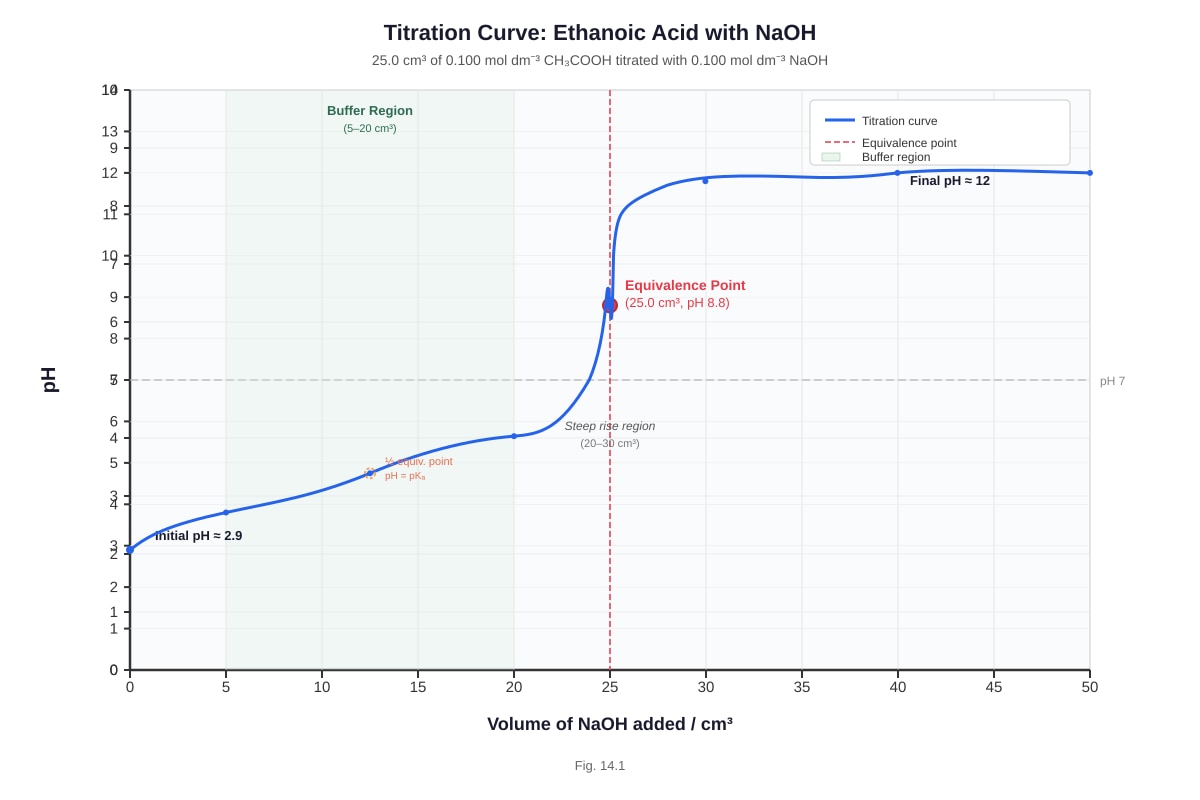
14. A titration is carried out by adding 0.100 mol dm30.100 \text{ mol dm}^{-3} sodium hydroxide solution from a burette to 25.0 cm325.0 \text{ cm}^3 of 0.100 mol dm30.100 \text{ mol dm}^{-3} ethanoic acid.

<image_placeholder> id: Q14-fig1 type: graph linked_question: Q14 description: A pH titration curve showing the titration of 25.0 cm³ of 0.100 mol dm⁻³ ethanoic acid with 0.100 mol dm⁻³ NaOH. The curve starts at approximately pH 2.9, rises gradually, then shows a steep rise between approximately 20 cm³ and 30 cm³ added, passing through pH 7 at the equivalence point (25.0 cm³), and levels off at approximately pH 12. The y-axis is labelled "pH" (range 0–14) and the x-axis is labelled "Volume of NaOH added / cm³" (range 0–50). labels: y-axis: pH (0 to 14), x-axis: Volume of NaOH added / cm³ (0 to 50), equivalence point at 25.0 cm³, initial pH ~2.9, final pH ~12 values: Initial pH ≈ 2.9, equivalence point at 25.0 cm³ NaOH, pH at equivalence point ≈ 8.8, buffer region visible between ~5 cm³ and ~20 cm³ must_show: Initial pH value, equivalence point location (25.0 cm³), steep rise region, buffer region, final pH plateau, correctly labelled axes with units

(a) Using the titration curve, state the pH at the equivalence point.


[1 mark]

(b) Explain why the pH at the equivalence point is greater than 7.


[2 marks]

(c) Suggest a suitable indicator for this titration, giving a reason for your choice.


[2 marks]

(d) Calculate the concentration of OH\text{OH}^- ions at the equivalence point if the pH is 8.8.


[1 mark]


15. (a) Explain what is meant by the term buffer solution.


[2 marks]

(b) A buffer solution contains 0.20 mol dm30.20 \text{ mol dm}^{-3} of a weak acid HA and 0.30 mol dm30.30 \text{ mol dm}^{-3} of its conjugate base A\text{A}^-. The KaK_a of HA is 6.3×10⁵ mol dm36.3 \times 10^{-5} \text{ mol dm}^{-3}.

(i) Calculate the pH of this buffer solution.


[2 marks]

(ii) A small amount of hydrochloric acid is added to this buffer. Explain, with the aid of an equation, how the buffer resists the change in pH.


[2 marks]


Section C: Data-Based and Application Questions (20 marks)

Answer ALL questions in this section.


16. A student investigates the properties of three unknown solutions labelled P, Q, and R. The following observations were recorded:

TestSolution PSolution QSolution R
pH1.57.013.0
Effect on litmusTurns blue litmus redNo changeTurns red litmus blue
Reaction with magnesium ribbonVigorous effervescenceNo reactionNo reaction
Electrical conductivityHighVery lowHigh

(a) Identify the nature of each solution (acidic, neutral, or alkaline).
Solution P: _________________________
Solution Q: _________________________
Solution R: _________________________
[3 marks]

(b) Write an equation for the reaction between solution P and magnesium.


[1 mark]

(c) Solution P is found to be a strong acid. Explain what is meant by a strong acid, illustrating your answer with an equation.


[2 marks]

(d) The student measures the electrical conductivity of solution Q and finds it to be very low. Explain this observation.


[1 mark]


17. The table below shows the KaK_a values for three weak acids at 25C25^\circ\text{C}.

AcidFormulaKaK_a / mol dm3\text{mol dm}^{-3}
Ethanoic acidCH3COOH\text{CH}_3\text{COOH}1.7×1051.7 \times 10^{-5}
Methanoic acidHCOOH\text{HCOOH}1.6×1041.6 \times 10^{-4}
Benzoic acidC6H5COOH\text{C}_6\text{H}_5\text{COOH}6.3×1056.3 \times 10^{-5}

(a) Arrange the three acids in order of increasing acid strength.


[1 mark]

(b) Explain your answer to (a) with reference to the KaK_a values.


[1 mark]

(c) Calculate the pH of a 0.050 mol dm30.050 \text{ mol dm}^{-3} solution of methanoic acid.


[2 marks]

(d) A solution of methanoic acid has a pH of 2.50. Calculate the initial concentration of this solution.


[3 marks]


18. A student wishes to prepare a buffer solution with a pH of 4.50 using ethanoic acid (CH3COOH\text{CH}_3\text{COOH}, Ka=1.7×10⁵ mol dm3K_a = 1.7 \times 10^{-5} \text{ mol dm}^{-3}) and sodium ethanoate (CH3COONa\text{CH}_3\text{COONa}).

(a) Calculate the ratio of [CH3COO][\text{CH}_3\text{COO}^-] to [CH3COOH][\text{CH}_3\text{COOH}] required to achieve this pH.


[3 marks]

(b) The student decides to prepare the buffer by mixing 100 cm3100 \text{ cm}^3 of 0.50 mol dm30.50 \text{ mol dm}^{-3} ethanoic acid with solid sodium ethanoate. Calculate the mass of sodium ethanoate (CH3COONa\text{CH}_3\text{COONa}) that must be added.
(Relative atomic masses: C=12.0\text{C} = 12.0, H=1.0\text{H} = 1.0, O=16.0\text{O} = 16.0, Na=23.0\text{Na} = 23.0)


[3 marks]


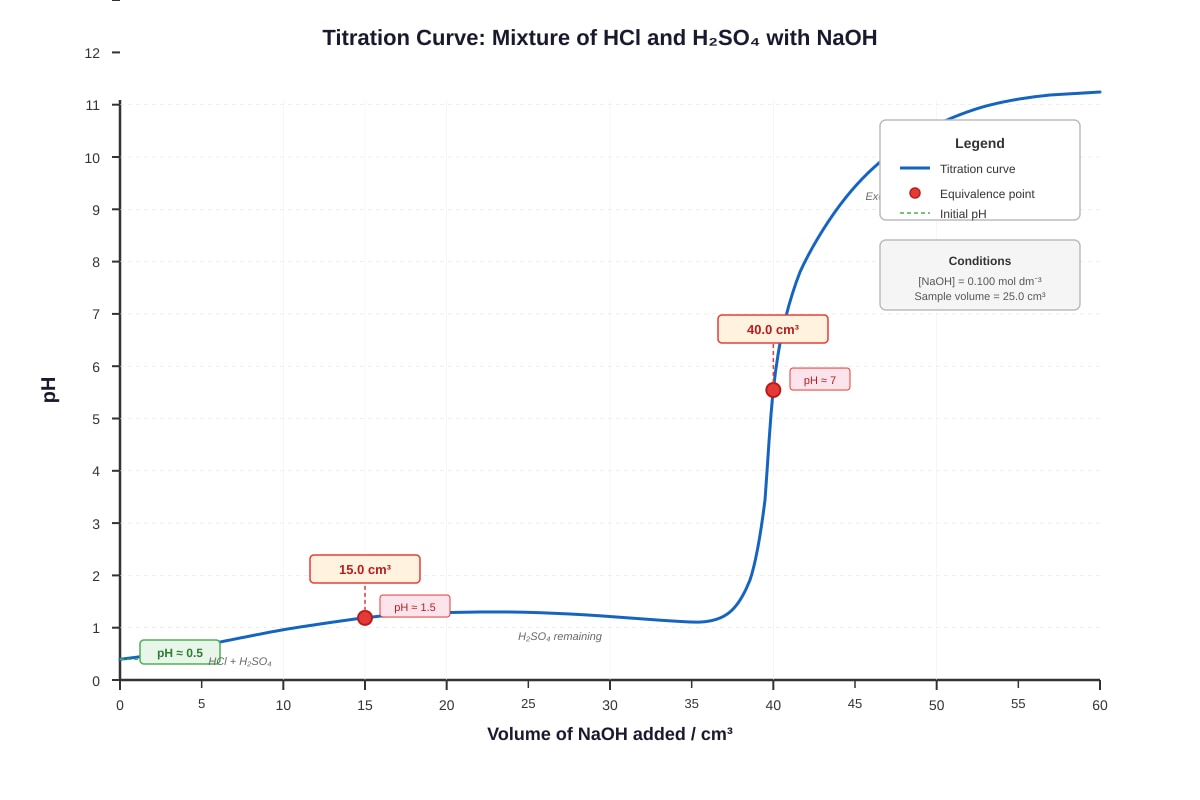
19. A 25.0 cm325.0 \text{ cm}^3 sample of a solution containing a mixture of hydrochloric acid and sulfuric acid is titrated with 0.100 mol dm30.100 \text{ mol dm}^{-3} sodium hydroxide. The titration curve obtained is shown below.

<image_placeholder> id: Q19-fig1 type: graph linked_question: Q19 description: A pH titration curve for the titration of a mixture of HCl and H₂SO₄ with 0.100 mol dm⁻³ NaOH. The curve starts at pH ~0.5, rises gradually, shows a first equivalence point at 15.0 cm³ NaOH (pH ~1.5), continues rising gradually, then shows a second steep rise between 35 cm³ and 45 cm³, with the second equivalence point at 40.0 cm³ NaOH (pH ~7). The y-axis is labelled "pH" (range 0–14) and the x-axis is labelled "Volume of NaOH added / cm³" (range 0–60). labels: y-axis: pH (0 to 14), x-axis: Volume of NaOH added / cm³ (0 to 60), first equivalence point at 15.0 cm³, second equivalence point at 40.0 cm³ values: Initial pH ≈ 0.5, first equivalence point at 15.0 cm³, second equivalence point at 40.0 cm³, total NaOH volume = 40.0 cm³ must_show: Initial pH, two distinct equivalence points (at 15.0 cm³ and 40.0 cm³), correctly labelled axes with units, steep rise regions at each equivalence point

(a) Explain why there are two equivalence points in this titration.


[2 marks]

(b) Using the titration curve, determine the total volume of sodium hydroxide required to neutralise the acid mixture completely.


[1 mark]

(c) The first equivalence point corresponds to the neutralisation of HCl\text{HCl} and the first proton of H2SO4\text{H}_2\text{SO}_4. Calculate the concentration of HCl\text{HCl} in the original acid mixture.


[2 marks]


20. A student investigates the effect of temperature on the ionic product of water, KwK_w. The following data is collected:

Temperature / C^\circ\text{C}KwK_w / mol2 dm6\text{mol}^2 \text{ dm}^{-6}pH of pure water
102.9×10152.9 \times 10^{-15}7.27
251.0×10141.0 \times 10^{-14}7.00
402.9×10142.9 \times 10^{-14}6.77
609.6×10149.6 \times 10^{-14}6.51

(a) Explain why the pH of pure water decreases as temperature increases, even though pure water remains neutral.


[2 marks]

(b) At 40C40^\circ\text{C}, calculate the concentration of H+\text{H}^+ ions in pure water.


[1 mark]

(c) At 60C60^\circ\text{C}, a solution has a pH of 5.50. Determine whether this solution is acidic, neutral, or alkaline at this temperature. Explain your reasoning.


[2 marks]

(d) State and explain whether the dissociation of water is an exothermic or endothermic process.


[1 mark]


Answers

<!-- TuitionGoWhere generation metadata: stage=3-1; model=openrouter/owl-alpha; model_label=Owl Alpha; generated=2026-06-06; Sources: Stage 2-1 real exam-derived templates and Stage 2-2 exam-enriched syllabus. -->

A-Level Chemistry H1 Quiz - Acids Bases Salts

Answer Key


Section A: Multiple Choice Questions (10 marks)

1. Answer: B
[1 mark]
A weak acid is defined as an acid that partially dissociates in aqueous solution. Option A confuses concentration with strength. Option C is incorrect because weak acids do produce H+\text{H}^+ ions, just not completely. Option D is incorrect because acids have pH less than 7.


2. Answer: B
[1 mark]
For a strong monoprotic acid, [H+]=0.050 mol dm3[\text{H}^+] = 0.050 \text{ mol dm}^{-3}.
pH=log10(0.050)=log10(5.0×10²)=2log105=20.70=1.30\text{pH} = -\log_{10}(0.050) = -\log_{10}(5.0 \times 10^{-2}) = 2 - \log_{10}5 = 2 - 0.70 = 1.30
Common mistake: Students may incorrectly calculate pH=log(0.05)=1.3\text{pH} = -\log(0.05) = 1.3 but choose option A (1.0) by rounding incorrectly.


3. Answer: B
[1 mark]
NH4Cl\text{NH}_4\text{Cl} is a salt of a weak base (NH3\text{NH}_3) and a strong acid (HCl\text{HCl}). The NH4+\text{NH}_4^+ ion undergoes hydrolysis to produce H+\text{H}^+ ions, making the solution acidic. Na2CO3\text{Na}_2\text{CO}_3 and CH3COONa\text{CH}_3\text{COONa} produce basic solutions (salts of strong base + weak acid). KNO3\text{KNO}_3 is neutral (strong acid + strong base).


4. Answer: B
[1 mark]
In pure water, [H+]=[OH][\text{H}^+] = [\text{OH}^-]. Since Kw=[H+][OH]=1.0×10¹⁴K_w = [\text{H}^+][\text{OH}^-] = 1.0 \times 10^{-14}, we have [H+]2=1.0×10¹⁴[\text{H}^+]^2 = 1.0 \times 10^{-14}, so [H+]=1.0×10⁷ mol dm3[\text{H}^+] = 1.0 \times 10^{-7} \text{ mol dm}^{-3}.
pH=log10(1.0×10⁷)=7\text{pH} = -\log_{10}(1.0 \times 10^{-7}) = 7


5. Answer: A
[1 mark]
When equal volumes of equimolar weak acid and its conjugate base are mixed, the concentrations of acid and conjugate base become equal. Using the Henderson–Hasselbalch equation: pH=pKa+log[A][HA]=pKa+log(1)=pKa\text{pH} = \text{p}K_a + \log\frac{[\text{A}^-]}{[\text{HA}]} = \text{p}K_a + \log(1) = \text{p}K_a. The pH is less than 7 (ethanoic acid has pKa4.77\text{p}K_a \approx 4.77). The buffer CAN resist pH changes. The concentrations are equal, not unequal.


6. Answer: B
[1 mark]
At the equivalence point of a strong acid–strong base titration, the salt formed is neutral (e.g., NaCl\text{NaCl}), so the pH is 7. The indicator does not determine the pH at the equivalence point; it only signals when the endpoint is reached.


7. Answer: B
[1 mark]
pKa=log10(Ka)=log10(1.6×10⁴)=4log101.6=40.20=3.80\text{p}K_a = -\log_{10}(K_a) = -\log_{10}(1.6 \times 10^{-4}) = 4 - \log_{10}1.6 = 4 - 0.20 = 3.80


8. Answer: C
[1 mark]
A buffer does not necessarily maintain a pH of 7. The pH of a buffer depends on the pKa\text{p}K_a of the weak acid and the ratio of conjugate base to acid. Buffers can be acidic (pH < 7) or basic (pH > 7). The other options are all correct properties of buffers.


9. Answer: B
[1 mark]
Moles of HCl=0.0250×0.100=0.00250 mol\text{HCl} = 0.0250 \times 0.100 = 0.00250 \text{ mol}
Since the reaction is 1:1 (HCl+NaOHNaCl+H2O\text{HCl} + \text{NaOH} \rightarrow \text{NaCl} + \text{H}_2\text{O}), moles of NaOH=0.00250 mol\text{NaOH} = 0.00250 \text{ mol}
Volume of NaOH=0.002500.100=0.0250 dm3=25.0 cm3\text{NaOH} = \frac{0.00250}{0.100} = 0.0250 \text{ dm}^3 = 25.0 \text{ cm}^3


10. Answer: C
[1 mark]
For a weak acid: [H+]=Ka×c=4.0×106×0.010=4.0×108=2.0×10⁴ mol dm3[\text{H}^+] = \sqrt{K_a \times c} = \sqrt{4.0 \times 10^{-6} \times 0.010} = \sqrt{4.0 \times 10^{-8}} = 2.0 \times 10^{-4} \text{ mol dm}^{-3}
pH=log10(2.0×10⁴)=4log102=40.30=3.70\text{pH} = -\log_{10}(2.0 \times 10^{-4}) = 4 - \log_{10}2 = 4 - 0.30 = 3.70


Section B: Structured Questions (30 marks)

11. (a) A Brønsted–Lowry acid is a proton (H+\text{H}^+) donor.
[1 mark]
Marking note: Must mention "proton" or "H⁺" and "donor" or "donates".

(b) Acid: H2O\text{H}_2\text{O}
Base: NH3\text{NH}_3
[2 marks – 1 mark each]
Water donates a proton to ammonia, forming NH4+\text{NH}_4^+ and OH\text{OH}^-. Therefore, water acts as the acid and ammonia acts as the base.

(c) Water is amphoteric because it can act as both an acid (proton donor) and a base (proton acceptor).
Acting as an acid: H2O+NH3OH+NH4+\text{H}_2\text{O} + \text{NH}_3 \rightleftharpoons \text{OH}^- + \text{NH}_4^+
Acting as a base: H2O+HClH3O++Cl\text{H}_2\text{O} + \text{HCl} \rightleftharpoons \text{H}_3\text{O}^+ + \text{Cl}^-
(or H2O+H2SO4H3O++HSO4\text{H}_2\text{O} + \text{H}_2\text{SO}_4 \rightleftharpoons \text{H}_3\text{O}^+ + \text{HSO}_4^-)
[3 marks – 1 mark for definition, 1 mark for each equation]
Marking note: The definition must state that water can act as both acid and base. Equations must show water donating H⁺ (acid) and accepting H⁺ (base).


12. (a) Molar mass of HCl=1.0+35.5=36.5 g mol1\text{HCl} = 1.0 + 35.5 = 36.5 \text{ g mol}^{-1}
Moles of HCl=0.36536.5=0.0100 mol\text{HCl} = \frac{0.365}{36.5} = 0.0100 \text{ mol}
Concentration = 0.01000.250=0.0400 mol dm3\frac{0.0100}{0.250} = 0.0400 \text{ mol dm}^{-3}
[2 marks – 1 mark for moles, 1 mark for concentration]

(b) HCl\text{HCl} is a strong acid, so [H+]=0.0400 mol dm3[\text{H}^+] = 0.0400 \text{ mol dm}^{-3}
pH=log10(0.0400)=1.40\text{pH} = -\log_{10}(0.0400) = 1.40
[1 mark]

(c) On dilution by a factor of 10, the new concentration = 0.040010=0.00400 mol dm3\frac{0.0400}{10} = 0.00400 \text{ mol dm}^{-3}
pH=log10(0.00400)=2.40\text{pH} = -\log_{10}(0.00400) = 2.40
[2 marks – 1 mark for new concentration, 1 mark for pH]
Teaching note: Diluting a strong acid by a factor of 10 increases the pH by 1 unit.


13. (a) Ka=[CH3COO][H+][CH3COOH]K_a = \frac{[\text{CH}_3\text{COO}^-][\text{H}^+]}{[\text{CH}_3\text{COOH}]}
[1 mark]
Marking note: Must be an expression with correct species. State symbols are not required in the KaK_a expression.

(b) For a weak acid: [H+]=Ka×c=1.7×105×0.10=1.7×106=1.30×10³ mol dm3[\text{H}^+] = \sqrt{K_a \times c} = \sqrt{1.7 \times 10^{-5} \times 0.10} = \sqrt{1.7 \times 10^{-6}} = 1.30 \times 10^{-3} \text{ mol dm}^{-3}
pH=log10(1.30×10³)=2.89\text{pH} = -\log_{10}(1.30 \times 10^{-3}) = 2.89
[3 marks – 1 mark for [H⁺] expression/substitution, 1 mark for [H⁺] value, 1 mark for pH]
Common mistake: Students may use [H+]=Ka×c[\text{H}^+] = K_a \times c instead of Ka×c\sqrt{K_a \times c}. The approximation is valid when cKac \gg K_a (here 0.101.7×1050.10 \gg 1.7 \times 10^{-5}, so the approximation is valid).

(c) After mixing equal volumes, concentrations are halved:
[CH3COOH]=0.102=0.050 mol dm3[\text{CH}_3\text{COOH}] = \frac{0.10}{2} = 0.050 \text{ mol dm}^{-3}
[CH3COO]=0.202=0.10 mol dm3[\text{CH}_3\text{COO}^-] = \frac{0.20}{2} = 0.10 \text{ mol dm}^{-3}
Using Henderson–Hasselbalch:
pH=pKa+log[CH3COO][CH3COOH]=log(1.7×10⁵)+log0.100.050\text{pH} = \text{p}K_a + \log\frac{[\text{CH}_3\text{COO}^-]}{[\text{CH}_3\text{COOH}]} = -\log(1.7 \times 10^{-5}) + \log\frac{0.10}{0.050}
=4.77+log(2.0)=4.77+0.30=5.07= 4.77 + \log(2.0) = 4.77 + 0.30 = 5.07
[3 marks – 1 mark for calculating diluted concentrations, 1 mark for pKₐ or Kₐ expression, 1 mark for final pH]
Alternative method using KaK_a: [H+]=Ka×[HA][A]=1.7×105×0.0500.10=8.5×10⁶[\text{H}^+] = K_a \times \frac{[\text{HA}]}{[\text{A}^-]} = 1.7 \times 10^{-5} \times \frac{0.050}{0.10} = 8.5 \times 10^{-6}; pH=log(8.5×10⁶)=5.07\text{pH} = -\log(8.5 \times 10^{-6}) = 5.07


14. (a) pH at equivalence point ≈ 8.8 (accept 8.5–9.0)
[1 mark]

(b) At the equivalence point, all the ethanoic acid has reacted with NaOH\text{NaOH} to form sodium ethanoate (CH3COONa\text{CH}_3\text{COONa}). The ethanoate ion (CH3COO\text{CH}_3\text{COO}^-) is the conjugate base of a weak acid and undergoes hydrolysis:
CH3COO+H2OCH3COOH+OH\text{CH}_3\text{COO}^- + \text{H}_2\text{O} \rightleftharpoons \text{CH}_3\text{COOH} + \text{OH}^-
This produces OH\text{OH}^- ions, making the solution slightly alkaline (pH > 7).
[2 marks – 1 mark for identifying the salt formed, 1 mark for explaining hydrolysis producing OH⁻]

(c) Phenolphthalein. The equivalence point occurs at pH ≈ 8.8, which falls within the pH range of phenolphthalein (8.2–10.0).
[2 marks – 1 mark for indicator, 1 mark for reason]
Note: Methyl orange (3.1–4.4) would not be suitable as its colour change occurs well before the equivalence point.

(d) pH=8.8\text{pH} = 8.8, so [H+]=108.8=1.58×10⁹ mol dm3[\text{H}^+] = 10^{-8.8} = 1.58 \times 10^{-9} \text{ mol dm}^{-3}
[OH]=Kw[H+]=1.0×10141.58×109=6.3×10⁶ mol dm3[\text{OH}^-] = \frac{K_w}{[\text{H}^+]} = \frac{1.0 \times 10^{-14}}{1.58 \times 10^{-9}} = 6.3 \times 10^{-6} \text{ mol dm}^{-3}
[1 mark]
Alternative: pOH=148.8=5.2\text{pOH} = 14 - 8.8 = 5.2; [OH]=105.2=6.3×10⁶ mol dm3[\text{OH}^-] = 10^{-5.2} = 6.3 \times 10^{-6} \text{ mol dm}^{-3}


15. (a) A buffer solution is a solution that resists changes in pH when small amounts of acid or base are added. It typically contains a weak acid and its conjugate base (or a weak base and its conjugate acid) in approximately equal concentrations.
[2 marks – 1 mark for resistance to pH change, 1 mark for composition]

(b) (i) Using the Henderson–Hasselbalch equation:
pKa=log(6.3×10⁵)=4.20\text{p}K_a = -\log(6.3 \times 10^{-5}) = 4.20
pH=pKa+log[A][HA]=4.20+log0.300.20=4.20+log(1.5)=4.20+0.18=4.38\text{pH} = \text{p}K_a + \log\frac{[\text{A}^-]}{[\text{HA}]} = 4.20 + \log\frac{0.30}{0.20} = 4.20 + \log(1.5) = 4.20 + 0.18 = 4.38
[2 marks – 1 mark for pKₐ, 1 mark for pH]

(ii) When HCl\text{HCl} is added, the H+\text{H}^+ ions react with the conjugate base A\text{A}^-:
A+H+HA\text{A}^- + \text{H}^+ \rightarrow \text{HA}
This removes the added H+\text{H}^+ ions by converting them into the weak acid HA, which only partially dissociates. The ratio [A]/[HA][\text{A}^-]/[\text{HA}] changes only slightly, so the pH remains relatively constant.
[2 marks – 1 mark for equation, 1 mark for explanation]
Teaching note: The buffer works because the added H⁺ is consumed by A⁻, and the resulting HA does not significantly increase [H⁺] because it is a weak acid.


Section C: Data-Based and Application Questions (20 marks)

16. (a) Solution P: Acidic
Solution Q: Neutral
Solution R: Alkaline
[3 marks – 1 mark each]

(b) Mg+2H+Mg2++H2\text{Mg} + 2\text{H}^+ \rightarrow \text{Mg}^{2+} + \text{H}_2
(or Mg+2HClMgCl2+H2\text{Mg} + 2\text{HCl} \rightarrow \text{MgCl}_2 + \text{H}_2)
[1 mark]

(c) A strong acid is an acid that completely dissociates in aqueous solution.
Equation: HClH++Cl\text{HCl} \rightarrow \text{H}^+ + \text{Cl}^-
(or HCl+H2OH3O++Cl\text{HCl} + \text{H}_2\text{O} \rightarrow \text{H}_3\text{O}^+ + \text{Cl}^- with a single arrow)
[2 marks – 1 mark for definition, 1 mark for equation with single arrow]
Key distinction: Strong acids use a single arrow (→) showing complete dissociation; weak acids use an equilibrium arrow (⇌) showing partial dissociation.

(d) Solution Q has a pH of 7.0 and very low electrical conductivity, indicating it is pure water. Pure water has very few ions (H+\text{H}^+ and OH\text{OH}^- at 107 mol dm310^{-7} \text{ mol dm}^{-3} each), so it conducts electricity very poorly.
[1 mark]


17. (a) Ethanoic acid < Benzoic acid < Methanoic acid
[1 mark]

(b) A larger KaK_a value indicates a greater degree of dissociation, meaning the acid is stronger. Methanoic acid has the largest KaK_a (1.6×1041.6 \times 10^{-4}), so it is the strongest. Ethanoic acid has the smallest KaK_a (1.7×1051.7 \times 10^{-5}), so it is the weakest.
[1 mark]

(c) [H+]=Ka×c=1.6×104×0.050=8.0×106=2.83×10³ mol dm3[\text{H}^+] = \sqrt{K_a \times c} = \sqrt{1.6 \times 10^{-4} \times 0.050} = \sqrt{8.0 \times 10^{-6}} = 2.83 \times 10^{-3} \text{ mol dm}^{-3}
pH=log10(2.83×10³)=2.55\text{pH} = -\log_{10}(2.83 \times 10^{-3}) = 2.55
[2 marks – 1 mark for [H⁺], 1 mark for pH]

(d) pH=2.50\text{pH} = 2.50, so [H+]=102.50=3.16×10³ mol dm3[\text{H}^+] = 10^{-2.50} = 3.16 \times 10^{-3} \text{ mol dm}^{-3}
For a weak acid: Ka=[H+]2c[H+]K_a = \frac{[\text{H}^+]^2}{c - [\text{H}^+]} (using the exact expression)
1.6×104=(3.16×10³)2c3.16×1031.6 \times 10^{-4} = \frac{(3.16 \times 10^{-3})^2}{c - 3.16 \times 10^{-3}}
c3.16×103=1.0×1051.6×104=0.0625c - 3.16 \times 10^{-3} = \frac{1.0 \times 10^{-5}}{1.6 \times 10^{-4}} = 0.0625
c=0.0625+0.00316=0.0657 mol dm3c = 0.0625 + 0.00316 = 0.0657 \text{ mol dm}^{-3}
Alternatively, using the approximation [H+]=Ka×c[\text{H}^+] = \sqrt{K_a \times c}:
c=[H+]2Ka=(3.16×10³)21.6×104=1.0×1051.6×104=0.0625 mol dm3c = \frac{[\text{H}^+]^2}{K_a} = \frac{(3.16 \times 10^{-3})^2}{1.6 \times 10^{-4}} = \frac{1.0 \times 10^{-5}}{1.6 \times 10^{-4}} = 0.0625 \text{ mol dm}^{-3}
[3 marks – 1 mark for [H⁺], 1 mark for Kₐ expression, 1 mark for concentration]
Note: The approximation gives 0.0625 mol dm⁻³ while the exact calculation gives 0.0657 mol dm⁻³. Both are acceptable, but the exact method is preferred when [H⁺] is not negligible compared to c.


18. (a) pKa=log(1.7×10⁵)=4.77\text{p}K_a = -\log(1.7 \times 10^{-5}) = 4.77
Using Henderson–Hasselbalch:
pH=pKa+log[CH3COO][CH3COOH]\text{pH} = \text{p}K_a + \log\frac{[\text{CH}_3\text{COO}^-]}{[\text{CH}_3\text{COOH}]}
4.50=4.77+log[CH3COO][CH3COOH]4.50 = 4.77 + \log\frac{[\text{CH}_3\text{COO}^-]}{[\text{CH}_3\text{COOH}]}
log[CH3COO][CH3COOH]=4.504.77=0.27\log\frac{[\text{CH}_3\text{COO}^-]}{[\text{CH}_3\text{COOH}]} = 4.50 - 4.77 = -0.27
[CH3COO][CH3COOH]=100.27=0.54\frac{[\text{CH}_3\text{COO}^-]}{[\text{CH}_3\text{COOH}]} = 10^{-0.27} = 0.54
[3 marks – 1 mark for pKₐ, 1 mark for substitution, 1 mark for ratio]

(b) From (a), [CH3COO][CH3COOH]=0.54\frac{[\text{CH}_3\text{COO}^-]}{[\text{CH}_3\text{COOH}]} = 0.54
[CH3COOH]=0.50 mol dm3[\text{CH}_3\text{COOH}] = 0.50 \text{ mol dm}^{-3} (in the final mixture, assuming volume change is negligible)
[CH3COO]=0.54×0.50=0.27 mol dm3[\text{CH}_3\text{COO}^-] = 0.54 \times 0.50 = 0.27 \text{ mol dm}^{-3}
Moles of CH3COONa\text{CH}_3\text{COONa} needed in 100 cm3=0.27×0.100=0.027 mol100 \text{ cm}^3 = 0.27 \times 0.100 = 0.027 \text{ mol}
Molar mass of CH3COONa=2(12.0)+3(1.0)+2(16.0)+23.0=82.0 g mol1\text{CH}_3\text{COONa} = 2(12.0) + 3(1.0) + 2(16.0) + 23.0 = 82.0 \text{ g mol}^{-1}
Mass of CH3COONa=0.027×82.0=2.21 g\text{CH}_3\text{COONa} = 0.027 \times 82.0 = 2.21 \text{ g}
[3 marks – 1 mark for [CH₃COO⁻], 1 mark for moles, 1 mark for mass]


19. (a) The mixture contains two acids: HCl\text{HCl} (a strong monoprotic acid) and H2SO4\text{H}_2\text{SO}_4 (a strong diprotic acid). The first equivalence point corresponds to the neutralisation of HCl\text{HCl} and the first proton of H2SO4\text{H}_2\text{SO}_4. The second equivalence point corresponds to the neutralisation of the second proton of H2SO4\text{H}_2\text{SO}_4.
[2 marks – 1 mark for identifying two acids, 1 mark for explaining two protons/stages]

(b) Total volume of NaOH=40.0 cm3\text{NaOH} = 40.0 \text{ cm}^3
[1 mark]

(c) At the first equivalence point (15.0 cm³), both HCl\text{HCl} and the first proton of H2SO4\text{H}_2\text{SO}_4 have been neutralised.
At the second equivalence point (40.0 cm³ total), the second proton of H2SO4\text{H}_2\text{SO}_4 is neutralised.
Volume of NaOH\text{NaOH} for the second proton of H2SO4=40.015.0=25.0 cm3\text{H}_2\text{SO}_4 = 40.0 - 15.0 = 25.0 \text{ cm}^3
Since H2SO4\text{H}_2\text{SO}_4 is diprotic, the volume for the first proton = volume for the second proton = 25.0 cm325.0 \text{ cm}^3
Volume of NaOH\text{NaOH} for HCl=15.025.0=Wait—this gives a negative value. Let me reconsider.\text{HCl} = 15.0 - 25.0 = \text{Wait—this gives a negative value. Let me reconsider.}

Re-analysis: The first equivalence point at 15.0 cm³ represents the neutralisation of HCl only (since HCl is a strong acid and reacts first). The second equivalence point at 40.0 cm³ represents the neutralisation of both protons of H₂SO₄.
Volume for HCl=15.0 cm3\text{HCl} = 15.0 \text{ cm}^3
Moles of NaOH\text{NaOH} for HCl=0.0150×0.100=0.00150 mol\text{HCl} = 0.0150 \times 0.100 = 0.00150 \text{ mol}
Concentration of HCl=0.001500.0250=0.060 mol dm3\text{HCl} = \frac{0.00150}{0.0250} = 0.060 \text{ mol dm}^{-3}
[2 marks – 1 mark for moles of NaOH, 1 mark for concentration]
Note: The interpretation depends on the relative acid strengths. Since both HCl and H₂SO₄ are strong acids, the first equivalence point likely corresponds to HCl (monoprotic) and the second to H₂SO₄ (diprotic, requiring twice the volume). However, the data shows 15.0 cm³ for the first and 25.0 cm³ more for the second, suggesting HCl = 15.0 cm³ and H₂SO₄ = 25.0 cm³ (for both protons).


20. (a) As temperature increases, KwK_w increases, meaning the dissociation of water increases. This produces more H+\text{H}^+ and OH\text{OH}^- ions in equal amounts. Since [H+][\text{H}^+] increases, the pH decreases. However, because [H+]=[OH][\text{H}^+] = [\text{OH}^-] at all temperatures, pure water remains neutral.
[2 marks – 1 mark for explaining increased dissociation, 1 mark for stating water remains neutral because [H⁺] = [OH⁻]]

(b) At 40C40^\circ\text{C}: Kw=2.9×10¹⁴K_w = 2.9 \times 10^{-14}
[H+]=Kw=2.9×1014=1.70×10⁷ mol dm3[\text{H}^+] = \sqrt{K_w} = \sqrt{2.9 \times 10^{-14}} = 1.70 \times 10^{-7} \text{ mol dm}^{-3}
[1 mark]

(c) At 60C60^\circ\text{C}, the pH of neutral water is 6.51 (from the table). A solution with pH 5.50 has a pH lower than 6.51, meaning [H+]>[OH][\text{H}^+] > [\text{OH}^-]. Therefore, the solution is acidic at this temperature.
[2 marks – 1 mark for identifying the neutral pH at 60°C, 1 mark for comparison and conclusion]

(d) The dissociation of water is an endothermic process. As temperature increases, KwK_w increases, meaning the equilibrium shifts to the right (towards more dissociation). By Le Chatelier's principle, increasing temperature favours the endothermic direction.
[1 mark]