From Real Exams Exam Paper
A Level H1 Chemistry Practice Paper 1
Free A Level H1 Chemistry Practice Paper 1, HY3 Exam version, with questions, answers, and A Level-style practice for Singapore students.
These static practice materials are generated from the site's syllabus and paper-generation workflow, with source and model context shown so students and parents can evaluate the material before use.
Questions
TuitionGoWhere Exam Practice (AI) — Practice Paper
Subject: Chemistry H1
Level: A-Level
Paper: Practice Paper (Version 1 of 5)
Duration: 1 hour 15 minutes
Total Marks: 60
Name: ________________________
Class: ________________________
Date: ________________________
Instructions:
- Answer all questions.
- Show your working clearly where calculations are involved.
- Use the Data Booklet if needed.
- Section A: Short Answer & Structured (20 marks)
- Section B: Calculations & Proof (25 marks)
- Section C: Data Interpretation & Reasoning (15 marks)
Section A: Short Answer & Structured (Questions 1–10) [20 marks]
1. What is meant by the term weak acid? Illustrate your answer with an equation. [2]
2. State the Brønsted–Lowry definition of a base. [1]
3. Write the conjugate acid–base pair in the reaction:
NH3(aq)+H2O(l)⇌NH4+(aq)+OH−(aq) [2]
4. Calcium hydroxide is added to fermentation tanks to prevent the production of lactic acid from slowing down. Why does high acidity reduce the effectiveness of the enzymes? [1]
5. Distinguish between a strong acid and a weak acid in terms of degree of dissociation. [2]
6. Write the expression for the ionic product of water, Kw, and state its value at 25 °C. [2]
7. A solution has [H+(aq)]=1.0×10⁻⁴ mol dm−3. State its pH. [1]
8. Name a suitable indicator for the titration of a strong acid with a strong base, and give its pH range. [2]
9. State the role of the HCO3−/CO32− system in ocean water. [1]
10. Explain why a buffer solution resists changes in pH when a small amount of strong acid is added. [2]
Section B: Calculations & Proof (Questions 11–16) [25 marks]
11. A solution of ethanoic acid (CH3COOH) has concentration 0.050 mol dm−3 and Ka=1.8×10⁻⁵ mol dm−3. Calculate the pH of the solution. [3]
12. 25.0 cm3 of 0.100 mol dm−3 hydrochloric acid is titrated with 0.200 mol dm−3 sodium hydroxide. Calculate the volume of NaOH required for neutralisation. [3]
13. Construct a balanced equation, including state symbols, for the first dissociation of carbonic acid in rainwater. Hence write an expression for Ka of carbonic acid. [3]
14. A 0.010 mol dm−3 solution of sodium hydroxide is prepared. Calculate the pH of this solution at 25 °C. (Kw=1.0×10⁻¹⁴ mol2 dm−6) [3]
15. 20.0 cm3 of 0.050 mol dm−3 benzoic acid (C6H5COOH) is titrated with 0.010 mol dm−3 NaOH. Using the equation
C6H5COOH+NaOH→C6H5COONa+H2O,
calculate the volume of NaOH needed for complete reaction. [4]
16. A buffer contains 0.10 mol dm−3 methanoic acid (Ka=1.6×10⁻⁴ mol dm−3) and 0.20 mol dm−3 sodium methanoate. Calculate the pH of the buffer. [4]
17. 50.0 cm3 of 0.020 mol dm−3 sulfuric acid (H2SO4) is diluted to 250.0 cm3. Calculate the concentration of H+(aq) in the final solution, assuming complete dissociation of both protons. [5]
Section C: Data Interpretation & Reasoning (Questions 18–20) [15 marks]
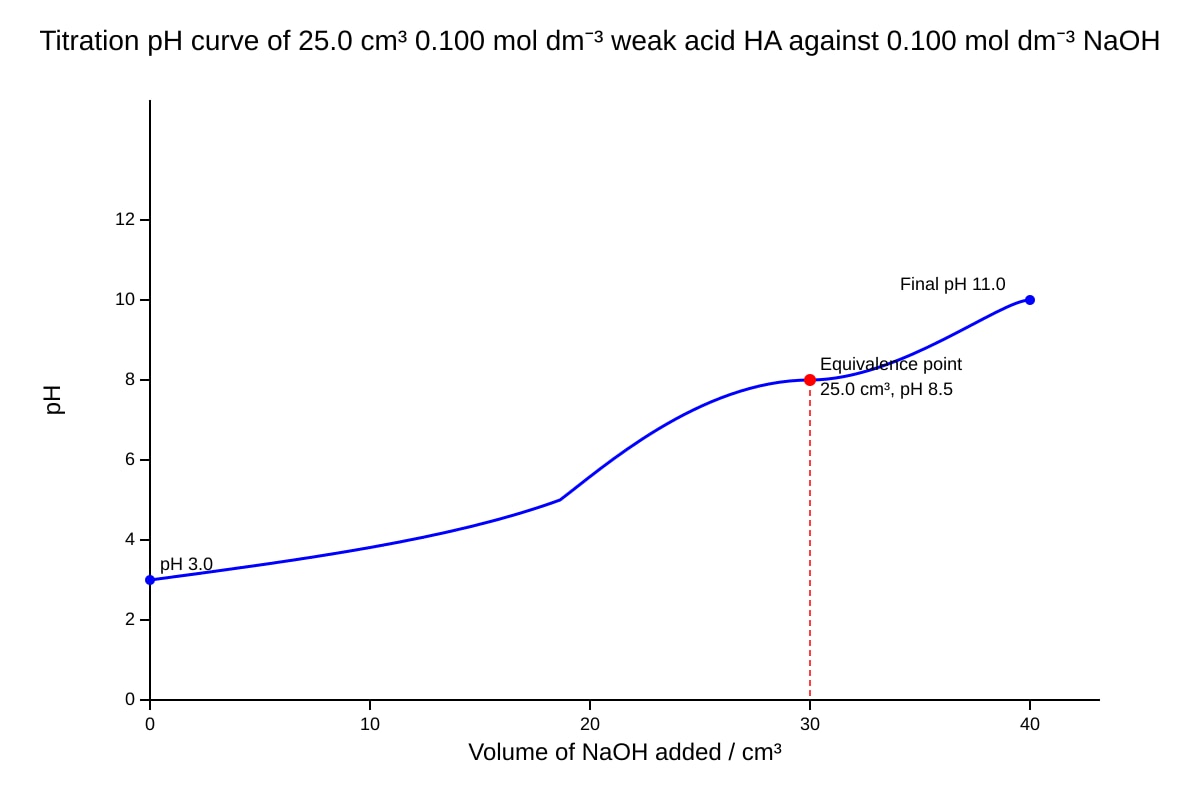
18. The graph below shows the pH curve for the titration of 25.0 cm3 of 0.100 mol dm−3 weak acid HA with 0.100 mol dm−3 NaOH.
Image pending generation: graph for Q18.
(a) State the volume of NaOH at the equivalence point. [1]
(b) Explain why the pH at equivalence is greater than 7. [2]
(c) Suggest a suitable indicator for this titration. [1]
19. Rainwater contains dissolved carbon dioxide forming carbonic acid:
H2CO3(aq)⇌H+(aq)+HCO3−(aq)
(a) Write the Ka expression. [1]
(b) Explain how increased atmospheric CO2 leads to ocean acidification. [3]
(c) State one environmental consequence. [1]
20. A student prepares a buffer by mixing 50.0 cm3 of 0.10 mol dm−3 ammonia (NH3, Kb=1.8×10⁻⁵ mol dm−3) with 50.0 cm3 of 0.10 mol dm−3 ammonium chloride.
(a) Identify the conjugate acid–base pair. [2]
(b) Calculate the pH of the buffer. (Kw=1.0×10⁻¹⁴) [3]
(c) Explain why adding 1.0 cm3 of 0.10 mol dm−3 HCl causes only a small pH change. [1]
Answers
TuitionGoWhere Exam Practice (AI) — Practice Paper Answer Key (Version 1 of 5)
Subject: Chemistry H1 | Level: A-Level | Paper: Practice Paper
Total Marks: 60
Section A (20 marks)
1. [2 marks]
A weak acid is one that only partially dissociates/ionises in water.
Equation: CH3COOH(aq)⇌CH3COO−(aq)+H+(aq)
Mark breakdown: 1 mark definition, 1 mark equation with reversible arrow and state symbols.
Teaching note: Weak ≠ dilute. Use ⇌ not →. Common error: writing (l) or omitting (aq).
2. [1 mark]
A Brønsted–Lowry base is a proton (H+) acceptor.
Teaching note: Do not confuse with Arrhenius (produces OH⁻ in water).
3. [2 marks]
Conjugate acid–base pairs: NH3/NH4+ and H2O/OH−.
Mark breakdown: 1 mark per pair.
Teaching note: Pair differs by one H+.
4. [1 mark]
High acidity (low pH) denatures enzymes, changing the active site shape so substrate cannot bind.
Teaching note: Link H⁺ to disruption of bonds in tertiary structure.
5. [2 marks]
Strong acid: almost complete dissociation in water. Weak acid: only partial dissociation.
Mark breakdown: 1 mark each.
6. [2 marks]
Kw=[H+(aq)][OH−(aq)]=1.0×10⁻¹⁴ mol2 dm−6 at 25 °C.
Mark breakdown: 1 mark expression, 1 mark value.
7. [1 mark]
pH = 4.00 (since −log10(1.0×10⁻⁴)=4).
8. [2 marks]
Phenolphthalein (pH range 8.2–10.0) or methyl orange (3.1–4.4) acceptable for strong–strong; state one with range.
Mark breakdown: 1 mark name, 1 mark range.
9. [1 mark]
It acts as a buffer system that helps maintain ocean pH around 8.1.
10. [2 marks]
The buffer contains weak acid and conjugate base; added H+ reacts with conjugate base to form weak acid, minimising free [H+] change.
Mark breakdown: 1 mark mechanism, 1 mark outcome.
Section B (25 marks)
11. [3 marks]
For CH3COOH⇌H++CH3COO−, Ka=c−[H+][H+]2≈c[H+]2
[H+]=Ka⋅c=1.8×10−5×0.050=9.0×10−7=9.49×10⁻⁴
pH = −log10(9.49×10⁻⁴)=3.02
Mark breakdown: 1 mark formula, 1 mark substitution, 1 mark pH.
12. [3 marks]
n(HCl)=0.100×(25.0/1000)=0.00250 mol
HCl + NaOH → NaCl + H₂O (1:1) ⇒ n(NaOH)=0.00250 mol
V=n/c=0.00250/0.200=0.0125 dm³ = 12.5 cm³
Mark breakdown: 1 mark moles acid, 1 mark moles base, 1 mark volume.
13. [3 marks]
H2CO3(aq)⇌H+(aq)+HCO3−(aq)
Ka=[H2CO3(aq)][H+(aq)][HCO3−(aq)]
Mark breakdown: 1 mark equation, 1 mark reversible + states, 1 mark expression.
14. [3 marks]
[OH−]=0.010 mol dm⁻³
[H+]=Kw/[OH−]=1.0×10−14/0.010=1.0×10−12
pH = −log10(1.0×10⁻¹²)=12.00
Mark breakdown: 1 mark [OH⁻], 1 mark [H⁺], 1 mark pH.
15. [4 marks]
n(acid)=0.050×(20.0/1000)=0.00100 mol
1:1 ratio ⇒ n(NaOH)=0.00100 mol
V=0.00100/0.010=0.100 dm³ = 100.0 cm³
Mark breakdown: 1 mark moles acid, 1 mark ratio, 1 mark volume calc, 1 mark unit.
16. [4 marks]
[H+]=Ka×[HCOO−][HCOOH]=1.6×10−4×0.200.10=8.0×10⁻⁵
pH = −log10(8.0×10⁻⁵)=4.10
Mark breakdown: 1 mark ratio, 1 mark substitution, 1 mark log, 1 mark pH.
17. [5 marks]
n(H2SO4)=0.020×(50.0/1000)=0.00100 mol
Each gives 2 H⁺ ⇒ n(H+)=0.00200 mol
Final V=250.0 cm³ = 0.250 dm³
[H+]=0.00200/0.250=0.00800 mol dm⁻³
Mark breakdown: 1 mark initial moles, 1 mark ×2, 1 mark final vol, 1 mark division, 1 mark answer.
Section C (15 marks)
18. [4 marks]
(a) [1] 25.0 cm³
(b) [2] Salt of weak acid (A⁻) hydrolyses: A−+H2O⇌HA+OH−, excess OH⁻ raises pH >7.
(c) [1] Phenolphthalein (suitable for weak–strong, range 8.2–10.0).
19. [5 marks]
(a) [1] Ka=[H2CO3][H+][HCO3−]
(b) [3] More CO₂ dissolves ⇒ more H₂CO₃ ⇒ more H⁺ ⇒ lower ocean pH; CO₃²⁻ combines with H⁺ reducing buffer capacity.
(c) [1] Coral bleaching / shell formation difficulty.
20. [6 marks]
(a) [2] NH3 (base) / NH4+ (conjugate acid).
(b) [3] Ka=Kw/Kb=1.0×10−14/1.8×10−5=5.56×10−10; equal concentrations ⇒ [H+]=Ka, pH = 9.25.
(c) [1] HCl reacts with NH₃ to form NH₄⁺, small change due to buffer reserve.
Free quiz and exam paper access
Enter your details to view this paper
Your access is remembered on this device.