A-Level Biology H3 Quiz - Plant Biology
Name:
Class:
Date:
Score:
Duration: 60 minutes
Total Marks: 40
Instructions: Answer all 20 questions. Section A is short structured items (1–10). Section B is data and applied items (11–15). Section C is extended response items (16–20). Use clear biological terminology and show reasoning where marks are awarded. This quiz is syllabus-first content generated from inferred patterns; it is not derived from past-year papers.
Section A: Core Knowledge (Questions 1–10, 1 mark each unless stated)
- State one anatomical feature of C4 plant leaves that enables spatial separation of initial CO₂ fixation from the Calvin cycle. [1]
- Name the enzyme in C4 plants that initially fixes CO₂ into a four-carbon compound in mesophyll cells. [1]
- Describe the temporal pattern of stomatal opening in a CAM plant. [1]
- Give one reason why photorespiration reduces photosynthetic efficiency in C3 plants at high temperature. [1]
- State the process by which mature plant cells may be returned to a stem cell state for cloning. [1]
- Name one epigenetic mechanism that alters gene expression without changing DNA sequence. [1]
- Identify the plant group that uses nocturnal CO₂ uptake and daytime closure of stomata to conserve water. [1]
- State one way in which C4 leaf anatomy minimises oxygenase activity of Rubisco. [1]
- Give one example of a C4 crop plant mentioned in the H3 syllabus. [1]
- Explain briefly why algae are considered relevant to global carbon mitigation alongside C3 and C4 plants. [1]
Section B: Data and Application (Questions 11–15)
- The table below shows leaf internal CO₂ concentration (µmol mol⁻¹) at midday for three plant types.
| Plant type | Midday internal CO₂ |
|---|
| C3 | 250 |
| C4 | 5 |
| CAM | 10 |
(a) Explain why C4 plants show a much lower midday internal CO₂ than C3 plants. [2]
(b) Suggest why CAM plants also maintain low midday internal CO₂. [1]
- A maize leaf (C4) is examined.
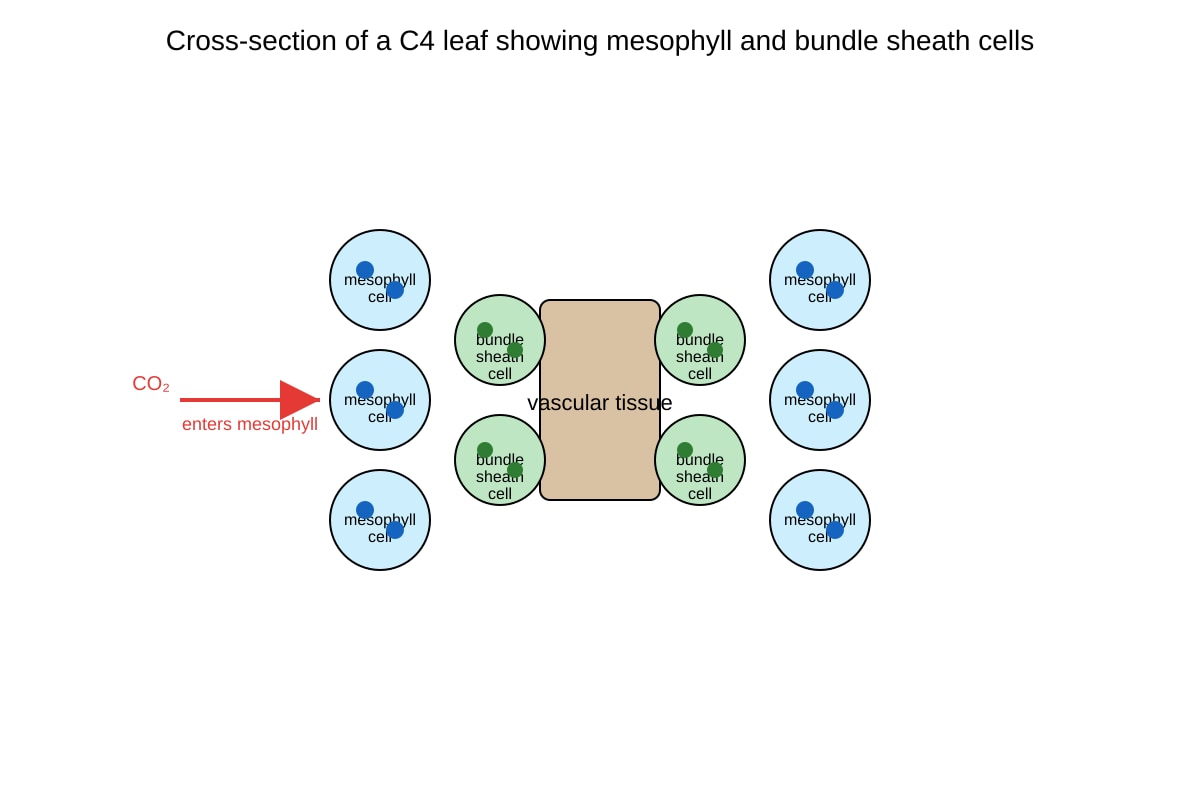
Generated diagram for Q12.
Using the diagram, describe the pathway of a carbon atom from atmospheric CO₂ to sugar in the Calvin cycle. [3]
- A CAM plant opens stomata at night and closes them by day.
(a) State the compound in which CO₂ is stored overnight. [1]
(b) Calculate the water saved as a percentage if a CAM plant loses 5 g H₂O per day versus a C3 plant losing 20 g H₂O per day under the same heat. [2]
- Drought-resistant crops are proposed as a climate-change response. Evaluate one benefit and one limitation of using genetic engineering to develop such crops, with reference to plant biology. [3]
- Describe how plant tissue culture can be used to regenerate whole plants from differentiated cells, and state its relevance to H3 genetics learning outcomes. [2]
Section C: Extended Response (Questions 16–20)
- Compare the importance of photosynthetic carbon fixation by C3, C4, CAM plants and algae in mitigating global warming. Include adaptation links. [5]
- Explain how C4 leaf anatomy and enzyme properties allow high rates of carbon fixation at high temperatures with minimal photorespiration. [4]
- Discuss how epigenetic modifications could influence plant response to climate change, using one mechanism. [3]
- A student claims: "CAM plants photosynthesise at night." Using your knowledge of temporal separation, assess this claim. [3]
- Synthesise how human biological measures (e.g. tree planting, drought-resistant crops) address climate change impacts on plants, with reference to C4/CAM adaptation principles. [4]
</stage5_quiz_answers_md>
A-Level Biology H3 Quiz - Plant Biology (Answer Key)
Total Marks: 40
Note: Syllabus-first generated content; not past-year derived.
Q1. [1] Presence of bundle sheath cells surrounding veins (Kranz anatomy).
Teaching note: C4 leaves separate initial fixation (mesophyll) from Calvin cycle (bundle sheath) spatially.
Q2. [1] PEP carboxylase.
Teaching note: Fixes CO₂ to PEP forming oxaloacetate (4C).
Q3. [1] Stomata open at night, closed during day.
Teaching note: Temporal separation conserves water.
Q4. [1] Rubisco binds O₂ instead of CO₂ (photorespiration) wasting energy.
Teaching note: High temp lowers CO₂/O₂ solubility ratio.
Q5. [1] Plant tissue culture (somatic embryogenesis / dedifferentiation).
Teaching note: Mature cell reprogrammed to meristematic state.
Q6. [1] DNA methylation (or histone modification / chromatin remodelling).
Teaching note: Alters transcription without sequence change.
Q7. [1] CAM plants (e.g. cactus).
Teaching note: Crassulacean Acid Metabolism.
Q8. [1] CO₂ concentrated in bundle sheath lowers O₂ competition at Rubisco.
Teaching note: Spatial pump.
Q9. [1] Maize (or sorghum).
Teaching note: Syllabus examples.
Q10. [1] Algae fix large CO₂ in oceans/corals, contributing to carbon sink.
Teaching note: Reef-building corals host photosynthetic algae.
Q11. [3 total]
(a) [2] C4 uses PEP carboxylase and bundle sheath concentration → internal CO₂ pumped to low level; C3 relies on diffusion only, accumulates.
(b) [1] CAM fixes at night, shuts stomata day → low daytime internal CO₂.
Q12. [3]
Step 1: CO₂ enters mesophyll (label shown).
Step 2: PEP carboxylase fixes to 4C acid.
Step 3: 4C acid moves to bundle sheath (label), releases CO₂ for Calvin cycle.
Marking: 1 each step.
Q13. [3]
(a) [1] Malate (or malic acid).
(b) [2] Saved = (20−5)/20 × 100 = 75%. Show subtraction, division, %.
Q14. [3] Benefit: precise trait insertion (e.g. stress gene) [1]; Limitation: ecological risk / regulatory [1]; linked to plant biology [1].
Q15. [2] Explants placed on auxin/cytokinin medium form callus then shoots/roots [1]; relates to cell state return outcome [1].
Q16. [5] C3: base-level fixation, less efficient heat [1]; C4: high temp efficiency [1]; CAM: arid water-saving [1]; algae: marine sink [1]; integration with warming mitigation [1].
Q17. [4] Kranz anatomy [1], PEP carboxylase high affinity [1], bundle sheath high temp enzymes [1], reduced photorespiration [1].
Q18. [3] Mechanism e.g. methylation [1], alters gene expression under stress [1], heritable plasticity [1].
Q19. [3] False: fixation at night, Calvin by day [1]; stomata night only [1]; assessment of wording [1].
Q20. [4] Tree planting increases C3/C4 sink [1]; drought crops use CAM/C4 principles [1]; reduces warming impact [1]; synthesis of measures [1].
</stage5_quiz_answers_md>
<stage5_quiz_md>
A-Level Biology H3 Quiz - Plant Biology
Name:
Class:
Date:
Score:
Duration: 60 minutes
Total Marks: 40
Instructions: Answer all 20 questions. Section A is short structured items (1–10). Section B is data and applied items (11–15). Section C is extended response items (16–20). Use clear biological terminology and show reasoning where marks are awarded. This quiz is syllabus-first content generated from inferred patterns; it is not derived from past-year papers.
Section A: Core Knowledge (Questions 1–10, 1 mark each unless stated)
- State one anatomical feature of C4 plant leaves that enables spatial separation of initial CO₂ fixation from the Calvin cycle. [1]
- Name the enzyme in C4 plants that initially fixes CO₂ into a four-carbon compound in mesophyll cells. [1]
- Describe the temporal pattern of stomatal opening in a CAM plant. [1]
- Give one reason why photorespiration reduces photosynthetic efficiency in C3 plants at high temperature. [1]
- State the process by which mature plant cells may be returned to a stem cell state for cloning. [1]
- Name one epigenetic mechanism that alters gene expression without changing DNA sequence. [1]
- Identify the plant group that uses nocturnal CO₂ uptake and daytime closure of stomata to conserve water. [1]
- State one way in which C4 leaf anatomy minimises oxygenase activity of Rubisco. [1]
- Give one example of a C4 crop plant mentioned in the H3 syllabus. [1]
- Explain briefly why algae are considered relevant to global carbon mitigation alongside C3 and C4 plants. [1]
Section B: Data and Application (Questions 11–15)
- The table below shows leaf internal CO₂ concentration (µmol mol⁻¹) at midday for three plant types.
| Plant type | Midday internal CO₂ |
|---|
| C3 | 250 |
| C4 | 5 |
| CAM | 10 |
(a) Explain why C4 plants show a much lower midday internal CO₂ than C3 plants. [2]
(b) Suggest why CAM plants also maintain low midday internal CO₂. [1]
- A maize leaf (C4) is examined.
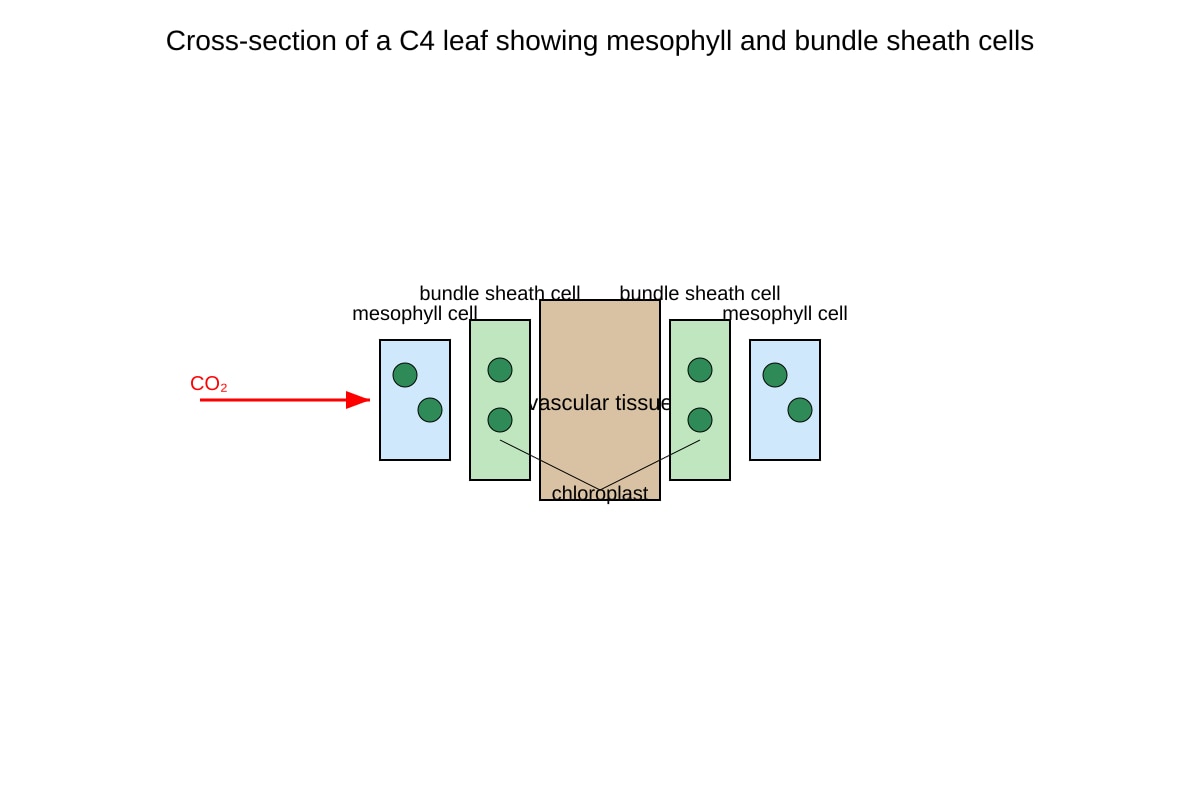
Generated diagram for Q12.
Using the diagram, describe the pathway of a carbon atom from atmospheric CO₂ to sugar in the Calvin cycle. [3]
- A CAM plant opens stomata at night and closes them by day.
(a) State the compound in which CO₂ is stored overnight. [1]
(b) Calculate the water saved as a percentage if a CAM plant loses 5 g H₂O per day versus a C3 plant losing 20 g H₂O per day under the same heat. [2]
- Drought-resistant crops are proposed as a climate-change response. Evaluate one benefit and one limitation of using genetic engineering to develop such crops, with reference to plant biology. [3]
- Describe how plant tissue culture can be used to regenerate whole plants from differentiated cells, and state its relevance to H3 genetics learning outcomes. [2]
Section C: Extended Response (Questions 16–20)
- Compare the importance of photosynthetic carbon fixation by C3, C4, CAM plants and algae in mitigating global warming. Include adaptation links. [5]
- Explain how C4 leaf anatomy and enzyme properties allow high rates of carbon fixation at high temperatures with minimal photorespiration. [4]
- Discuss how epigenetic modifications could influence plant response to climate change, using one mechanism. [3]
- A student claims: "CAM plants photosynthesise at night." Using your knowledge of temporal separation, assess this claim. [3]
- Synthesise how human biological measures (e.g. tree planting, drought-resistant crops) address climate change impacts on plants, with reference to C4/CAM adaptation principles. [4]