AI Generated Quiz
A Level Biology H3 Plant Biology Quiz
Free A Level Biology H3 Plant Biology quiz, AI version, with questions, answers, and A Level-style practice for Singapore students.
These static practice materials are generated from the site's syllabus and paper-generation workflow, with source and model context shown so students and parents can evaluate the material before use.
Questions
Free quiz and exam paper access
Enter your details to view this paper
Your access is remembered on this device.
Answers
A-Level Biology H3 Quiz - Plant Biology: Answer Key
Total Marks: 60
Section A: Short Answer Questions (Questions 1 - 10, 20 marks)
1. State two structural features of the leaves of C4 plants, such as maize, that are adaptations to minimise photorespiration and allow high rates of carbon fixation at high temperatures. [2 marks]
Answer:
- Kranz anatomy: The presence of two distinct photosynthetic cell types, mesophyll cells and bundle sheath cells, arranged in a wreath-like pattern around the vascular bundles. [1]
- A tight layer of bundle sheath cells with thick cell walls, which are impermeable to CO₂, creating a high CO₂ concentration around RuBisCO. [1]
Marking Notes: Accept any two correct structural features. Do not accept biochemical features (e.g., PEP carboxylase) for this question.
2. Explain how the temporal separation of carbon fixation in CAM plants allows them to minimise water loss while still carrying out photosynthesis. [3 marks]
Answer:
- At night, CAM plants open their stomata to take up CO₂. [1]
- Cooler night temperatures and higher humidity reduce the water potential gradient between the leaf and the air, so water loss through the open stomata is minimised. [1]
- During the day, stomata are closed, preventing water loss, but photosynthesis can still occur because CO₂ is released from malic acid stored in the vacuole and used in the Calvin cycle. [1]
Marking Notes: Award marks for the key steps: nocturnal stomatal opening, reduced water loss at night, and daytime CO₂ release from malate with closed stomata.
3. The enzyme PEP carboxylase found in the mesophyll cells of C4 plants has a much higher optimum temperature than RuBisCO. Suggest one advantage of this adaptation for C4 plants in hot climates. [2 marks]
Answer:
- At high temperatures, PEP carboxylase remains highly active, allowing C4 plants to continue fixing CO₂ efficiently. [1]
- This ensures a continuous supply of CO₂ to the bundle sheath cells, maintaining high rates of photosynthesis even when temperatures would cause RuBisCO to be less efficient or promote photorespiration. [1]
Marking Notes: Award 1 mark for stating the enzyme remains active at high temperatures, and 1 mark for linking this to sustained carbon fixation/photosynthesis.
4. A researcher measures the rate of CO₂ uptake by a CAM plant over a 24-hour period. The highest rate of CO₂ uptake is observed during the night. Explain this observation. [3 marks]
Answer:
- CAM plants open their stomata at night to take up CO₂. [1]
- This is because the cooler night temperatures and higher humidity reduce water loss. [1]
- CO₂ is fixed at night by PEP carboxylase into organic acids (e.g., malic acid), which are stored in the vacuole. During the day, stomata are closed to conserve water, and CO₂ is released from these acids for the Calvin cycle. [1]
Marking Notes: Award marks for nocturnal stomatal opening, the reason (water conservation), and the storage of CO₂ as organic acids.
5. State two differences between the initial carbon fixation step in C4 plants and CAM plants. [2 marks]
Answer:
- Timing: In C4 plants, initial carbon fixation occurs during the day; in CAM plants, it occurs at night. [1]
- Location: In C4 plants, initial carbon fixation occurs in the mesophyll cells; in CAM plants, it occurs in the same cells (mesophyll cells) but at a different time. [1]
Marking Notes: Accept any two correct differences. Other acceptable differences include the type of organic acid stored (malate) or the spatial vs. temporal separation.
6. Predict the effect of a 2°C increase in global temperature on the rate of photorespiration in a C3 plant. Explain your answer. [2 marks]
Answer:
- The rate of photorespiration would increase. [1]
- Higher temperatures increase the oxygenase activity of RuBisCO relative to its carboxylase activity, and also decrease the solubility of CO₂ relative to O₂, favouring the oxygenation reaction and thus photorespiration. [1]
Marking Notes: Award 1 mark for the prediction (increase) and 1 mark for a valid explanation.
7. Explain why reef-building corals, which harbour photosynthetic algae, are considered important in mitigating global warming. [2 marks]
Answer:
- The photosynthetic algae (zooxanthellae) within the corals fix atmospheric CO₂ through photosynthesis, acting as a carbon sink. [1]
- Coral reefs are highly productive ecosystems, fixing large amounts of carbon per unit area, and they contribute to the long-term storage of carbon in calcium carbonate skeletons. [1]
Marking Notes: Award marks for CO₂ fixation and the role as a carbon sink/high productivity.
8. Describe the role of the bundle sheath cells in the C4 photosynthetic pathway. [2 marks]
Answer:
- Bundle sheath cells are the site of the Calvin cycle in C4 plants. [1]
- They receive CO₂ released from C4 acids (e.g., malate) and use it to fix carbon via RuBisCO. The thick cell walls of bundle sheath cells help maintain a high CO₂ concentration, minimising photorespiration. [1]
Marking Notes: Award 1 mark for identifying bundle sheath cells as the site of the Calvin cycle and 1 mark for the high CO₂ concentration/minimised photorespiration.
9. Suggest one reason why C4 plants are more efficient than C3 plants in their use of water. [2 marks]
Answer:
- C4 plants can maintain high rates of photosynthesis at lower stomatal conductance (i.e., with stomata more closed) because the CO₂ concentrating mechanism in bundle sheath cells ensures a high CO₂ concentration around RuBisCO. [1]
- This means they lose less water through transpiration per unit of CO₂ fixed, giving them a higher water-use efficiency. [1]
Marking Notes: Award 1 mark for the CO₂ concentrating mechanism and 1 mark for reduced water loss per unit CO₂ fixed.
10. State the main function of stomata in CAM plants during the day. [1 mark]
Answer:
- They are closed to minimise water loss. [1]
Marking Notes: Accept "closed" or "to prevent water loss".
Section B: Data-Based Question (Questions 11 - 15, 20 marks)
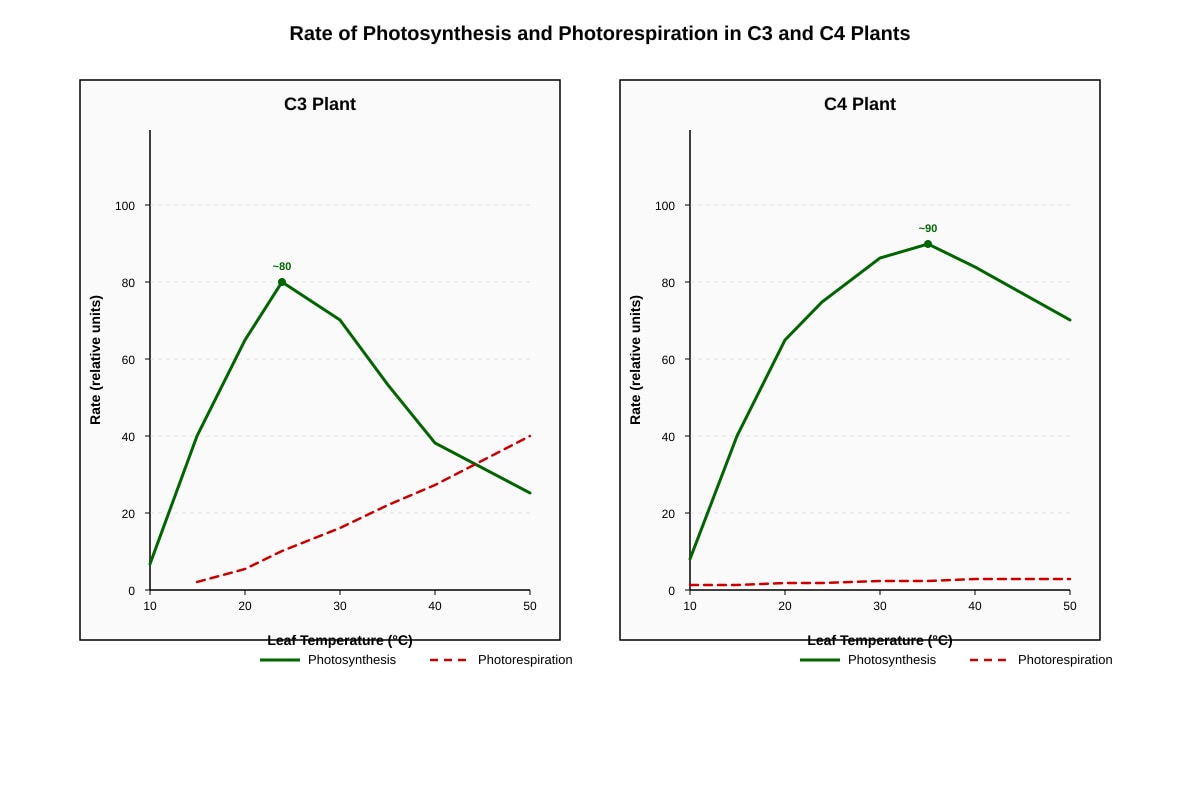
11. (a) Using the graph, compare the effect of increasing leaf temperature from 25°C to 40°C on the rate of photosynthesis in the C3 plant and the C4 plant. [2 marks]
Answer:
- In the C3 plant, the rate of photosynthesis decreases significantly (from about 80 to about 30 relative units). [1]
- In the C4 plant, the rate of photosynthesis continues to increase (from about 80 to about 90 relative units) or remains high. [1]
Marking Notes: Award 1 mark for each correct comparison. Accept quantitative or qualitative descriptions.
(b) With reference to the graph, explain the relationship between photorespiration and the rate of photosynthesis in the C3 plant at temperatures above 30°C. [3 marks]
Answer:
- As temperature increases above 30°C, the rate of photorespiration increases (from about 10 to 40 relative units). [1]
- This increase in photorespiration is accompanied by a decrease in the rate of photosynthesis. [1]
- This is because photorespiration competes with photosynthesis for RuBP; the oxygenase activity of RuBisCO increases at higher temperatures, reducing the efficiency of carbon fixation. [1]
Marking Notes: Award 1 mark for describing the increase in photorespiration, 1 mark for the decrease in photosynthesis, and 1 mark for the mechanistic explanation (RuBisCO oxygenase activity).
12. (a) Describe the pattern of stomatal conductance in the CAM plant over the 24-hour period. [2 marks]
Answer:
- Stomatal conductance is low during the day (0.02–0.05 mol m⁻² s⁻¹). [1]
- It increases sharply at night, reaching a peak at 24:00 (0.30 mol m⁻² s⁻¹). [1]
Marking Notes: Award 1 mark for describing low daytime conductance and 1 mark for high nighttime conductance.
(b) Explain how the pattern of stomatal conductance in the CAM plant is related to the temporal separation of carbon fixation. [3 marks]
Answer:
- At night, stomata are open, allowing CO₂ to enter the leaf. [1]
- This CO₂ is fixed by PEP carboxylase into organic acids (e.g., malic acid), which are stored in the vacuole. [1]
- During the day, stomata are closed to conserve water, and the stored organic acids are decarboxylated to release CO₂ for the Calvin cycle. [1]
Marking Notes: Award marks for the link between open stomata at night and CO₂ uptake/fixation, and closed stomata during the day and CO₂ release from stored acids.
13. (a) Calculate the percentage increase in annual carbon fixation of maize compared to wheat. Show your working. [2 marks]
Answer:
- Difference = 10.0 – 6.5 = 3.5 tonnes C ha⁻¹ yr⁻¹ [1]
- Percentage increase = (3.5 / 6.5) × 100 = 53.8% [1]
Marking Notes: Award 1 mark for the correct difference and 1 mark for the correct percentage. Accept 53.8% or 54%.
(b) Suggest two reasons why the tropical rainforest fixes more carbon per unit area than the maize crop. [2 marks]
Answer:
- The rainforest has a much higher leaf area index (more layers of leaves), allowing for greater light interception and photosynthesis. [1]
- The rainforest has a longer growing season (evergreen) compared to an annual crop like maize, which is harvested and has a period of no growth. [1]
Marking Notes: Accept any two valid reasons, e.g., higher biodiversity, multiple canopy layers, continuous growth.
14. Explain how the high optimum temperature of enzymes involved in the C4 pathway, such as PEP carboxylase, contributes to the high rates of carbon fixation in C4 plants at high temperatures. [3 marks]
Answer:
- At high temperatures, enzymes like PEP carboxylase remain highly active because their optimum temperature is high. [1]
- This ensures that the initial fixation of CO₂ in the mesophyll cells continues at a high rate. [1]
- This provides a constant supply of C4 acids to the bundle sheath cells, where CO₂ is released, maintaining a high CO₂ concentration around RuBisCO and sustaining high rates of photosynthesis. [1]
Marking Notes: Award marks for enzyme activity at high temperatures, sustained initial CO₂ fixation, and the supply of CO₂ to bundle sheath cells.
15. Discuss the relative importance of C3 plants, C4 plants, CAM plants, and algae (including reef-building corals) in mitigating global warming. Use your knowledge of their photosynthetic pathways and distribution to support your answer. [3 marks]
Answer:
- C3 plants: They cover vast areas of land (e.g., forests, temperate crops) and are major global carbon sinks, despite being less efficient in hot, dry conditions. [1]
- C4 plants: They are more efficient in hot, dry conditions and can fix more carbon per unit water used, making them important in tropical and subtropical regions. [1]
- CAM plants: They are adapted to extremely arid environments and contribute to carbon fixation in deserts, but their overall contribution is limited by their slow growth rates and low biomass. [1]
- Algae (including reef-building corals): They are highly productive and fix large amounts of CO₂, especially in marine environments. Coral reefs are significant carbon sinks, storing carbon in their calcium carbonate skeletons. [1]
Marking Notes: Award up to 3 marks for a well-structured discussion that covers at least three of the four groups and links their photosynthetic pathway to their role in carbon fixation. Award 1 mark for each valid point, up to a maximum of 3.
Section C: Extended Response Question (Questions 16 - 20, 20 marks)
16. Describe the anatomical adaptations of a C4 plant leaf that allow for the spatial separation of the initial carbon fixation and the Calvin cycle. [4 marks]
Answer:
- Kranz anatomy: The leaf has two distinct photosynthetic cell types arranged in concentric rings around the vascular bundles: an outer ring of mesophyll cells and an inner ring of bundle sheath cells. [1]
- Mesophyll cells: These cells are located near the leaf surface and contain PEP carboxylase, which fixes CO₂ into a four-carbon compound (oxaloacetate/malate). They are not the site of the Calvin cycle. [1]
- Bundle sheath cells: These cells are tightly packed around the vascular bundles and contain RuBisCO. They are the site of the Calvin cycle. [1]
- Thick cell walls of bundle sheath cells: These walls are relatively impermeable to CO₂, trapping CO₂ inside the bundle sheath cells and creating a high CO₂ concentration around RuBisCO, which suppresses photorespiration. [1]
Marking Notes: Award 1 mark for each correct anatomical feature and its role. Accept descriptions of the arrangement of cells, the location of the enzymes, and the role of the thick cell walls.
17. Explain how the biochemical pathway of CAM plants allows them to survive in arid environments. [4 marks]
Answer:
- Nocturnal CO₂ uptake: CAM plants open their stomata at night to take up CO₂. This is when temperatures are cooler and humidity is higher, reducing water loss through transpiration. [1]
- Initial fixation: At night, CO₂ is fixed by PEP carboxylase in the mesophyll cells to form organic acids (e.g., malic acid), which are stored in the vacuole. [1]
- Diurnal stomatal closure: During the day, stomata are closed, preventing water loss. [1]
- Release of CO₂: During the day, the stored organic acids are decarboxylated to release CO₂, which is then fixed by RuBisCO in the Calvin cycle. This allows photosynthesis to continue without opening stomata. [1]
Marking Notes: Award 1 mark for each key step: nocturnal stomatal opening, storage of CO₂ as organic acids, diurnal stomatal closure, and release of CO₂ for the Calvin cycle.
18. Compare the mechanisms by which C4 and CAM plants minimise photorespiration. [4 marks]
Answer:
- C4 plants: Use spatial separation. Initial carbon fixation occurs in mesophyll cells, and the Calvin cycle occurs in bundle sheath cells. [1]
- C4 mechanism: CO₂ is pumped into bundle sheath cells, creating a high CO₂ concentration around RuBisCO, which suppresses the oxygenase activity of RuBisCO and thus photorespiration. [1]
- CAM plants: Use temporal separation. Initial carbon fixation occurs at night, and the Calvin cycle occurs during the day. [1]
- CAM mechanism: CO₂ is stored as organic acids at night and released during the day, creating a high CO₂ concentration around RuBisCO during the day, which suppresses photorespiration. [1]
Marking Notes: Award 1 mark for each correct point of comparison. The key difference is spatial vs. temporal separation.
19. Evaluate the contribution of different photosynthetic organisms (C3, C4, CAM plants, and algae) to the global carbon cycle and their potential role in mitigating climate change. [4 marks]
Answer:
- C3 plants: They are the most widespread and dominate many ecosystems (e.g., forests, temperate grasslands). They are major carbon sinks but are less efficient in hot, dry conditions due to photorespiration. [1]
- C4 plants: They are more efficient in hot, sunny environments and have higher water-use efficiency. They contribute significantly to carbon fixation in tropical and subtropical regions, including important crops like maize and sugarcane. [1]
- CAM plants: They are adapted to arid environments and can fix carbon with minimal water loss. However, their growth rates are generally slow, and their overall contribution to the global carbon cycle is limited compared to C3 and C4 plants. [1]
- Algae (including reef-building corals): They are highly productive and fix large amounts of CO₂ in aquatic environments. Coral reefs are significant carbon sinks, storing carbon in their calcium carbonate skeletons. Algae also contribute to the biological carbon pump in oceans. [1]
Evaluation: The relative contribution depends on the area covered, the rate of carbon fixation, and the longevity of carbon storage. C3 plants and algae are likely the most significant global carbon sinks, while C4 plants are important regionally. CAM plants have a minor global role. [1]
Marking Notes: Award 1 mark for each group correctly described (up to 4 marks) and 1 mark for an evaluative conclusion. Maximum 4 marks.
20. A researcher is investigating a plant species that shows CAM photosynthesis. Describe an experiment the researcher could carry out to confirm that the plant uses CAM photosynthesis rather than C4 photosynthesis. [4 marks]
Answer:
- Measure the pattern of stomatal conductance/CO₂ uptake over 24 hours: If the plant is CAM, stomatal conductance and CO₂ uptake will be highest at night and lowest during the day. If it is C4, the highest rates will be during the day. [1]
- Measure the acidity of the leaf sap at different times of day: In CAM plants, the acidity of the leaf sap will be high in the early morning (due to the accumulation of malic acid overnight) and low in the late afternoon (after the malic acid has been decarboxylated). In C4 plants, there will be no such diurnal fluctuation in acidity. [1]
- Measure the δ¹³C isotope ratio: CAM plants have δ¹³C values that are intermediate between C3 and C4 plants, while C4 plants have a distinct, less negative δ¹³C value. [1]
- Microscopy: Examine leaf cross-sections. C4 plants will show Kranz anatomy (distinct bundle sheath cells), while CAM plants will not have this anatomical feature. [1]
Marking Notes: Award 1 mark for each valid experimental method and expected result. Accept other valid methods, such as measuring the activity of PEP carboxylase at night vs. day.