AI Generated Quiz
A Level Biology H3 Plant Biology Quiz
Free A Level Biology H3 Plant Biology quiz, AI version, with questions, answers, and A Level-style practice for Singapore students.
These static practice materials are generated from the site's syllabus and paper-generation workflow, with source and model context shown so students and parents can evaluate the material before use.
Questions
Free quiz and exam paper access
Enter your details to view this paper
Your access is remembered on this device.
Answers
A-Level Biology H3 Quiz - Plant Biology: Answer Key
Total Marks: 75
Section A: Multiple-Choice Questions (15 marks)
-
B (1 mark)
- Explanation: C4 plants concentrate CO₂ in bundle sheath cells, suppressing the oxygenase activity of rubisco and thus photorespiration. This allows them to fix carbon efficiently even when stomata are partially closed to conserve water.
- Common mistake: Option A describes CAM plants, not C4 plants. Option C is incorrect because photorespiration is wasteful, not beneficial. Option D is false; all plants need stomata for gas exchange.
-
B (1 mark)
- Explanation: In CAM plants, PEP carboxylase catalyses the fixation of CO₂ into oxaloacetate (a C4 acid) at night. Rubisco is involved in the Calvin cycle, which occurs during the day. NADP⁺ reductase and ATP synthase are involved in the light-dependent reactions.
-
B (1 mark)
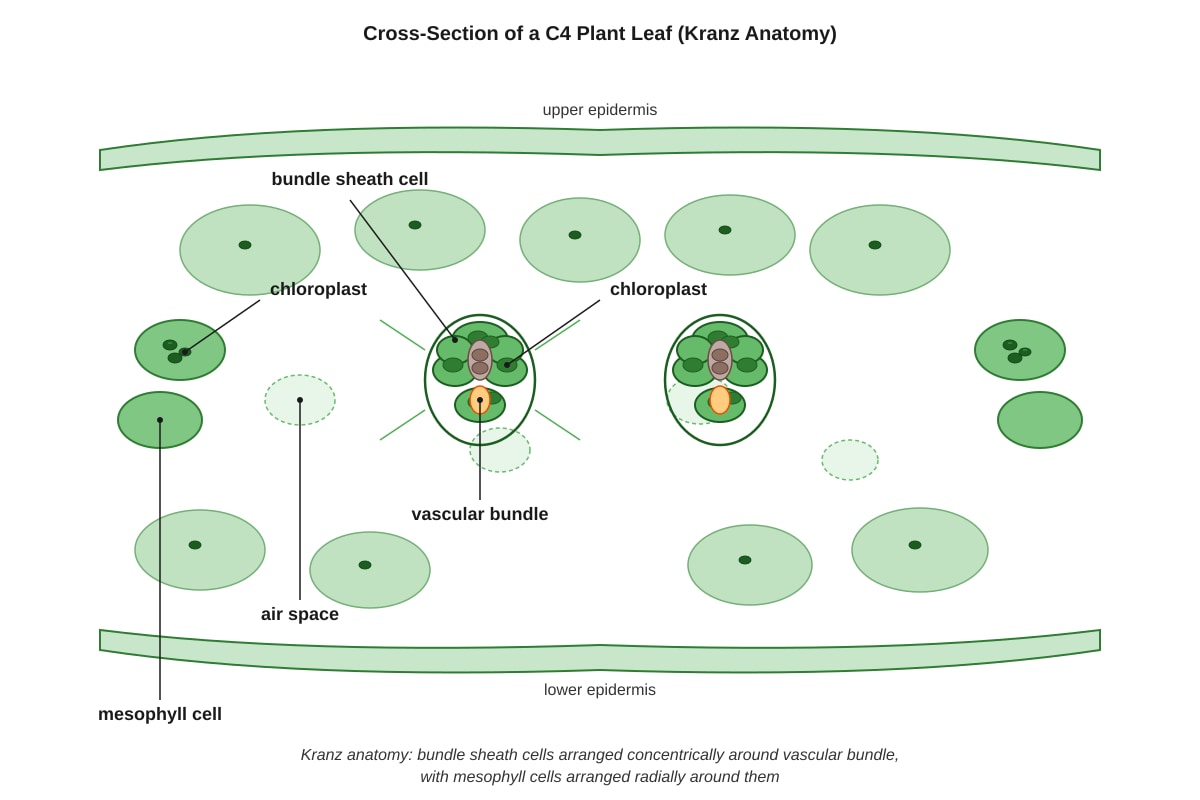
- Explanation: In C4 plants, the Calvin cycle occurs in the bundle sheath cells, where rubisco is located. CO₂ is concentrated in these cells, minimising photorespiration. The mesophyll cells are where the initial fixation of CO₂ into a C4 acid occurs.
-
C (1 mark)
- Explanation: Kranz anatomy is the arrangement of mesophyll cells around bundle sheath cells in C4 leaves. This spatial separation allows for the initial fixation of CO₂ in mesophyll cells and its subsequent release in bundle sheath cells, concentrating CO₂ for rubisco.
-
B (1 mark)
- Explanation: PEP carboxylase has a high affinity for CO₂ and a high optimum temperature. This allows C4 plants to fix CO₂ efficiently even when stomata are partially closed (to reduce water loss) and at high temperatures, where C3 plants would experience high rates of photorespiration.
-
D (1 mark)
- Explanation: Algae, particularly reef-building corals (which host symbiotic algae), have very high rates of carbon fixation per unit area and contribute significantly to long-term carbon storage in marine sediments. While C4 plants are efficient, algae generally have higher productivity in aquatic environments.
-
A (1 mark)
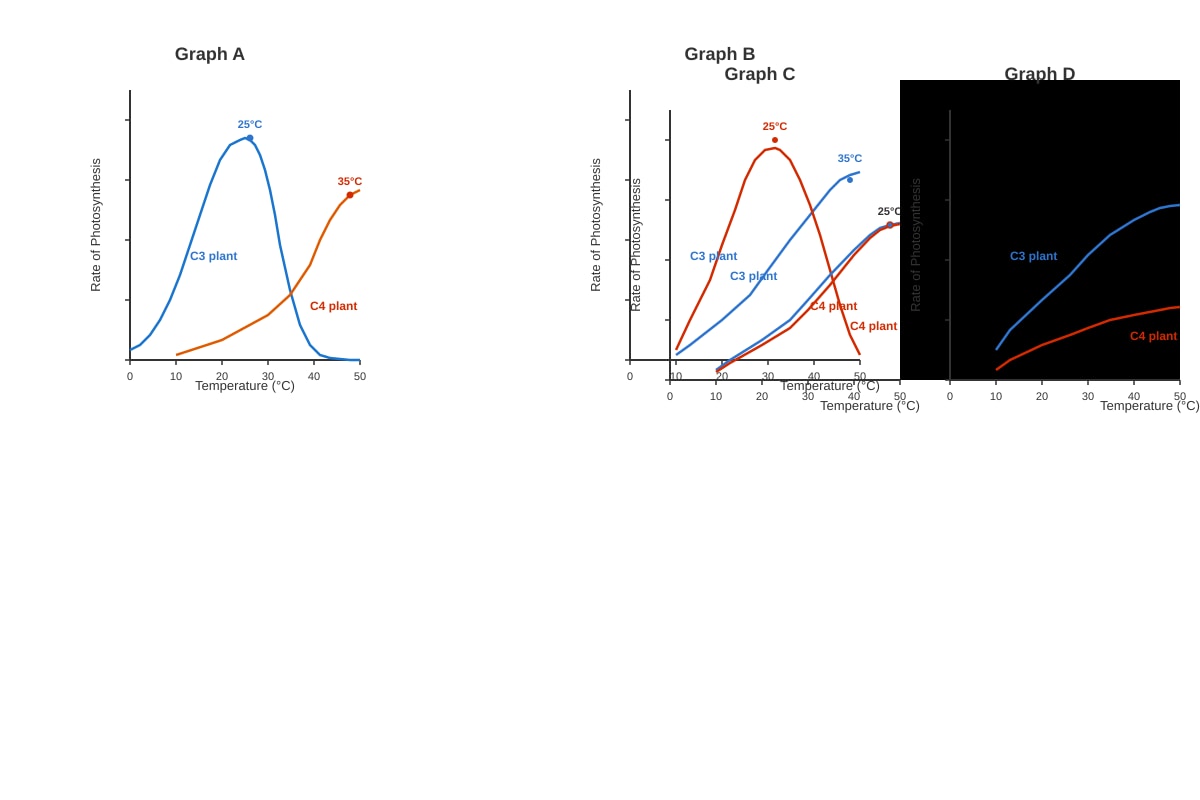
- Explanation: C3 plants have a lower optimal temperature for photosynthesis (around 25°C) and their rate declines sharply at higher temperatures due to increased photorespiration. C4 plants have a higher optimal temperature (around 35°C) and maintain higher rates at elevated temperatures.
-
A (1 mark)
- Explanation: CAM plants open their stomata at night to take in CO₂, which is fixed into a C4 acid (e.g., malate) and stored in the vacuole. During the day, the C4 acid is decarboxylated, releasing CO₂ for the Calvin cycle. This temporal separation minimises water loss.
-
B (1 mark)
- Explanation: Photorespiration occurs when rubisco fixes O₂ instead of CO₂, producing a compound that is then metabolised in a pathway that releases CO₂ and consumes ATP and NADPH without producing sugar. It is wasteful because it reduces the efficiency of photosynthesis.
-
C (1 mark)
- Explanation: C4 photosynthesis evolved in response to high temperatures and low atmospheric CO₂ concentrations. Under these conditions, photorespiration is high in C3 plants. The C4 pathway concentrates CO₂, suppressing photorespiration and allowing efficient carbon fixation.
-
B (1 mark)
- Explanation: In C4 plants, PEP carboxylase in mesophyll cells fixes CO₂ into phosphoenolpyruvate (PEP) to form oxaloacetate (OAA), a four-carbon compound. 3-PGA is the first product of the Calvin cycle in C3 plants. RuBP is the CO₂ acceptor in the Calvin cycle. G3P is a product of the Calvin cycle.
-
C (1 mark)
- Explanation: CAM plants exhibit temporal separation of carbon fixation (night) and the Calvin cycle (day). C4 plants exhibit spatial separation (mesophyll vs. bundle sheath cells). Option C describes the C4 mechanism, not CAM.
-
A (1 mark)
- Explanation: C3 plants have a more negative δ¹³C value (around -28 to -30‰) because rubisco discriminates more strongly against ¹³C. C4 plants have a less negative δ¹³C value (around -12 to -14‰) because PEP carboxylase discriminates less against ¹³C. This difference is used to distinguish between C3 and C4 plants in ecological and paleontological studies.
-
B (1 mark)
- Explanation: In C4 plants, rubisco is located exclusively in the bundle sheath cells, where the Calvin cycle takes place. The mesophyll cells contain PEP carboxylase for the initial fixation of CO₂. In C3 plants, rubisco is found in mesophyll cells.
-
B (1 mark)
- Explanation: C4 plants can fix CO₂ at a higher rate for a given stomatal opening because the CO₂-concentrating mechanism allows rubisco to operate near saturation. This means they can achieve the same amount of carbon fixation with less water loss through transpiration, resulting in higher water-use efficiency.
Section B: Structured Questions (30 marks)
-
(a) Role of PEP carboxylase in C4 photosynthesis: (2 marks)
- PEP carboxylase catalyses the fixation of CO₂ (from the mesophyll air spaces) with phosphoenolpyruvate (PEP) to form oxaloacetate (OAA), a four-carbon compound. (1 mark)
- It has a high affinity for CO₂ and no oxygenase activity, allowing efficient carbon fixation even at low CO₂ concentrations. (1 mark)
(b) How spatial separation reduces photorespiration: (4 marks)
- In C4 plants, CO₂ is initially fixed in mesophyll cells by PEP carboxylase, forming a C4 acid (e.g., malate). (1 mark)
- The C4 acid is transported to bundle sheath cells, where it is decarboxylated, releasing a high concentration of CO₂. (1 mark)
- This high CO₂ concentration in bundle sheath cells saturates rubisco, favouring its carboxylase activity over its oxygenase activity. (1 mark)
- As a result, photorespiration is minimised, even under conditions (high temperature, partial stomatal closure) that would promote it in C3 plants. (1 mark)
-
(a) Two adaptations of CAM plants that minimise water loss: (2 marks)
- Stomata open at night (when temperatures are lower and humidity is higher) to take in CO₂, reducing transpirational water loss. (1 mark)
- Succulent leaves/stems with a thick cuticle and water-storage tissue. (1 mark)
(b) Comparison of C4 and CAM mechanisms to minimise photorespiration: (6 marks)
- Similarity: Both use PEP carboxylase for the initial fixation of CO₂ into a C4 acid, which is then decarboxylated to release CO₂ for the Calvin cycle. This concentrates CO₂ for rubisco, suppressing photorespiration. (2 marks)
- Difference (Spatial vs. Temporal): C4 plants achieve this through spatial separation: initial fixation in mesophyll cells, Calvin cycle in bundle sheath cells. CAM plants achieve this through temporal separation: initial fixation at night, Calvin cycle during the day. (2 marks)
- Difference (Water Loss): CAM plants are more extreme in water conservation, opening stomata only at night. C4 plants can keep stomata partially open during the day but still have higher water-use efficiency than C3 plants. (1 mark)
- Difference (Energetic Cost): Both pathways have an additional ATP cost compared to C3 photosynthesis. The C4 pathway requires 2 extra ATP per CO₂ fixed (for the regeneration of PEP). CAM also has an additional cost for transporting and storing malate in the vacuole. (1 mark)
-
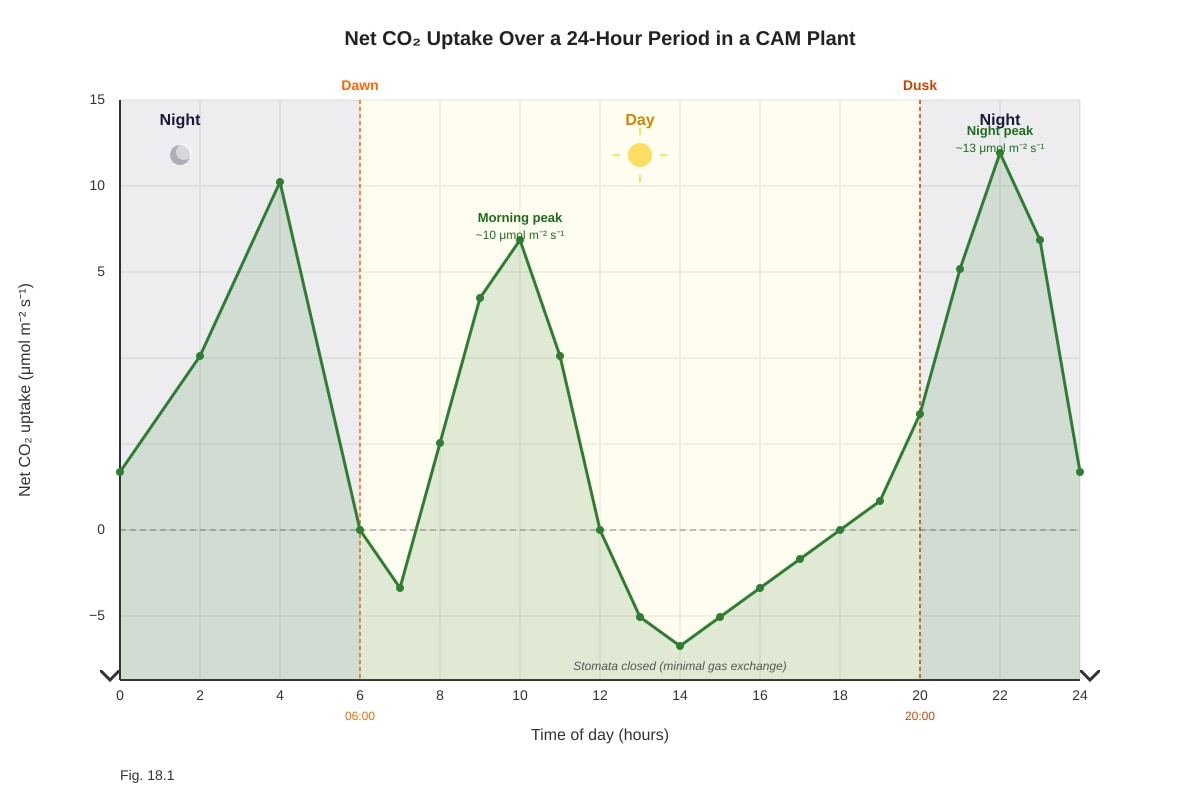
(a) Pattern of CO₂ uptake at night: (3 marks)
- At night, stomata open to allow CO₂ to enter the leaf. (1 mark)
- PEP carboxylase fixes CO₂ into oxaloacetate, which is then converted to malate and stored in the vacuole. (1 mark)
- This results in a net uptake of CO₂, as seen in the graph. (1 mark)
(b) Pattern of CO₂ uptake in the early morning: (3 marks)
- During the early morning, stomata may close partially or fully to conserve water. (1 mark)
- The stored malate is decarboxylated, releasing CO₂ for the Calvin cycle. (1 mark)
- Some of this CO₂ may be refixed if it escapes, leading to a second, smaller peak of net CO₂ uptake. (1 mark)
-
(a) Definition of photorespiration: (1 mark)
- Photorespiration is a process that occurs when rubisco fixes O₂ instead of CO₂, leading to the production of phosphoglycolate, which is then metabolised in a pathway that releases CO₂ and consumes ATP and NADPH without producing sugar.
(b) Why photorespiration is wasteful: (2 marks)
- It reduces the efficiency of photosynthesis because it consumes ATP and NADPH without fixing carbon into a usable sugar. (1 mark)
- It also releases previously fixed CO₂, reducing net carbon gain. (1 mark)
(c) How the C4 pathway overcomes photorespiration: (4 marks)
- In hot, dry environments, C3 plants close their stomata to conserve water, leading to low internal CO₂ concentrations and high O₂ concentrations, which promote photorespiration. (1 mark)
- C4 plants use PEP carboxylase in mesophyll cells to fix CO₂ into a C4 acid. PEP carboxylase has a high affinity for CO₂ and no oxygenase activity, so it can fix CO₂ efficiently even at low concentrations. (1 mark)
- The C4 acid is transported to bundle sheath cells, where it releases a high concentration of CO₂. (1 mark)
- This high CO₂ concentration saturates rubisco, suppressing its oxygenase activity and thus minimising photorespiration. (1 mark)
-
(a) Primary function of rubisco: (1 mark)
- Rubisco catalyses the carboxylation of ribulose-1,5-bisphosphate (RuBP) with CO₂ to form two molecules of 3-phosphoglycerate (3-PGA), the first step of the Calvin cycle.
(b) Why rubisco's dual specificity is an evolutionary constraint: (2 marks)
- Rubisco's inability to completely distinguish between CO₂ and O₂ means that under conditions of high temperature and low CO₂ (e.g., when stomata are closed), it will catalyse a wasteful oxygenation reaction (photorespiration). (1 mark)
- This limits the efficiency of C3 photosynthesis in hot, dry, or high-light environments, and has driven the evolution of CO₂-concentrating mechanisms like C4 and CAM photosynthesis. (1 mark)
(c) Relative importance in mitigating global warming: (6 marks)
- C3 plants: Dominate in temperate and cool regions. They have moderate carbon sequestration rates but are vulnerable to climate change (increased temperature, drought) which can increase photorespiration and reduce productivity. (1 mark)
- C4 plants: Highly efficient in hot, dry, and high-light environments (e.g., tropical grasslands, savannas). They have high carbon sequestration rates and are more resilient to warming and drought. They contribute significantly to global carbon storage, especially in soils. (1 mark)
- CAM plants: Adapted to extremely arid environments (e.g., deserts). They have lower overall productivity but can survive in areas where other plants cannot, contributing to carbon sequestration in marginal lands. Some CAM plants (e.g., agave) are being explored for bioenergy. (1 mark)
- Algae (including reef-building corals): Have very high rates of carbon fixation per unit area, especially in marine environments. They contribute to long-term carbon storage through the formation of calcium carbonate skeletons (corals) and the export of organic carbon to deep ocean sediments. They are, however, vulnerable to ocean acidification and warming. (1 mark)
- Overall assessment: No single group is the "best". A combination of all types is needed for global carbon sequestration. C4 plants and algae likely have the highest potential for rapid carbon uptake, but C3 plants cover the largest land area. (1 mark)
- Vulnerability: Climate change poses a threat to all groups, but C3 plants are generally most vulnerable to warming, while corals are vulnerable to ocean acidification. C4 and CAM plants may be more resilient to future climate conditions in some regions. (1 mark)
Section C: Free-Response Question (30 marks)
Question 21: Model Answer
Introduction (2-3 marks):
- Define photorespiration as the wasteful process where rubisco fixes O₂ instead of CO₂, consuming ATP and NADPH and releasing CO₂.
- State that the evolution of C4 and CAM photosynthesis represents a solution to this problem, but that the statement needs to be evaluated by considering the costs and trade-offs.
Biochemical Basis of Photorespiration (5-6 marks):
- Explain rubisco's dual specificity: it can catalyse both carboxylation (with CO₂) and oxygenation (with O₂).
- Describe the conditions that favour oxygenation: high temperature (which decreases the solubility of CO₂ relative to O₂ and increases the affinity of rubisco for O₂), low CO₂ concentrations (e.g., when stomata are closed to conserve water), and high O₂ concentrations.
- Explain the consequences of photorespiration: production of phosphoglycolate, which is metabolised in the photorespiratory pathway, consuming ATP and NADPH and releasing CO₂. This reduces the efficiency of photosynthesis by up to 30% in C3 plants.
Adaptations of C4 Plants (6-8 marks):
- Describe the C4 pathway: spatial separation of carbon fixation.
- In mesophyll cells: PEP carboxylase fixes CO₂ into a C4 acid (e.g., oxaloacetate, then malate).
- The C4 acid is transported to bundle sheath cells.
- In bundle sheath cells: the C4 acid is decarboxylated, releasing a high concentration of CO₂.
- Rubisco in bundle sheath cells fixes the concentrated CO₂ into the Calvin cycle.
- Explain how this solves the problem: The CO₂-concentrating mechanism saturates rubisco, suppressing its oxygenase activity and minimising photorespiration. This allows C4 plants to have high rates of photosynthesis even at high temperatures and when stomata are partially closed.
- Provide examples: Maize, sugarcane, sorghum.
Adaptations of CAM Plants (6-8 marks):
- Describe the CAM pathway: temporal separation of carbon fixation.
- At night: stomata open, PEP carboxylase fixes CO₂ into a C4 acid (e.g., malate), which is stored in the vacuole.
- During the day: stomata close, the C4 acid is decarboxylated, releasing CO₂ for the Calvin cycle.
- Explain how this solves the problem: By opening stomata only at night, CAM plants drastically reduce water loss. The stored CO₂ is then used during the day, allowing photosynthesis to occur without the need for open stomata. The high CO₂ concentration released from the C4 acid also suppresses photorespiration.
- Provide examples: Cacti, succulents, pineapple.
Evolutionary Significance (4-6 marks):
- Discuss the evolution of C4 and CAM as convergent solutions to the problem of photorespiration in different environments.
- Explain that C4 photosynthesis has evolved independently many times (over 60 times) in different plant lineages, suggesting strong selective pressure.
- Discuss the role of declining atmospheric CO₂ levels in the evolution of C4 photosynthesis.
- Mention that these adaptations are not "perfect" solutions; they come with energetic costs (e.g., extra ATP for C4, storage costs for CAM).
Evaluation (4-6 marks):
- The statement is largely correct: C4 and CAM are elegant solutions to a biochemical problem.
- However, they are not the only solutions, and they have trade-offs.
- C4 plants are less competitive in cool, shaded environments.
- CAM plants have slow growth rates due to the limited storage capacity for malate.
- The statement could be seen as teleological (evolution does not "solve" problems with a goal in mind). It is more accurate to say that natural selection has favoured these adaptations in specific environments.
- Conclude that while the statement is a useful simplification, a more nuanced view acknowledges the costs and context-dependence of these adaptations.
Quality of Written Communication (2-3 marks):
- Clear, logical structure.
- Accurate use of scientific terminology.
- Well-reasoned argument with specific examples.
Question 22: Model Answer
Introduction (2-3 marks):
- State that C3, C4, and CAM photosynthesis represent different strategies for carbon fixation, each with its own advantages and disadvantages.
- The statement is correct: C4 and CAM pathways solve the problem of photorespiration but incur energetic and ecological costs.
Energetic Costs (8-10 marks):
- C3: The Calvin cycle requires 3 ATP and 2 NADPH per CO₂ fixed. No additional energy is needed for a CO₂-concentrating mechanism.
- C4: The C4 pathway requires an additional 2 ATP per CO₂ fixed (for the regeneration of PEP from pyruvate in mesophyll cells). This makes C4 photosynthesis more energetically expensive than C3.
- CAM: The CAM pathway also has an additional ATP cost for the active transport of malate into the vacuole at night and its release during the day. The exact cost is debated but is generally higher than C3.
- Implication: In cool, low-light environments, the extra energy cost of C4 and CAM can outweigh the benefits, making C3 plants more competitive.
Water-Use Efficiency (6-8 marks):
- C3: Low water-use efficiency. Stomata must be open during the day to allow CO₂ entry, leading to high rates of transpirational water loss.
- C4: High water-use efficiency. The CO₂-concentrating mechanism allows C4 plants to fix CO₂ at a high rate even when stomata are partially closed, reducing water loss.
- CAM: Extremely high water-use efficiency. Stomata open only at night, when transpiration rates are lowest. This allows CAM plants to survive in extremely arid environments.
- Implication: In dry environments, the water-saving benefits of C4 and CAM outweigh their higher energetic costs.
Ecological Niches (6-8 marks):
- C3 plants: Most successful in cool, temperate, and moist environments (e.g., forests, grasslands in temperate regions). They are also dominant in aquatic environments. Examples: Rice, wheat, soybeans, trees.
- C4 plants: Most successful in hot, dry, and high-light environments (e.g., tropical and subtropical grasslands, savannas). They are also common in disturbed areas. Examples: Maize, sugarcane, sorghum, many grasses.
- CAM plants: Most successful in extremely arid environments (e.g., deserts, semi-deserts). They are also found in epiphytic habitats (e.g., bromeliads, orchids) where water is scarce. Examples: Cacti, succulents, pineapple, agave.
- Implication: Each pathway is adapted to a specific set of environmental conditions. No single pathway is universally "best".
Advantages and Disadvantages Summary (4-6 marks):
- C3: Advantage: Lower energetic cost, higher productivity in cool, moist conditions. Disadvantage: High photorespiration in hot, dry conditions, low water-use efficiency.
- C4: Advantage: Low photorespiration, high water-use efficiency, high productivity in hot, dry conditions. Disadvantage: Higher energetic cost, less competitive in cool, shaded environments.
- CAM: Advantage: Extremely high water-use efficiency, can survive in extreme aridity. Disadvantage: Slow growth rates, lower overall productivity, higher energetic cost.
Conclusion (2-3 marks):
- The statement is valid. C4 and CAM are not "free" solutions; they involve trade-offs.
- The success of each pathway depends on the specific environmental context.
- The diversity of photosynthetic pathways reflects the power of natural selection to adapt organisms to a wide range of ecological niches.
Quality of Written Communication (2-3 marks):
- Clear, logical structure.
- Accurate use of scientific terminology.
- Well-reasoned argument with specific examples and comparisons.