AI Generated Quiz
A Level Biology H3 Human Physiology Quiz
Free A Level Biology H3 Human Physiology quiz, HY3 AI version, with questions, answers, and A Level-style practice for Singapore students.
These static practice materials are generated from the site's syllabus and paper-generation workflow, with source and model context shown so students and parents can evaluate the material before use.
Questions
Free quiz and exam paper access
Enter your details to view this paper
Your access is remembered on this device.
Answers
A-Level Biology H3 Quiz - Human Physiology (Answer Key)
Total Marks: 40
Section A (Q1–8): 13 marks
Section B (Q9–14): 21 marks
Section C (Q15–20): 18 marks
Q1. [2 marks]
Na⁺ (sodium ions) responsible for depolarisation; K⁺ (potassium ions) responsible for repolarisation.
Teaching note: During depolarisation, voltage-gated Na⁺ channels open and Na⁺ influx reverses membrane potential. Repolarisation occurs as K⁺ channels open and K⁺ efflux restores negative interior.
Q2. [2 marks]
Any two of: phospholipid bilayer (hydrophobic core limits polar passage); channel proteins (selective ion passage); carrier proteins (facilitated diffusion); glycoproteins (recognition, not directly permeability but part of mosaic).
Marking: 1 mark each component named and linked to selective permeability.
Q3. [1 mark]
Maintenance of a stable internal environment despite external change.
Q4. [2 marks]
Acetylcholine; Ca²⁺ enters presynaptic terminal.
Note: Ca²⁺ influx triggers vesicle fusion and exocytosis of acetylcholine.
Q5. [1 mark]
e.g. bundle sheath cells separate from mesophyll (spatial separation of PEP carboxylase and Rubisco).
Q6. [1 mark]
Nocturnal stomatal opening for initial fixation into malate; Calvin cycle by day.
Q7. [2 marks]
Negative feedback; example: insulin reducing blood glucose after meal.
Common mistake: stating positive feedback without example.
Q8. [2 marks]
Beta cells (β-cells) of islets of Langerhans; high blood glucose concentration.
Q9. [4 marks]
- Myelin sheath formed by Schwann cells/oligodendrocytes insulates axon (1).
- Nodes of Ranvier expose membrane with high Na⁺ channels (1).
- Action potential jumps node to node (saltatory) (1).
- Increases speed by reducing continuous depolarisation needed (1).
Teaching: Saltatory from Latin saltare = leap.
Q10. [4 marks]
- AP arrives, depolarises terminal (1)
- Voltage-gated Ca²⁺ channels open, Ca²⁺ enters (1)
- Vesicles fuse, acetylcholine released (1)
- ACh binds receptors, Na⁺ influx depolarises postsynaptic (1).
Q11. [4 marks]
- Innate: barrier, phagocytosis, inflammation (1)
- Adaptive: B/T cells, antibodies (1)
- Interdependent: innate presents antigen to adaptive via APC (1)
- Example given (1).
Q12. [3 marks]
- Methyl groups added to cytosine (1)
- Recruits proteins that condense chromatin (1)
- Blocks transcription factor access, reduces expression (1).
Q13. [3 marks]
- Low glucose detected by α-cells (1)
- Glucagon secreted, liver glycogenolysis (1)
- Blood glucose rises, inhibits glucagon (negative feedback) (1).
Q14. [3 marks]
- Competes with pathogens (1)
- Produces vitamins e.g. K (1)
- Trains immune system (1).
Q15. [3 marks]
Amplitude = Peak – Resting (magnitude).
A: 35 – (–70) = 105 mV
B: 40 – (–65) = 105 mV
C: 30 – (–75) = 105 mV
All 105 mV; 1 mark each.
Q16. [2 marks]
Increase = (138 – 72)/72 × 100 = 91.7% ≈ 92%.
Working shown for 1 mark, final for 1.
Q17. [3 marks]
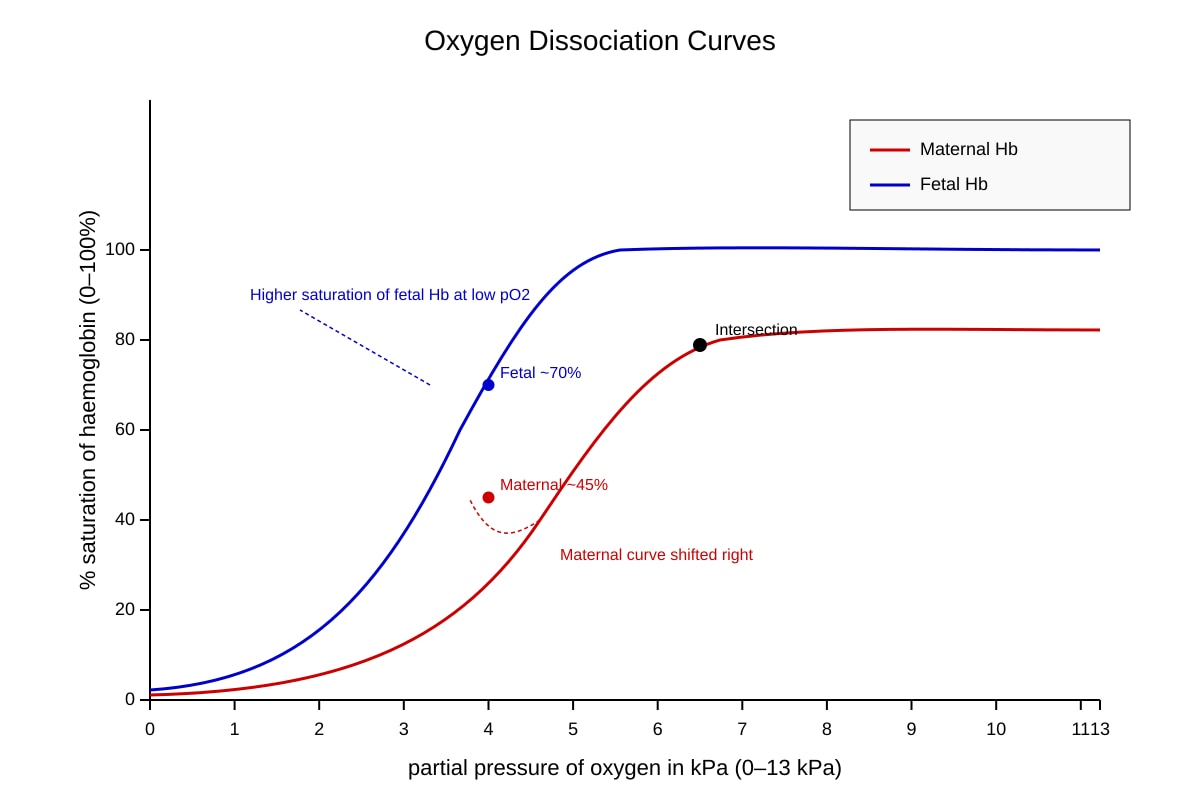
- Fetal Hb has higher affinity (left shift) due to different subunits (2,2,γ,γ) (1)
- Advantage: extracts O₂ from maternal at low pO2 (1)
- Left shift shown in placeholder (1).
Q18. [3 marks]
- C4 uses PEP carboxylase in mesophyll, no photorespiration at high T (1)
- Bundle sheath concentrates CO₂ for Rubisco (1)
- C3 suffers photorespiration, lower rate (1).
Q19. [3 marks]
Description: rise then fall to baseline. Hormone: insulin.
- Plot points (1), state trend (1), insulin (1).
Q20. [4 marks]
- Epigenetics allows reversible change without DNA seq (1)
- Example: plant flowering time shift via methylation with temperature (2)
- Significance: rapid adaptation (1).