AI Generated Quiz
A Level Biology H3 Genetics Inheritance Quiz
Free A Level Biology H3 Genetics Inheritance quiz, AI version, with questions, answers, and A Level-style practice for Singapore students.
These static practice materials are generated from the site's syllabus and paper-generation workflow, with source and model context shown so students and parents can evaluate the material before use.
Questions
Free quiz and exam paper access
Enter your details to view this paper
Your access is remembered on this device.
Answers
A-Level Biology H3 Quiz - Genetics Inheritance: Answer Key
Total Marks: 75
Section A: Multiple Choice and Short Answer Questions (20 marks)
1. B [2 marks]
- Explanation: A key difference is that the bacterial RNA polymerase must recognise the promoter to initiate transcription. Eukaryotic promoters are not recognised by bacterial RNA polymerase, so a bacterial promoter must be placed upstream of the eukaryotic gene in the plasmid. Option A is incorrect because RNA polymerase is used in both systems. Option C is incorrect because E. coli cannot splice introns, which is why cDNA is used. Option D is incorrect because DNA ligase is used in both natural and artificial joining of DNA fragments.
- Common Mistake: Students often think introns are the main issue, but the promoter incompatibility is the first and most critical barrier.
2. C [2 marks]
- Explanation: E. coli is a prokaryote and lacks the spliceosomes needed to remove introns from pre-mRNA. Therefore, to produce a functional human protein, a cDNA copy (which is made from the mature mRNA and therefore lacks introns) must be used. Option A is about yield, not functionality. Option B would fail because E. coli cannot splice the introns. Option D is necessary but not sufficient; the gene must also be in a form the bacteria can express.
- Key Concept: The use of cDNA is essential for expressing eukaryotic genes in prokaryotic hosts.
3. C [2 marks]
- Explanation: Phosphorylation of histone H3 at serine 10 is a modification associated with chromatin decondensation and active gene transcription. This makes the DNA more accessible to transcription factors and RNA polymerase, thus increasing gene expression. Options A, B, and D are all associated with chromatin condensation and gene silencing (heterochromatin formation).
- Key Concept: Histone modifications can either activate or repress gene expression. Acetylation generally activates, deacetylation represses. Methylation can do either depending on context, but promoter methylation typically represses.
4. B [2 marks]
- Explanation: The restriction enzyme EcoRI cuts the palindromic sequence GAATTC between the G and the A on both strands. This creates staggered cuts, leaving single-stranded overhangs. The sequence of the overhang on the 5' end is AATT, so it is a 5' overhang (or sticky end).
- Key Concept: Restriction enzymes can create either blunt ends or sticky ends (overhangs). Sticky ends are useful for directional cloning.
5. B [2 marks]
- Explanation: Developing herbicide-resistant crops is a direct application of genetic engineering. A gene from a bacterium (e.g., Agrobacterium tumefaciens or Bacillus thuringiensis) is inserted into the crop's genome to confer a new trait. Option A is selective breeding, not genetic engineering. Options C and D are agricultural practices, not genetic engineering.
- Key Concept: Genetic engineering involves the direct manipulation of an organism's genes using biotechnology.
6. [2 marks]
- Answer: Reverse transcriptase is used to synthesise complementary DNA (cDNA) from a mature mRNA template. This is necessary because eukaryotic genes contain introns that cannot be processed by prokaryotic hosts like E. coli. The resulting cDNA is a copy of the gene's coding sequence without introns, allowing for functional expression in a prokaryotic system.
- Marking Scheme:
- 1 mark for stating that it synthesises cDNA from mRNA.
- 1 mark for explaining that this removes introns, enabling expression in prokaryotes.
7. [2 marks]
- Answer: One mechanism is induced pluripotency, where mature cells (e.g., skin fibroblasts) are reprogrammed by introducing a set of specific transcription factor genes (e.g., Oct4, Sox2, Klf4, c-Myc). These factors are delivered via viral vectors and cause the cell to de-differentiate and return to a stem cell-like state, known as induced pluripotent stem cells (iPSCs).
- Marking Scheme:
- 1 mark for identifying the method (iPSC technology or SCNT).
- 1 mark for a brief description of the process.
- Acceptable Alternative: Somatic cell nuclear transfer (SCNT), where the nucleus of a mature cell is transferred into an enucleated egg cell, which then reprograms the nucleus to an embryonic state.
8. [2 marks]
- Answer: In brain cells, the promoter region of the gene may be heavily methylated (hypermethylated) at CpG islands. This methylation recruits proteins (e.g., MeCP2) that promote a condensed chromatin structure (heterochromatin), preventing transcription factors and RNA polymerase from accessing the DNA, thus silencing the gene. In liver cells, the same promoter is unmethylated, allowing for active transcription.
- Marking Scheme:
- 1 mark for linking hypermethylation to gene silencing.
- 1 mark for explaining the mechanism (e.g., preventing transcription factor binding or promoting heterochromatin formation).
9. [2 marks]
- Answer: Two properties are:
- Origin of replication (ori): Allows the plasmid to replicate independently within the host cell, ensuring multiple copies are made.
- Selectable marker (e.g., antibiotic resistance gene): Allows for the identification and selection of bacterial cells that have successfully taken up the plasmid.
- Marking Scheme: 1 mark for each correctly stated property with a brief explanation.
10. [2 marks]
- Answer: A ribozyme is an RNA molecule that has catalytic activity, i.e., it can catalyse a chemical reaction. A potential role in genetic engineering is in novel peptide synthesis, where a ribozyme could be engineered to catalyse the formation of peptide bonds between specific amino acids, creating new proteins or peptides that are not found in nature.
- Marking Scheme:
- 1 mark for defining a ribozyme as a catalytic RNA.
- 1 mark for a plausible role (e.g., RNA splicing, peptide bond formation, modifying other RNA molecules).
Section B: Data-Based and Structured Questions (30 marks)
11. (a) [1 mark]
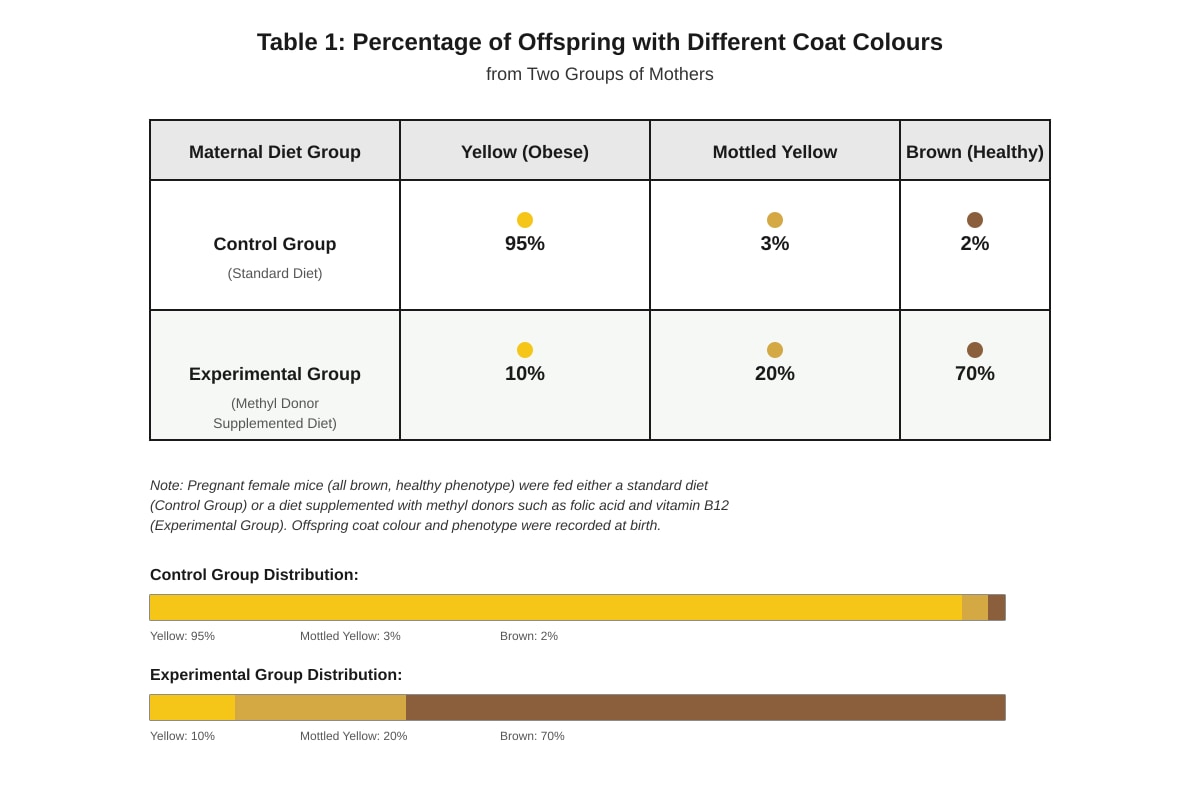
- Answer: Yellow (Obese) offspring.
- Explanation: The yellow coat colour is a direct result of high agouti gene expression.
(b) [2 marks]
- Answer: The maternal diet supplemented with methyl donors led to a significant increase in the proportion of brown (healthy) offspring (from 40% to 70%) and a decrease in yellow (obese) offspring (from 10% to 0%). This is because the methyl donors provided the raw material for increased DNA methylation of the IAP element in the developing embryos, leading to greater silencing of the agouti gene.
- Marking Scheme:
- 1 mark for correctly interpreting the data (increase in brown, decrease in yellow).
- 1 mark for linking the methyl donors to increased methylation and gene silencing.
12. [3 marks]
- Answer: The IAP element acts as an epigenetic switch because its methylation state is metastable and can be influenced by the environment (e.g., maternal diet). When the IAP is methylated, it recruits proteins that promote a closed chromatin structure, preventing the enhancer elements within the IAP from activating the agouti gene promoter. This silencing is heritable because during cell division, the methylation pattern is copied onto the new daughter strand by maintenance methyltransferases (e.g., DNMT1), which recognise hemi-methylated DNA. Thus, the silenced state is propagated through mitosis, and in some cases, through meiosis (transgenerational epigenetic inheritance).
- Marking Scheme:
- 1 mark for explaining how methylation silences the gene (e.g., by blocking enhancers or promoting heterochromatin).
- 1 mark for explaining the heritability through maintenance methylation during DNA replication.
- 1 mark for linking to the concept of an "epigenetic switch" (metastable, influenced by environment).
13. [3 marks]
- Answer: The brown parents from the Experimental Group had a methylated IAP element, which silenced the agouti gene. However, this methylation pattern is not 100% stable. During gamete formation (meiosis), the methylation marks on the IAP element may not be fully erased or may be incompletely re-established. Therefore, some gametes from the brown parents could carry an unmethylated IAP element. If two such gametes (one from each parent) fuse, the resulting offspring would have an unmethylated IAP element on both alleles, leading to high agouti gene expression and a yellow coat colour. This demonstrates that the epigenetic state is not always faithfully inherited across generations.
- Marking Scheme:
- 1 mark for recognising that the methylation pattern is not 100% stable.
- 1 mark for explaining that incomplete erasure or re-establishment of methylation during gametogenesis can lead to unmethylated IAP elements in gametes.
- 1 mark for explaining that fusion of two such gametes results in an offspring with an unmethylated IAP and a yellow coat colour.
14. [4 marks]
- Answer: This study has significant implications for human health and disease:
- Maternal nutrition: It highlights that a mother's diet during pregnancy can have profound effects on the phenotype of her offspring, not just through direct nutritional effects but also through epigenetic modifications. This suggests that maternal supplementation with methyl donors (e.g., folic acid, which is already recommended to prevent neural tube defects) could have additional, potentially beneficial, effects on the offspring's long-term health (e.g., reducing the risk of obesity and diabetes).
- Transgenerational inheritance: The observation that the F2 generation can show the yellow phenotype even when both parents are brown suggests that epigenetic marks can be inherited across generations. This challenges the traditional view that only DNA sequence is inherited. In humans, this could mean that the nutritional status of a grandmother could influence the health of her grandchildren, independent of the DNA sequence.
- Disease risk: The study provides a mechanism for how environmental factors (diet) can influence disease risk (obesity, diabetes) through epigenetic changes. This opens up possibilities for epigenetic therapies or preventative strategies.
- Ethical considerations: It raises ethical questions about responsibility for the health of future generations and the potential for unintended consequences of nutritional interventions.
- Marking Scheme:
- 1 mark for discussing the impact of maternal nutrition on offspring phenotype.
- 1 mark for discussing transgenerational inheritance.
- 1 mark for linking to human disease risk (obesity, diabetes).
- 1 mark for discussing broader implications (e.g., ethical, therapeutic).
15. [2 marks]
- Answer: The most appropriate source of DNA would be a cDNA library made from the mRNA of mouse cells that express the agouti gene (e.g., from skin or liver cells). This is because the cDNA is a copy of the mature mRNA and therefore lacks introns. E. coli is a prokaryote and cannot splice introns, so using genomic DNA (which contains introns) would not result in the production of a functional protein. Using cDNA ensures that the coding sequence is continuous and can be expressed in E. coli.
- Marking Scheme:
- 1 mark for identifying cDNA as the source.
- 1 mark for explaining that it lacks introns, which is necessary for expression in E. coli.
16. [4 marks]
- Answer: Restriction endonucleases are enzymes that cut DNA at specific recognition sequences (restriction sites). They are used to cut both the bacterial plasmid and the eukaryotic gene of interest at specific points, creating complementary sticky ends. DNA ligase is then used to join the sticky ends of the gene and the plasmid together, forming a recombinant plasmid. Using the same restriction enzyme for both the plasmid and the target DNA is advantageous because it creates complementary sticky ends on both fragments. This increases the efficiency of ligation because the sticky ends can base-pair with each other, and it also ensures that the gene is inserted in the correct orientation (directional cloning) if the restriction sites are different at each end.
- Marking Scheme:
- 1 mark for describing the role of restriction endonucleases.
- 1 mark for describing the role of DNA ligase.
- 1 mark for explaining that using the same enzyme creates complementary sticky ends.
- 1 mark for explaining the advantage (increased ligation efficiency and/or directional cloning).
17. [4 marks]
- Answer:
- Similarities: Both SCNT and iPSC technology aim to return a mature, differentiated cell to a pluripotent stem cell state. Both have potential applications in regenerative medicine and disease modelling.
- Differences:
- SCNT: Involves transferring the nucleus of a somatic cell into an enucleated egg cell. The egg cell's cytoplasm contains factors that reprogram the somatic nucleus to an embryonic state. This process is technically challenging, requires a donor egg, and raises ethical concerns about the creation and destruction of embryos.
- iPSC technology: Involves introducing specific transcription factor genes (e.g., Oct4, Sox2, Klf4, c-Myc) into a somatic cell using viral vectors. These factors directly reprogram the cell's gene expression profile to a pluripotent state. This method is technically simpler, does not require donor eggs, and avoids the ethical issues associated with embryos. However, it carries the risk of insertional mutagenesis and the potential for tumour formation (especially with c-Myc).
- Marking Scheme:
- 1 mark for stating a similarity.
- 1 mark for describing SCNT mechanism.
- 1 mark for describing iPSC mechanism.
- 1 mark for a valid comparison (e.g., ethical considerations, technical difficulty, efficiency).
18. [5 marks]
- Answer: Genetic engineering has been highly significant in developing new treatments for human genetic diseases.
- Significance: It allows for the direct correction of the underlying genetic defect, rather than just treating symptoms. This can potentially provide a permanent cure. Examples include gene therapy for severe combined immunodeficiency (SCID) and haemophilia.
- Example: Gene therapy for SCID-X1 involves using a retroviral vector to deliver a functional copy of the IL2RG gene into the patient's haematopoietic stem cells. These corrected stem cells are then transplanted back into the patient, where they can differentiate into functional immune cells. This has been successful in restoring immune function in many patients.
- Challenges: Despite successes, there are significant challenges. These include:
- Delivery: Efficiently and safely delivering the therapeutic gene to the correct cells.
- Immune response: The patient's immune system may attack the viral vector or the corrected cells.
- Insertional mutagenesis: The viral vector may integrate into the host genome in a way that disrupts a tumour suppressor gene or activates an oncogene, leading to cancer (as seen in some SCID trials).
- Ethical considerations: Germline gene therapy (which would affect future generations) raises profound ethical questions and is currently not permitted in many countries.
- Conclusion: Genetic engineering has already provided life-saving treatments for some genetic diseases, but significant technical and ethical hurdles remain before it can be widely applied.
- Marking Scheme:
- 1 mark for stating the significance (potential for a cure).
- 1 mark for describing a specific example (e.g., SCID, haemophilia, cystic fibrosis).
- 1 mark for discussing a challenge (e.g., delivery, immune response, insertional mutagenesis).
- 1 mark for discussing ethical considerations.
- 1 mark for a balanced evaluation (acknowledging both successes and limitations).
19. [4 marks]
- Answer: This epigenetic change allows for a rapid and reversible response to the environment because:
- Rapidity: Demethylation of the promoter can occur relatively quickly in response to the environmental signal. This is faster than waiting for a mutation to occur in the DNA sequence. The demethylation allows transcription factors to bind and initiate gene expression, leading to a rapid cellular response.
- Reversibility: When the environmental signal is removed, the promoter can be re-methylated, and gene expression is turned off again. This reversibility is crucial for responding to fluctuating environmental conditions. The cell does not need to permanently alter its DNA sequence; it can simply change the epigenetic mark.
- Mechanism: The signal likely activates a demethylase enzyme (e.g., TET proteins) that removes the methyl groups from the CpG islands in the promoter. This opens up the chromatin structure, making the DNA accessible to transcription factors and RNA polymerase. When the signal is gone, methyltransferases (e.g., DNMT3a/b) can re-methylate the promoter, restoring the silenced state.
- Marking Scheme:
- 1 mark for explaining rapidity (faster than mutation).
- 1 mark for explaining reversibility (can be turned on and off).
- 1 mark for describing the mechanism (demethylation/methylation enzymes).
- 1 mark for linking to the environmental response.
20. [5 marks]
- Answer: The study of epigenetics has fundamentally changed our understanding of heredity beyond the classical Mendelian model.
- Beyond DNA sequence: Classical Mendelian genetics focuses on the inheritance of alleles (different versions of a gene) that are passed from parent to offspring. Epigenetics reveals that heritable changes in gene expression can occur without changes in the DNA sequence. These changes are mediated by mechanisms like DNA methylation and histone modifications.
- Role of the environment: The environment can influence the epigenome. For example, diet, stress, and toxins can cause epigenetic modifications that affect gene expression. This means that an individual's experiences and environment can leave a heritable mark on their genome, which can be passed to their offspring. This is a form of Lamarckian inheritance that was previously dismissed.
- Transgenerational epigenetic inheritance: Epigenetic marks can be inherited across multiple generations. The agouti mouse study is a classic example: the diet of a pregnant female can affect not only her offspring but also her grandchildren. This challenges the idea that only the DNA sequence is inherited and that all traits are determined by the genes we receive from our parents.
- Implications: This new understanding has profound implications for our understanding of evolution, disease risk, and the nature vs. nurture debate. It suggests that the environment can shape the genome in a heritable way, and that we are not simply the product of our genes but also of our ancestors' experiences.
- Marking Scheme:
- 1 mark for contrasting with Mendelian inheritance (DNA sequence only).
- 1 mark for explaining the role of the environment.
- 1 mark for explaining transgenerational epigenetic inheritance.
- 1 mark for discussing implications (e.g., evolution, disease, nature vs. nurture).
- 1 mark for a clear and well-structured explanation.