AI Generated Quiz
A Level Biology H3 Genetics Inheritance Quiz
Free A Level Biology H3 Genetics Inheritance quiz, AI version, with questions, answers, and A Level-style practice for Singapore students.
These static practice materials are generated from the site's syllabus and paper-generation workflow, with source and model context shown so students and parents can evaluate the material before use.
Questions
Free quiz and exam paper access
Enter your details to view this paper
Your access is remembered on this device.
Answers
A-Level Biology H3 Quiz - Genetics Inheritance: Answer Key
Total Marks: 50
Section A: Multiple-Choice Questions (Questions 1–5, 10 marks)
1. B [2 marks]
- Explanation: SCNT involves transferring the nucleus of a somatic (body) cell into an enucleated egg cell. The egg cell's cytoplasm contains factors that reprogram the transferred nucleus back to a pluripotent state. In contrast, iPSC technology involves introducing specific transcription factor genes (e.g., Oct4, Sox2, Klf4, c-Myc) into a somatic cell using a viral vector, reprogramming it to a pluripotent state without the need for an egg cell.
- Common mistake: Students may confuse the two techniques. Remember: SCNT uses an egg cell; iPSC uses gene introduction.
2. B [2 marks]
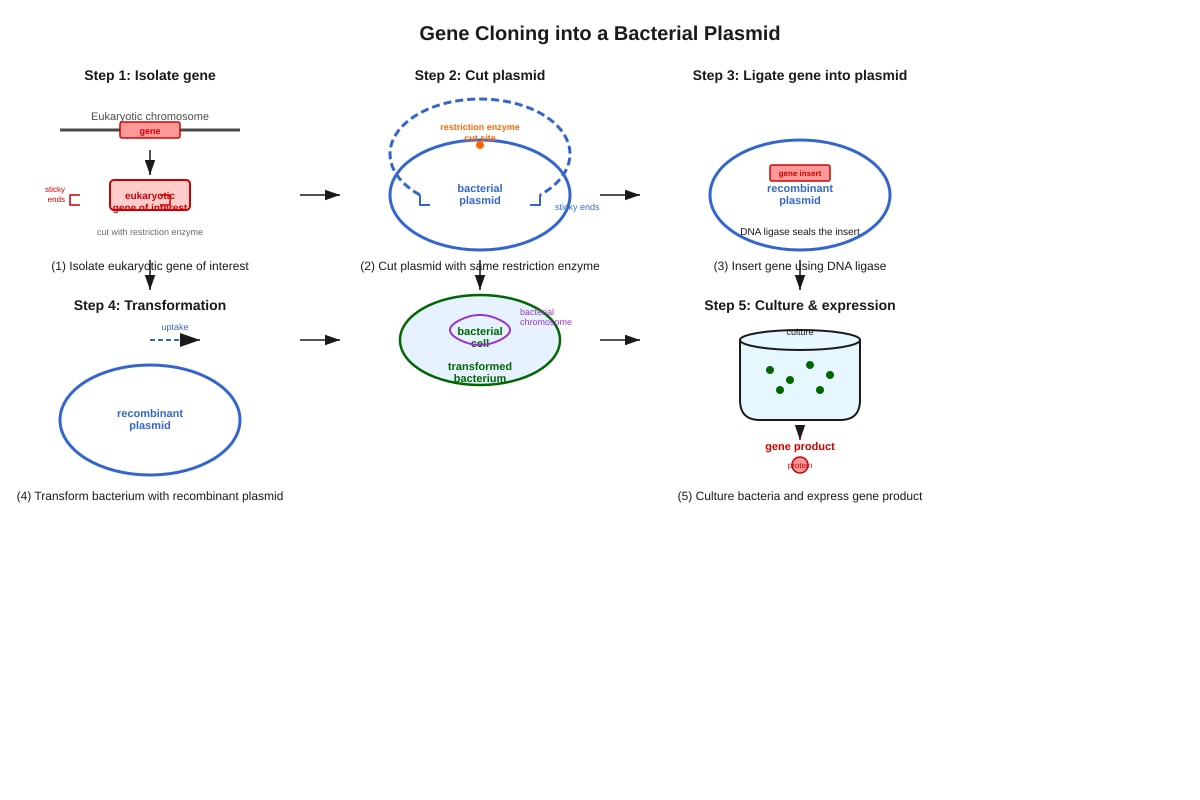
- Explanation: Restriction endonucleases (restriction enzymes) are molecular scissors that cut DNA at specific palindromic recognition sequences. Many of them cut in a staggered fashion, producing single-stranded overhangs called "sticky ends." These sticky ends are complementary and can base-pair with each other, facilitating the ligation (joining) of DNA fragments from different sources.
- Why not A: DNA ligase, not restriction enzymes, joins DNA fragments by forming phosphodiester bonds.
- Why not C: Reverse transcriptase synthesises cDNA from mRNA.
- Why not D: Transformation (e.g., heat shock or electroporation) introduces plasmids into bacteria.
3. C [2 marks]
- Explanation: Eukaryotic proteins often require post-translational modifications (e.g., glycosylation, phosphorylation, disulfide bond formation) for proper folding and function. Bacteria like E. coli lack the complex cellular machinery (e.g., endoplasmic reticulum and Golgi apparatus) to perform these modifications. Therefore, the protein may be produced but in a non-functional form.
- Why not A: Bacterial ribosomes can translate eukaryotic mRNA, as the genetic code is universal.
- Why not B: This is a common issue, but it is solved by placing the eukaryotic gene under the control of a bacterial promoter. The question asks for the most likely reason for a non-functional protein, which is often post-translational modification.
- Why not D: This is a potential problem during cloning, but it would likely prevent the full gene from being cloned, not just result in a non-functional protein.
4. B [2 marks]
- Explanation: Epigenetics refers to heritable changes in gene expression that do not involve changes to the DNA sequence itself. DNA methylation, specifically the addition of a methyl group to a cytosine base in a CpG dinucleotide, is a classic epigenetic modification. Methylation of promoter regions typically silences gene expression.
- Why not A, C, D: These are all examples of changes to the DNA sequence itself (mutations and chromosomal rearrangements), which are genetic, not epigenetic.
5. B [2 marks]
- Explanation: Reverse transcriptase is an enzyme used by retroviruses to convert their RNA genome into DNA. In genetic engineering, it is used to synthesise a complementary DNA (cDNA) strand from an mRNA template. This cDNA can then be made double-stranded and cloned into a vector. This is crucial for cloning eukaryotic genes because the cDNA lacks introns.
- Why not A: Restriction enzymes cut DNA.
- Why not C: DNA ligase joins DNA fragments.
- Why not D: DNA replication within the host is carried out by the host's own DNA polymerase.
Section B: Short-Answer Questions (Questions 6–15, 20 marks)
6. Principle of SCNT (1 mark): The nucleus from a somatic (differentiated) cell is transferred into an enucleated egg cell (an egg cell that has had its own nucleus removed). [1 mark] Explanation of reprogramming (2 marks): The egg cell's cytoplasm contains cytoplasmic factors (proteins, mRNAs, etc.) that can reprogram the transferred somatic nucleus. These factors erase the epigenetic marks (e.g., DNA methylation patterns) that were responsible for the somatic cell's differentiated state, returning the nucleus to a pluripotent, embryonic-like state. [2 marks]
- Marking note: Award 1 mark for describing the transfer of the nucleus. Award 1 mark for mentioning the role of the egg cytoplasm in reprogramming. Award 1 mark for linking this to the return to a stem cell/pluripotent state.
7. Evaluation (2 marks): The statement is inaccurate. [1 mark] Epigenetic changes, such as DNA methylation patterns, can be heritable. During cell division, epigenetic marks can be copied to daughter cells (mitotic inheritance). In some cases, epigenetic marks can even be passed from one generation to the next (meiotic/transgenerational inheritance), although this is less common and often erased and re-established. [1 mark]
- Marking note: Award 1 mark for stating the statement is inaccurate/false. Award 1 mark for explaining that epigenetic changes can be heritable (mitotically or meiotically).
8. Explanation (2 marks): Eukaryotic genes contain non-coding sequences called introns, which are interspersed between the coding sequences (exons). Bacteria lack the spliceosome machinery to remove introns from pre-mRNA. [1 mark] Therefore, if a genomic DNA sequence is used, the bacteria would transcribe and translate the introns, producing a non-functional protein. A cDNA copy is synthesised from the mature mRNA (which has already had introns spliced out), so it contains only the coding sequence (exons) and can be correctly expressed in bacteria. [1 mark]
9. Two properties (2 marks): Any two of the following:
- They are small, circular DNA molecules that are easy to manipulate and purify. [1 mark]
- They contain an origin of replication (ori), allowing them to replicate independently within the bacterial host. [1 mark]
- They contain selectable marker genes (e.g., antibiotic resistance genes) that allow for the identification of bacteria that have taken up the plasmid. [1 mark]
- They have multiple cloning sites (polylinkers) with unique restriction enzyme recognition sequences for inserting foreign DNA. [1 mark]
10. Role of DNA ligase (2 marks): After the plasmid vector and the human insulin gene have been cut with the same restriction enzyme, they will have complementary sticky ends. [1 mark] DNA ligase catalyses the formation of phosphodiester bonds between the sugar-phosphate backbone of the plasmid DNA and the inserted gene, effectively "gluing" them together to form a stable, recombinant plasmid molecule. [1 mark]
11. Distinction (2 marks):
- DNA methylation (1 mark): Involves the addition of a methyl group (-CH₃) to the 5' carbon of a cytosine base, typically in a CpG dinucleotide context. This usually leads to gene silencing by preventing transcription factors from binding or by recruiting proteins that promote a condensed chromatin state.
- Histone modification (1 mark): Involves the covalent addition or removal of chemical groups (e.g., acetyl, methyl, phosphate) to the N-terminal tails of histone proteins. For example, histone acetylation (adding an acetyl group) neutralises the positive charge on histones, loosening their grip on DNA and promoting gene expression. Histone methylation can either activate or repress gene expression depending on the specific residue and context.
12. Potential application (2 marks): Any one of the following:
- Novel peptide synthesis: Ribozymes (catalytic RNA molecules) could be engineered to catalyse the formation of peptide bonds, allowing for the synthesis of novel peptides or proteins with non-natural amino acids. [2 marks]
- Gene therapy: Ribozymes can be designed to cleave specific mRNA molecules, effectively "silencing" a disease-causing gene. [2 marks]
- Modification of RNA: Ribozymes could be used to modify RNA transcripts (e.g., RNA editing) for therapeutic purposes. [2 marks]
- Marking note: Award 1 mark for a basic description and 1 mark for linking it to a specific application in genetic engineering.
13. Explanation (2 marks): Chromatin remodelling refers to the dynamic changes in the structure of chromatin (the complex of DNA and histone proteins). [1 mark] Remodelling complexes can use ATP to slide, eject, or restructure nucleosomes. This can make specific regions of DNA more or less accessible to transcription factors and RNA polymerase. For example, opening up a promoter region (euchromatin) allows gene expression, while tightly packing it (heterochromatin) silences the gene. This occurs without any change to the DNA sequence itself. [1 mark]
14. Challenge and solution (2 marks):
- Challenge (1 mark): The human protein may require post-translational modifications (e.g., glycosylation) for proper folding and function, which E. coli cannot perform.
- Solution (1 mark): Use a different expression host, such as yeast (Saccharomyces cerevisiae or Pichia pastoris), insect cells (using a baculovirus vector), or mammalian cell lines (e.g., CHO cells), which have the machinery for eukaryotic post-translational modifications.
- Alternative challenge/solution: The eukaryotic gene may have introns. Solution: Use a cDNA copy of the gene.
15. Evaluation and example (3 marks):
- Significance (1 mark): Genetic engineering is highly significant for disease treatment. It allows for the production of large quantities of safe, pure, and effective therapeutic proteins that were previously difficult or impossible to obtain.
- Example (1 mark): The production of human insulin in genetically engineered E. coli or yeast. Before this, insulin for diabetics was extracted from the pancreases of pigs or cows, which was expensive, limited in supply, and could cause allergic reactions due to slight differences in amino acid sequence.
- Further evaluation (1 mark): Genetic engineering also enables the development of new therapies, such as gene therapy (e.g., using viral vectors to deliver a functional copy of a gene to treat genetic disorders like Severe Combined Immunodeficiency, SCID) and the production of monoclonal antibodies for targeted cancer therapy.
- Marking note: Award 1 mark for a general statement of significance. Award 1 mark for a specific, well-described example. Award 1 mark for further elaboration or evaluation of the impact.
Section C: Data-Based and Extended-Response Questions (Questions 16–20, 20 marks)
16. (a) Restriction endonuclease (or restriction enzyme) [1 mark]
(b) Explanation (2 marks): Using the same restriction enzyme ensures that both the gene and the plasmid are cut with the same complementary sticky ends. [1 mark] This complementarity allows the sticky ends of the gene insert to base-pair with the sticky ends of the linearised plasmid, which is a necessary step for DNA ligase to then covalently join them together. If different enzymes were used, the ends would likely be incompatible and could not be ligated. [1 mark]
(c) Method (1 mark): Any one of the following:
- Heat shock: Bacteria are incubated in a calcium chloride solution and then briefly heated (e.g., 42°C), which makes their cell membranes more permeable to DNA.
- Electroporation: A brief electrical pulse is applied to the bacteria, creating temporary pores in the cell membrane through which the DNA can enter.
17. (a) Relationship (2 marks): The data shows a positive correlation between histone acetylation and gene expression. [1 mark] When histone acetylation at the gene promoter is low (control), gene expression is low. When histone acetylation is high (HDAC inhibitor added), gene expression is high (8.5-fold increase). This supports the model that histone acetylation promotes an open, transcriptionally active chromatin state (euchromatin), allowing transcription factors and RNA polymerase to access the DNA. [1 mark]
(b) Mechanism (2 marks): Histone deacetylases (HDACs) remove acetyl groups from histone tails, leading to a more condensed, transcriptionally silent chromatin state (heterochromatin). [1 mark] The HDAC inhibitor prevents HDACs from removing acetyl groups. This results in a build-up of acetylated histones at the tumour suppressor gene promoter, keeping the chromatin in an open, active state and allowing the gene to be expressed at a high level. [1 mark]
18. Discussion (4 marks):
- Introduction (1 mark): Genetic engineering has significant potential to enhance food sustainability by increasing crop yields, reducing reliance on chemical pesticides and fertilisers, and improving the nutritional content of food.
- Example (1 mark): Golden Rice is a genetically modified variety of rice engineered to produce beta-carotene, a precursor of vitamin A. Vitamin A deficiency is a major public health problem in many developing countries where rice is a staple food, leading to blindness and increased mortality.
- Addressing sustainability (2 marks):
- Nutritional sustainability: Golden Rice addresses a specific nutritional deficiency, improving public health without requiring major changes in diet or the need for expensive supplements. This contributes to the sustainability of human health and well-being.
- Agricultural sustainability: Other GM crops, such as Bt cotton or Bt corn, are engineered to produce a bacterial toxin that is lethal to specific insect pests. This reduces the need for broad-spectrum chemical insecticides, which can harm beneficial insects, pollute water sources, and pose health risks to farmers. This makes agriculture more environmentally sustainable.
- Marking note: Award 1 mark for a clear introduction linking GE to sustainability. Award 1 mark for a specific, well-described example. Award up to 2 marks for explaining how the example addresses a specific sustainability challenge (e.g., nutritional, environmental, economic).
19. (a) Explanation (2 marks): Although the mice are genetically identical (same DNA sequence), they can have different phenotypes due to epigenetic differences. [1 mark] In this case, different patterns of DNA methylation at the agouti gene promoter lead to different levels of gene expression. The mouse with higher methylation likely has the agouti gene silenced, resulting in one coat colour, while the mouse with lower methylation has the gene expressed, resulting in a different coat colour. [1 mark]
(b) Prediction and justification (2 marks):
- Prediction (1 mark): Yes, the difference in coat colour is likely to be inherited by their offspring, at least to some extent.
- Justification (1 mark): Epigenetic marks, such as DNA methylation patterns, can be heritable. During gamete formation and early embryonic development, epigenetic marks are often erased and re-established. However, some epigenetic marks can escape this reprogramming and be passed from parent to offspring. This is known as transgenerational epigenetic inheritance. Therefore, the offspring may inherit a similar methylation pattern at the agouti gene and thus a similar coat colour to their parent.
- Marking note: Accept a "no" answer if the student argues that the marks are erased during reprogramming, but they must provide a biologically sound justification. The "yes" answer is more aligned with the H3-level understanding of transgenerational inheritance.
20. Evaluation (4 marks):
- Introduction (1 mark): Genetic engineering has revolutionised drug design by enabling the production of complex therapeutic proteins that are safe, effective, and available in large quantities.
- Specific example (1 mark): Human insulin is a prime example. The human insulin gene was inserted into a bacterial plasmid and expressed in E. coli or yeast to produce recombinant human insulin (e.g., Humulin).
- Advantages over traditional methods (2 marks):
- Purity and safety: Traditional insulin was extracted from the pancreases of pigs or cows (porcine/bovine insulin). This carried a risk of contamination with animal viruses or prions. Recombinant human insulin is produced in a controlled environment and is identical to human insulin, greatly reducing the risk of allergic reactions or immune responses.
- Scalability and cost: Obtaining insulin from animals was inefficient and expensive, requiring thousands of animals to produce a small amount of insulin. Genetic engineering allows for large-scale production in fermentation tanks, making insulin more affordable and accessible to millions of diabetics worldwide.
- Ethical considerations: Animal-derived insulin raised ethical concerns about the use of animals. Recombinant production avoids these issues.
- Marking note: Award 1 mark for a clear introductory statement. Award 1 mark for a specific, well-described example (human insulin, human growth hormone, erythropoietin, etc.). Award up to 2 marks for a detailed comparison of the advantages of the recombinant method over the traditional method, covering at least two distinct points (e.g., purity, safety, scalability, cost, ethics).