AI Generated Quiz
A Level Biology H3 Evolution Diversity Quiz
Free A Level Biology H3 Evolution Diversity quiz, AI version, with questions, answers, and A Level-style practice for Singapore students.
These static practice materials are generated from the site's syllabus and paper-generation workflow, with source and model context shown so students and parents can evaluate the material before use.
Questions
Free quiz and exam paper access
Enter your details to view this paper
Your access is remembered on this device.
Answers
A-Level Biology H3 Quiz - Evolution Diversity: Answer Key
Total Marks: 75
Section A: Multiple-Choice and Short-Answer Questions (Questions 1–10, 30 marks)
1. Answer: C [2 marks]
- Explanation: Sexual selection is a mode of natural selection where members of one biological sex choose mates of the other sex to mate with (intersexual selection), and compete with members of the same sex for access to mates (intrasexual selection). The direct consequence is the evolution of traits that improve mating success, even if they are costly to survival. Option A describes a general benefit of sexual reproduction, not a direct consequence of sexual selection. Option B describes natural selection for survival. Option D is incorrect; sexual selection often increases the frequency of alleles for competitive traits.
- Marking: 2 marks for correct answer. 0 marks for any other answer.
2. Answer: B [2 marks]
- Explanation: Adaptive radiation is the rapid diversification of a single ancestral lineage into a variety of forms that occupy different ecological niches. The key condition is the availability of diverse, unoccupied (or underutilised) niches. The Hawaiian honeycreepers evolved from a single finch ancestor that colonised the islands, which had a wide range of habitats and food sources with few competing bird species. Option A (many competing species) would hinder radiation. Option C is not a critical condition. Option D (hybridisation) can contribute to diversity but is not the most critical condition for adaptive radiation.
- Marking: 2 marks for correct answer. 0 marks for any other answer.
3. Answer: B [2 marks]
- Explanation: A ring species is a prime example of parapatric speciation. In parapatric speciation, divergence occurs between populations that have contiguous but non-overlapping geographic ranges. The ring species shows a continuous gradient of variation around a geographic barrier, with the two ends of the ring being reproductively isolated. This demonstrates that speciation can occur without complete geographic isolation (allopatry). Option A (sympatric) occurs in the same area. Option C (allopatric) requires a physical barrier. Option D (polyploidy) is a form of instantaneous sympatric speciation.
- Marking: 2 marks for correct answer. 0 marks for any other answer.
4. Answer: B [2 marks]
- Explanation: Polyploidy (having more than two sets of chromosomes) is common in plants because they can self-fertilise and reproduce asexually (e.g., via runners, bulbs, or vegetative propagation). This allows a newly formed polyploid individual to reproduce even if it cannot find a mate, as it can self-pollinate or clone itself. In animals, self-fertilisation is rare, and complex mating behaviours and sex determination systems make it much harder for a polyploid individual to find a compatible mate and produce fertile offspring.
- Marking: 2 marks for correct answer. 0 marks for any other answer.
5. Answer: B [2 marks]
- Explanation: Introgression, also known as introgressive hybridisation, is the movement of a gene (alleles) from one species into the gene pool of another by the repeated backcrossing of an interspecific hybrid with one of its parent species. This can introduce new genetic variation into a population. Option A describes allopolyploidy. Option C is incorrect; it does not result in a single uniform population. Option D is incorrect; it describes one possible outcome, but not the definition of introgression.
- Marking: 2 marks for correct answer. 0 marks for any other answer.
6. Answer: [3 marks]
- Explanation: The evolution of sexual reproduction is a major innovation because it generates genetic diversity through recombination (crossing over and independent assortment) and the mixing of alleles from two parents. This diversity is the raw material for natural selection, allowing populations to adapt more quickly to changing environments and to resist parasites (the Red Queen hypothesis). Despite the "two-fold cost" (asexual females produce twice as many daughters as sexual females), the long-term advantage of increased adaptability and the ability to purge deleterious mutations outweighs the short-term cost in many environments.
- Marking:
- 1 mark: Identifies the generation of genetic diversity (recombination, mixing of alleles).
- 1 mark: Explains the advantage of this diversity (e.g., faster adaptation, Red Queen hypothesis).
- 1 mark: Acknowledges the costs (e.g., two-fold cost, only 50% of genes passed on) but explains why the benefits are significant.
7. Answer: [2 marks]
- Explanation: Divergent evolution is the process by which populations of a common ancestor evolve different traits, often due to different selective pressures. Adaptive radiation is a specific, rapid form of divergent evolution where a single ancestral lineage diversifies into many species, each adapted to a different ecological niche. In short, adaptive radiation is divergent evolution on a grand, rapid scale, often following the colonisation of a new environment with many unoccupied niches.
- Marking:
- 1 mark: Defines divergent evolution as the accumulation of differences between related populations.
- 1 mark: Defines adaptive radiation as a rapid diversification into multiple species adapted to different niches, linking it to divergent evolution.
8. Answer: B [1 mark]
- Explanation: Directional selection favours one extreme phenotype over the other, causing a shift in the population's trait distribution. In this case, the drought creates a selective pressure that favours birds with larger beaks (one extreme), shifting the average beak size in the population towards larger sizes. Stabilising selection favours the intermediate phenotype. Disruptive selection favours both extremes.
- Marking: 1 mark for correct answer. 0 marks for any other answer.
9. Answer: [3 marks]
- Explanation: The misuse of antibiotics (e.g., over-prescription, not completing a course, use in livestock) creates a strong selective pressure for the evolution of resistance. Antibiotics kill susceptible bacteria, but any bacteria with a pre-existing resistance mutation will survive and reproduce. The misuse of antibiotics:
- Increases the frequency of exposure: More bacteria are exposed to the antibiotic, increasing the number of "selection events".
- Reduces the effectiveness of the drug: Sub-lethal doses (from incomplete courses) can allow partially resistant bacteria to survive and evolve further.
- Removes competition: By killing susceptible bacteria, antibiotics remove competition, allowing resistant strains to proliferate rapidly.
- Marking:
- 1 mark: States that antibiotics create a selective pressure favouring resistant bacteria.
- 1 mark: Explains how misuse (e.g., incomplete courses, overuse) increases this selective pressure.
- 1 mark: Explains the consequence (resistant strains proliferate, reducing antibiotic effectiveness).
10. Answer: [2 marks]
- Explanation: Biomolecules, particularly DNA and proteins, provide a molecular "clock" for evolution. By comparing the sequences of DNA or amino acids in proteins (e.g., cytochrome c, haemoglobin) from different species, scientists can quantify the degree of genetic relatedness. The more similar the sequences, the more recent the common ancestor. This allows for the construction of highly robust phylogenetic trees that can confirm or challenge relationships inferred from morphology and fossils.
- Marking:
- 1 mark: States that biomolecules provide a quantitative measure of relatedness (sequence similarity).
- 1 mark: Explains that this allows for the construction of phylogenetic trees and can confirm/refute morphological evidence.
Section B: Data-Based and Structured Questions (Questions 11–15, 25 marks)
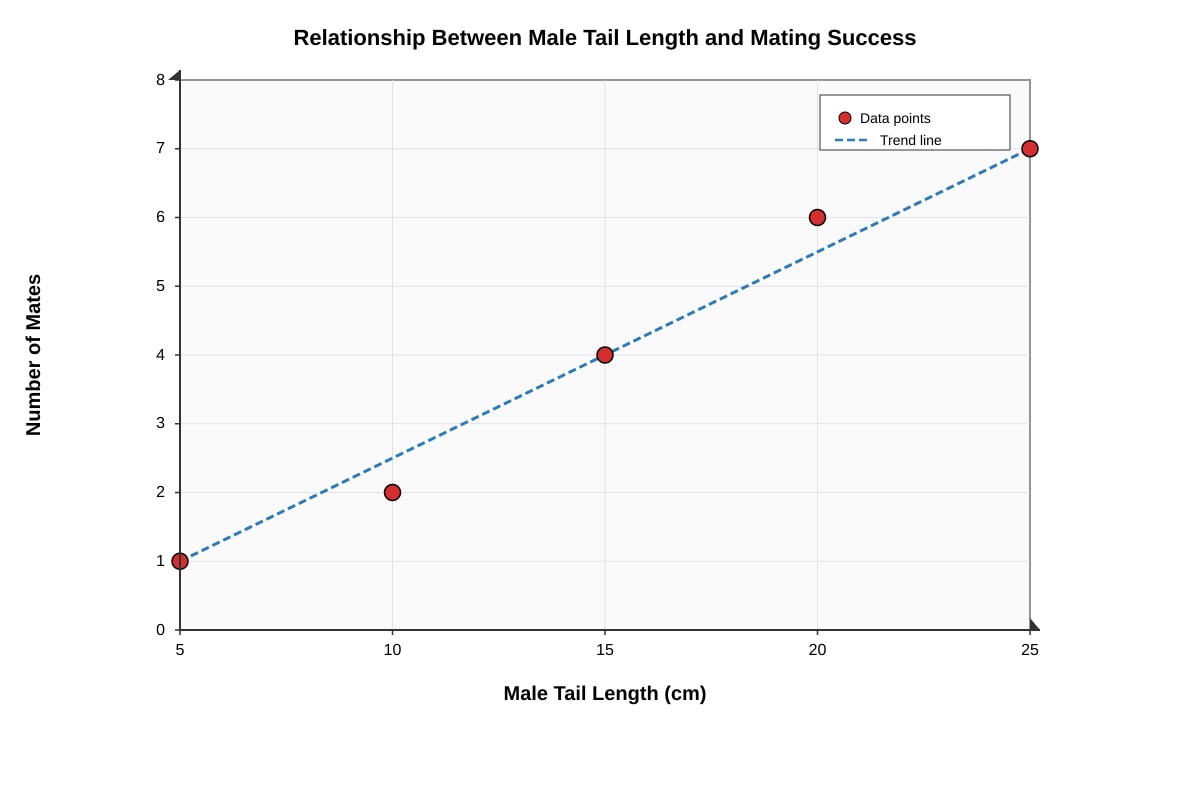
11. (a) Answer: Sexual selection (specifically, intersexual selection or female choice). [1 mark]
- Explanation: The graph shows a positive correlation between male tail length and mating success. This is a classic signature of female choice, where females prefer males with longer tails. This is a form of sexual selection, not natural selection for survival.
- Marking: 1 mark for "sexual selection" or "female choice".
(b) Answer: [4 marks]
- Explanation: This is an example of a "runaway" or "Fisherian" selection process.
- Initial preference: Females may have a pre-existing sensory bias for longer tails, or a genetic mutation for a longer tail arises in a male.
- Genetic correlation: If the genes for the male trait (long tail) and the female preference for it become genetically correlated (e.g., through non-random mating), they can co-evolve.
- Runaway process: Sons inherit the long tail, and daughters inherit the preference. Males with longer tails have more mates, passing on both the trait and the preference. This creates a positive feedback loop that drives the evolution of increasingly exaggerated tails.
- Survival cost: The long tail may make the male more conspicuous to predators, slower to escape, or more energetically costly to maintain. However, the mating advantage outweighs the survival cost, as long as the trait does not become so costly that it kills the male before he can mate.
- Marking:
- 1 mark: Identifies the process as Fisherian runaway selection or a "good genes" process.
- 1 mark: Explains the genetic correlation between trait and preference.
- 1 mark: Describes the positive feedback loop (runaway).
- 1 mark: Explains the trade-off between mating success and survival.
12. (a) Answer: [2 marks]
- Explanation: Hybrid C has a chromosome number of 21 (2n = 21). This is an odd number. During meiosis, chromosomes need to pair up as homologous pairs (bivalents) to segregate properly. In Hybrid C, the 21 chromosomes cannot form 10.5 perfect pairs. They will form univalents and multivalents, leading to non-disjunction and the production of aneuploid gametes (with an unbalanced set of chromosomes). These gametes are inviable, making the hybrid sterile.
- Marking:
- 1 mark: States that the odd chromosome number prevents proper pairing during meiosis.
- 1 mark: Explains that this leads to non-disjunction and inviable gametes.
(b) Answer: [3 marks]
- Explanation: If Hybrid C (2n = 21) undergoes a spontaneous chromosome doubling event, its new chromosome number would be 42 (4n = 42). This process is called allopolyploidy. The doubled cell now has two complete sets of chromosomes from each parent species (14 from Species A and 28 from Species B). During meiosis, each chromosome now has a homologous partner to pair with (e.g., the two A-genome chromosomes pair, the two B-genome chromosomes pair). This allows for normal meiosis and the production of viable, fertile gametes. This new polyploid individual is reproductively isolated from both parent species (as mating with them would produce sterile triploid offspring), thus constituting a new species in a single generation (instantaneous speciation).
- Marking:
- 1 mark: States the new chromosome number is 42.
- 1 mark: Explains that doubling restores homologous pairing, allowing normal meiosis.
- 1 mark: Explains that this creates a new species reproductively isolated from parents (instantaneous speciation).
13. (a) Answer: The key evidence is that the two end populations (E. eschscholtzii and E. klauberi) are reproductively isolated (do not interbreed) despite being connected by a chain of interbreeding populations. [1 mark]
- Explanation: If they were simply two separate species, there would be no chain of interbreeding populations connecting them. The existence of the chain shows they are part of a single, genetically connected lineage that has diverged around a barrier.
- Marking: 1 mark for identifying the reproductive isolation of the end forms despite the connecting chain.
(b) Answer: [3 marks]
- Explanation: The ring species provides a snapshot of the speciation process because it shows the intermediate stages of divergence.
- Geographic barrier: A population becomes separated by a geographic barrier (the Central Valley).
- Divergence: The separated populations evolve independently along the edges of the barrier, accumulating genetic and phenotypic differences due to different selective pressures and genetic drift.
- Re-contact: When the two ends of the ring meet after encircling the barrier, they have diverged to the point of being reproductively isolated. The chain of interbreeding populations around the ring shows that they are still the same species, but the end forms show that speciation is occurring. It demonstrates that reproductive isolation can evolve as a by-product of geographic separation.
- Marking:
- 1 mark: Describes the initial separation by a geographic barrier.
- 1 mark: Explains the accumulation of differences along the ring.
- 1 mark: Explains that the reproductively isolated end forms show the final stage of speciation.
14. (a) Answer: Introgression (or introgressive hybridisation). [1 mark]
- Explanation: This is the specific term for the transfer of genetic material from one species to another via hybridisation and repeated backcrossing.
- Marking: 1 mark for "introgression".
(b) Answer: [2 marks]
- Explanation: Phylogenetic trees are built on the assumption that DNA sequences diverge in a bifurcating manner (like a tree branch). Introgression creates a network-like pattern of evolution, where genes can "jump" between branches. This means that a gene tree (the evolutionary history of a single gene) can be different from the species tree (the evolutionary history of the species). If a researcher uses a gene that has been introgressed, they may infer a false relationship, suggesting that two species are more closely related than they actually are, or that they share a common ancestor more recently than they do.
- Marking:
- 1 mark: States that introgression creates a network-like pattern, not a simple tree.
- 1 mark: Explains that this can lead to gene trees that conflict with species trees, causing incorrect phylogenetic inferences.
15. Answer: [4 marks]
- Explanation: Biochemical processes and the molecules they involve provide powerful evidence for evolution.
- Unversal biochemical processes: All life uses DNA as genetic material, RNA for transcription, and proteins for catalysis. The universality of the genetic code and core metabolic pathways (e.g., glycolysis, Krebs cycle) strongly suggests a common ancestor.
- Protein sequences: Comparing the amino acid sequences of homologous proteins (e.g., cytochrome c, a protein involved in electron transport) reveals evolutionary relationships. The number of differences in the sequence is proportional to the time since two species diverged from a common ancestor (molecular clock). For example, human and chimpanzee cytochrome c are identical, while human and yeast cytochrome c differ in many amino acids, reflecting their more distant relationship.
- DNA sequences: Comparing DNA sequences (e.g., ribosomal RNA genes) allows for even more detailed phylogenies. The more similar the DNA sequence, the more recent the common ancestor.
- Example: The enzyme lysozyme is found in many animals. Comparing its amino acid sequence across species has helped trace the evolution of foregut fermentation in ruminants and the evolution of digestion in other mammals.
- Marking:
- 1 mark: States that universal biochemical processes (e.g., genetic code) imply common ancestry.
- 1 mark: Describes how comparing protein/DNA sequences provides a quantitative measure of relatedness.
- 1 mark: Provides a named example (e.g., cytochrome c, rRNA, lysozyme).
- 1 mark: Explains how the example supports evolutionary relationships (e.g., more differences = more distant relative).
Section C: Free-Response Question (Questions 16–20, 20 marks)
Note: For all questions in this section, marks are awarded for:
- Scientific accuracy and depth of knowledge (8 marks)
- Ability to construct a logical, well-structured argument (6 marks)
- Evidence of wider reading or integration of different topics (6 marks)
16. Answer Outline:
- Introduction: Define sexual reproduction and state the "paradox of sex" – its high cost vs. its widespread prevalence.
- Disadvantages (Costs):
- Two-fold cost of sex: Asexual females produce twice as many daughters as sexual females.
- Cost of mating: Time, energy, risk of predation, disease transmission.
- Breaking up of favourable gene combinations: Recombination can separate co-adapted gene complexes.
- Advantages (Benefits):
- Genetic diversity: Recombination and independent assortment generate new combinations of alleles, the raw material for natural selection.
- Faster adaptation: Allows populations to adapt more quickly to changing environments.
- Purging of deleterious mutations: Sex can help eliminate harmful mutations from the population (Muller's ratchet).
- Red Queen hypothesis: Sex helps populations keep pace with rapidly evolving parasites and pathogens.
- Evaluation:
- The benefits are most significant in variable, unpredictable, or co-evolutionary environments.
- The costs are most significant in stable, predictable environments where asexual reproduction is more efficient.
- The diversity of life is shaped by this trade-off. Many groups are predominantly asexual (e.g., some plants, aphids), while others are obligately sexual (most animals). The existence of both strategies shows that neither is universally superior.
- Conclusion: The evolution of sex is not a solved problem, but the balance of evidence suggests that the long-term advantages of increased adaptability and resistance to parasites outweigh the short-term costs in most complex, changing environments.
17. Answer Outline:
- Introduction: Define biological diversity (biodiversity) and state that polyploidy, hybridisation, and adaptive radiation are three key, often interacting, mechanisms that generate it.
- Polyploidy:
- Contribution: Instantaneous speciation, especially in plants. Creates reproductively isolated individuals in one generation.
- Example: Allopolyploidy in wheat (Triticum aestivum, 6n = 42) from hybridisation of different wild grasses. Many crop plants (cotton, coffee, bananas) are polyploids.
- Significance: Creates new genetic material and can lead to novel traits (e.g., larger fruits, hybrid vigour).
- Hybridisation:
- Contribution: Can lead to introgression, transferring adaptive alleles between species. Can also lead to hybrid speciation (especially when combined with polyploidy).
- Example: Introgression of pesticide resistance genes between mosquito species. Hybrid speciation in sunflowers (Helianthus).
- Significance: Introduces new genetic variation into populations, allowing for rapid adaptation. Challenges the concept of species as isolated gene pools.
- Adaptive Radiation:
- Contribution: Rapid diversification of a single lineage into many species adapted to different ecological niches.
- Example: Darwin's finches (beak shapes for different seeds), Hawaiian honeycreepers (diverse bill shapes for nectar, insects, seeds), cichlid fishes in African lakes (diverse feeding strategies).
- Significance: Explains the filling of ecological space and the generation of high species diversity in regions with many available niches (e.g., islands, post-extinction events).
- Integration: These processes are not mutually exclusive. For example, hybridisation can provide the genetic raw material for adaptive radiation, and polyploidy can stabilise hybrid genomes.
- Conclusion: Polyploidy, hybridisation, and adaptive radiation are powerful, often interacting, forces that have generated a significant proportion of the biological diversity we see today, particularly in plants and in island ecosystems.
18. Answer Outline:
- Introduction: Define sexual selection as a form of natural selection acting on an individual's ability to obtain mates. Distinguish between intrasexual (male-male competition) and intersexual (female choice) selection.
- Role in Evolution:
- Intrasexual selection: Leads to the evolution of weapons (e.g., antlers in deer, horns in beetles) and large body size. These traits directly improve access to mates.
- Intersexual selection: Leads to the evolution of elaborate ornaments and displays (e.g., peacock's tail, bird of paradise feathers, bowerbird bowers). These traits are signals of "good genes" or health.
- Explaining "Costly" Traits (The Handicap Principle):
- Zahavi's Handicap Principle: An extravagant, costly trait (like a peacock's tail) is an honest signal of quality. Only a high-quality male can afford to produce and carry such a costly handicap. A low-quality male would be killed by predators or unable to survive with such a trait.
- Fisherian Runaway Selection: Female preference for a trait can become genetically correlated with the trait itself, leading to a runaway process where the trait becomes exaggerated even if it is costly, as long as the mating advantage outweighs the survival cost.
- Extent of Explanation:
- Sexual selection explains many traits that natural selection (for survival) cannot. It explains the sexual dimorphism seen in many species.
- However, it is not the only explanation. Some traits may be the result of sensory bias (females have a pre-existing preference for a certain stimulus) or may serve multiple functions (e.g., a bird's bright plumage may also be used for species recognition).
- Conclusion: Sexual selection is a powerful and well-supported mechanism for the evolution of seemingly maladaptive traits. The Handicap Principle and Fisherian Runaway provide compelling, though not mutually exclusive, explanations for how these traits evolve.
19. Answer Outline:
- Introduction: State that molecular biology has revolutionised systematics, providing a more objective and quantitative way to infer evolutionary relationships than morphology alone.
- How Biomolecules Revolutionised Phylogenetics:
- DNA sequencing: Direct comparison of DNA sequences (e.g., mitochondrial DNA, ribosomal RNA genes) allows for the construction of highly resolved phylogenetic trees.
- Molecular Clocks: The assumption that mutations accumulate at a roughly constant rate allows scientists to estimate the time of divergence between species.
- Protein sequences: Comparing amino acid sequences (e.g., cytochrome c, haemoglobin) provides similar information.
- Resolving difficult relationships: Molecular data has resolved many long-standing debates, such as the relationship between whales and hippos (they are sister groups within Cetartiodactyla) and the placement of humans among the great apes.
- Challenges from Hybridisation and Introgression:
- Network vs. Tree: Hybridisation and introgression create a network of relationships, not a simple bifurcating tree. A single gene tree may not reflect the species tree.
- Incomplete Lineage Sorting: Ancestral polymorphisms can be retained across speciation events, leading to gene trees that conflict with the species tree.
- Example: The human genome contains evidence of introgression from Neanderthals and Denisovans. This complicates the simple "Out of Africa" model and shows that our evolutionary history is more reticulate than a simple tree.
- Conclusion: Molecular phylogenetics has been transformative, but it is not a panacea. The processes of hybridisation and introgression mean that the evolutionary history of many groups is best represented as a network or a "web of life" rather than a simple tree. A combination of molecular, morphological, and fossil evidence is often needed for the most robust picture.
20. Answer Outline:
- Introduction: Define the Biological Species Concept (BSC) – a group of interbreeding natural populations that are reproductively isolated from other such groups. State that the essay will evaluate the BSC against "messy" evolutionary realities.
- Ring Species:
- Challenge to BSC: A ring species (e.g., Ensatina salamanders) consists of populations that can interbreed in a chain, but the end populations are reproductively isolated. Are they one species or two? The BSC struggles to give a clear answer.
- Support for the statement: It shows that reproductive isolation is not a binary state but can evolve gradually along a continuum.
- Polyploidy:
- Challenge to BSC: A new polyploid individual is reproductively isolated from its parents instantly. It fits the BSC as a new species. However, if the polyploid can self-fertilise, it is a population of one. The BSC works here, but it highlights that speciation can occur without geographic isolation.
- Support for the statement: It shows that the "interbreeding population" criterion can be met by a single individual in some cases, challenging the idea of a species as a large, interbreeding community.
- Hybridisation:
- Challenge to BSC: Hybridisation and introgression show that gene flow can occur between species, blurring the boundaries. The BSC defines species by the absence of gene flow, but in nature, gene flow is often present, even if limited.
- Example: "Hybrid zones" where two species meet and interbreed. The existence of these zones shows that reproductive isolation is often incomplete.
- Support for the statement: It shows that species are not always isolated gene pools, but can be leaky.
- Conclusion: The concept of a species is a useful tool for categorising biodiversity, but it is a human construct that simplifies a complex reality. The BSC works well for many animal groups but fails for asexual organisms, plants with frequent hybridisation, and cases like ring species. A more pluralistic approach, using multiple species concepts (e.g., phylogenetic species concept, morphological species concept), is often more practical and reflects the "messy reality" of evolution.