AI Generated Quiz
A Level Biology H3 Evolution Diversity Quiz
Free A Level Biology H3 Evolution Diversity quiz, AI version, with questions, answers, and A Level-style practice for Singapore students.
These static practice materials are generated from the site's syllabus and paper-generation workflow, with source and model context shown so students and parents can evaluate the material before use.
Questions
Free quiz and exam paper access
Enter your details to view this paper
Your access is remembered on this device.
Answers
Answer Key - A-Level Biology H3 Quiz - Evolution Diversity
Total Marks: 50
Section A: Multiple-Choice Questions (10 marks)
1 mark each.
1. (B) It favours traits that improve mating success, even if they reduce survival. 2. (B) The colonisation of a new environment with few competing species. 3. (C) Gradual genetic divergence along a geographic gradient. 4. (C) Plants 5. (B) The transfer of genetic material from one species into the gene pool of another through repeated backcrossing. 6. (C) Ribosomal RNA (rRNA) 7. (C) Mitochondria have their own circular DNA and replicate independently of the host cell. 8. (B) Made aerobic respiration possible, which is more efficient in ATP production. 9. (B) Directional selection 10. (D) Gene flow between populations
Section B: Structured Questions (20 marks)
11. (a) [1 mark]
- Definition: Sexual selection is a form of natural selection that acts on an individual's ability to obtain mates, favouring traits that increase mating success, even if they reduce survival. [1 mark]
(b) [2 marks]
- Explanation: Traits favoured by sexual selection, such as the peacock's tail, are often costly in terms of energy and increase predation risk. [1 mark]
- Example: The peacock's large, colourful tail makes it more attractive to peahens, increasing mating opportunities, but it also makes the peacock more visible to predators and requires significant energy to maintain. [1 mark]
12. [3 marks]
- Colonisation: A single ancestral finch species colonised the Hawaiian Islands, which were isolated and had diverse, unoccupied ecological niches. [1 mark]
- Adaptive Radiation: The finches underwent adaptive radiation, evolving different beak shapes and sizes adapted to different food sources (e.g., seeds, insects, nectar). [1 mark]
- Speciation: Geographic isolation on different islands and divergent natural selection led to reproductive isolation and the formation of over 50 distinct species. [1 mark]
13. [3 marks]
- Geographic Gradient: Ensatina salamanders form a ring around the Central Valley of California, with populations gradually diverging genetically along the geographic gradient. [1 mark]
- Interbreeding: Adjacent populations can interbreed, but the two end populations (e.g., in southern California) are reproductively isolated and cannot interbreed. [1 mark]
- Evidence for Speciation: This demonstrates that speciation can occur gradually through geographic isolation and genetic divergence, without complete physical separation, providing evidence for the process of speciation. [1 mark]
14. (a) [2 marks]
- Autopolyploidy: Arises from the duplication of chromosomes within a single species (e.g., due to nondisjunction). [1 mark]
- Allopolyploidy: Arises from the hybridisation of two different species, followed by chromosome duplication, resulting in a polyploid with sets from both parents. [1 mark]
(b) [2 marks]
- Chromosome Mismatch: Polyploids have a different number of chromosomes compared to their diploid parents. [1 mark]
- Meiotic Failure: When a polyploid mates with a diploid, the resulting offspring have an uneven number of chromosome sets, leading to meiotic failure and sterility, thus creating reproductive isolation. [1 mark]
15. [3 marks]
- Gene Flow: Introgression involves the transfer of genes from one species to another through hybridisation and backcrossing. [1 mark]
- Conflicting Signals: This gene flow can introduce genetic material that is not inherited vertically, creating conflicting phylogenetic signals. [1 mark]
- Incorrect Relationships: Phylogenetic trees based on DNA sequences may show incorrect relationships if introgression is not accounted for, as genes from a different species can appear to be shared derived traits. [1 mark]
16. (a) [1 mark]
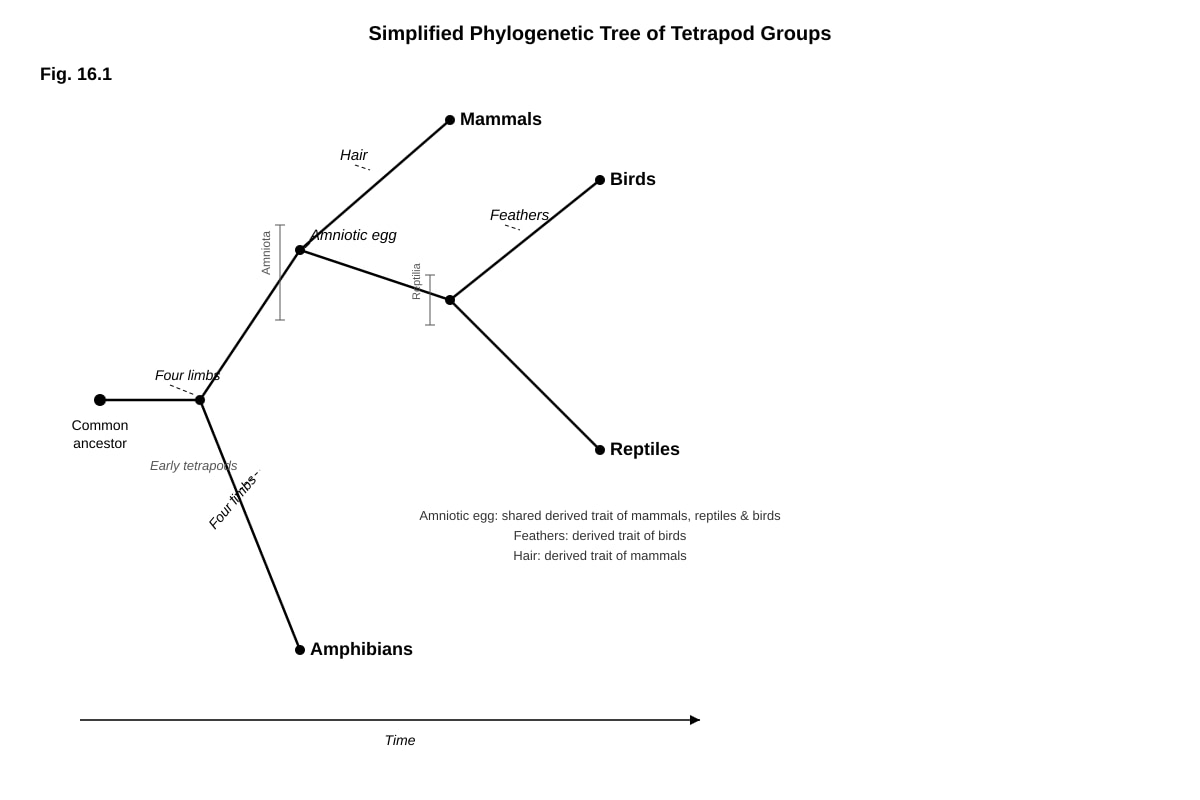
- Reptiles (specifically, crocodilians are the closest living relatives, but based on the tree, birds are nested within reptiles). [1 mark]
(b) [2 marks]
- Shared Ancestry: The phylogenetic tree shows that birds share a common ancestor with reptiles (specifically, they are descended from theropod dinosaurs). [1 mark]
- Cladistic Classification: In cladistics, a group is defined by its common ancestor. Since birds share a more recent common ancestor with reptiles than reptiles do with amphibians, birds are considered a subgroup of reptiles. [1 mark]
17. [3 marks]
- Definition: Molecular co-option (or exaptation) is the process by which a gene or biochemical pathway that evolved for one function is later adapted for a new, often different, function. [1 mark]
- Example: The Calvin cycle (photosynthesis) likely co-opted enzymes from ancient metabolic pathways, such as those involved in glycolysis or the pentose phosphate pathway. [1 mark]
- Explanation: This explains how complex pathways can evolve step-by-step: existing components are modified and assembled for new roles, rather than evolving entirely from scratch. [1 mark]
Section C: Free-Response Questions (20 marks)
18. [10 marks]
- Introduction: Biological complexity arises from the interplay of chance (mutation, genetic drift) and necessity (natural selection). [1 mark]
- Mutation: Random mutations provide the raw material for evolution. Most are neutral or harmful, but some can be beneficial, leading to new traits (e.g., antibiotic resistance in bacteria). [2 marks]
- Genetic Drift: In small populations, chance events can cause allele frequencies to change randomly, leading to fixation or loss of alleles, even if they are not adaptive (e.g., founder effect in island populations). [2 marks]
- Examples:
- Peppered moth: Mutation for dark colouration was favoured by natural selection during industrial revolution. [1 mark]
- Hawaiian fruit flies: Genetic drift and founder effects contributed to rapid speciation and diversity. [1 mark]
- Conclusion: Complexity is not directed; it emerges from random variation filtered by selection and drift. [1 mark]
- Quality of argumentation and communication: [2 marks]
19. [5 marks]
- Introduction: The endosymbiotic theory proposes that mitochondria and chloroplasts originated from free-living bacteria that were engulfed by a host cell. [1 mark]
- Evidence:
- DNA: Mitochondria and chloroplasts have their own circular DNA, similar to bacterial DNA. [1 mark]
- Ribosomes: Their ribosomes are 70S (like bacteria), not 80S (like eukaryotic cytoplasm). [1 mark]
- Double membrane: The inner membrane is derived from the bacterium, the outer from the host cell. [1 mark]
- Replication: They replicate independently by binary fission, like bacteria. [1 mark]
- Conclusion: This theory explains the origin of key eukaryotic organelles and the evolution of complex cells. [1 mark]
20. [5 marks]
- Definition: Molecular co-option (exaptation) is the process by which existing genes or pathways are adapted for new functions. [1 mark]
- Example 1 - Photosynthesis: The Calvin cycle likely co-opted enzymes from ancient metabolic pathways (e.g., Rubisco may have evolved from a non-photosynthetic enzyme). [1 mark]
- Example 2 - Respiration: The electron transport chain components (e.g., cytochromes) may have originally functioned in detoxification or other processes. [1 mark]
- Explanation: This stepwise co-option explains how complex pathways can evolve gradually: each intermediate step provides a selective advantage, even if the final function is different. [1 mark]
- Conclusion: Co-option allows evolution to "tinker" with existing components, building complexity without requiring entirely new structures. [1 mark]
End of Answer Key