AI Generated Quiz
A Level Biology H3 Evolution Diversity Quiz
Free A Level Biology H3 Evolution Diversity quiz, AI version, with questions, answers, and A Level-style practice for Singapore students.
These static practice materials are generated from the site's syllabus and paper-generation workflow, with source and model context shown so students and parents can evaluate the material before use.
Questions
Free quiz and exam paper access
Enter your details to view this paper
Your access is remembered on this device.
Answers
A-Level Biology H3 Quiz - Evolution Diversity: Answer Key
Total Marks: 60
Section A: Multiple-Choice Questions (20 marks)
1. C) 0.70 [1 mark]
- Working:
- Frequency of blue-winged beetles (homozygous recessive, ) = .
- Therefore, the frequency of the allele, .
- Since , the frequency of the allele, .
- Teaching Note: This question tests the application of the Hardy–Weinberg equation. The key is to recognise that the phenotype frequency of the recessive trait directly gives . Always take the square root to find the allele frequency , then subtract from 1 to find .
2. B) It favours traits that increase an individual's chance of obtaining mates and reproducing. [1 mark]
- Teaching Note: Sexual selection is a type of natural selection that acts on an individual's ability to obtain a mate. It can favour traits that are costly to survival (e.g., bright plumage) but increase reproductive success. Option A describes general natural selection (viability selection). Option C is incorrect because sexual selection can favour traits that are detrimental to survival but beneficial for mating.
3. B) Adaptive radiation [1 mark]
- Teaching Note: Adaptive radiation is the rapid diversification of a single ancestral lineage into many species that occupy a wide variety of ecological niches. The Hawaiian honeycreepers are a classic textbook example, where different beak morphologies evolved to exploit different food sources (e.g., nectar, insects, seeds).
4. B) Autopolyploidy [1 mark]
- Teaching Note: Autopolyploidy is the doubling of the chromosome number within a single species, often due to a failure of meiosis or mitosis. Allopolyploidy, in contrast, results from the hybridisation of two different species followed by chromosome doubling.
5. B) The sequence of a highly conserved ribosomal RNA gene [1 mark]
- Teaching Note: For deep evolutionary relationships (e.g., between kingdoms or phyla), a gene that evolves very slowly is needed. Highly conserved genes, like those coding for rRNA, have a low mutation rate and are present in all organisms, making them ideal for comparing distantly related species. Rapidly evolving genes are better for comparing closely related species.
6. B) Directional selection via sexual selection [1 mark]
- Teaching Note: The female preference for longer tails creates a selective pressure that shifts the mean tail length in the male population over generations. This is a classic example of directional selection, where the trait distribution shifts in one direction. The driving force is sexual selection (female choice).
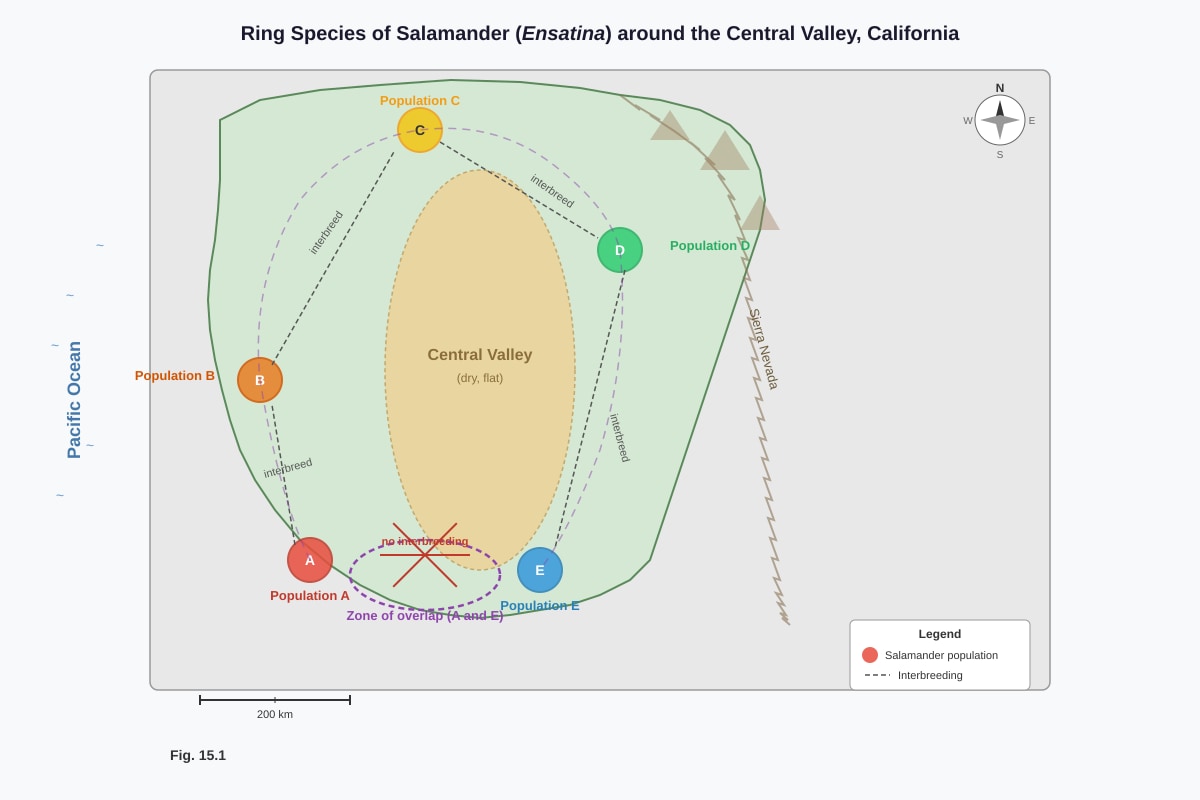
7. B) A chain of populations around a geographic barrier, where adjacent populations can interbreed, but the populations at the two ends of the chain cannot. [1 mark]
- Teaching Note: This is the standard definition of a ring species. The geographic barrier prevents gene flow across the centre, but gene flow can occur around the edges. Over time, the populations at the two ends of the ring accumulate enough genetic differences to become reproductively isolated, even though they are connected by a continuous chain of interbreeding populations.
8. B) Transfer of genetic material between species through repeated backcrossing of hybrids with one of the parent species. [1 mark]
- Teaching Note: Introgression is a specific type of gene flow. It occurs when a hybrid (e.g., between species A and B) backcrosses with one of the parent species (e.g., species A) repeatedly. This results in the transfer of some alleles from species B into the gene pool of species A.
9. D) Both B and C. [1 mark]
- Teaching Note: The endosymbiotic theory is supported by several lines of evidence. Mitochondria have their own circular DNA, their own ribosomes that resemble prokaryotic ribosomes (70S), and they divide by binary fission, just like bacteria. These are strong pieces of evidence for their prokaryotic origin.
10. D) A robust and well-funded global public health system. [1 mark]
- Teaching Note: A robust public health system is a mitigating factor that decreases the probability of a pandemic. All other options (high population density, movement of people, new virulent strains, drug resistance) are factors that increase the risk of a pandemic.
Section B: Structured Questions (20 marks)
11. (a) Adaptive radiation is the rapid diversification of a single ancestral lineage into a multitude of new species that occupy a wide range of ecological niches. [2 marks]
- Marking Notes:
- 1 mark for "rapid diversification from a single ancestor".
- 1 mark for "occupying different ecological niches" or "adapting to different environments".
(b) Example: Darwin's finches of the Galápagos Islands. [3 marks]
-
A single ancestral finch species colonised the Galápagos Islands.
-
On different islands, the finches encountered different food sources (e.g., seeds of different sizes, insects, cactus flowers).
-
Natural selection favoured individuals with beak shapes best suited to the available food on their respective islands.
-
Over many generations, populations on different islands diverged, accumulating genetic and phenotypic differences, eventually becoming reproductively isolated and forming distinct species.
-
Marking Notes:
- 1 mark for a named example (e.g., Darwin's finches, Hawaiian honeycreepers).
- 1 mark for explaining the role of different ecological niches/environments.
- 1 mark for explaining the role of natural selection and reproductive isolation in driving divergence.
12. (a) Expected number of heterozygous frogs (). [2 marks]
- Working:
- Frequency of allele, .
- Frequency of allele, .
- Frequency of heterozygous genotype, .
- Expected number of heterozygous frogs = .
- Marking Notes:
- 1 mark for correct calculation of .
- 1 mark for the correct final answer (480 frogs).
(b) Two assumptions of the Hardy–Weinberg equilibrium: [2 marks]
-
The population is infinitely large (or large enough to avoid genetic drift).
-
Mating is random.
-
There is no mutation.
-
There is no migration (gene flow) into or out of the population.
-
There is no natural selection.
-
Marking Notes: Award 1 mark for each correct assumption, up to a maximum of 2 marks.
13. (a) Distinguish between autopolyploidy and allopolyploidy. [2 marks]
-
Autopolyploidy is the possession of more than two sets of chromosomes, all derived from the same species (e.g., due to a failure of meiosis in a single species).
-
Allopolyploidy is the possession of more than two sets of chromosomes, derived from two or more different species (e.g., resulting from hybridisation between two species followed by chromosome doubling).
-
Marking Notes:
- 1 mark for each correct definition, with a clear reference to the origin of the chromosome sets (same vs. different species).
(b) Explain how polyploidy can lead to instant speciation in plants. [3 marks]
-
Polyploidy arises from a failure of cell division (meiosis or mitosis), leading to a doubling of the chromosome number.
-
A polyploid individual cannot interbreed successfully with the original diploid population because the offspring would have an odd number of chromosomes (e.g., triploid), leading to sterility due to problems in chromosome pairing during meiosis.
-
This creates an immediate reproductive barrier between the polyploid and its parent species.
-
Because the polyploid is reproductively isolated, it is considered a new species instantly, without the need for gradual geographic separation.
-
Marking Notes:
- 1 mark for the mechanism (failure of cell division/chromosome doubling).
- 1 mark for explaining the reproductive barrier (sterility of hybrids with odd chromosome numbers).
- 1 mark for concluding that this leads to instant speciation.
14. (a) Sexual selection is a form of natural selection that acts on an individual's ability to obtain a mate, favouring traits that increase mating success. [1 mark]
- Marking Notes: Award 1 mark for a clear definition that emphasises "mating success" or "obtaining mates".
(b) Example: Peacock's tail. [3 marks]
-
Female peacocks prefer males with larger, more colourful tails.
-
This preference drives the evolution of increasingly elaborate tails in males.
-
However, a large, colourful tail is costly: it requires energy to grow and maintain, makes the male more visible to predators, and hinders escape.
-
Despite these survival costs, the trait persists because it significantly increases the male's reproductive success (more mating opportunities).
-
Marking Notes:
- 1 mark for a named example (e.g., peacock's tail, bird of paradise plumage).
- 1 mark for explaining how the trait increases mating success.
- 1 mark for explaining the survival cost (e.g., predation risk, energy cost).
15. (a) Using the diagram, explain what is meant by a ring species. [2 marks]
-
A ring species is a chain of populations encircling a geographic barrier (the Central Valley).
-
Adjacent populations (e.g., A-B, B-C, C-D, D-E) can interbreed, forming a continuous genetic link.
-
However, the populations at the two ends of the ring (A and E) overlap in the south but are reproductively isolated (cannot interbreed).
-
Marking Notes:
- 1 mark for describing the continuous chain around a barrier.
- 1 mark for identifying that the end populations are reproductively isolated.
(b) One evolutionary process that could contribute to reproductive isolation between populations A and E: [1 mark]
-
Genetic drift: Random changes in allele frequencies in the small populations at the ends of the ring could lead to genetic divergence and reproductive isolation.
-
Mutation: The accumulation of different mutations in populations A and E over time could lead to genetic incompatibilities.
-
Sexual selection: Different mate preferences could evolve in populations A and E, leading to behavioural isolation.
-
Marking Notes: Award 1 mark for any valid evolutionary process (other than natural selection) with a brief explanation.
Section C: Free-Response Questions (20 marks)
16. Discuss the significance of biomolecules in our understanding of evolutionary relationships and processes. [10 marks]
Model Answer:
Biomolecules, particularly nucleic acids (DNA and RNA) and proteins, have revolutionised our understanding of evolutionary relationships and processes. They provide a molecular record of evolutionary history that complements and extends the fossil record.
Reconstructing Phylogenies:
- Molecular data allows us to construct phylogenetic trees based on sequence similarities. The more similar the DNA or protein sequences of two species, the more recently they shared a common ancestor.
- Example: Comparing the sequence of cytochrome c (a protein involved in electron transport) across species. Humans and chimpanzees have identical cytochrome c sequences, while humans and yeast differ in many amino acids. This reflects their evolutionary distance.
- Highly conserved genes (e.g., ribosomal RNA genes) are used to study deep evolutionary relationships (e.g., between kingdoms). Slowly evolving sequences provide a "molecular clock" for ancient divergences.
- Rapidly evolving genes (e.g., mitochondrial DNA) are used to study recent evolutionary events and relationships between closely related species or populations.
Understanding Evolutionary Mechanisms:
- Molecular evidence for common ancestry: The universal genetic code (DNA, RNA, and the same 20 amino acids) strongly suggests that all life on Earth shares a common ancestor.
- Molecular clocks: The rate of mutation in a gene can be used to estimate the time since two species diverged. This has been used to date the divergence of humans and chimpanzees to about 6-7 million years ago.
- Detecting selection: By comparing the rate of synonymous (silent) vs. non-synonymous (amino acid-changing) mutations, we can detect whether a gene has been under positive selection (adaptive evolution) or purifying selection.
- Example: The FOXP2 gene, involved in speech and language, shows evidence of positive selection in the human lineage, suggesting its role in the evolution of human language.
Conclusion: Molecular data provides a powerful and quantitative tool for studying evolution. It has confirmed many evolutionary relationships inferred from morphology, resolved many previously ambiguous relationships, and provided insights into the mechanisms of evolutionary change at the genetic level.
- Marking Notes:
- 3-4 marks: Excellent answer with detailed examples (e.g., cytochrome c, rRNA, mtDNA, FOXP2) and clear explanation of how molecular data is used.
- 2-3 marks: Good answer with some examples and explanation, but may lack depth or detail.
- 1-2 marks: Basic answer that mentions biomolecules but lacks specific examples or clear explanation.
- 0 marks: No relevant content.
17. (a) Explain how the evolution of atmospheric oxygen concentration on early Earth was important for the evolution of life. [4 marks]
Model Answer:
-
The early Earth had a reducing atmosphere with little or no free oxygen.
-
The evolution of photosynthetic cyanobacteria (about 2.5 billion years ago) led to the production of oxygen as a by-product of photosynthesis.
-
The gradual increase in atmospheric oxygen (the "Great Oxidation Event") had several important consequences:
- Allowed the evolution of aerobic respiration: Aerobic respiration is much more efficient (produces ~36 ATP per glucose) than anaerobic respiration (produces ~2 ATP per glucose). This allowed for the evolution of more complex, energy-demanding organisms.
- Formation of the ozone layer: Oxygen in the upper atmosphere formed ozone (O₃), which blocks harmful ultraviolet (UV) radiation from the sun. This allowed life to colonise land surfaces, as UV radiation was previously a barrier.
- Enabled the evolution of multicellular life: The increased energy availability from aerobic respiration and the protection from UV radiation were key factors that allowed the evolution of large, complex, multicellular organisms.
-
Marking Notes:
- 1 mark for mentioning the role of photosynthetic organisms.
- 1 mark for explaining the link to aerobic respiration and increased energy.
- 1 mark for explaining the formation of the ozone layer and protection from UV.
- 1 mark for linking these changes to the evolution of complex/multicellular life.
(b) Describe the evidence from the fossil record that supports the theory of evolution. [6 marks]
Model Answer: The fossil record provides several lines of evidence supporting evolution:
-
Succession of forms: Fossils show a clear progression of life forms over geological time. Older rocks contain simpler, more primitive organisms, while younger rocks contain more complex, modern-looking forms. This is consistent with the idea of descent with modification.
-
Transitional fossils: These are fossils that show intermediate characteristics between ancestral and descendant groups. They provide direct evidence of evolutionary transitions.
- Example: Tiktaalik is a transitional fossil between fish and tetrapods (four-limbed vertebrates). It has fish-like features (scales, fins) but also tetrapod-like features (a neck, wrist bones, and a flat skull with eyes on top).
- Example: Archaeopteryx is a transitional fossil between dinosaurs and birds. It has feathers and wings (bird-like) but also teeth, a long bony tail, and claws on its wings (dinosaur-like).
-
Extinction: The fossil record shows that many species have gone extinct over time. This is consistent with the idea that species change and are replaced by others, rather than being fixed and unchanging.
-
Biogeography: Fossils of similar organisms are often found in the same geographic regions, suggesting they evolved from a common ancestor in that area. For example, marsupial fossils are found primarily in Australia and South America, reflecting the evolutionary history of marsupials.
- Marking Notes:
- 1-2 marks: Basic description of the fossil record showing change over time.
- 3-4 marks: Good answer with mention of transitional fossils and at least one named example.
- 5-6 marks: Excellent answer with detailed description of multiple lines of evidence (succession, transitional fossils, extinction, biogeography) and named examples.
18. (a) Define the term genetic drift. [2 marks]
-
Genetic drift is the random change in allele frequencies in a population due to chance events, particularly in small populations.
-
It can lead to the loss or fixation of alleles over time, independent of natural selection.
-
Marking Notes:
- 1 mark for "random change in allele frequencies".
- 1 mark for mentioning "due to chance" or "in small populations".
(b) Explain how a population bottleneck can lead to a loss of genetic diversity. [3 marks]
-
A population bottleneck occurs when a large population is drastically reduced in size due to a catastrophic event (e.g., natural disaster, disease).
-
The surviving individuals represent a random sample of the original gene pool.
-
This random sampling can lead to a loss of rare alleles and a reduction in overall genetic diversity.
-
The small surviving population is then subject to genetic drift, which can further reduce diversity and lead to the fixation of some alleles and the loss of others.
-
Example: Northern elephant seals were hunted to near extinction (bottleneck of ~20 individuals). Their current population, though large, has very low genetic diversity compared to before the bottleneck.
-
Marking Notes:
- 1 mark for defining a population bottleneck.
- 1 mark for explaining the random sampling effect and loss of alleles.
- 1 mark for explaining the role of genetic drift in the small population.
19. (a) What is meant by the term coevolution? [2 marks]
-
Coevolution is the process where two or more species reciprocally affect each other's evolution.
-
Evolutionary changes in one species act as selective pressures on the other, leading to a cycle of adaptation and counter-adaptation.
-
Marking Notes:
- 1 mark for "reciprocal evolutionary change".
- 1 mark for "selective pressures on each other".
(b) Describe, using a named example, how coevolution can occur between a predator and its prey. [3 marks]
Example: Cheetahs and gazelles.
-
Cheetahs (predator) evolve to run faster to catch gazelles (prey).
-
Gazelles (prey) evolve to run faster to escape cheetahs.
-
This creates an "evolutionary arms race": faster cheetahs select for faster gazelles, which in turn select for even faster cheetahs.
-
Over time, both species become faster, but the relative difference in speed may remain similar. This is an example of reciprocal selection pressure driving the evolution of speed in both species.
-
Marking Notes:
- 1 mark for a named example (e.g., cheetah-gazelle, predator-prey).
- 1 mark for explaining the reciprocal selective pressures.
- 1 mark for describing the "arms race" or cycle of adaptation.
20. (a) Distinguish between homologous structures and analogous structures. [2 marks]
-
Homologous structures are structures that are similar in different species because they were inherited from a common ancestor, even if they have different functions (e.g., the forelimb bones of humans, whales, and bats).
-
Analogous structures are structures that have similar functions in different species but evolved independently (convergent evolution) and do not share a common ancestry (e.g., the wings of birds and insects).
-
Marking Notes:
- 1 mark for each correct definition, with a clear distinction based on common ancestry vs. convergent evolution.
(b) Explain how homologous structures provide evidence for common ancestry. [3 marks]
-
Homologous structures share a similar underlying anatomy (e.g., the same set of bones in the forelimbs of mammals), despite being adapted for different functions (e.g., running, swimming, flying).
-
This similarity is best explained by descent from a common ancestor that had the same basic structure.
-
Modifications to the structure over time (e.g., elongation of bones in bats for flight, reduction of bones in whales for swimming) reflect adaptation to different environments, but the underlying homology points to a shared evolutionary origin.
-
Marking Notes:
- 1 mark for describing the similarity in underlying structure.
- 1 mark for explaining that this is due to inheritance from a common ancestor.
- 1 mark for explaining that modifications reflect adaptation to different functions.