AI Generated Quiz
A Level Biology H3 Ecology Quiz
Free A Level Biology H3 Ecology quiz, AI version, with questions, answers, and A Level-style practice for Singapore students.
These static practice materials are generated from the site's syllabus and paper-generation workflow, with source and model context shown so students and parents can evaluate the material before use.
Questions
Free quiz and exam paper access
Enter your details to view this paper
Your access is remembered on this device.
Answers
A-Level Biology H3 Quiz - Ecology — Answer Key
Total Marks: 75
Section A: Multiple-Choice Questions (Questions 1–5)
1. B — The ecological niche encompasses the role and position of a species, including its interactions with biotic and abiotic factors. Option A describes a habitat, C describes population size, and D describes a tolerance range.
2. C — Carrying capacity is the maximum population size that can be sustained indefinitely by the available resources. At carrying capacity, the population size stabilizes as birth and death rates are equal.
3. B — A keystone species has a disproportionately large effect on its environment relative to its abundance. A predator that controls herbivore populations and maintains plant diversity is a classic example.
4. B — The species-area relationship states that the number of species increases with area, typically following a power law (S = cA^z).
5. C — Density-dependent factors, such as competition for food, have an effect that varies with population density. Density-independent factors (e.g., natural disasters, climate change, volcanic eruptions) affect populations regardless of density.
Section B: Data-Based and Structured Questions (Questions 6–15)
6. (a) The experiment demonstrates competitive exclusion and niche partitioning. Chthamalus is competitively excluded from the lower zone by Semibalanus, but Semibalanus is limited by physical factors (e.g., desiccation) in the upper zone. This shows that the realized niche of Chthamalus is smaller than its fundamental niche due to competition. [2 marks]
(b) Semibalanus could not expand into the upper zone because it is less tolerant to desiccation or extreme temperatures. [1 mark]
7. (a) Percentage transfer = (3000 / 20,000) × 100% = 15%. [1 mark]
(b) Energy transfer is inefficient because:
- Not all biomass is consumed (e.g., roots, inedible parts).
- Some energy is lost as heat through respiration.
- Some energy is lost in waste products (e.g., faeces, urine). [2 marks]
(c) The tertiary consumer population would decline or collapse due to loss of food source. [1 mark]
8. Primary succession begins on bare rock or newly formed land. Pioneer species (e.g., lichens, mosses) colonize first, breaking down rock and forming soil. As soil develops, small plants and grasses establish, followed by shrubs and eventually trees. Each community modifies the environment, making it suitable for the next. The process culminates in a climax community. [4 marks]
9. (a) Frequency of B allele = 1 - 0.3 = 0.7. [1 mark]
(b) Heterozygous frequency = 2pq = 2 × 0.7 × 0.3 = 0.42. Expected number = 0.42 × 500 = 210 butterflies. [2 marks]
10. The competitive exclusion principle states that two species competing for the same limiting resource cannot coexist indefinitely. Niche partitioning allows coexistence by reducing competition. For example, warblers in a forest feed on insects at different heights or parts of trees, thus partitioning the resource. This reduces direct competition and allows multiple species to coexist. [4 marks]
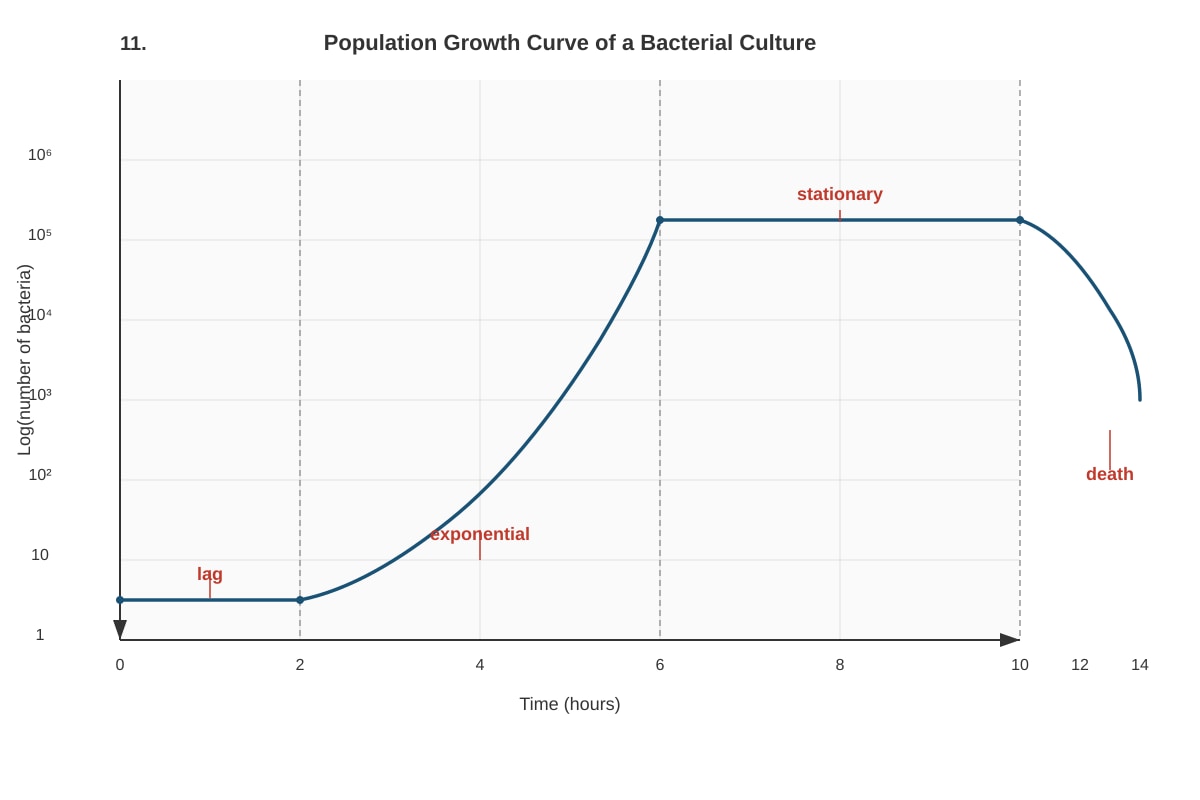
11. (a) Stationary phase. [1 mark]
(b) Reasons for stationary phase:
- Depletion of nutrients.
- Accumulation of toxic waste products.
- Limited oxygen availability. [2 marks]
12. A food chain is a linear sequence of energy transfer, while a food web is a network of interconnected food chains. Food webs are more stable because they have multiple pathways for energy flow. If one species is lost, alternative food sources prevent the collapse of the entire system. [4 marks]
13. (a) Species density = number of species / area. Forest A: 45 / 10 = 4.5 species per hectare. Forest B: 90 / 100 = 0.9 species per hectare. [1 mark]
(b) Using the species-area relationship (S = cA^z), with z typically around 0.25–0.3, we can estimate. Assuming z = 0.25, S_1000 = S_100 × (1000/100)^0.25 = 90 × 10^0.25 ≈ 90 × 1.78 ≈ 160 species. [2 marks]
14. Ecological succession can guide restoration by identifying the natural sequence of species that will colonize a degraded site. Restoration ecologists may accelerate succession by introducing pioneer species, improving soil conditions, or planting keystone species. This helps re-establish a self-sustaining ecosystem. [3 marks]
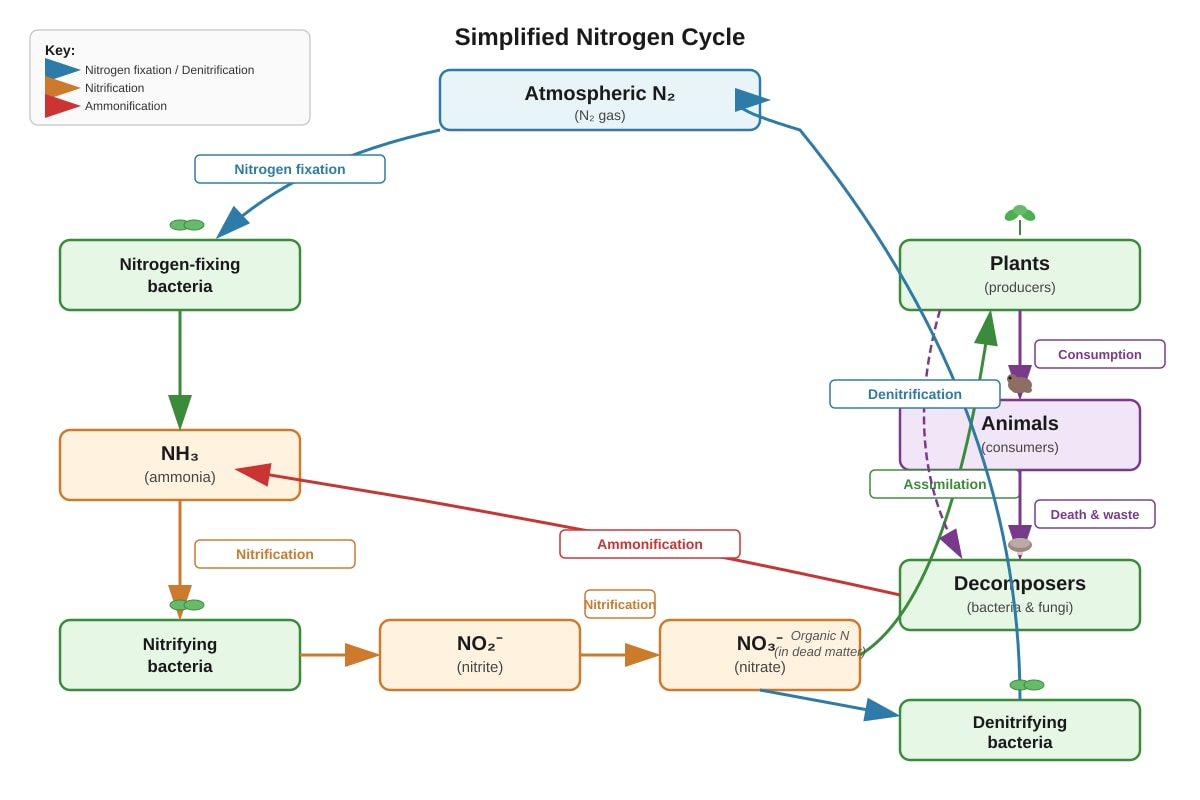
15. (a) Nitrogen fixation. [1 mark]
(b) Decomposers break down dead organic matter (e.g., dead plants, animals, waste) and release ammonia (NH₃) into the soil through ammonification. This ammonia can then be converted to nitrate by nitrifying bacteria, making nitrogen available to plants. [2 marks]
Section C: Free-Response Questions (Questions 16–20)
16. Climate change is altering species distributions and abundances. As temperatures rise, many species are shifting their ranges poleward or to higher elevations. For example, the Edith's checkerspot butterfly has moved northward in North America. Phenology (timing of life events) is also affected; earlier springs cause mismatches between species, such as birds hatching after their insect prey peaks. Species unable to adapt or disperse face extinction. [6 marks]
17. Conservation biology aims to protect biodiversity. In-situ conservation (e.g., national parks, wildlife reserves) protects species in their natural habitats. Ex-situ conservation (e.g., zoos, seed banks) preserves species outside their habitats. Both methods are important; in-situ maintains ecological interactions, while ex-situ provides a safety net for critically endangered species. Examples: In-situ — Yellowstone National Park; Ex-situ — Svalbard Global Seed Vault. [6 marks]
18. Island biogeography theory predicts that species richness on an island is determined by immigration and extinction rates, which are influenced by island size and distance from the mainland. Larger reserves support more species and have lower extinction rates. Connectivity (e.g., corridors) between reserves facilitates immigration and gene flow, reducing extinction risk. Therefore, reserves should be large and connected. [6 marks]
19. Habitat fragmentation divides large habitats into smaller, isolated patches. This reduces population sizes, limits gene flow, and increases edge effects. Species requiring large territories (e.g., tigers) are particularly vulnerable. Evolutionary consequences include genetic drift and inbreeding in small populations. Example: Fragmentation of Amazon rainforest threatens species like the jaguar. [6 marks]
20. Invasive species spread due to human activities (e.g., trade, travel) and their own traits (e.g., high reproductive rate, lack of natural predators). They outcompete, prey on, or introduce diseases to native species, disrupting ecosystems. Management strategies include prevention (e.g., biosecurity), early detection and rapid response, biological control (e.g., introducing natural enemies), and physical removal. Example: Cane toad in Australia. [6 marks]
End of Answer Key