AI Generated Quiz
A Level Biology H3 Ecology Quiz
Free A Level Biology H3 Ecology quiz, AI version, with questions, answers, and A Level-style practice for Singapore students.
These static practice materials are generated from the site's syllabus and paper-generation workflow, with source and model context shown so students and parents can evaluate the material before use.
Questions
Free quiz and exam paper access
Enter your details to view this paper
Your access is remembered on this device.
Answers
A-Level Biology H3 Quiz - Ecology: Answer Key
Total Marks: 100
Section A: Multiple-Choice Questions (Questions 1–10)
1. B) All the individuals of a single species living in a defined area at a given time [2 marks]
Explanation: A population is defined as a group of individuals of the same species that live in the same area and interbreed. Option A describes a community, C describes an ecosystem, and D describes a niche.
2. C) Patchy distribution of food and nesting sites [2 marks]
Explanation: Clumped dispersion is the most common pattern in nature and often results from patchy resources. Territorial behaviour (B) leads to uniform dispersion, and random seed dispersal (D) can lead to random dispersion.
3. B) 200 [2 marks]
Explanation: Using the Lincoln-Petersen index: Population size (N) = (Number marked in first sample × Total in second sample) / Number of marked individuals in second sample = (50 × 80) / 20 = 200.
4. C) A volcanic eruption [2 marks]
Explanation: Density-independent factors affect a population regardless of its density. Volcanic eruptions, floods, fires, and storms are examples. Competition, predation, and disease are density-dependent factors.
5. B) The maximum population size that an environment can sustain indefinitely [2 marks]
Explanation: Carrying capacity (K) is the maximum population size that can be supported by the available resources in an environment over a long period. Option A describes intrinsic rate of increase (r), and D describes zero population growth.
6. C) The population size is at half the carrying capacity [2 marks]
Explanation: In logistic growth, the per capita growth rate is highest when the population is small and resources are abundant. However, the overall population growth rate (dN/dt) is highest at K/2. The per capita growth rate decreases linearly as population size increases.
7. B) Its removal would cause significant changes in ecosystem structure [2 marks]
Explanation: A keystone species has a disproportionately large effect on its environment relative to its abundance. Its removal can cause a cascade of changes, often leading to a decline in biodiversity.
8. B) Fox and hawk [2 marks]
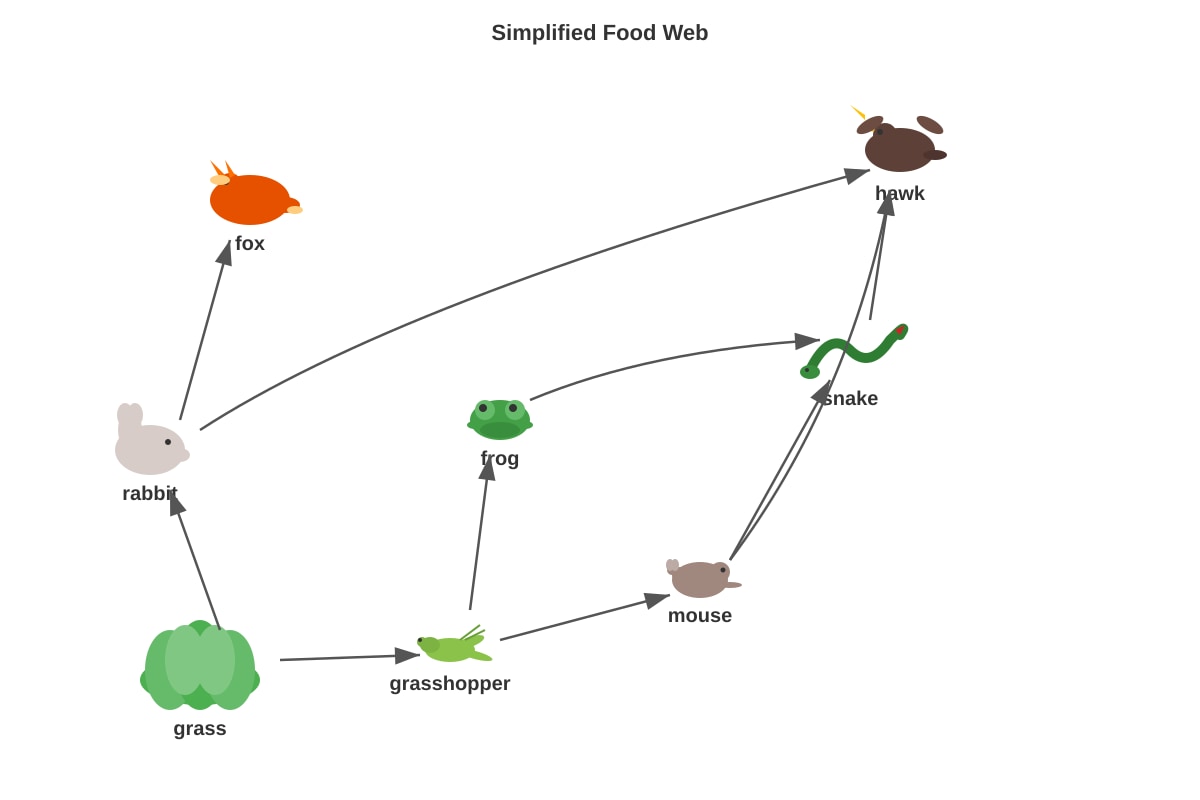
Explanation: In the food web, the hawk eats rabbit, mouse, and snake. The fox eats rabbit. The snake eats frog and mouse, and is eaten by the hawk. Therefore, the fox and hawk are at the highest trophic levels (tertiary/apex consumers). The snake is a secondary consumer that is also prey.
9. A) Heat through metabolic processes [2 marks]
Explanation: The 10% rule reflects the inefficiency of energy transfer. Most energy is lost as heat during cellular respiration (metabolic processes) and is not available to the next trophic level.
10. B) Gross primary productivity (GPP) [2 marks]
Explanation: GPP is the total rate of photosynthesis by primary producers. NPP (A) is GPP minus energy used by producers for respiration. NEP (C) is NPP minus energy lost to decomposition and other losses.
Section B: Short-Answer Questions (Questions 11–15)
11. (a) Mean = (4 + 6 + 2 + 8 + 5 + 3 + 7 + 5 + 4 + 6) / 10 = 50 / 10 = 5 daisies per quadrat [1 mark]
(b) Area of one quadrat = 0.5 m × 0.5 m = 0.25 m² [1 mark] Population density = Mean number per quadrat / Area of quadrat = 5 / 0.25 = 20 daisies per m² [1 mark]
(c) Limitations may include: [1 mark for any valid limitation]
- Quadrats may not capture clumped distribution accurately.
- Difficult to count individuals if plants are overlapping or very small.
- The number of quadrats may not be sufficient to represent the whole field.
12. [4 marks]
- Fundamental niche: The full range of environmental conditions (biotic and abiotic) under which a species can survive and reproduce, in the absence of interactions with other species. [1 mark]
- Realised niche: The actual set of conditions under which a species exists, after accounting for interactions such as competition, predation, and mutualism. It is often a subset of the fundamental niche. [1 mark]
- Example: The barnacle Chthamalus has a fundamental niche covering the entire intertidal zone. However, due to competition with another barnacle, Balanus, its realised niche is restricted to the upper intertidal zone, where Balanus cannot survive. [2 marks for a clear, named example]
13. [5 marks]
- Pioneer species: The first organisms to colonise the barren volcanic island. These are typically hardy species like lichens and mosses that can tolerate extreme conditions (e.g., lack of soil, high UV exposure). [1 mark]
- Soil formation: Lichens and mosses secrete acids that break down rock, and their dead remains accumulate, forming a thin layer of soil. [1 mark]
- Successional stages: As soil develops, small grasses and ferns colonise, followed by shrubs and eventually trees. Each stage modifies the environment, making it more suitable for later species. [1 mark]
- Increased biodiversity: Species diversity and biomass increase over time as the habitat becomes more complex. [1 mark]
- Climax community: The process culminates in a stable climax community (e.g., a forest) that is in equilibrium with the climate. [1 mark]
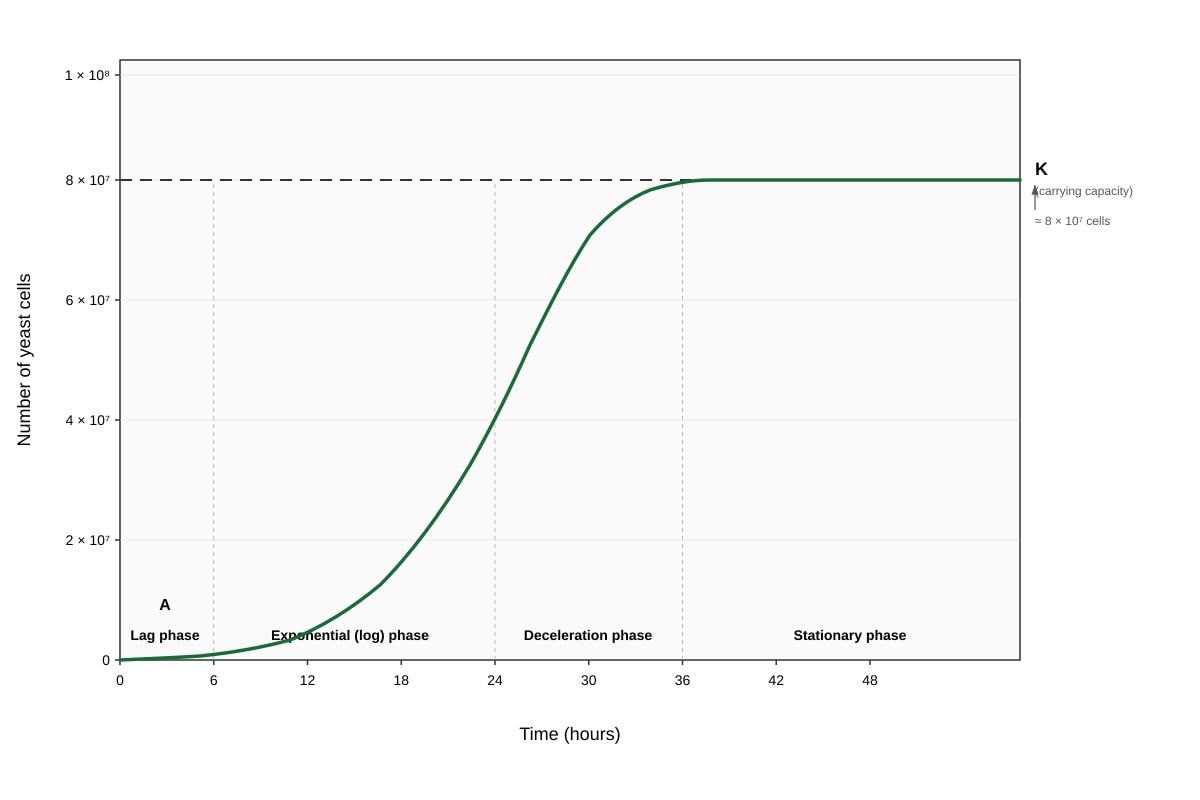
14. (a) Phase A is the lag phase. [1 mark]
(b) After the exponential phase, the population growth rate decreases because: [2 marks]
- Nutrients in the closed flask become depleted.
- Waste products (e.g., ethanol, CO₂) accumulate and become toxic.
- The carrying capacity of the environment is approached, leading to increased competition for resources.
(c) If fresh nutrient medium is added at hour 30, the yeast population would likely resume exponential growth. [1 mark] This is because the limiting factor (nutrient availability) has been removed, allowing the population to increase until a new carrying capacity is reached. [1 mark]
15. (a) For Forest X: [3 marks] Total individuals (N) = 50 + 30 + 10 + 5 + 5 = 100 for each species:
- Species A: (50/100)² = 0.25
- Species B: (30/100)² = 0.09
- Species C: (10/100)² = 0.01
- Species D: (5/100)² = 0.0025
- Species E: (5/100)² = 0.0025 = 0.25 + 0.09 + 0.01 + 0.0025 + 0.0025 = 0.355
(b) Forest Y has higher species diversity. [1 mark] Although both forests have the same number of species (species richness = 5), Forest Y has a more even distribution of individuals among species (20 individuals each). Simpson's Index for Forest Y would be higher (closer to 1), indicating greater diversity. [1 mark]
Section C: Extended-Response Questions (Questions 16–20)
16. [6 marks]
- Competitive exclusion principle: States that two species competing for the same limiting resource cannot coexist indefinitely. The superior competitor will eventually exclude the other. [1 mark]
- Niche differentiation (resource partitioning): The process by which competing species evolve to use different parts of a resource, reducing direct competition and allowing coexistence. [1 mark]
- Example: Darwin's finches on the Galápagos Islands. Different species of finches have evolved different beak sizes and shapes, allowing them to specialise on different seed sizes. This reduces competition for food. [2 marks for a clear, named example with explanation]
- Mechanism: Through natural selection, individuals that use underutilised resources have a selective advantage, leading to character displacement and niche partitioning. [1 mark]
- Conclusion: Niche differentiation is a key mechanism that allows the coexistence of species that would otherwise be subject to competitive exclusion. [1 mark]
17. [6 marks]
- Genetic consequences:
- Genetic bottleneck: The severe reduction in population size (90% mortality) creates a genetic bottleneck. The surviving individuals have only a fraction of the original genetic diversity. [1 mark]
- Loss of genetic variation: Rare alleles may be lost, reducing the population's adaptive potential. [1 mark]
- Increased inbreeding: With fewer individuals, mating between close relatives becomes more likely, leading to inbreeding depression (reduced fitness due to expression of deleterious recessive alleles). [1 mark]
- Ecological consequences:
- Reduced population size: The small population is more vulnerable to stochastic events (e.g., another drought, disease). [1 mark]
- Altered species interactions: The decline of the orchid may affect its pollinators, seed dispersers, or mycorrhizal fungi. [1 mark]
- Increased extinction risk: The combination of reduced genetic diversity and small population size increases the risk of local extinction. [1 mark]
18. [6 marks]
- Role of decomposers: Decomposers (e.g., bacteria, fungi) break down dead organic matter (detritus) from all trophic levels. [1 mark] They release inorganic nutrients (e.g., nitrogen, phosphorus, carbon) back into the soil or water, making them available for primary producers. This process is essential for nutrient cycling. [1 mark]
- Abiotic factors affecting decomposition rate:
- Temperature: Decomposition rates increase with temperature up to an optimum, as enzyme activity increases. Very high temperatures can denature enzymes and kill decomposers. [1 mark]
- Moisture: Adequate moisture is essential for decomposer metabolism and for the diffusion of enzymes and nutrients. Decomposition is slow in dry conditions (e.g., deserts) and waterlogged conditions (e.g., bogs) where oxygen is limited. [1 mark]
- Oxygen availability: Aerobic decomposers require oxygen for respiration. Decomposition is rapid in well-oxygenated environments (e.g., forest floor). In anaerobic conditions (e.g., waterlogged soils, deep sediments), decomposition is slow and carried out by anaerobic organisms, producing different end products (e.g., methane). [1 mark]
- Integration: The interaction of these factors determines the overall rate of decomposition and, consequently, the rate of nutrient cycling in an ecosystem. [1 mark]
19. (a) Ecological footprint: The total area of productive land and water required to sustainably support a population, including the resources it consumes and the waste it generates. [2 marks]
(b) A larger ecological footprint indicates higher consumption of resources (e.g., food, energy, water) and greater waste production (e.g., CO₂ emissions, solid waste). [1 mark] Populations with high consumption patterns (e.g., developed countries) have a larger ecological footprint than those with lower consumption. [1 mark]
(c) Two strategies to reduce ecological footprint: [2 marks, 1 mark each]
- Reduce energy consumption: Transition to renewable energy sources (solar, wind), improve energy efficiency in buildings and transport.
- Reduce waste: Promote recycling, composting, and reducing single-use plastics.
- Sustainable food choices: Reduce meat consumption (especially beef), support local and seasonal food.
- Sustainable transport: Increase use of public transport, cycling, and electric vehicles.
20. [8 marks]
- Range shifts: As temperatures rise, many species are shifting their geographic ranges towards higher latitudes (poles) or higher elevations to track their preferred climatic conditions. [1 mark] Species that cannot disperse quickly enough (e.g., plants with poor seed dispersal, slow-moving animals) may face population declines. [1 mark]
- Phenology: Climate change is altering the timing of seasonal events (phenology), such as flowering, migration, and breeding. [1 mark] Mismatches can occur if, for example, a bird's breeding season no longer coincides with the peak abundance of its insect prey, leading to reduced reproductive success. [1 mark]
- Abundance and population dynamics: Changes in temperature and precipitation can directly affect species' survival and reproduction. [1 mark] For example, increased drought frequency can reduce plant growth and seed production, affecting herbivore populations. [1 mark]
- Extinction risk: Species with narrow climatic tolerances, limited dispersal abilities, or small population sizes are at high risk of extinction. [1 mark] Coral reefs are particularly vulnerable to ocean warming and acidification. [1 mark]
- Ecosystem-level effects: Changes in species distribution and abundance can alter community structure, food web dynamics, and ecosystem services. [1 mark for a well-integrated conclusion]