AI Generated Quiz
A Level Biology H3 Ecology Quiz
Free A Level Biology H3 Ecology quiz, AI version, with questions, answers, and A Level-style practice for Singapore students.
These static practice materials are generated from the site's syllabus and paper-generation workflow, with source and model context shown so students and parents can evaluate the material before use.
Questions
Free quiz and exam paper access
Enter your details to view this paper
Your access is remembered on this device.
Answers
A-Level Biology H3 Quiz - Ecology: Answer Key
Total Marks: 50
Section A: Multiple-Choice Questions (10 marks)
1. B) The role and position a species has in its environment, including its interactions with biotic and abiotic factors.
- Explanation: The niche is a fundamental concept in ecology. It is not just the habitat (where it lives, A) but its functional role, including what it eats, how it reproduces, and its interactions. Population size (C) and tolerance range (D) are components of the niche but do not define it entirely.
- Marking: 1 mark for correct answer.
2. B) 200
- Explanation: The Lincoln-Petersen index for mark-release-recapture is: Estimated Population Size (N) = (Number marked in first sample × Total number in second sample) / Number of marked individuals recaptured. N = (50 × 60) / 15 = 3000 / 15 = 200.
- Marking: 1 mark for correct answer.
- Common Mistake: Students may incorrectly calculate N = (50 × 15) / 60 or forget to use the formula correctly.
3. C) Competition for food
- Explanation: Density-dependent factors are those whose effects on a population change with population density. Competition for food, disease, and predation are classic examples. Volcanic eruptions (A), droughts (B), and floods (D) are density-independent factors; their impact is generally the same regardless of population size.
- Marking: 1 mark for correct answer.
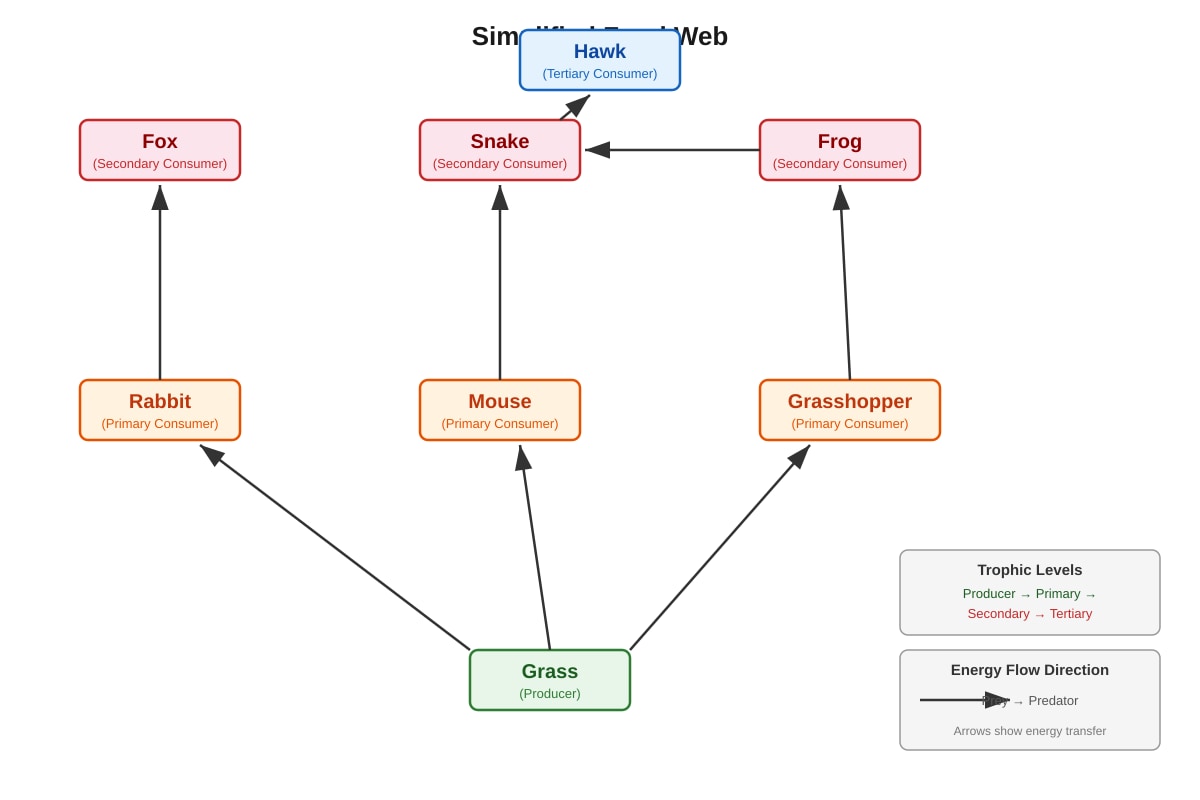
4. C) Hawk
- Explanation: A tertiary consumer is a carnivore at the top of the food chain that eats other carnivores. In the food web, the Hawk eats the Snake (a secondary consumer). The Rabbit (A) is a primary consumer. The Snake (B) is a secondary consumer. The Frog (D) is a secondary consumer.
- Marking: 1 mark for correct answer.
5. D) Natural selection
- Explanation: The Hardy-Weinberg principle describes a non-evolving population. The conditions for equilibrium are: no mutations, random mating, no natural selection, extremely large population size, and no gene flow. Natural selection is a force that changes allele frequencies, so it is not a condition for equilibrium.
- Marking: 1 mark for correct answer.
6. B) Deforestation and burning of fossil fuels
- Explanation: Burning fossil fuels releases vast amounts of CO2 stored underground over millions of years. Deforestation reduces the planet's capacity to absorb CO2 through photosynthesis. Solar panels (A), recycling (C), and hydroelectric dams (D) are all strategies to reduce carbon emissions, not increase them.
- Marking: 1 mark for correct answer.
7. B) Endemic
- Explanation: An endemic species is one that is native to a single defined geographic location, such as an island, nation, or other defined zone, and is found nowhere else. Invasive (A) species are introduced and cause harm. Keystone (C) species have a disproportionately large effect on their environment. Pioneer (D) species are the first to colonize a disturbed area.
- Marking: 1 mark for correct answer.
8. B) The means of two groups to see if they are significantly different from each other.
- Explanation: The t-test is a parametric statistical test used to determine if there is a significant difference between the means of two groups. The chi-squared test (A) is for categorical data. The t-test does not directly compare variance (C) or correlation (D).
- Marking: 1 mark for correct answer.
9. B) Developing drought-resistant crop varieties
- Explanation: Biological measures to mitigate climate change involve using living organisms or biological processes. Developing drought-resistant crops is a form of genetic modification or selective breeding that helps agriculture adapt to climate change. Reducing car usage (A) and installing efficient air conditioners (C) are technological or lifestyle changes. Switching to a vegetarian diet (D) is a lifestyle change that reduces the carbon footprint of food production.
- Marking: 1 mark for correct answer.
10. B) The capacity of an ecosystem to produce useful biological materials and absorb waste materials.
- Explanation: Biocapacity is a measure of the productivity of a given area of land or water. It is often compared to the ecological footprint (the demand humans place on the environment). Carrying capacity (C) is a related but distinct concept for a single species. Biocapacity is about the ecosystem's overall regenerative capacity.
- Marking: 1 mark for correct answer.
Section B: Structured Questions (20 marks)
11. (a) Distinguish between 'population' and 'community'.
- Answer: A population is a group of individuals of the same species living in the same area at the same time. A community is a group of populations of different species living and interacting in the same area.
- Marking: 1 mark for a correct definition of population. 1 mark for a correct definition of community. [2]
(b) Suitable statistical test and justification.
- Answer: A suitable test would be the chi-squared (χ²) test for association.
- Justification: The data collected is categorical (presence/absence or percentage cover categories of species X and Y at each point). The chi-squared test is used to determine if there is a significant association between two categorical variables. It compares the observed distribution of the two species to the distribution expected if they were distributed independently of each other.
- Marking: 1 mark for identifying the chi-squared test. 1 mark for a valid justification linking it to categorical data and testing for association. [2]
12. (a) Calculate expected number of homozygous dominant individuals.
- Working:
- Frequency of recessive allele, q = 0.3
- Frequency of dominant allele, p = 1 - q = 1 - 0.3 = 0.7
- Frequency of homozygous dominant genotype (AA) = p² = (0.7)² = 0.49
- Expected number of AA individuals = p² × total population size = 0.49 × 200 = 98
- Answer: 98 individuals.
- Marking: 1 mark for calculating p. 1 mark for calculating p². 1 mark for correct final answer (98). [3]
(b) State one assumption unlikely to be met.
- Answer: Any one of the following:
- The population is small (genetic drift is likely).
- Non-random mating may occur (e.g., inbreeding).
- Natural selection may be acting on the trait.
- Gene flow (migration) may occur.
- Mutations may occur.
- Marking: 1 mark for a valid assumption that is unlikely to be met. [1]
13. Describe how the human microbiota contributes to our health.
- Answer: The human microbiota (the community of microorganisms living on and in the body) contributes to health in several ways:
- Digestion and Nutrition: Gut bacteria help break down complex carbohydrates (e.g., dietary fibre) that human enzymes cannot digest, producing short-chain fatty acids that are an energy source for colon cells. They also synthesize essential vitamins like vitamin K and some B vitamins.
- Immune System Development and Regulation: The microbiota helps train the immune system to distinguish between harmless and pathogenic microbes. It stimulates the development of gut-associated lymphoid tissue (GALT) and helps maintain immune tolerance.
- Pathogen Exclusion: Commensal bacteria compete with pathogenic bacteria for space and nutrients, and can produce antimicrobial substances, creating a barrier against infection (colonization resistance).
- Marking: 1 mark for each valid point, up to a maximum of 3 marks. Award marks for clear, specific explanations. [3]
14. Explain how adaptive radiation can lead to the formation of ring species.
- Answer:
- Adaptive radiation is the process by which a single ancestral species diversifies into many different species, each adapted to a different ecological niche. This often occurs when a population colonizes a new area with diverse habitats.
- A ring species forms when a species expands its range around a geographic barrier (e.g., a mountain range or a large body of water). As the population spreads, it encounters different selective pressures along the way, leading to gradual adaptation and divergence.
- At the extremes of the range, the populations have diverged so much that they are reproductively isolated and cannot interbreed, even though they are connected by a continuous chain of interbreeding populations around the barrier.
- Example: The Ensatina salamanders in California. They form a ring around the Central Valley. Populations at the southern end of the ring (e.g., E. klauberi and E. eschscholtzii) are distinct species that do not interbreed where their ranges meet, but they are connected by a series of intergrading subspecies around the valley.
- Marking: 1 mark for defining adaptive radiation. 1 mark for explaining the role of geographic barriers and gradual divergence. 1 mark for explaining reproductive isolation at the ring's ends. 1 mark for a specific, accurate example. [4]
15. (a) Calculate the percentage change in mean growth rate for A. millepora.
- Working:
- Change in growth rate = 1.2 - 2.5 = -1.3 mm/week
- Percentage change = (Change / Original value) × 100% = (-1.3 / 2.5) × 100% = -52%
- Answer: -52% (or a 52% decrease).
- Marking: 1 mark for correct calculation of change. 1 mark for correct final percentage (including negative sign or stating decrease). [2]
(b) Suggest a reason for the different responses.
- Answer: A. millepora is likely a more thermally sensitive species, possibly with a narrower thermal tolerance range, or it may have a less robust symbiotic relationship with its zooxanthellae (algae) compared to P. lobata. P. lobata may have a more heat-tolerant algal symbiont or a greater capacity for acclimatization.
- Marking: 1 mark for a valid suggestion related to differences in thermal tolerance, symbiont sensitivity, or acclimatization capacity. 1 mark for linking it to the specific species. [2]
(c) Explain how loss of coral reefs impacts global carbon cycles.
- Answer:
- Coral reefs are significant carbon sinks. They sequester carbon dioxide (CO2) from the atmosphere and ocean through the process of calcification, where corals build their calcium carbonate skeletons.
- When corals die and reefs are degraded, this calcification process stops, reducing the ocean's capacity to absorb CO2.
- Additionally, the erosion of dead coral skeletons can release stored carbon back into the water and potentially into the atmosphere as CO2, turning a carbon sink into a carbon source.
- Marking: 1 mark for identifying reefs as carbon sinks via calcification. 1 mark for explaining that reef loss stops this process. 1 mark for explaining the potential release of stored carbon. [3]
Section C: Free-Response Questions (20 marks)
16. Describe how rising global temperatures and changing precipitation patterns directly affect the physiology and distribution of both animal and plant species. Use specific examples in your answer.
- Answer:
- Physiological Effects:
- Temperature: Increased temperatures can exceed the thermal tolerance of species. For example, coral bleaching occurs when high sea temperatures cause corals to expel their symbiotic zooxanthellae, leading to death. In animals, higher temperatures can increase metabolic rates, leading to increased energy demands and potential starvation if food is limited. For plants, high temperatures can increase photorespiration and reduce photosynthetic efficiency.
- Precipitation: Changes in rainfall patterns can cause drought or flooding. Drought stress in plants leads to stomatal closure, reduced photosynthesis, and wilting. For animals, drought can reduce water availability and food resources. For example, many amphibian species are highly sensitive to desication and require moist conditions for reproduction.
- Distributional Effects:
- Range Shifts: Species are moving to higher latitudes and higher elevations to track their preferred climate envelopes. For example, many bird species in North America have shifted their ranges northward. On mountains, species like the American pika have moved to higher elevations.
- Range Contractions: Species that cannot disperse or adapt may face range contractions and local extinctions. For example, the Bramble Cay melomys (a rodent) is considered extinct due to sea-level rise from climate change.
- Physiological Effects:
- Marking: Up to 2 marks for physiological effects (1 for temperature, 1 for precipitation). Up to 2 marks for distributional effects (1 for range shifts, 1 for range contractions). 1 mark for specific animal example. 1 mark for specific plant example. [6]
17. Explain how direct effects of climate change on individual species can lead to altered species interactions, such as predator-prey relationships, competition, and mutualism. Use specific examples.
- Answer:
- Predator-Prey: Phenological mismatches can occur when the timing of key life events changes at different rates for predator and prey. For example, the great tit (Parus major) in Europe relies on peak caterpillar abundance to feed its chicks. Warmer springs cause caterpillars to emerge earlier, but the tits have not advanced their breeding date as quickly, leading to a mismatch and reduced chick survival.
- Competition: Climate change can alter the competitive balance between species. For example, warming temperatures in the Arctic are allowing shrubs to expand into tundra habitats, outcompeting lichens and mosses. This reduces food availability for caribou, which rely on lichens in winter.
- Mutualism: Climate change can disrupt mutualistic relationships. For example, coral bleaching breaks down the mutualism between coral and zooxanthellae. Another example is the potential mismatch between flowering plants and their pollinators if both shift their phenology at different rates.
- Marking: 2 marks for predator-prey with example. 2 marks for competition with example. 2 marks for mutualism with example. [6]
18. Evaluate the potential for species to adapt to climate change through evolutionary processes, including the role of genetic variation and natural selection.
- Answer:
- Potential for Adaptation:
- Genetic Variation: The raw material for natural selection is genetic variation within a population. If a population has high genetic diversity, there is a greater chance that some individuals possess alleles that confer tolerance to new climatic conditions (e.g., heat tolerance, drought resistance).
- Natural Selection: Under the new selective pressures of climate change, individuals with advantageous traits will have higher survival and reproductive success, passing on those alleles to future generations. This can lead to evolutionary adaptation over generations.
- Limitations:
- Rate of Change: Climate change is occurring very rapidly. Many species, especially those with long generation times (e.g., trees, large mammals), may not be able to evolve fast enough to keep pace.
- Small Population Size: Small, fragmented populations have low genetic variation and are more vulnerable to genetic drift, reducing their adaptive potential.
- Lack of Genetic Variation: Some species may simply lack the genetic variation needed to adapt to the novel conditions.
- Multiple Stressors: Species may face multiple simultaneous stressors (e.g., temperature, drought, new diseases), making adaptation more complex.
- Potential for Adaptation:
- Marking: 1 mark for explaining the role of genetic variation. 1 mark for explaining natural selection. 1 mark for discussing limitations (e.g., rate of change, small populations). 1 mark for a balanced evaluation. [4]
19. Critically assess the effectiveness of human-led mitigation and adaptation strategies in preserving biodiversity in the face of climate change.
- Answer:
- Mitigation Strategies (reducing the cause):
- Effectiveness: Reducing greenhouse gas emissions (e.g., through renewable energy, carbon taxes) is the most fundamental strategy to limit the extent of climate change. International agreements like the Paris Agreement aim to keep global warming well below 2°C.
- Limitations: Global efforts have been insufficient to date, with emissions still rising. Political and economic barriers hinder rapid implementation. Even if emissions stop now, some climate change is already "baked in."
- Adaptation Strategies (managing the impacts):
- Effectiveness: Strategies like creating wildlife corridors to allow species to migrate, assisted colonization (moving species to new suitable habitats), and ex situ conservation (e.g., seed banks, zoos) can help preserve species in the short term.
- Limitations: These are often expensive, logistically challenging, and can have unintended consequences (e.g., assisted colonization introducing invasive species). They are often reactive rather than proactive and may not be scalable to protect all biodiversity.
- Overall Assessment: While mitigation is the only long-term solution, current efforts are inadequate. Adaptation strategies are crucial for buying time and preserving species in the short term, but they are not a substitute for aggressive mitigation. A combination of both is necessary, but the effectiveness is currently limited by political will, funding, and the sheer scale of the problem.
- Mitigation Strategies (reducing the cause):
- Marking: 1 mark for discussing mitigation effectiveness and limitations. 1 mark for discussing adaptation effectiveness and limitations. 1 mark for a critical comparison. 1 mark for an overall assessment. [4]
20. "The impact of climate change on ecosystems is a complex interplay of direct physiological effects on individual species and indirect effects mediated through species interactions." Discuss this statement, integrating concepts from your answers to questions 16-19.
- Answer: (This question requires a synthesis of the previous four answers. A high-quality answer will explicitly link the concepts.)
- Introduction: Restate the statement and outline the essay structure.
- Direct Effects (from Q16): Describe how climate change directly affects the physiology (e.g., coral bleaching, plant water stress) and distribution (range shifts, contractions) of species. These are the foundational impacts.
- Indirect Effects (from Q17): Explain how these direct effects cascade through ecosystems by altering species interactions. Use examples from Q17 (e.g., phenological mismatches in predator-prey, competition between shrubs and lichens, breakdown of coral-algae mutualism). Emphasize that the indirect effects can be as important, if not more so, than the direct effects.
- Potential for Adaptation (from Q18): Discuss whether species can evolve to cope with these combined direct and indirect pressures. Note the limitations (rapid rate of change, low genetic variation) that make evolutionary rescue unlikely for many species.
- Human Responses (from Q19): Evaluate the role of human mitigation and adaptation strategies. Argue that effective mitigation is needed to reduce the overall pressure, while adaptation strategies can help manage the complex, cascading impacts on species and their interactions.
- Conclusion: Reiterate that the "complex interplay" is real and that understanding both direct and indirect effects is crucial for effective conservation. The statement is accurate and highlights the challenge of predicting and managing ecosystem responses to climate change.
- Marking: This is a 20-mark essay. Marks are awarded for:
- Knowledge and Understanding (8 marks): Accurate and detailed use of concepts from Q16-19.
- Integration and Synthesis (6 marks): Explicitly linking direct and indirect effects, and connecting evolutionary potential and human strategies to the overall discussion.
- Critical Analysis and Evaluation (4 marks): A balanced discussion that acknowledges complexity and limitations.
- Quality of Written Communication (2 marks): Clear, logical structure, use of scientific terminology, and coherent argument. [20]