AI Generated Quiz
A Level Biology H3 Cells Biomolecules Quiz
Free A Level Biology H3 Cells Biomolecules quiz, HY3 AI version, with questions, answers, and A Level-style practice for Singapore students.
These static practice materials are generated from the site's syllabus and paper-generation workflow, with source and model context shown so students and parents can evaluate the material before use.
Questions
Free quiz and exam paper access
Enter your details to view this paper
Your access is remembered on this device.
Answers
A-Level Biology H3 Quiz - Cells Biomolecules (Answer Key)
Topic: Cells Biomolecules
Version: 1 of 5
Total Marks: 40
Syllabus-first content; no past-paper evidence used.
Section A
1. [1] Fluid mosaic model.
Teaching note: The current model describes membrane as mosaic of proteins and lipids, mobile within bilayer. Early models were static; this is dynamic.
2. [1] Prions are infectious proteins without nucleic acid (viruses contain DNA or RNA).
Common mistake: saying prions are “alive” — they are misfolded proteins.
3. [1] To allow specialised functions (e.g., muscle vs nerve cells) from same genome.
Teaching note: Differentiation enables division of labour in multicellular organisms.
4. [1] Phosphorylation.
Teaching note: Kinases add phosphate from ATP, changing charge and shape.
5. [1] Hyphae / mycelium formation (multinucleate threads).
Teaching note: Hyphae are not divided into single cells; septa may be absent.
6. [1] Algae (e.g., green algae).
Teaching note: Protista includes algae, protozoa; algae are photosynthetic.
7. [1] Adds carbohydrate, affecting folding, stability, or recognition.
Teaching note: Glycosylation occurs in ER/Golgi; affects cell-surface markers.
8. [1] Haemoglobin (or immunoglobulin, or prokaryotic RNA polymerase).
Teaching note: These are H3-named subunit proteins.
Section B
9. [3]
- Support: mitochondria have own circular DNA and ribosomes like bacteria (2 marks if both stated; 1 for one).
- Conform: they are enclosed by double membrane and divide by fission, behaving as organelles within cell (1).
Marking: 1 + 1 + 1 or 2 + 1.
10. [2]
- Freeze-fracture showed proteins embedded, not surface-only (1).
- Fluorescence recovery showed lateral movement of membrane proteins (1).
Teaching note: Sandwich model had static protein layers; evidence disproved.
11. [3]
| Feature | Yeast | Filamentous fungus |
|---|---|---|
| Morphology | Unicellular round/oval | Hyphae (threads) |
| Nuclear arrangement | Usually uninucleate | Multinucleate (coenocytic) |
| Reproduction | Budding | Spore formation / extension |
| (1 mark each row, total 3) |
12. [3]
- Proinsulin has A, B, C chains (1).
- Cleavage removes C peptide (1).
- Leaves A+B linked by disulfides = active insulin (1).
Teaching note: Cleavage activates by exposing functional form.
13. [2]
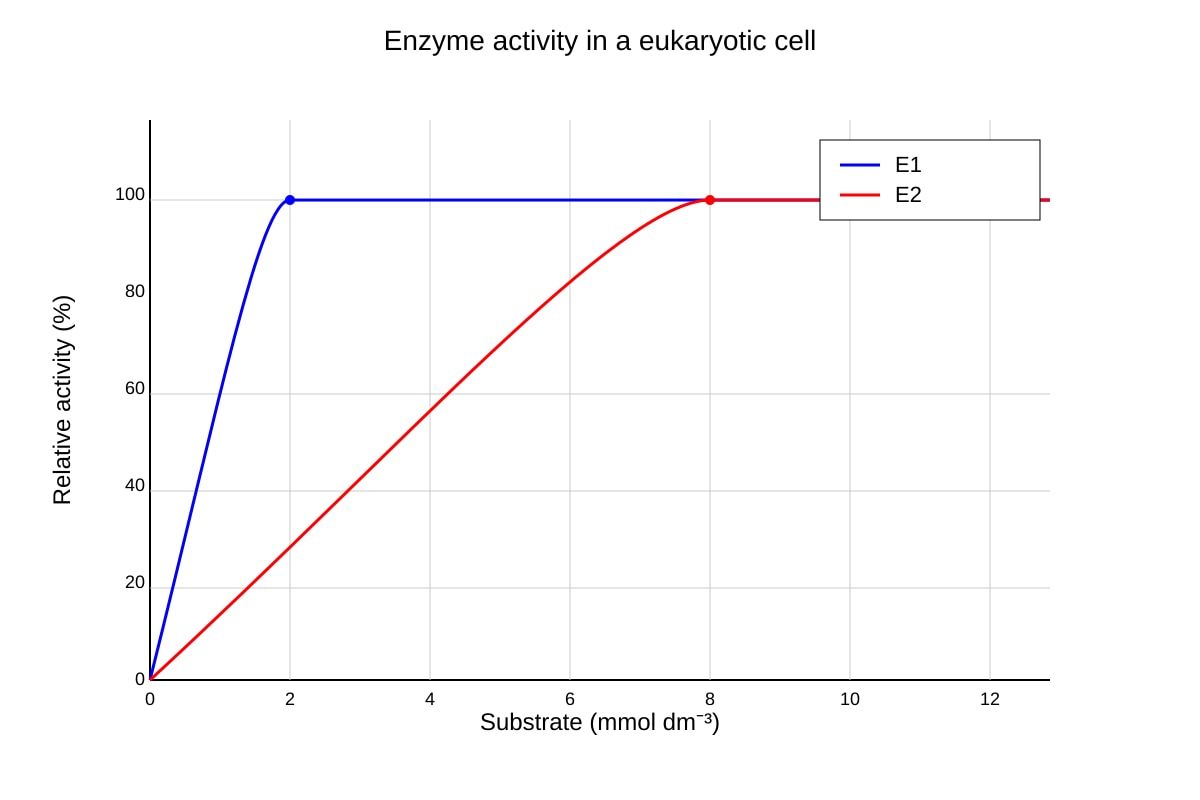
- E1 reaches half-max at lower [substrate] (1).
- Indicates higher affinity / regulated at lower concentration, efficient at low substrate (1).
Image support: Graph shows E1 plateau earlier.
14. [3]
- Cleft shape is complementary to antigen (1).
- Non-covalent interactions (H-bonds, ionic) bind (1).
- Specificity from surface charge/hydrophobic pattern (1).
Teaching note: Immunoglobulin variable region illustrates this.
Section C
15. [5]
- Prions: no cellular structure, no nucleic acid, challenge “all life is cellular” (2).
- Viruses: acellular, require host to reproduce, challenge autonomy (1).
- Conform: both depend on host cells; considered biological agents not independent cells (2).
Descriptors: 5 marks for balanced challenge+conform with examples.
16. [4]
- 4 subunits (2α2β) (1).
- Each binds O₂ at haem (1).
- Cooperativity: binding changes shape, easier next (1).
- Quaternary allows allosteric regulation (1).
17. [3]
- Compartmentalisation (1).
- Allosteric regulation (1).
- Covalent mod (phosphorylation) or gene expression control (1).
18. [3]
- Yeast: unicellular, budding, usually one nucleus (1).
- Filamentous: hyphae, multinucleate (1).
- Life cycle: yeast diploid/haploid switch; fungus spore→mycelium (1).
19. [3]
- Example: cell cycle (CDK) (1).
- Kinase phosphorylates target (1).
- Changes activity/on-off switch (1).
20. [4]
- Model shows proteins mobile in lipid sea (1).
- Receptors cluster for signalling (1).
- Lipids form microdomains (1).
- Explains communication via membrane organisation (1).