AI Generated Quiz
A Level Biology H3 Cells Biomolecules Quiz
Free A Level Biology H3 Cells Biomolecules quiz, AI version, with questions, answers, and A Level-style practice for Singapore students.
These static practice materials are generated from the site's syllabus and paper-generation workflow, with source and model context shown so students and parents can evaluate the material before use.
Questions
Free quiz and exam paper access
Enter your details to view this paper
Your access is remembered on this device.
Answers
A-Level Biology H3 Quiz - Cells Biomolecules: ANSWER KEY
Total Marks: 75
Section A: Multiple-Choice Questions (Questions 1–10, 20 marks)
1. B [2 marks]
- Explanation: Prions are infectious proteins with no nucleic acid. The classical cell theory states that all living things are composed of cells, and that cells are the basic unit of life. A key component of cells is the presence of genetic material (DNA/RNA). Prions challenge this because they are acellular infectious agents that can replicate (by converting normal proteins) without containing any nucleic acid. While option A (acellular and cannot replicate independently) is also a challenge, option B is more fundamental as it directly contradicts the idea that genetic information is stored in nucleic acids. Prions replicate by a conformational change mechanism, not by independent replication.
- Common Mistake: Students may choose A, but the most significant challenge is the lack of nucleic acid, as this was thought to be a universal requirement for biological information.
2. D [2 marks]
- Explanation: Random diffusion of enzymes throughout the cytoplasm would be highly inefficient for regulation. It would lead to slow response times and a lack of spatial control. The other options are all key mechanisms for efficient enzyme regulation in eukaryotic cells:
- A (Compartmentalisation): Isolates enzymes and substrates in specific organelles (e.g., lysosomal enzymes, mitochondrial enzymes), preventing unwanted reactions and allowing for localised control.
- B (Allosteric regulation): Allows for rapid, fine-tuned control of enzyme activity by binding of effectors at sites distinct from the active site.
- C (Covalent modification): Provides a rapid and reversible (or irreversible) way to switch enzymes on or off (e.g., phosphorylation cascades).
- Common Mistake: Students may think all enzymes are freely diffusing, but in reality, many are localised or part of multi-enzyme complexes.
3. C [2 marks]
- Explanation: The current fluid mosaic model is much more complex than the original. A key refinement is the recognition of lipid rafts—microdomains in the membrane enriched in sphingolipids and cholesterol. These rafts are more ordered and less fluid than the surrounding membrane and can concentrate specific proteins, playing a role in cell signalling and membrane trafficking.
- A: Incorrect. The membrane is dynamic, not static.
- B: Incorrect. Proteins are embedded throughout the membrane (integral) and on both surfaces (peripheral).
- D: Incorrect. Many proteins are anchored to the cytoskeleton or to other proteins, restricting their lateral diffusion.
- Common Mistake: Students may think the original model is still the complete picture.
4. B [2 marks]
- Explanation: The strongest evidence is the similarity between the ribosomes of mitochondria/chloroplasts and those of prokaryotes. Both have 70S ribosomes (as opposed to the 80S ribosomes in eukaryotic cytoplasm), and their rRNA sequences are more closely related to bacteria than to the host cell's nuclear DNA. This strongly suggests a prokaryotic origin.
- A: Incorrect. Mitochondria and chloroplasts are surrounded by a double membrane, which is consistent with an engulfing event (the inner membrane from the prokaryote, the outer from the host cell's vesicle).
- C: Incorrect. Not all eukaryotes have chloroplasts (e.g., animals, fungi).
- D: Incorrect. While they do replicate independently, this is also true of many other organelles to some extent. The ribosome evidence is more direct and specific.
- Common Mistake: Students may confuse the double membrane with a single membrane.
5. C [2 marks]
- Explanation: A flexible surface with multiple clefts and pockets of varying shapes and chemical properties allows a protein to bind to diverse ligands. The binding sites can be complementary to different molecular shapes and can utilise different types of chemical interactions (e.g., ionic bonds, hydrogen bonds, van der Waals forces, hydrophobic interactions) depending on the ligand.
- A: Incorrect. A single, deep, rigid cleft would be highly specific for a single type of ligand.
- B: Incorrect. A highly hydrophobic core is important for structural stability, but binding to diverse ligands requires a variety of surface properties.
- D: Incorrect. A primary structure of non-polar amino acids would make the protein insoluble in water and unable to interact with many polar or charged ligands.
- Common Mistake: Students may think binding sites are always rigid and specific.
6. C [2 marks]
- Explanation: Glycosylation is the addition of oligosaccharide (sugar) chains. This modification can confer new capabilities, such as targeting a protein for secretion (as in the case of many secreted proteins and membrane proteins), cell-cell recognition, and protection from proteolysis.
- A: This is an example of proteolytic cleavage.
- B: This is an example of phosphorylation.
- D: This is an example of signal peptide removal (a type of cleavage).
- Common Mistake: Students may confuse the different types of post-translational modifications.
7. B [2 marks]
- Explanation: The cell theory traditionally defines a cell as the basic structural and functional unit of life, typically containing a single nucleus. Coenocytic hyphae challenge this by having a continuous cytoplasm with many nuclei, not separated by cell walls (septa). This blurs the line between a single "cell" and a multinucleate mass.
- A: While true, size alone is not a direct challenge to the definition of a cell.
- C: Incorrect. Fungi are true eukaryotes.
- D: Incorrect. Growth occurs by cell elongation and nuclear division, but the lack of cell division (cytokinesis) is a consequence of the coenocytic condition, not a direct challenge to the definition of a cell.
- Common Mistake: Students may not understand the precise definition of "cell" being challenged.
8. B [2 marks]
- Explanation: The antigen-binding sites of an IgG molecule are formed by the variable (V) regions of both the heavy (H) and light (L) chains. The combination of these variable regions creates a unique three-dimensional shape that is complementary to a specific antigenic epitope.
- A: Incorrect. Each IgG molecule has two identical antigen-binding sites (it is bivalent).
- C: Incorrect. The constant (C) regions are responsible for effector functions (e.g., binding to immune cells, complement activation).
- D: Incorrect. The binding sites are located on the Fab (Fragment, antigen-binding) fragments, not the Fc (Fragment, crystallizable) fragment.
- Common Mistake: Students may confuse the roles of the Fab and Fc fragments.
9. C [2 marks]
- Explanation: Unicellular algae are single-celled organisms. They do not form multicellular embryos. Embryo formation is a characteristic of multicellular organisms, particularly in plants and animals. Unicellular algae reproduce asexually (e.g., binary fission, mitosis) and sexually (e.g., meiosis, formation of gametes).
- A (Mitosis): Used for asexual reproduction and growth.
- B (Meiosis): Used for sexual reproduction to produce gametes or spores.
- D (Binary fission): A common form of asexual reproduction in many unicellular organisms.
- Common Mistake: Students may confuse unicellular algae with multicellular algae (seaweeds).
10. B [2 marks]
- Explanation: In prokaryotic RNA polymerase, the sigma (σ) subunit is a specificity factor that is required for the enzyme to bind to the promoter region of DNA. It recognises and binds to specific consensus sequences in the promoter (e.g., the -10 and -35 boxes), allowing the core enzyme to initiate transcription at the correct site.
- A: The core enzyme (α2ββ'ω) catalyses phosphodiester bond formation.
- C: Prokaryotic RNA polymerase does not have a proofreading function.
- D: Termination is mediated by other factors (e.g., Rho factor) or by intrinsic terminator sequences.
- Common Mistake: Students may think the sigma subunit is part of the catalytic core.
Section B: Short-Answer Questions (Questions 11–15, 25 marks)
11. The development of the fluid mosaic model [5 marks]
(a) Evidence from freeze-fracture electron microscopy: [3 marks]
- Key Idea: Freeze-fracture splits the lipid bilayer, revealing the interior of the membrane.
- Evidence: The technique revealed the presence of small, irregularly shaped particles (intramembrane particles) on the fracture faces. [1 mark]
- Interpretation: These particles were interpreted as being integral membrane proteins that span or are embedded within the lipid bilayer. [1 mark]
- Conclusion: This provided direct visual evidence that proteins are not just on the surface but are an integral part of the membrane structure, supporting the "mosaic" aspect of the model. [1 mark]
(b) Refinement by the concept of lipid rafts: [2 marks]
- Original Model: The original model suggested a homogeneous, uniform fluid lipid bilayer with randomly distributed proteins. [1 mark]
- Refinement: The discovery of lipid rafts showed that the membrane is not homogeneous. Rafts are microdomains enriched in sphingolipids and cholesterol that are more ordered and less fluid. They can concentrate specific proteins, creating functional platforms for processes like cell signalling and membrane trafficking. This adds a layer of spatial and functional organisation to the model. [1 mark]
12. Prions [5 marks]
(a) Molecular mechanism of conversion: [3 marks]
- Normal Form: The normal cellular prion protein (PrP^C) is a harmless protein found on the surface of neurons. It has a high α-helix content. [1 mark]
- Infectious Form: The disease-associated form (PrP^Sc) has a high β-sheet content. [1 mark]
- Conversion: PrP^Sc acts as a template. It binds to PrP^C and induces a conformational change in PrP^C, converting it into the PrP^Sc form. This is a chain reaction, as the newly formed PrP^Sc molecules can then convert more PrP^C. [1 mark]
(b) Acellularity and challenge to cell theory: [2 marks]
- Acellularity: Prions are acellular because they are not cells. They are simply misfolded proteins with no cytoplasm, organelles, or genetic material. They cannot replicate independently; they require host cells to provide the normal PrP^C substrate. [1 mark]
- Challenge: The first tenet of cell theory states that "all living organisms are composed of cells." Prions are infectious agents that can cause disease and "replicate" (by conversion), yet they are not composed of cells. This challenges the idea that a "living" or "infectious" entity must be cellular. [1 mark]
13. Coenocytic hyphae [5 marks]
(a) Definition and origin: [2 marks]
- Definition: "Coenocytic" (or aseptate) refers to a multinucleate condition where a hypha (a filament of a fungus) is not divided into individual cells by cross-walls called septa. The cytoplasm is continuous and contains many nuclei. [1 mark]
- Origin: This condition arises from repeated nuclear division (mitosis) without subsequent cytokinesis (cell division). The nuclei divide, but the cytoplasm does not split, leading to a long, continuous cell with many nuclei. [1 mark]
(b) Challenge to the definition of a cell: [3 marks]
- Traditional Definition: A cell is typically defined as the basic structural and functional unit of an organism, bounded by a plasma membrane and containing a single nucleus. [1 mark]
- Challenge: In a coenocytic hypha, the continuous cytoplasm with many nuclei is not divided into discrete, individual cells. This blurs the boundary of what constitutes a single "cell." [1 mark]
- Implication: It challenges the idea that a cell must be a mononucleate unit. The entire hypha could be considered a single, giant, multinucleate "cell," or it could be considered a multinucleate mass that is not strictly cellular. This shows that the cell theory is a generalisation with exceptions. [1 mark]
14. Haemoglobin [5 marks]
(a) Subunit composition of HbA: [2 marks]
- Adult haemoglobin (HbA) is a tetramer. [1 mark]
- It is composed of two α-globin subunits and two β-globin subunits (α2β2). Each subunit contains a heme group with an iron atom that can bind one oxygen molecule. [1 mark]
(b) Cooperativity in oxygen binding: [3 marks]
- Phenomenon: This is called cooperativity (or positive cooperativity). [1 mark]
- Mechanism: When one oxygen molecule binds to the heme iron of one subunit, it causes a conformational change in that subunit. This change is transmitted to the other subunits, altering their shape and increasing their affinity for oxygen. [1 mark]
- Result: This makes the oxygen-binding curve sigmoidal, allowing haemoglobin to efficiently load oxygen in the lungs (high pO2) and unload it in the tissues (low pO2). [1 mark]
15. Enzyme regulation in eukaryotic cells [5 marks]
(a) Compartmentalisation: [2 marks]
- Compartmentalisation involves enclosing specific sets of enzymes and their substrates within membrane-bound organelles (e.g., lysosomes, mitochondria, peroxisomes). [1 mark]
- This allows for:
- Isolation: Potentially harmful enzymes (e.g., digestive hydrolases in lysosomes) are kept separate from the rest of the cell.
- Optimal Conditions: Different organelles can maintain different pH levels and ionic conditions, optimising the activity of their resident enzymes.
- Localised Control: Substrate concentrations and regulatory signals can be controlled locally within an organelle, allowing for efficient and specific regulation. [1 mark for any one of these points]
(b) Role of protein phosphorylation: [3 marks]
- Process: Protein phosphorylation is the reversible addition of a phosphate group (PO4^3-) to specific amino acid residues (usually serine, threonine, or tyrosine) of a protein. This is catalysed by protein kinases. Dephosphorylation is catalysed by protein phosphatases. [1 mark]
- Mechanism: The addition of a negatively charged phosphate group can cause a significant conformational change in the protein's structure. This can alter the shape of the active site, thereby activating or inactivating the enzyme. [1 mark]
- Advantages: It is a rapid, reversible, and highly regulated mechanism. A single kinase can phosphorylate many target proteins, allowing for signal amplification and coordinated cellular responses. [1 mark]
Section C: Data-Based and Free-Response Questions (Questions 16–20, 30 marks)
16. Protein X binding [6 marks]
(a) Explanation for diverse binding: [4 marks]
- Surface Properties: Protein surfaces are not uniform. They contain a variety of clefts, pockets, and grooves of different shapes, sizes, and chemical properties. [1 mark]
- Chemical Diversity: These surfaces can contain a mix of polar, charged, and hydrophobic amino acid residues. This allows the protein to interact with a wide range of ligands through different types of non-covalent interactions:
- ATP (charged, polar): Could bind to a positively charged cleft via ionic and hydrogen bonds. [1 mark]
- Short peptide (polar, charged, hydrophobic): Could bind in a groove that accommodates the peptide backbone and has pockets for specific side chains. [1 mark]
- Lipid molecule (hydrophobic): Could bind to a hydrophobic pocket or cleft on the protein surface. [1 mark]
- Flexibility: The protein may also have some degree of conformational flexibility, allowing it to adjust its shape to accommodate different ligands (induced fit).
(b) Hypothesis for loss of ATP binding after dephosphorylation: [2 marks]
- Hypothesis: The phosphate group on Protein X is essential for maintaining the structure of the ATP-binding site. [1 mark]
- Explanation: The negatively charged phosphate group may form an ionic bond with a positively charged amino acid (e.g., lysine, arginine) within the binding site, stabilising the correct conformation. Removal of the phosphate group (dephosphorylation) could cause a conformational change that collapses or distorts the ATP-binding cleft, preventing ATP from binding. [1 mark]
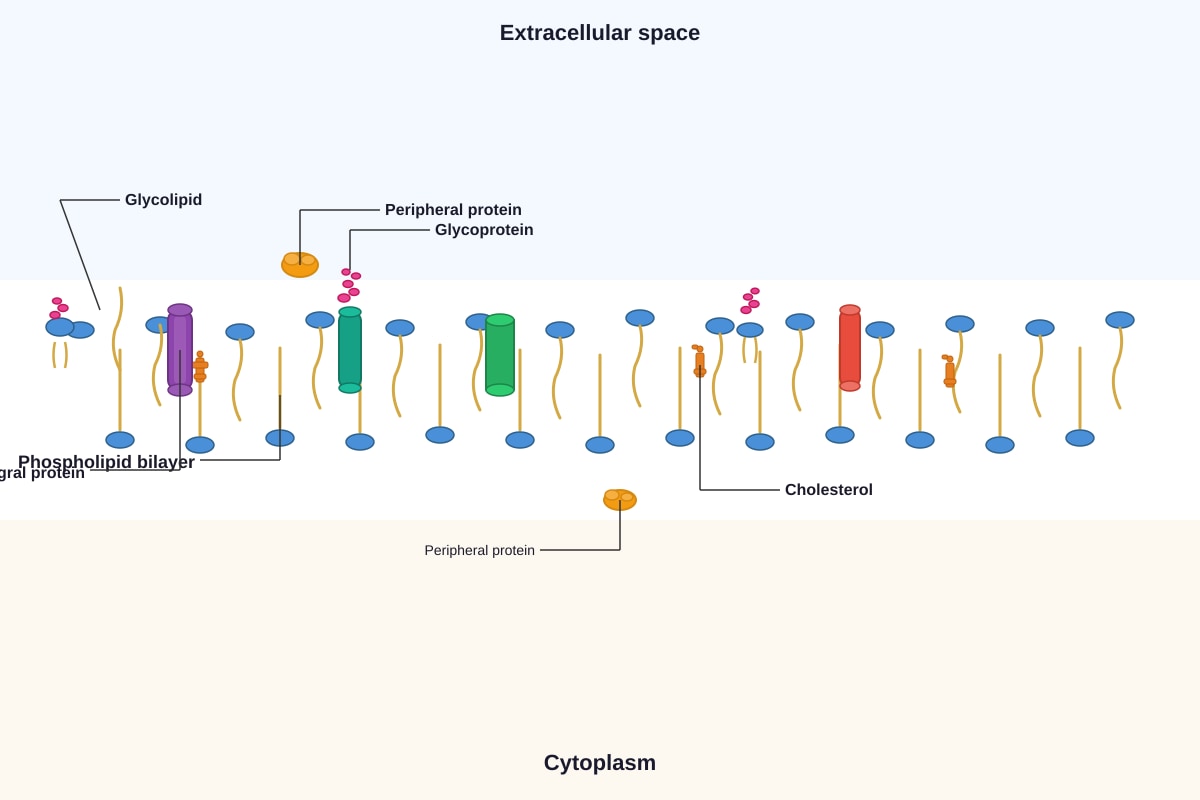
17. Cell membrane diagram [7 marks]
(a) Identification of components: [3 marks]
- A: Glycoprotein (a protein with a carbohydrate chain attached). [1 mark]
- B: Integral membrane protein (a protein that spans the lipid bilayer). [1 mark]
- C: Cholesterol (a lipid molecule embedded in the bilayer). [1 mark]
(b) Role of cholesterol in modulating membrane fluidity: [2 marks]
- At high temperatures: Cholesterol restrains the movement of phospholipid fatty acid tails, reducing fluidity and preventing the membrane from becoming too leaky. [1 mark]
- At low temperatures: Cholesterol prevents the phospholipid tails from packing too closely together, interfering with their crystallisation and thus preventing the membrane from becoming too rigid. It acts as a "fluidity buffer." [1 mark]
(c) Role of carbohydrate chains in cell-cell recognition: [2 marks]
- The carbohydrate chains of glycoproteins and glycolipids extend into the extracellular space, forming the glycocalyx. [1 mark]
- These carbohydrate chains have a huge variety of structures (different monosaccharides, linkages, branching patterns). They act as specific molecular "tags" or "markers" that can be recognised by other cells (e.g., via lectins) or by the extracellular matrix. This is crucial for processes like immune recognition (e.g., blood group antigens), cell adhesion, and cell signalling. [1 mark]
18. Endosymbiotic theory [5 marks]
(a) Three pieces of evidence: [3 marks]
- 1. Double Membrane: Mitochondria and chloroplasts are surrounded by a double membrane, consistent with an engulfing event (inner membrane from the prokaryote, outer from the host cell's vesicle). [1 mark]
- 2. Own DNA: They contain their own circular DNA, which is similar in structure to prokaryotic DNA (no histones, circular). [1 mark]
- 3. Own Ribosomes: They have their own 70S ribosomes (like prokaryotes), which are smaller than the 80S ribosomes in the eukaryotic cytoplasm. [1 mark]
- (Other acceptable evidence: They replicate independently by binary fission; their rRNA sequences are more closely related to bacteria than to the host cell's nuclear DNA.)
(b) Challenge to "all cells arise from pre-existing cells": [2 marks]
- The endosymbiotic theory proposes that mitochondria and chloroplasts originated from free-living prokaryotes that were engulfed by a host cell. [1 mark]
- This means that these organelles did not arise from pre-existing eukaryotic cells. They originated from a separate, independent lineage of cells. This challenges the idea that all cellular components can trace their lineage back through a single line of cell division. It introduces the concept of a merging of two distinct cell lineages. [1 mark]
19. Yeast life cycle [6 marks]
(a) Budding in yeast vs. binary fission in bacteria: [3 marks]
- Budding: A small outgrowth (bud) forms on the parent cell. The nucleus undergoes mitosis, and one daughter nucleus migrates into the bud. The bud grows and eventually separates from the parent cell, which may be smaller than the parent. [1 mark]
- Binary Fission: The bacterial cell replicates its DNA, elongates, and then divides into two equal-sized daughter cells through the formation of a septum. [1 mark]
- Key Difference: Budding is an asymmetric form of division (unequal size), while binary fission is a symmetric form of division (equal size). [1 mark]
(b) Sexual reproduction in yeast: [3 marks]
- Mating Types: Yeast has two mating types, a and α. Cells of opposite mating types can fuse (conjugate). [1 mark]
- Fusion: The fusion of an a cell and an α cell results in the formation of a diploid a/α cell. [1 mark]
- Ascospore Formation: Under nutrient-deprived conditions, the diploid cell undergoes meiosis, producing four haploid nuclei. These nuclei are packaged into spores called ascospores within a structure called an ascus. When conditions improve, the ascospores germinate to release haploid yeast cells. [1 mark]
20. Necessity of cell differentiation [6 marks]
Justification:
- Definition: Cell differentiation is the process by which a less specialised cell becomes a more specialised cell type, expressing a specific set of genes and acquiring a specific structure and function. [1 mark]
- Problem with Undifferentiated Cells: A multicellular organism composed of identical, undifferentiated cells would face severe limitations:
- Lack of Specialisation: All cells would perform the same basic functions. There would be no cells specialised for nutrient absorption, gas exchange, defence, movement, signal transmission, or reproduction. [1 mark]
- Inefficiency: The organism would be extremely inefficient. For example, without specialised cells for nutrient uptake, every cell would have to be in direct contact with the environment. This would severely limit the size and complexity of the organism. [1 mark]
- No Division of Labour: The organism could not perform complex, integrated functions. There would be no tissues, organs, or organ systems. For example, there would be no nervous system for rapid communication, no circulatory system for transport, and no muscle cells for movement. [1 mark]
- Vulnerability: The organism would be highly vulnerable. Without specialised immune cells, it would have no defence against pathogens. Without a protective outer layer (e.g., skin, epidermis), it would be susceptible to physical damage and desiccation. [1 mark]
- Conclusion: Cell differentiation allows for a division of labour, where different cell types become highly efficient at specific tasks. This enables the development of complex, large, and adaptable multicellular organisms that can survive in a wide range of environments. It is a fundamental requirement for the evolution of complex life. [1 mark]
Marking Scheme:
- 1 mark for a clear definition of cell differentiation.
- 4 marks for a well-reasoned explanation of the limitations of an undifferentiated organism (at least 2-3 distinct limitations, each explained).
- 1 mark for a concluding statement linking differentiation to the evolution of complex life.