AI Generated Quiz
A Level Biology H3 Cells Biomolecules Quiz
Free A Level Biology H3 Cells Biomolecules quiz, AI version, with questions, answers, and A Level-style practice for Singapore students.
These static practice materials are generated from the site's syllabus and paper-generation workflow, with source and model context shown so students and parents can evaluate the material before use.
Questions
Free quiz and exam paper access
Enter your details to view this paper
Your access is remembered on this device.
Answers
A-Level Biology H3 Quiz - Cells Biomolecules - Answer Key
Total Marks: 50
Section A: Multiple-Choice Questions (Questions 1–10, 20 marks)
1. C) The acellular nature of viruses and prions
- Explanation: The classical cell theory states that all living organisms are composed of cells. Prions (infectious proteins) and viruses are acellular—they are not made of cells and cannot carry out life processes independently. This directly challenges the first tenet of the cell theory. Options A and B are features of cells that support the theory, and D is a process that occurs within cells.
- Marks: 1 mark for correct answer.
2. B) The membrane is a fluid structure where lipids and proteins can diffuse laterally, and the bilayer is asymmetric.
- Explanation: The current fluid mosaic model emphasises the dynamic nature of the membrane. Lipids and proteins can move laterally within the bilayer. The bilayer is also asymmetric, meaning the two leaflets have different lipid and protein compositions. Option A is incorrect because the membrane is not static. Option C is incorrect; it's a bilayer. Option D is incorrect; proteins can be found on both surfaces and spanning the membrane.
- Marks: 1 mark for correct answer.
3. B) A misfolded protein that can induce normal proteins to adopt the same misfolded conformation.
- Explanation: Prions are infectious agents composed entirely of protein. They are misfolded versions of a normal cellular protein (PrP^C). The misfolded prion (PrP^Sc) can convert normal PrP^C into the misfolded form, leading to a chain reaction that causes disease. Option A describes a ribozyme. Option C is incorrect; prions are not viruses. Option D is incorrect; they are not bacteria.
- Marks: 1 mark for correct answer.
4. C) The hyphae lack septa and contain many nuclei within a continuous cytoplasm.
- Explanation: "Multinucleate" means having many nuclei. In filamentous fungi like Rhizopus, the hyphae are coenocytic, meaning they lack cross-walls (septa). This results in a continuous cytoplasmic mass (syncytium) containing many nuclei. This challenges the idea that a cell is a single, membrane-bound unit with one nucleus. Option A is incorrect. Option B describes septate hyphae. Option D is incorrect.
- Marks: 1 mark for correct answer.
5. B) Mitochondria and chloroplasts have their own circular DNA and ribosomes similar to those of bacteria.
- Explanation: The endosymbiotic theory proposes that mitochondria and chloroplasts were once free-living bacteria that were engulfed by a host cell. The strongest evidence is that they possess their own circular DNA (like bacterial chromosomes) and 70S ribosomes (like bacterial ribosomes), which are distinct from the host cell's linear DNA and 80S ribosomes. Option A is incorrect; they have a double membrane. Option C is incorrect; not all eukaryotes have chloroplasts. Option D is incorrect; their genomes are separate.
- Marks: 1 mark for correct answer.
6. C) To alter protein folding, stability, and cell-cell recognition.
- Explanation: Glycosylation is the enzymatic addition of carbohydrate groups (glycans) to proteins. This modification can affect protein folding, increase stability, and play a crucial role in cell-cell recognition and signalling (e.g., blood group antigens). Option A describes proteolytic cleavage. Option B is often a function of ubiquitination. Option D describes phosphorylation.
- Marks: 1 mark for correct answer.
7. C) The unique shape and chemical properties of the antigen-binding site (paratope).
- Explanation: The specificity of an antibody is determined by the variable region, specifically the antigen-binding site (paratope). This site has a unique three-dimensional shape and a specific arrangement of amino acid side chains (chemical properties) that allow it to bind to a complementary epitope on the antigen with high affinity. Option A is too general. Option B is incorrect; the variable region is hypervariable. Option D is incorrect; binding is specific, not a general shape change.
- Marks: 1 mark for correct answer.
8. C) Allosteric regulation by small molecule effectors.
- Explanation: Allosteric regulation involves the binding of an effector molecule at a site distinct from the active site, causing a conformational change that alters enzyme activity. This is rapid (milliseconds to seconds) and reversible, making it ideal for fine-tuning metabolic pathways in response to immediate cellular needs. Option A (transcription) is slower. Option D (degradation) is irreversible. Option B (compartmentalisation) is a longer-term strategy.
- Marks: 1 mark for correct answer.
9. C) Haemoglobin is a tetramer composed of two α-globin and two β-globin subunits.
- Explanation: Haemoglobin is a classic example of a protein with quaternary structure. It is a tetramer consisting of four polypeptide subunits: two α-globin chains and two β-globin chains. Each subunit contains a heme group that binds oxygen. The interaction between subunits allows for cooperative oxygen binding. Option A is incorrect. Option B is incorrect; it's a tetramer. Option D is incorrect; it has quaternary structure.
- Marks: 1 mark for correct answer.
10. C) All living organisms are composed of one or more cells.
- Explanation: Prions are infectious proteins that lack any cellular structure. They are not composed of cells, nor do they contain any of the organelles or metabolic machinery found in cells. Therefore, their existence directly violates the fundamental tenet of cell theory that all life is cellular. Options A, B, and D are not directly violated by prions in the same way.
- Marks: 1 mark for correct answer.
Section B: Short-Answer Questions (Questions 11–15, 15 marks)
11. Explain how the multinucleate condition of filamentous fungi challenges the classical cell theory. In your answer, describe the structure of the fungal hyphae.
- Answer:
- The classical cell theory states that a cell is a fundamental unit of life, typically defined as a membrane-bound structure containing a single nucleus. (1 mark)
- Filamentous fungi (e.g., Rhizopus) have hyphae that are coenocytic, meaning they lack septa (cross-walls). (1 mark)
- This results in a continuous, multinucleate cytoplasmic mass (a syncytium) where many nuclei are present within a single, continuous cell membrane. This challenges the idea that a cell is a discrete, uninucleate unit. (1 mark)
- Teaching Note: The key is to link the definition of a cell (one nucleus, membrane-bound) to the fungal structure (many nuclei, one continuous membrane). The term "coenocytic" is important.
12. Describe how the endosymbiotic theory accounts for the origin of mitochondria. Provide two pieces of evidence that support this theory.
- Answer:
- Theory: The endosymbiotic theory proposes that mitochondria originated from a free-living aerobic bacterium that was engulfed by a primitive ancestral eukaryotic cell. Instead of being digested, the bacterium formed a symbiotic relationship with the host cell, eventually becoming an organelle. (1 mark)
- Evidence 1: Mitochondria have their own circular DNA, which is similar in structure to bacterial chromosomes, unlike the linear DNA found in the eukaryotic nucleus. (1 mark)
- Evidence 2: Mitochondria have their own 70S ribosomes (like bacteria), which are smaller than the 80S ribosomes found in the eukaryotic cytoplasm. (1 mark)
- Additional evidence (can be used for either point): Mitochondria are surrounded by a double membrane; the inner membrane is derived from the bacterium's plasma membrane, and the outer membrane is derived from the host cell's vesicle. (1 mark)
- Teaching Note: Students should be able to clearly state the theory and then provide specific, factual evidence. The double membrane is a key piece of structural evidence.
13. A researcher is studying a novel protein that is synthesised in the cytoplasm. After translation, the protein is modified by the addition of a carbohydrate group (glycosylation). Explain how this modification could confer a new capability to the protein, using a specific example.
- Answer:
- Glycosylation can alter the protein's folding, stability, and surface properties. (1 mark)
- Specific example: The addition of carbohydrate chains can create a glycoprotein that acts as a cell surface receptor for cell-cell recognition. For example, the glycoproteins on the surface of red blood cells determine blood type (A, B, O). (1 mark)
- New capability: Without glycosylation, the protein might not be able to fold correctly or be transported to the cell surface. The carbohydrate groups provide a new "code" for recognition by other cells or molecules, enabling processes like immune recognition and cell adhesion. (1 mark)
- Teaching Note: The answer must link the modification (glycosylation) to a specific new function (e.g., cell recognition, stability, signalling). A concrete example like blood groups or MHC molecules is excellent.
14. The binding site of an enzyme is a type of protein cleft. Explain why the shape and chemical properties of this cleft are critical for the enzyme's function, with reference to the "lock and key" or "induced fit" model.
- Answer:
- The shape of the cleft (active site) is complementary to the shape of the substrate. This allows for specific binding, as described by the "lock and key" model. (1 mark)
- The chemical properties (e.g., presence of charged, polar, or hydrophobic amino acid side chains) within the cleft determine which substrate can bind and how it is held. (1 mark)
- In the "induced fit" model, the binding of the substrate induces a conformational change in the enzyme, which further optimises the shape of the cleft for catalysis. This precise fit is essential for lowering the activation energy of the reaction. (1 mark)
- Teaching Note: Students should connect the physical (shape) and chemical (properties) aspects of the active site to the concept of specificity and catalysis.
15. A eukaryotic cell needs to regulate the activity of thousands of enzymes. Describe two distinct mechanisms, other than allosteric regulation, that a cell uses to achieve this efficiently.
- Answer:
- Mechanism 1: Compartmentalisation. Enzymes and their substrates are confined to specific organelles (e.g., lysosomal enzymes are separated from the cytosol; enzymes of the Krebs cycle are in the mitochondrial matrix). This prevents unwanted reactions and creates optimal microenvironments. (1 mark)
- Mechanism 2: Covalent modification (e.g., phosphorylation). Enzymes can be rapidly and reversibly activated or deactivated by the addition or removal of a phosphate group. This is a common mechanism in signal transduction pathways. (1 mark)
- Other acceptable mechanisms: Control of enzyme synthesis (gene expression), proteolytic activation (zymogens), or feedback inhibition (though this is a form of allosteric regulation, it's best to avoid it).
- Teaching Note: The question explicitly says "other than allosteric regulation." Students must provide two distinct mechanisms. Compartmentalisation and covalent modification are excellent examples.
Section C: Structured and Free-Response Questions (Questions 16–20, 15 marks)
16. The diagram below shows a simplified representation of a cell membrane according to the fluid mosaic model.
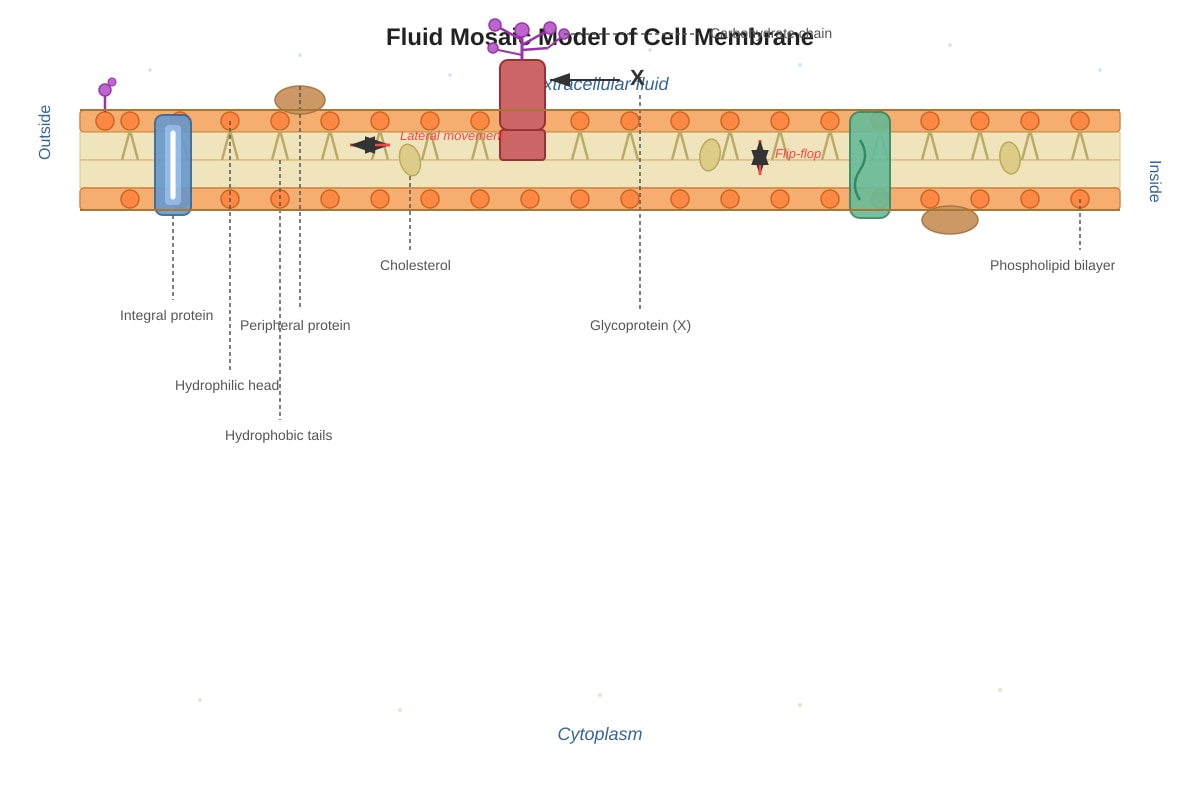
Generated diagram for this question.
(a) Identify the component labelled X (the structure with carbohydrate chains) and state its function in cell recognition.
- Answer:
- Component X: Glycoprotein. (1 mark)
- Function: The carbohydrate chains (glycans) of glycoproteins extend into the extracellular space and act as recognition sites. They are involved in cell-cell adhesion, immune recognition (e.g., as antigens), and cell signalling. (1 mark)
- Teaching Note: Students must correctly identify the structure and then give a specific function related to recognition.
(b) Explain how the term "fluid" in the fluid mosaic model relates to the movement of components within the membrane.
- Answer:
- The term "fluid" refers to the ability of phospholipids and proteins to diffuse laterally within the plane of the membrane. (1 mark)
- This lateral movement is possible because the membrane is not a rigid, static structure. The hydrophobic tails of the phospholipids are in constant motion, creating a fluid environment. This fluidity is essential for processes like membrane fusion, endocytosis, and the movement of membrane proteins to different parts of the cell. (1 mark)
- Teaching Note: The answer should focus on lateral diffusion and the dynamic nature of the membrane.
17. Discuss how the existence of prions challenges the classical cell theory. In your answer, describe the nature of a prion and explain why it is considered a "biological anomaly".
- Answer:
- Nature of a prion: A prion is an infectious agent composed entirely of a misfolded protein. It has no nucleic acid (DNA or RNA). (1 mark)
- Challenge to cell theory: The classical cell theory states that all living organisms are composed of cells. Prions are acellular—they are not cells and do not arise from cells in the same way. They are simply misfolded proteins that can replicate by converting normal proteins. (1 mark)
- Biological anomaly: Prions are considered an anomaly because they violate the central dogma of molecular biology (information flows from DNA to RNA to protein). They are a protein-only infectious agent that can "replicate" without a genome, challenging our fundamental understanding of what constitutes a "living" entity. (1 mark)
- Teaching Note: The discussion should cover the definition of a prion, how it violates cell theory (acellularity), and why it's a conceptual anomaly (protein-only replication).
18. Compare and contrast the mechanisms by which a eukaryotic cell regulates the activity of a metabolic enzyme (e.g., phosphofructokinase) through allosteric regulation and covalent modification (e.g., phosphorylation). In your answer, explain the advantage of each mechanism for the cell.
- Answer:
- Allosteric Regulation:
- Mechanism: A small molecule (effector) binds non-covalently to a site distinct from the active site, causing a conformational change that alters enzyme activity. (1 mark)
- Advantage: It is rapid and reversible, allowing for fine-tuning of metabolic pathways in response to immediate changes in metabolite concentrations (e.g., feedback inhibition). (1 mark)
- Covalent Modification (Phosphorylation):
- Mechanism: A phosphate group is covalently attached to (or removed from) specific amino acid residues (e.g., serine, threonine) by a kinase (or phosphatase), altering the enzyme's activity. (1 mark)
- Advantage: It allows for a more stable and amplified response, often triggered by hormonal or extracellular signals. It can also integrate signals from multiple pathways. (1 mark)
- Allosteric Regulation:
- Teaching Note: A good answer will have a clear comparison (both regulate activity, both are reversible) and a clear contrast (non-covalent vs. covalent, speed, type of signal). The advantages must be specific to each mechanism.
19. The diagram below shows the structure of an immunoglobulin G (IgG) antibody.
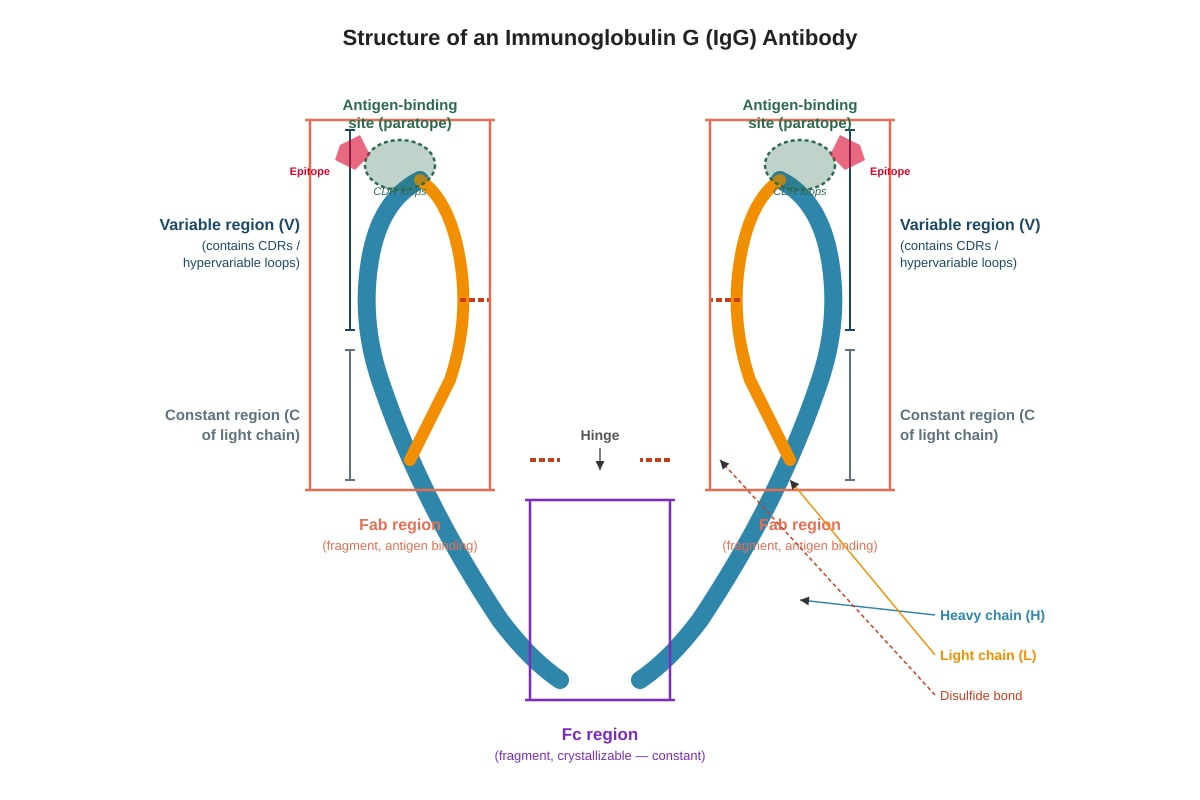
Generated diagram for this question.
(a) Identify the region of the antibody that is responsible for binding to an antigen. Explain how the structure of this region allows for the recognition of a vast diversity of antigens.
- Answer:
- Region: The variable region (Fab region), specifically the antigen-binding site (paratope) at the tips of the Y. (1 mark)
- Explanation: The variable region contains hypervariable loops (complementarity-determining regions, CDRs). The amino acid sequence in these loops is highly diverse, creating a vast library of different binding site shapes and chemical properties. This allows different antibodies to bind to a huge variety of different antigen shapes (epitopes). (1 mark)
- Teaching Note: The key is to link the structural diversity of the variable region (hypervariable loops) to the functional diversity of antigen recognition.
(b) State one function of the constant region (Fc) of the antibody.
- Answer: The constant region (Fc) is responsible for binding to immune cells (e.g., macrophages, NK cells) or complement proteins, triggering effector functions like opsonisation, antibody-dependent cell-mediated cytotoxicity (ADCC), or complement activation. (1 mark)
- Teaching Note: Any one specific effector function is acceptable.
20. The endosymbiotic theory is a cornerstone of modern cell biology. Evaluate the extent to which the endosymbiotic theory conforms to, or challenges, the classical cell theory. In your answer, refer to the origin of mitochondria and chloroplasts.
- Answer:
- Conforms to cell theory: The endosymbiotic theory describes the origin of organelles from once-independent cells. This process is consistent with the idea that cells arise from pre-existing cells (the engulfed bacterium was a cell). The resulting eukaryotic cell is still composed of cells (the host cell and its organelles). (1 mark)
- Challenges cell theory: The theory challenges the idea that all parts of a cell are derived solely from the host cell's genetic material. Mitochondria and chloroplasts have their own DNA and ribosomes, suggesting they were once independent organisms. This blurs the line between a "cell" and an "organelle." (1 mark)
- Evaluation: The endosymbiotic theory is a modification and extension of cell theory, not a complete refutation. It explains how the complexity of eukaryotic cells arose while still adhering to the principle of continuity (cells from cells). It shows that cell theory is a dynamic framework that can accommodate new discoveries. (1 mark)
- Conclusion: The theory conforms to the core principle of biogenesis but challenges the idea of a cell as a single, genetically homogeneous unit. It demonstrates that the evolution of cellular complexity can involve the integration of multiple cellular entities. (1 mark)
- Teaching Note: This is an evaluation question. Students must present both sides (conforms and challenges) and then provide a balanced judgment. The best answers will show an understanding that scientific theories are refined, not simply proven or disproven.
End of Answer Key