AI Generated Quiz
A Level H2 Biology Plant Biology Quiz
Free A Level H2 Biology Plant Biology quiz, LongCat AI version, with questions, answers, and A Level-style practice for Singapore students.
These static practice materials are generated from the site's syllabus and paper-generation workflow, with source and model context shown so students and parents can evaluate the material before use.
Questions

Free quiz and exam paper access
Enter your details to view this paper
Your access is remembered on this device.
Answers
A-Level Biology H2 Quiz - Plant Biology
Answer Key and Marking Scheme
Section A: Multiple Choice Questions (10 marks)
1. B [1]
Explanation: RuBisCO (ribulose bisphosphate carboxylase/oxygenase) catalyses the fixation of to ribulose bisphosphate (RuBP, a 5-carbon compound) to form two molecules of glycerate-3-phosphate (GP, a 3-carbon compound). This is the first step of the Calvin cycle. Option A describes the reduction step (catalysed by enzymes using ATP and NADPH, not RuBisCO). Option C describes the regeneration phase. Option D describes photolysis in Photosystem II.
Common mistake: Students often confuse the role of RuBisCO with the reduction of GP to triose phosphate, which requires ATP and NADPH.
2. B [1]
Explanation: In C4 plants, the initial fixation of is catalysed by PEP carboxylase (phosphoenolpyruvate carboxylase) in the mesophyll cells. PEP carboxylase combines with phosphoenolpyruvate (PEP, a 3-carbon compound) to form oxaloacetate (a 4-carbon compound, hence "C4"). RuBisCO (Option A) operates later in the bundle sheath cells. ATP synthase (C) and NADP reductase (D) are involved in the light-dependent reactions, not carbon fixation.
3. B [1]
Explanation: The lamella (leaf blade) is orientated perpendicular to the surface of the leaf so that the palisade mesophyll cells, which contain the highest density of chloroplasts, are positioned to receive maximum light. This orientation maximises light absorption for photosynthesis. While gas exchange (Option A) occurs through stomata, the lamella orientation is primarily for light capture. Option C relates to the waxy cuticle and stomatal regulation. Option D is not the primary reason.
4. B [1]
Explanation: The proton gradient is generated by (i) the photolysis of water, which releases ions into the thylakoid lumen, and (ii) the electron transport chain, where energy from excited electrons is used to actively pump from the stroma into the thylakoid lumen. This creates a high concentration in the lumen relative to the stroma, driving chemiosmosis through ATP synthase. Option A relates to the Calvin cycle. Option C consumes protons in the stroma. Option D is the reverse of what occurs.
5. C [1]
Explanation: A controlled variable is one that is kept constant to ensure a fair test. Temperature must be kept constant because it affects enzyme activity and thus the rate of photosynthesis. Light intensity (A) is the independent variable. Number of oxygen bubbles (B) and rate of photosynthesis (D) are the dependent variables.
6. B [1]
Explanation: The Casparian strip is a band of suberin (a waxy, waterproof substance) in the cell walls of endodermal cells. It blocks the apoplastic pathway (movement through cell walls and intercellular spaces), forcing water and dissolved minerals to pass through the selectively permeable plasma membrane and cytoplasm of endodermal cells. This allows the plant to control which ions enter the stele and xylem. Option A describes active transport, which occurs but is not the function of the Casparian strip itself. Option C describes root hairs. Option D describes the role of lignified xylem.
7. B [1]
Explanation: Companion cells are metabolically active cells closely associated with sieve tube elements. They actively load sucrose into sieve tube elements via proton-sucrose co-transport (using gradients generated by proton pumps in companion cell membranes). This creates a high solute concentration at the source, lowering water potential and drawing in water from the xylem by osmosis, generating turgor pressure for mass flow. Option A is incorrect as companion cells are not primarily structural. Option C describes storage parenchyma. Option D describes mesophyll cells.
8. B [1]
Explanation: Xylem vessels are dead, hollow cells (having lost their cytoplasm and organelles at maturity) with no end walls, forming continuous tubes. Their walls are impregnated with lignin, which provides structural support and prevents collapse under the tension created by transpiration pull. Option A describes sieve tube elements (phloem). Option C describes living cells with plasmodesmata. Option D is incorrect because xylem walls are lignified, not unlignified.
9. A [1]
Explanation: Only the green parts of the leaf contain chlorophyll and can carry out photosynthesis to produce starch. The white parts lack chlorophyll and cannot photosynthesise. Starch is not transported from green to white parts in significant quantities during a 6-hour experiment. Therefore, only the green parts will turn blue-black with iodine solution.
10. B [1]
Explanation: ATP and NADPH produced in the light-dependent reactions are used in the Calvin cycle (light-independent reactions). Specifically, ATP provides energy and NADPH provides reducing power (electrons and hydrogen ions) for the reduction of glycerate-3-phosphate (GP) to triose phosphate (TP). Option A describes photolysis, which produces ATP and NADPH, not uses them. Option C describes the regeneration of RuBP, which uses ATP but not NADPH. Option D describes the fixation of by RuBisCO, which does not directly require ATP or NADPH.
Section B: Structured Questions (25 marks)
11.
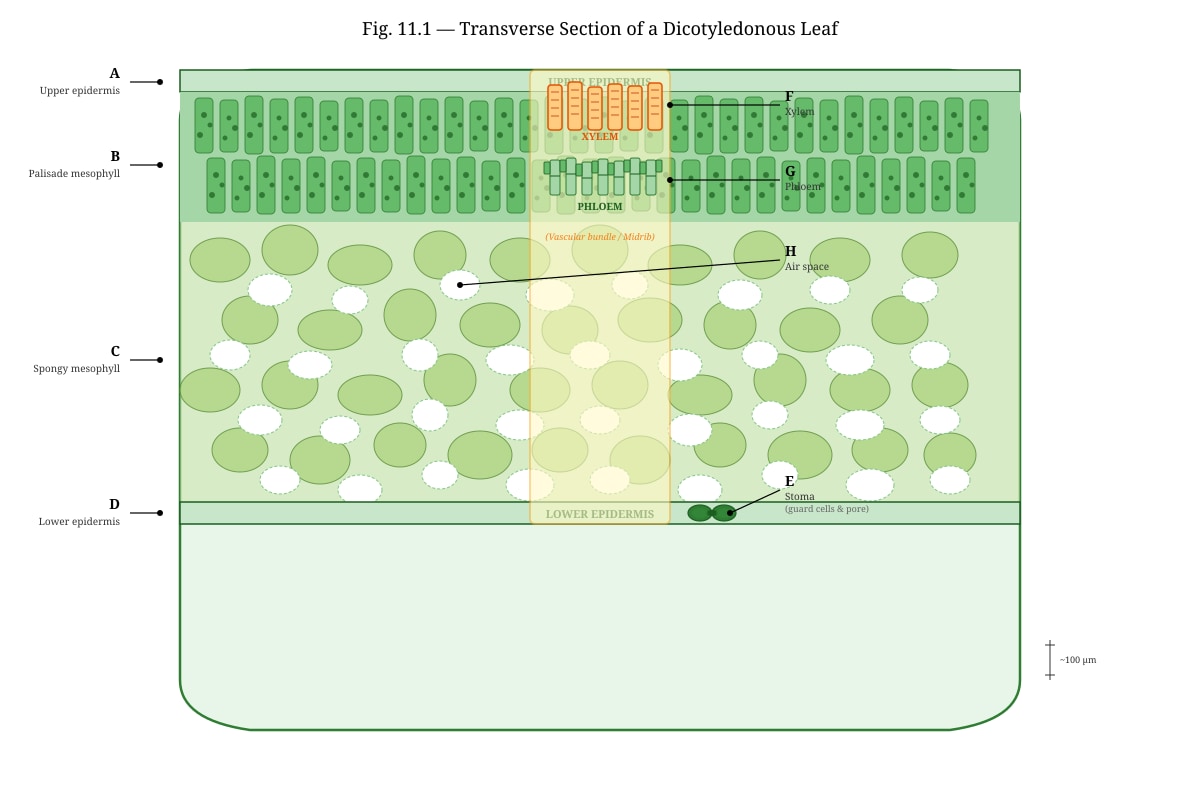
(a) B [1] – The palisade mesophyll contains the highest density of chloroplasts and is positioned near the upper surface to receive maximum light. [1]
Marking: 1 mark for correct letter (B); 1 mark for explanation linking high chloroplast density and/or light absorption to photosynthesis.
Common mistake: Students may label the spongy mesophyll (C), which does carry out photosynthesis but at a lower rate due to fewer chloroplasts and less light penetration.
(b) The palisade mesophyll is adapted for photosynthesis in the following ways: [3]
- The cells are elongated and tightly packed, providing a large surface area for light absorption. [1]
- They contain a high density of chloroplasts, which contain the photosynthetic pigments (chlorophyll and carotenoids) needed to absorb light energy. [1]
- They are located near the upper surface of the leaf, where light intensity is greatest, maximising light capture. [1]
Marking: 1 mark each for any three valid adaptations.
Common mistake: Students may describe the function without linking it to the structure (e.g., saying "it carries out photosynthesis" without explaining how the structure enables this).
(c) The stoma (E) plays the following roles: [3]
- In photosynthesis: The stoma allows carbon dioxide () from the atmosphere to diffuse into the leaf air spaces and then into the mesophyll cells, where it is used as a substrate in the Calvin cycle. [1]
- In transpiration: The stoma allows water vapour to diffuse out of the leaf (transpiration), which creates a transpiration pull that draws water up through the xylem from the roots. [1]
- Guard cells regulate the aperture of the stoma by changing turgor, balancing the need for uptake with the need to minimise water loss. [1]
Marking: 1 mark for entry for photosynthesis; 1 mark for water vapour loss / transpiration pull; 1 mark for guard cell regulation.
Common mistake: Students may only describe one function (e.g., only gas exchange for photosynthesis) without mentioning transpiration.
12.
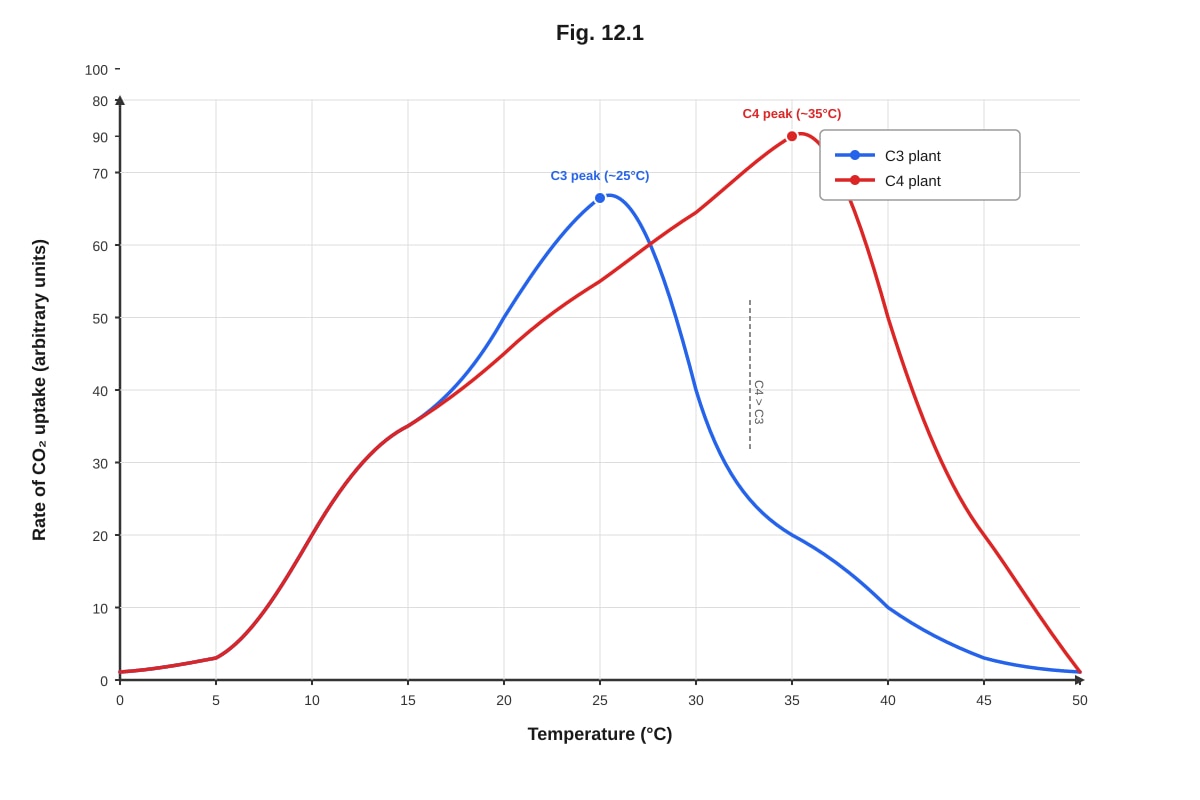
(a) As temperature increases from 10 °C to 25 °C, the rate of uptake in the C3 plant increases from approximately 20 to 85 arbitrary units. [1] This is because increasing temperature increases the kinetic energy of molecules, increasing the rate of enzyme-catalysed reactions in the Calvin cycle (e.g., RuBisCO activity). [1]
Marking: 1 mark for describing the trend (increase); 1 mark for explanation in terms of kinetic energy / enzyme activity.
(b) Above 25 °C, the rate of uptake decreases because: [3]
- High temperatures cause enzymes involved in photosynthesis (e.g., RuBisCO, other Calvin cycle enzymes) to denature, reducing their catalytic efficiency. [1]
- At higher temperatures, the oxygenase activity of RuBisCO increases relative to its carboxylase activity, leading to photorespiration, which consumes and releases , reducing net uptake. [1]
- Stomata may close at high temperatures to reduce water loss, limiting entry into the leaf. [1]
Marking: 1 mark each for any three valid points.
Common mistake: Students may only mention enzyme denaturation without considering photorespiration or stomatal closure.
(c) The C4 plant has a higher optimum temperature (~35 °C) than the C3 plant (~25 °C) because: [4]
- C4 plants use PEP carboxylase to initially fix in mesophyll cells. PEP carboxylase has a high affinity for and does not catalyse photorespiration (unlike RuBisCO). [1]
- The C4 pathway concentrates in bundle sheath cells, maintaining a high : ratio around RuBisCO, which suppresses photorespiration even at higher temperatures. [1]
- In C3 plants, as temperature rises, the solubility of decreases relative to , and RuBisCO's oxygenase activity increases, leading to greater photorespiration and reduced net fixation. [1]
- C4 plants are therefore better adapted to hot environments, and their photosynthetic enzymes may also have higher thermal stability. [1]
Marking: 1 mark for PEP carboxylase having no oxygenase activity; 1 mark for concentration mechanism suppressing photorespiration; 1 mark for explaining why C3 plants suffer at high temperatures (photorespiration); 1 mark for thermal stability / adaptation to hot environments.
Common mistake: Students may describe the C4 pathway without explaining why it confers a higher temperature optimum.
13.
(a) As concentration increases from 0 to 200 mmol dm⁻³, the percentage of open stomata increases from 12% to 93%. [1] The relationship is positive but non-linear: the rate of increase is greatest between 0 and 50 mmol dm⁻³, and the curve plateaus above 100 mmol dm⁻³. [1]
Marking: 1 mark for describing the positive trend; 1 mark for noting the non-linear / plateau nature.
(b) The mechanism of stomatal opening in response to : [4]
- ions are actively taken up into guard cells from neighbouring epidermal cells via channels and proton pumps (H⁺-ATPases). [1]
- The accumulation of (along with accompanying anions such as and malate²⁻) lowers the water potential inside the guard cells. [1]
- Water enters the guard cells by osmosis from neighbouring cells, increasing the turgor pressure of the guard cells. [1]
- The guard cells have unevenly thickened cell walls (thicker on the inner wall facing the pore). As they become turgid, the thinner outer walls expand more, causing the guard cells to curve apart and the stomatal pore to open. [1]
Marking: 1 mark each for the four key steps.
Common mistake: Students may describe osmosis without explaining the role of in lowering water potential, or may not mention the differential wall thickness of guard cells.
(c) At 100 mmol dm⁻³, the guard cells are already near maximum turgor, so further increasing concentration has little additional effect. The system has reached saturation / maximum stomatal aperture. [1]
Marking: 1 mark for the concept of saturation or maximum turgor.
14.
(a) The Casparian strip (C) is a band of suberin in the radial and transverse walls of endodermal cells. It blocks the apoplastic pathway, preventing water and dissolved ions from passing freely through the cell walls into the stele. [1] This forces water and solutes to pass through the selectively permeable plasma membrane and cytoplasm of endodermal cells. [1] This allows the plant to selectively control which ions enter the xylem via active transport and membrane transport proteins, preventing harmful substances from entering the transpiration stream. [1]
Marking: 1 mark for blocking apoplastic pathway; 1 mark for forcing passage through selectively permeable membrane; 1 mark for selective control of ion entry.
(b) Water moves from the root xylem to the leaf mesophyll cells via the transpiration stream: [4]
- Transpiration (evaporation of water from mesophyll cell surfaces into air spaces and diffusion out through stomata) removes water from the leaf mesophyll cells. [1]
- This increases the solute concentration in mesophyll cells, lowering their water potential (). [1]
- Water moves by osmosis from the xylem in the leaf veins (higher ) into the mesophyll cells (lower ) along a water potential gradient. [1]
- This creates a tension (negative pressure) in the xylem that is transmitted down through the continuous column of water in the xylem vessels (cohesion-tension theory), drawing water up from the roots. Water enters the root xylem from the soil along a water potential gradient (soil solution has higher than root xylem). [1]
Marking: 1 mark for transpiration from leaf; 1 mark for water potential gradient; 1 mark for osmosis from xylem to mesophyll; 1 mark for cohesion-tension / continuous water column drawing water from roots.
Common mistake: Students may describe the pathway without explaining the water potential gradient or the role of transpiration in creating tension.
15. The mass flow hypothesis for phloem translocation: [5]
- Loading at the source: Sucrose produced by photosynthesis in mesophyll cells is actively loaded into sieve tube elements at the source (e.g., leaves). Companion cells use proton pumps to create an gradient, which drives proton-sucrose co-transport into the sieve tube elements. This increases solute concentration in the sieve tube, lowering water potential. [1]
- Water entry at the source: Water enters the sieve tube elements from the adjacent xylem by osmosis, following the water potential gradient. This increases the hydrostatic pressure (turgor pressure) at the source end of the sieve tube. [1]
- Mass flow through sieve tubes: The difference in hydrostatic pressure between the source (high pressure) and the sink (low pressure) drives the bulk flow of sucrose solution through the sieve tube elements. Sucrose and other solutes are carried along in this mass flow. [1]
- Unloading at the sink: At the sink (e.g., roots, fruits, growing tissues), sucrose is actively or passively removed from the sieve tube elements into the surrounding cells, where it is used in respiration or converted to starch for storage. This increases the water potential in the sieve tube at the sink. [1]
- Water return at the sink: Water leaves the sieve tube at the sink by osmosis (following the water potential gradient back to the xylem), reducing the hydrostatic pressure at the sink. The pressure gradient between source and sink is thus maintained, sustaining mass flow. [1]
Marking: 1 mark each for the five key steps.
Common mistake: Students may describe loading and unloading without explaining the pressure gradient that drives mass flow, or may confuse phloem translocation with xylem transport.
Section C: Free Response (15 marks)
16. Explanation of wilting and the farmer's interventions: [5]
- During hot, dry afternoons, the rate of transpiration is very high because high temperature increases the rate of evaporation of water from mesophyll cells, and low humidity increases the water vapour concentration gradient between the leaf interior and the atmosphere. [1]
- Rapid transpiration causes water to be lost from leaf cells faster than it can be replaced by the roots. The water potential of leaf cells decreases (becomes more negative), and cells lose turgor pressure. [1]
- When cells lose turgor, the leaf wilts. Wilting reduces the leaf surface area exposed to sunlight, which is a protective mechanism to reduce further water loss. [1]
- The shading screen reduces the light intensity and temperature in the greenhouse. Lower temperature reduces the rate of evaporation from mesophyll cells and the kinetic energy of water molecules, decreasing the transpiration rate. [1]
- The misting system increases the humidity of the air around the leaves. Higher humidity reduces the water vapour concentration gradient between the leaf interior and the atmosphere, decreasing the rate of transpiration. [1]
Marking: 1 mark for high transpiration rate due to heat and low humidity; 1 mark for water loss exceeding water uptake / loss of turgor; 1 mark for wilting as loss of turgor; 1 mark for shading reducing temperature and transpiration; 1 mark for misting increasing humidity and reducing transpiration.
Common mistake: Students may describe wilting without explaining the water potential changes, or may not link the interventions to specific effects on transpiration.
17.
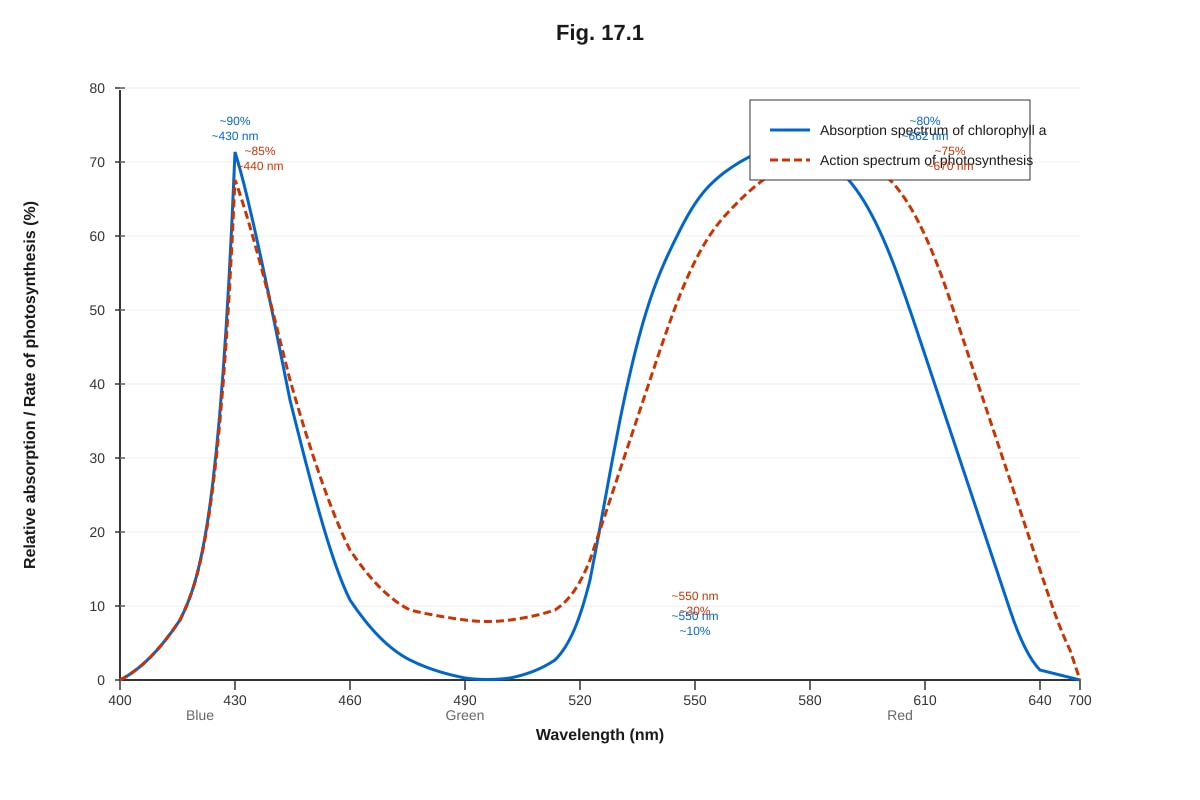
(a) The action spectrum does not exactly match the absorption spectrum of chlorophyll a because: [3]
- The action spectrum measures the overall rate of photosynthesis at different wavelengths, which depends on the combined absorption of all photosynthetic pigments, not just chlorophyll a. [1]
- Accessory pigments such as chlorophyll *b does not absorb efficiently (e.g., in the 450–500 nm range). [1]
- Energy absorbed by accessory pigments is transferred to chlorophyll *a absorption spectrum in the green-blue region (~470–500 nm). [1]
Marking: 1 mark for action spectrum reflecting all pigments; 1 mark for accessory pigments absorbing different wavelengths; 1 mark for energy transfer to chlorophyll *a$.
(b) The significance of accessory pigments: [2]
- Accessory pigments broaden the range of wavelengths of light that can be absorbed for photosynthesis (increasing the absorption spectrum), allowing the plant to capture more light energy from the visible spectrum. [1]
- They also serve a protective function: carotenoids quench reactive oxygen species (e.g., singlet oxygen, ) and dissipate excess light energy as heat, preventing photo-oxidative damage to chlorophyll and other components of the photosystems. [1]
Marking: 1 mark for broadening the absorption spectrum; 1 mark for photoprotection.
18. Comparison of light-dependent and light-independent reactions: [5]
| Feature | Light-dependent reactions | Light-independent reactions |
|---|---|---|
| Site | Thylakoid membranes of chloroplasts | Stroma of chloroplasts |
| Inputs | Light energy, water (), NADP⁺, ADP + | , ATP, NADPH |
| Outputs | ATP, NADPH, oxygen () | Triose phosphate (GP/TP), ADP + , NADP⁺ |
| Key processes | Photolysis of water, electron transport chain, chemiosmosis, photophosphorylation | Calvin cycle: carbon fixation (RuBisCO), reduction of GP to TP, regeneration of RuBP |
- The two stages are linked because the ATP and NADPH produced in the light-dependent reactions are used as the energy source and reducing power, respectively, in the Calvin cycle to reduce glycerate-3-phosphate to triose phosphate. [1]
- The ADP, , and NADP⁺ produced in the Calvin cycle are returned to the light-dependent reactions to be recharged. [1]
Marking: 1 mark for correct site of each; 1 mark for correct inputs/outputs of each; 1 mark for key processes; 1 mark for ATP/NADPH linking the stages; 1 mark for ADP/NADP⁺ recycling.
Common mistake: Students may confuse the inputs and outputs of the two stages, or may not explain how they are linked.
19.
(a) It is important that the potometer is completely watertight because: [2]
- Any leak would allow water to escape from the system, meaning that the measured water uptake would not accurately reflect the transpiration rate of the shoot. [1]
- Air bubbles in the system (other than the one being measured) would break the continuous column of water, disrupting the cohesion of the water column and preventing accurate measurement of water uptake. The potometer relies on the movement of a single air bubble to measure the volume of water taken up by the shoot. [1]
Marking: 1 mark for leaks causing inaccurate measurement; 1 mark for air bubbles breaking the water column.
(b) Effect of a fan: [3]
- The fan would increase the rate of bubble movement (i.e., increase the measured rate of water uptake). [1]
- The fan removes water vapour from the vicinity of the stomata, reducing the humidity around the leaf. [1]
- This increases the water vapour concentration gradient between the moist air spaces inside the leaf and the drier external air, increasing the rate of transpiration and thus the rate of water uptake measured by the potometer. [1]
Marking: 1 mark for predicting increased rate; 1 mark for fan reducing humidity / removing water vapour; 1 mark for increased concentration gradient increasing transpiration.
20. Adaptations of xylem vessels: [5]
- Dead, hollow cells: Xylem vessels are dead at maturity (they have lost their cytoplasm and organelles), forming continuous, hollow tubes with no end walls. This provides an unobstructed pathway for water to flow through with minimal resistance. [1]
- Lignified cell walls: The cell walls of xylem vessels are impregnated with lignin, a rigid, waterproof polymer. Lignification provides mechanical strength, preventing the vessels from collapsing under the negative pressure (tension) created by transpiration pull. [1]
- No end walls: Xylem vessels are formed from vessel elements stacked end to end, with their end walls broken down (perforation plates). This creates long, continuous columns of water, enabling efficient long-distance transport. [1]
- Pits in the walls: The lignified walls have unlignified regions called pits, which allow water and dissolved minerals to move laterally between adjacent xylem vessels or into surrounding tissues, providing alternative pathways if one vessel is blocked (e.g., by an air embolism). [1]
- Narrow diameter: The narrow diameter of xylem vessels helps maintain the water column through capillary action and cohesion between water molecules, supporting the cohesion-tension mechanism of water transport. [1]
Marking: 1 mark each for any five valid adaptations.
Common mistake: Students may describe xylem as living cells, or may describe the function (water transport) without explaining how the structure enables it.
Total: 50 marks