AI Generated Quiz
A Level H2 Biology Plant Biology Quiz
Free A Level H2 Biology Plant Biology quiz, HY3 AI version, with questions, answers, and A Level-style practice for Singapore students.
These static practice materials are generated from the site's syllabus and paper-generation workflow, with source and model context shown so students and parents can evaluate the material before use.
Questions
Free quiz and exam paper access
Enter your details to view this paper
Your access is remembered on this device.
Answers
A-Level Biology H2 Quiz - Plant Biology: Answer Key
Total Marks: 40
Topic: Plant Biology (syllabus-first content; not derived from past-year papers)
Section A: Short Answer
1. [1 mark]
Answer: Water (H₂O), light energy, and NADP⁺ / ADP + Pi.
Teaching note: Light-dependent reactions use H₂O as electron donor, light as energy, and regenerate NADPH and ATP from NADP⁺ and ADP+Pi. Common mistake: omitting NADP⁺/ADP.
2. [1 mark]
Answer: Rubisco (ribulose-1,5-bisphosphate carboxylase/oxygenase).
Teaching note: Rubisco catalyses carboxylation of RuBP in Calvin cycle.
3. [1 mark]
Answer: Loss of water vapour from plant surfaces (mainly leaves) via transpiration stream.
Teaching note: Define as passive evaporation from aerial parts.
4. [1 mark]
Answer: Lignified walls / dead cells at maturity / no cross walls (pits allowed) / narrow lumen. (Any one.)
Teaching note: Xylem adapted for low-resistance water column.
5. [1 mark]
Answer: Chlorophyll b (or carotenoids).
Teaching note: Accessory pigments widen spectrum absorbed.
6. [1 mark]
Answer: Protons (H⁺), electrons (e⁻), and O₂. (State any immediate product; O₂ and H⁺ expected.)
Teaching note: 2H₂O → 4H⁺ + 4e⁻ + O₂ at PSII.
7. [1 mark]
Answer: C4 plants minimise photorespiration by concentrating CO₂ in bundle sheath cells.
Teaching note: Hot dry → stomata close → C3 photorespires; C4 avoids.
8. [1 mark]
Answer: Auxin (IAA).
Teaching note: Auxin promotes elongation on shaded side causing phototropism.
Section B: Structured Responses
9. [3 marks]
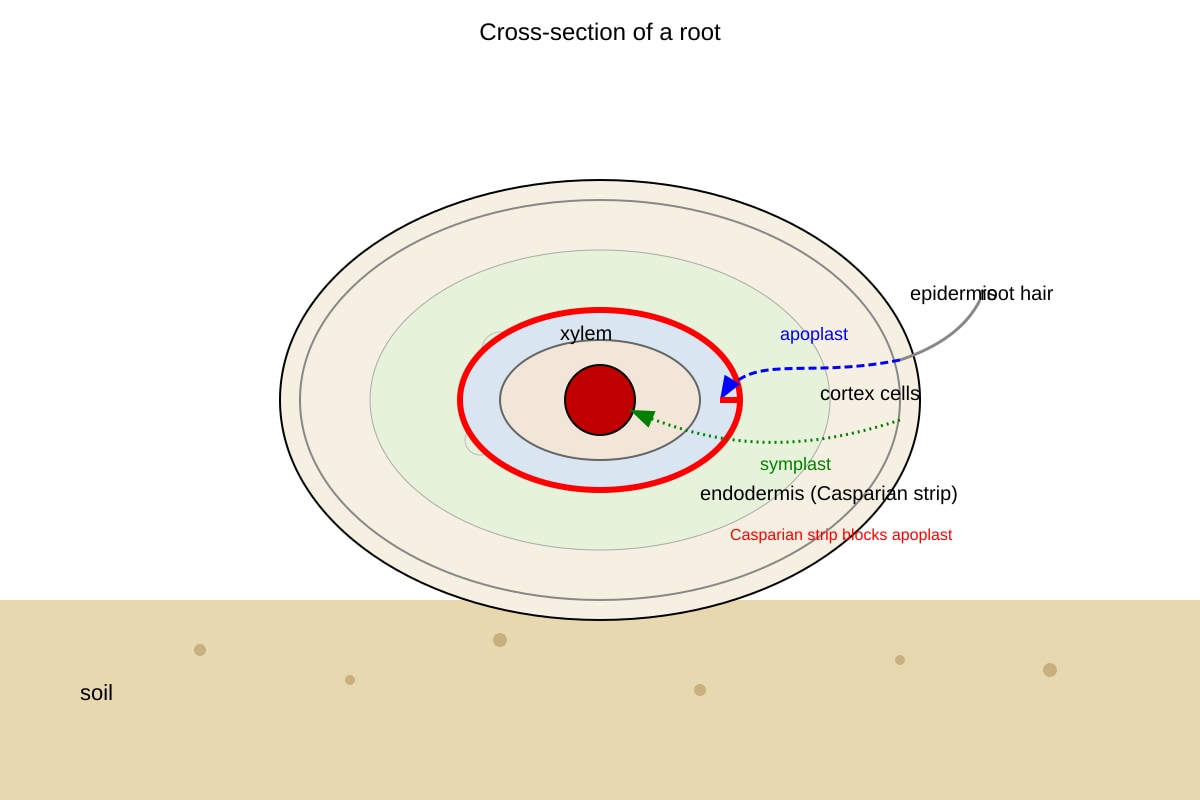
Marking: 1 mark root hair uptake, 1 mark apoplast/symplast path, 1 mark Casparian strip forces symplast entry to xylem.
Answer: Water enters via root hair by osmosis (soil ψ > cell ψ). It moves through cortex via apoplast (cell walls) and symplast (plasmodesmata). At endodermis, Casparian strip blocks apoplast, forcing water/ions through symplast into xylem.
Teaching note: Diagram must show arrows; apoplast = non-living route, symplast = living cytoplasm route.
10. [4 marks]
Marking: 1 photolysis/electron transport pumps H⁺ into lumen; 1 gradient formed; 1 ATP synthase allows H⁺ flow out; 1 chemiosmosis produces ATP.
Answer: Light energy splits water at PSII releasing H⁺ into thylakoid lumen. Electron transport chains pump further H⁺ from stroma to lumen. This creates electrochemical proton gradient (high lumen, low stroma). H⁺ diffuses through ATP synthase (chemiosmosis) driving phosphorylation of ADP + Pi → ATP.
Teaching note: Link gradient to potential energy like dam.
11. [3 marks]
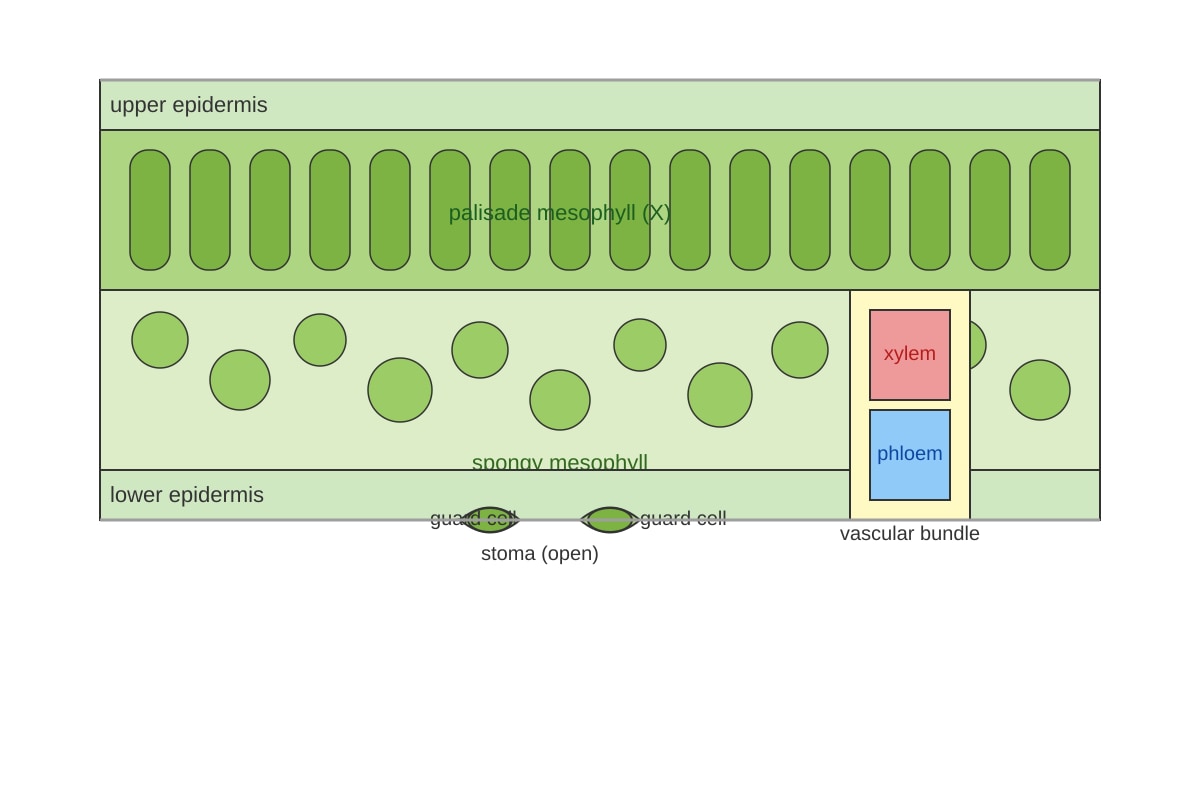
Marking: 1 identify palisade mesophyll; 1 tall columnar cells packed with chloroplasts; 1 positioned upper to receive max light.
Answer: Tissue X is palisade mesophyll. Adaptations: (i) elongated cells with many chloroplasts for light capture; (ii) located near upper epidermis to absorb maximum incident light.
Teaching note: Do not confuse with spongy (air spaces).
12. [3 marks]
Marking: 1 opening: K⁺ uptake lowers ψ, water enters, turgor opens; 1 closing: K⁺ loss raises ψ, water leaves, flaccid; 1 contrast stated.
Answer: Opening: guard cells actively take up K⁺, lowering water potential, water enters by osmosis, cells become turgid and bow apart. Closing: K⁺ exported, water potential rises, water leaves, cells flaccid, stoma closes. Contrast: opposite ion movement and turgor state.
Teaching note: Uneven thickening of guard cell walls enables curvature.
13. [2 marks]
Marking: 1 blocks apoplast; 1 forces selective symplast entry via living cells.
Answer: Casparian strip (suberin) blocks passive apoplast flow at endodermis, forcing water/ions through living endodermal cytoplasm where membrane controls uptake.
Teaching note: Ensures selective mineral absorption.
14. [3 marks]
Marking: 1 temp ↑ kinetic energy; 1 more evaporation from mesophyll; 1 steeper vapour pressure gradient.
Answer: Higher temperature increases kinetic energy of water molecules, raising evaporation rate from cell walls. This steepens water vapour gradient between leaf and air, increasing transpiration pull.
Teaching note: Also lowers relative humidity capacity of air.
Section C: Data Interpretation
15. [4 marks total]
(a) [1] Light compensation point = light intensity where O₂ production = 0. From table, between 0 (-0.4) and 50 (1.2); interpolate ≈ 14 μmol photons m⁻² s⁻¹. Accept "between 0 and 50".
(b) [1] 7.0 – 2.8 = 4.2 μmol m⁻² s⁻¹.
(c) [2] At 800, rate plateau = light-saturated; limiting factor now CO₂ or enzyme (Rubisco) capacity.
Teaching note: Compensation point is net zero photosynthesis.
16. [3 marks]
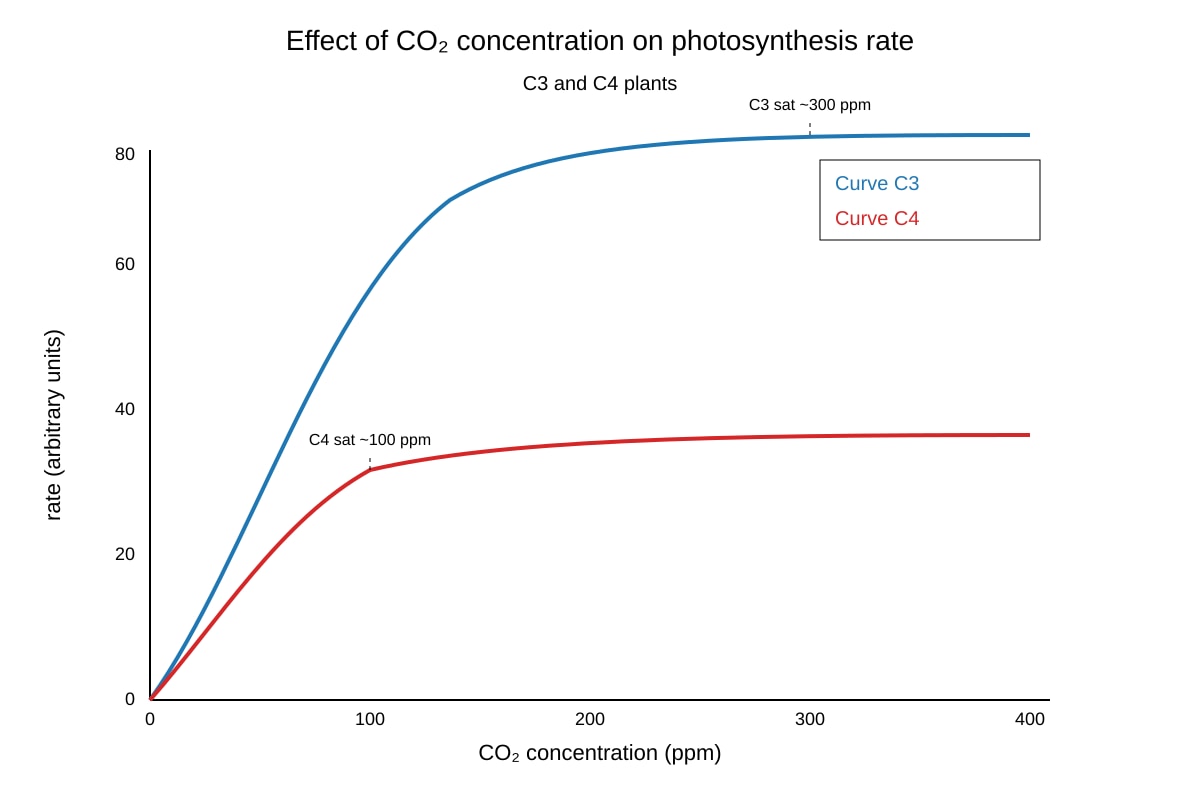
Marking: 1 C3 saturates higher; 1 C4 has CO₂ pump so saturates at low external CO₂; 1 C4 efficient at low CO₂.
Answer: C3 shows higher saturation (~300 ppm) because Rubisco directly uses atmospheric CO₂. C4 saturates earlier (~100 ppm) as PEP carboxylase concentrates CO₂ internally, so external CO₂ need is low. Thus C4 more efficient at low CO₂.
Teaching note: Graph reading must cite values.
17. [4 marks]
Marking: 1 drought → stomata close; 1 C3: O₂ builds, Rubisco oxygenates → photorespiration wastes energy; 1 C4: PEP carboxylase concentrates CO₂, suppresses photorespiration; 1 maize retains photosynthetic efficiency.
Answer: Drought closes stomata, reducing internal CO₂. In rice (C3), Rubisco binds O₂ causing photorespiration, lowering net photosynthesis. Maize (C4) uses PEP carboxylase to fix CO₂ into 4C acids, pumped to bundle sheath, maintaining high CO₂ around Rubisco, minimising photorespiration. Hence maize yield less affected.
Teaching note: Photorespiration is futile cycle.
18. [2 marks]
Marking: 1 floating leaf upper surface exposed to air; 1 lower submerged so stomata only upper.
Answer: Nymphaea floats; upper surface contacts air, lower in water. Stomata on upper surface allow gas exchange with atmosphere; submerged lower surface has none to prevent water entry.
Teaching note: Contrast with terrestrial hypostomatous leaves.
19. [3 marks]
Marking: 1 source high sucrose → low ψ; 1 water enters phloem, high pressure; 1 mass flow to sink where sucrose unloaded.
Answer: At source, sucrose loaded raises solute concentration (0.8 M), lowering ψ; water enters phloem by osmosis, increasing hydrostatic pressure. At sink (0.2 M), sucrose unloaded, ψ rises, water leaves. Pressure gradient drives bulk flow from source to sink (pressure flow).
Teaching note: Active loading at source is key.
20. [3 marks]
Marking: 1 ψ = ψs + ψp; 1 at equilibrium ψcell = ψext = -0.6; ψp = -0.6 - (-0.8) = +0.2 MPa; 1 initially ψcell = -0.8 < -0.6 so water enters cell.
Working:
ψ_cell = ψ_s + ψ_p = -0.8 + ψ_p
At equilibrium ψ_cell = -0.6 MPa
⇒ ψ_p = -0.6 - (-0.8) = +0.2 MPa
Initially ψ_cell = -0.8 MPa, external = -0.6 MPa; water moves from higher (less negative) to lower (more negative) potential → into cell.
Teaching note: Water potential in MPa; negative values indicate tension.