AI Generated Quiz
A Level H2 Biology Plant Biology Quiz
Free A Level H2 Biology Plant Biology quiz, DeepSeek AI version, with questions, answers, and A Level-style practice for Singapore students.
These static practice materials are generated from the site's syllabus and paper-generation workflow, with source and model context shown so students and parents can evaluate the material before use.
Questions
Free quiz and exam paper access
Enter your details to view this paper
Your access is remembered on this device.
Answers
A-Level Biology H2 Quiz - Plant Biology: Answer Key and Marking Scheme
Total Marks: 60
Section A: Short Answer and Structured Questions (15 marks)
1. State the primary function of the Casparian strip in the endodermis of plant roots.
[2 marks]
Answer:
- The Casparian strip is a band of suberin (waxy, waterproof material) in the radial and transverse walls of endodermal cells. (1)
- It blocks the apoplastic pathway, forcing water and dissolved mineral ions to pass through the selectively permeable plasma membrane (symplastic pathway) of endodermal cells, thus controlling the entry of substances into the vascular cylinder. (1)
2. Distinguish between apoplastic and symplastic pathways of water movement in the root cortex.
[3 marks]
Answer:
- Apoplastic pathway: Water moves through the cell walls and intercellular spaces without crossing any plasma membranes; it is a passive, non-selective route driven by cohesion and tension. (1)
- Symplastic pathway: Water moves through the cytoplasm of cells, connected by plasmodesmata; it crosses plasma membranes (entering cells by osmosis) and is therefore subject to selective permeability. (1)
- The apoplastic pathway is faster and less regulated, while the symplastic pathway allows the plant to control which solutes enter the xylem. (1)
3. Explain why the xylem is described as a tissue rather than a simple cell type.
[2 marks]
Answer:
- Xylem is a complex tissue because it is composed of several different cell types: tracheids, vessel elements, xylem parenchyma, and xylem fibres. (1)
- These cells work together to perform the functions of water transport, mechanical support, and storage. (1)
4. A student placed a piece of potato tissue in a sucrose solution and observed that the tissue became flaccid after 30 minutes. Explain this observation in terms of water potential.
[3 marks]
Answer:
- The sucrose solution has a lower (more negative) water potential than the potato cells. (1)
- Water moves out of the potato cells by osmosis, from a region of higher water potential (inside cells) to lower water potential (external solution). (1)
- Loss of water causes the cells to lose turgor pressure; the plasma membrane pulls away from the cell wall (plasmolysis), and the tissue becomes flaccid. (1)
5. State two structural adaptations of xylem vessel elements that facilitate efficient water transport.
[2 marks]
Answer:
- No end walls / perforation plates: Vessel elements are aligned end-to-end with their end walls largely broken down, forming continuous hollow tubes that offer low resistance to water flow. (1)
- Lignified walls: Lignin strengthens the walls, preventing collapse under the negative pressure (tension) generated by transpiration, and also makes the walls waterproof. (1)
(Accept: absence of cytoplasm/organelles at maturity; pits in walls allowing lateral water movement.)
Section B: Transport and Photosynthesis (15 marks)
6. Outline the role of companion cells in phloem transport.
[3 marks]
Answer:
- Companion cells are closely associated with sieve tube elements and contain many mitochondria to provide ATP. (1)
- They actively load sucrose (and other solutes) from mesophyll cells into the sieve tubes at the source, using proton pumps and co-transport proteins. (1)
- They also help maintain the metabolic functions of the enucleate sieve tube elements, supporting their survival and function. (1)
7. A plant physiologist measured the rate of transpiration in a plant under different environmental conditions. Suggest and explain the effect of increasing wind speed on the rate of transpiration.
[3 marks]
Answer:
- Increasing wind speed initially increases the rate of transpiration. (1)
- Wind removes the layer of humid air (boundary layer) surrounding the leaf, maintaining a steep water vapour concentration gradient between the leaf's internal air spaces and the external atmosphere. (1)
- This increases the rate of diffusion of water vapour out of the stomata. At very high wind speeds, stomata may close to prevent excessive water loss, reducing transpiration. (1)
8. State the name of the photosynthetic pigment found in the reaction centre of Photosystem I.
[2 marks]
Answer:
- Chlorophyll a (specifically, a special pair of chlorophyll a molecules known as P700). (2)
9. Explain why the action spectrum of photosynthesis does not perfectly match the absorption spectrum of chlorophyll a.
[2 marks]
Answer:
- The action spectrum represents the overall rate of photosynthesis at each wavelength, which depends on all photosynthetic pigments, not just chlorophyll a. (1)
- Accessory pigments such as chlorophyll b and carotenoids absorb light at wavelengths where chlorophyll a absorbs poorly (e.g., green-yellow region) and transfer the energy to chlorophyll a, broadening the action spectrum. (1)
10. Light intensity and photosynthesis.
(a) Plot a graph of the data on the grid below. Label both axes with appropriate units.
[4 marks]
Marking:
- Correctly labelled axes: x-axis "Light intensity (arbitrary units)", y-axis "Bubbles per minute" (1)
- Appropriate linear scales (1)
- All points accurately plotted (1)
- Smooth curve or best-fit line drawn through points, showing plateau (1)
(b) Describe the trend shown by the data.
[2 marks]
Answer:
- As light intensity increases from 0 to 10 arbitrary units, the rate of photosynthesis (bubbles per minute) increases proportionally. (1)
- Beyond 10 arbitrary units, the rate levels off (plateaus) at 40 bubbles per minute, showing no further increase with increasing light intensity. (1)
(c) Explain why the rate of photosynthesis reaches a plateau at higher light intensities.
[2 marks]
Answer:
- At low light intensities, light is the limiting factor for photosynthesis. As light intensity increases, the rate increases until another factor becomes limiting. (1)
- At the plateau, factors such as carbon dioxide concentration, temperature, or the availability of photosynthetic enzymes/chlorophyll become limiting, so further increases in light intensity cannot increase the rate. (1)
Section C: Data Interpretation and Diagram Questions (15 marks)
11. Figure 2 data analysis.
(a) Describe the relationship between chlorophyll a absorption and the rate of photosynthesis at wavelengths 400–500 nm.
[2 marks]
Answer:
- Both chlorophyll a absorption and the rate of photosynthesis are high in this range (1), with a peak at around 450 nm where absorption is 95% and photosynthesis rate is 80 arbitrary units. (1)
- There is a positive correlation: as absorption increases, the rate of photosynthesis also increases.
(b) At 550 nm, the rate of photosynthesis is low despite some absorption by chlorophyll a. Suggest an explanation for this observation.
[2 marks]
Answer:
- Chlorophyll a absorbs mainly in the blue (400–450 nm) and red (650–700 nm) regions of the spectrum; it absorbs very little green light (around 550 nm). (1)
- The low absorption means fewer photons are captured to drive the light-dependent reactions, resulting in a low rate of photosynthesis. The small amount of absorption may be due to accessory pigments (e.g., carotenoids) that transfer energy to chlorophyll a. (1)
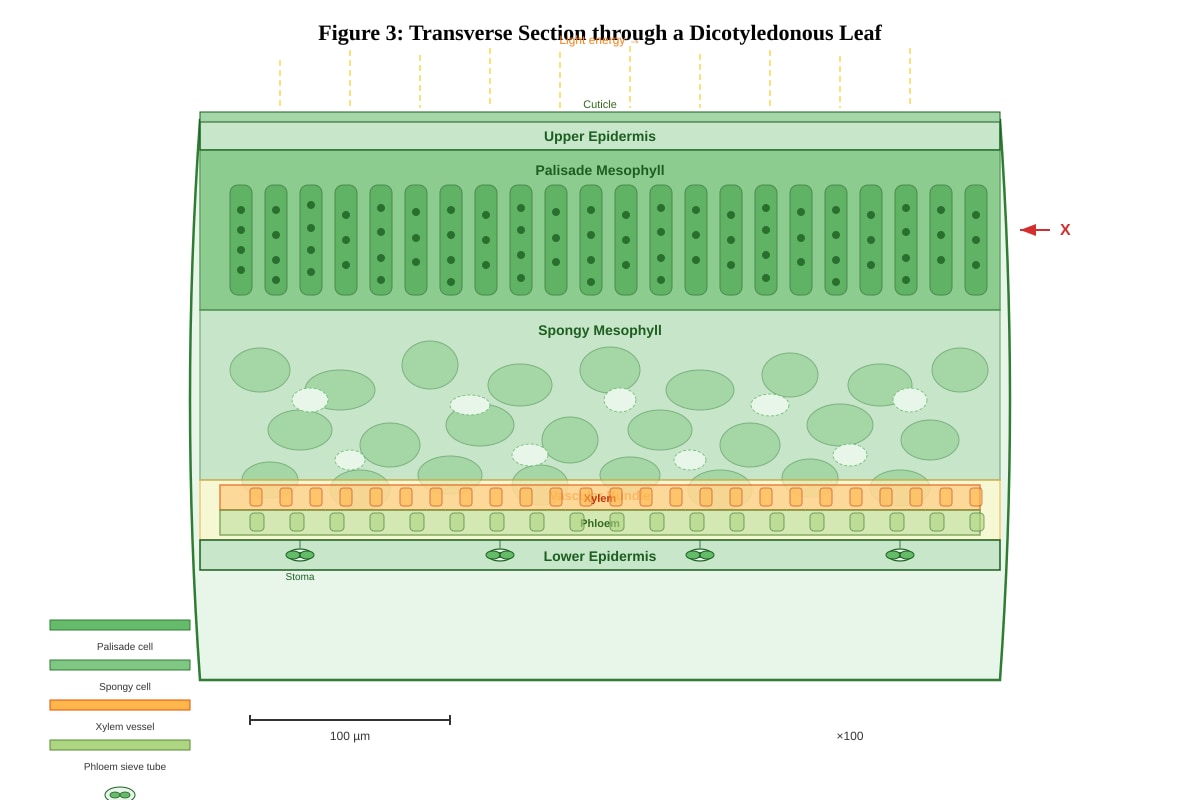
12. Leaf transverse section.
(a) Identify the tissue labelled X (palisade mesophyll) and state its main function.
[2 marks]
Answer:
- Tissue X is the palisade mesophyll. (1)
- Its main function is to carry out the majority of photosynthesis; it contains a high density of chloroplasts to absorb light energy. (1)
(b) Explain how the distribution of chloroplasts in the leaf section shown in Figure 3 maximises light absorption.
[2 marks]
Answer:
- Chloroplasts are most abundant in the palisade mesophyll cells, which are tightly packed and located near the upper epidermis where light intensity is highest. (1)
- Chloroplasts can move within cells and orient themselves to maximise light capture, and their arrangement in the palisade layer minimises shading of lower cells. (1)
(c) The spongy mesophyll contains large intercellular air spaces. Suggest the importance of these air spaces for photosynthesis.
[2 marks]
Answer:
- The air spaces allow rapid diffusion of carbon dioxide from the stomata to the photosynthesising cells. (1)
- They also facilitate the diffusion of oxygen out of the leaf and provide a large surface area for gas exchange with the moist cell surfaces. (1)
13. Compare the structure and function of xylem and phloem in flowering plants.
[5 marks]
Answer:
- Xylem transports water and dissolved mineral ions from roots to shoots; phloem transports sucrose and other organic solutes from sources to sinks. (1)
- Xylem consists mainly of dead cells (vessel elements and tracheids) with lignified walls; phloem consists of living cells (sieve tube elements and companion cells). (1)
- Xylem vessels have no end walls, forming continuous tubes; phloem sieve tubes have sieve plates with pores. (1)
- Xylem transport is passive, driven by transpiration pull (cohesion-tension); phloem transport is active, requiring energy for loading and unloading (mass flow). (1)
- Both are vascular tissues arranged in vascular bundles, providing structural support and long-distance transport. (1)
Section D: Extended Response Questions (15 marks)
14. Describe the light-dependent reactions of photosynthesis, including the roles of Photosystem II, Photosystem I, and the electron transport chain.
[6 marks]
Answer:
- Light energy is absorbed by chlorophyll and accessory pigments in Photosystem II (PSII), exciting electrons to a higher energy level. (1)
- The excited electrons are passed to an electron transport chain (ETC), while PSII splits water molecules (photolysis) to replace the lost electrons, releasing oxygen and protons. (1)
- As electrons move along the ETC, energy is released to pump protons into the thylakoid lumen, creating a proton gradient. (1)
- Light energy also excites electrons in Photosystem I (PSI), which are replaced by electrons from the ETC. (1)
- Excited electrons from PSI are used to reduce NADP+ to NADPH, with the help of the enzyme NADP reductase. (1)
- The proton gradient drives ATP synthesis via chemiosmosis, as protons flow back through ATP synthase. Thus, the light-dependent reactions produce ATP and NADPH for the Calvin cycle. (1)
15. Explain how sucrose is transported from a mature leaf (source) to a developing root tip (sink) according to the mass flow hypothesis.
[6 marks]
Answer:
- At the source (mature leaf), sucrose is actively loaded into the sieve tubes from companion cells, using energy (ATP) and co-transport proteins. (1)
- This loading lowers the water potential in the sieve tube, causing water to enter by osmosis from the adjacent xylem. (1)
- The entry of water increases the hydrostatic pressure at the source. (1)
- At the sink (root tip), sucrose is actively unloaded from the sieve tubes into the sink cells, where it is used for respiration or stored as starch. (1)
- Unloading raises the water potential in the sieve tube, so water moves out by osmosis, reducing hydrostatic pressure at the sink. (1)
- The pressure difference between source and sink drives a bulk flow of phloem sap (mass flow) from source to sink through the sieve tubes. (1)
16. Compare and contrast the adaptations of C3 and C4 plants for photosynthesis in hot, dry environments.
[8 marks]
Answer:
- C3 plants: Use the Calvin cycle directly; the first product of carbon fixation is a 3-carbon compound (3-PGA), catalysed by RuBisCO. (1)
- C4 plants: Initially fix CO2 into a 4-carbon compound (oxaloacetate) in mesophyll cells, using PEP carboxylase, which has a higher affinity for CO2 and no oxygenase activity. (1)
- In hot, dry conditions, C3 plants suffer from photorespiration because RuBisCO fixes O2 instead of CO2 when stomata close, reducing photosynthetic efficiency. (1)
- C4 plants minimise photorespiration by concentrating CO2 in bundle sheath cells, where the Calvin cycle occurs, maintaining a high CO2:O2 ratio. (1)
- C4 plants have Kranz anatomy: mesophyll cells surround bundle sheath cells, which contain chloroplasts specialised for the Calvin cycle. (1)
- C4 plants are more water-efficient because PEP carboxylase allows them to maintain photosynthesis with partially closed stomata, reducing water loss. (1)
- Both C3 and C4 plants ultimately use the Calvin cycle to produce carbohydrates, but C4 plants have an additional preparatory step that incurs an energy cost (ATP). (1)
- C4 plants are generally better adapted to high temperatures and intense light, while C3 plants are more efficient in cooler, wetter conditions. (1)
17. Discuss the factors that affect the rate of transpiration in a terrestrial plant.
[6 marks]
Answer:
- Light intensity: Increases transpiration by stimulating stomatal opening and providing energy to drive evaporation; stomata close in darkness, reducing transpiration. (1)
- Temperature: Higher temperatures increase the kinetic energy of water molecules, raising the rate of evaporation and the water vapour concentration gradient; also decreases relative humidity. (1)
- Humidity: Low humidity increases the water vapour concentration gradient between the leaf and the atmosphere, increasing transpiration; high humidity reduces the gradient and slows transpiration. (1)
- Wind speed: Wind removes the boundary layer of humid air, steepening the concentration gradient and increasing transpiration; very high wind may cause stomatal closure. (1)
- Soil water availability: If soil water is limited, the plant may close stomata to conserve water, reducing transpiration; water stress triggers ABA production. (1)
- Leaf structure: Adaptations such as thick cuticle, sunken stomata, and reduced leaf area reduce transpiration; number and distribution of stomata also affect the rate. (1)
18. Explain the process of water uptake and transport from the soil to the leaves of a tall tree.
[6 marks]
Answer:
- Water enters root hair cells by osmosis, driven by a water potential gradient between the soil (higher water potential) and the root cells (lower water potential due to dissolved solutes). (1)
- Water moves across the root cortex via the apoplastic and symplastic pathways until it reaches the endodermis, where the Casparian strip forces it into the symplastic pathway. (1)
- Water passes through the pericycle into the xylem vessels of the root, where it is transported upwards. (1)
- Transpiration from the leaves creates a tension (negative pressure) at the top of the xylem, pulling water up the stem due to the cohesive forces between water molecules (cohesion-tension theory). (1)
- Adhesion of water molecules to the xylem walls helps maintain the continuous water column. (1)
- The continuous column of water is maintained by the narrow diameter of xylem vessels, and root pressure (active transport of ions into the xylem) may contribute to water movement, especially at night. (1)
19. Describe the role of stomata in gas exchange and explain how their opening and closing are regulated.
[6 marks]
Answer:
- Stomata are pores mainly on the lower leaf epidermis that allow the diffusion of CO2 into the leaf for photosynthesis and O2 out as a by-product. (1)
- They also allow water vapour to escape during transpiration, which drives water transport. (1)
- Opening and closing are controlled by changes in turgor pressure of the guard cells. (1)
- In the light, guard cells actively pump K+ ions into the vacuole, lowering water potential; water enters by osmosis, causing the cells to swell and bow apart, opening the stoma. (1)
- In darkness or under water stress, K+ ions are pumped out, water follows by osmosis, guard cells become flaccid, and the stoma closes. (1)
- The process is regulated by environmental signals (light, CO2 concentration, humidity) and the plant hormone abscisic acid (ABA), which triggers stomatal closure during drought. (1)
20. Evaluate the significance of the mass flow hypothesis in explaining phloem transport, including its limitations.
[6 marks]
Answer:
- The mass flow hypothesis explains how solutes (mainly sucrose) move from sources to sinks by a pressure-driven bulk flow in the phloem sieve tubes. (1)
- It is supported by evidence such as the observation of pressure gradients between source and sink, the exudation of phloem sap when cut, and the correlation between solute loading and flow rate. (1)
- The hypothesis explains bidirectional transport in different sieve tubes, as flow direction depends on the location of sources and sinks. (1)
- However, it does not fully explain how sieve pores remain unblocked despite the presence of P-protein and other materials. (1)
- It also does not account for the precise control of solute distribution among competing sinks, which may involve active regulation. (1)
- Additionally, the energy requirement for maintaining the pressure gradient and the role of companion cells in loading/unloading are still areas of active research, indicating the hypothesis is a simplified model. (1)
END OF ANSWER KEY