AI Generated Quiz
A Level H2 Biology Human Physiology Quiz
Free A Level H2 Biology Human Physiology quiz, HY3 AI version, with questions, answers, and A Level-style practice for Singapore students.
These static practice materials are generated from the site's syllabus and paper-generation workflow, with source and model context shown so students and parents can evaluate the material before use.
Questions
Free quiz and exam paper access
Enter your details to view this paper
Your access is remembered on this device.
Answers
A-Level Biology H2 Quiz - Human Physiology (Answer Key)
Total Marks: 40
Note: Syllabus-first generated content; not past-year derived.
Section A
Q1. [2 marks]
- Quaternary structure with four polypeptide subunits (2 α, 2 β) allowing cooperative binding. [1]
- Contains haem (Fe²⁺) group that reversibly binds O₂. [1]
Teaching note: Haemoglobin's structure lets one O₂ binding increase affinity at other subunits (cooperativity).
Q2. [2 marks]
- Afferent arteriole has wider diameter; brings blood into glomerulus. [1]
- Efferent arteriole has narrower diameter; carries blood away, maintaining high capillary pressure. [1]
Q3. [2 marks]
Right atrium → right ventricle → left atrium → left ventricle. [2 for all four in order; 1 if one error]
Q4. [2 marks]
- Produced in hypothalamus (synthesised), released from posterior pituitary. [1]
- Stimulus: high blood osmolarity / low water potential. [1]
Q5. [2 marks]
Any two: large surface area; thin walls (one cell thick); rich capillary network; moist lining. [1 each]
Section B
Q6. [2 marks]
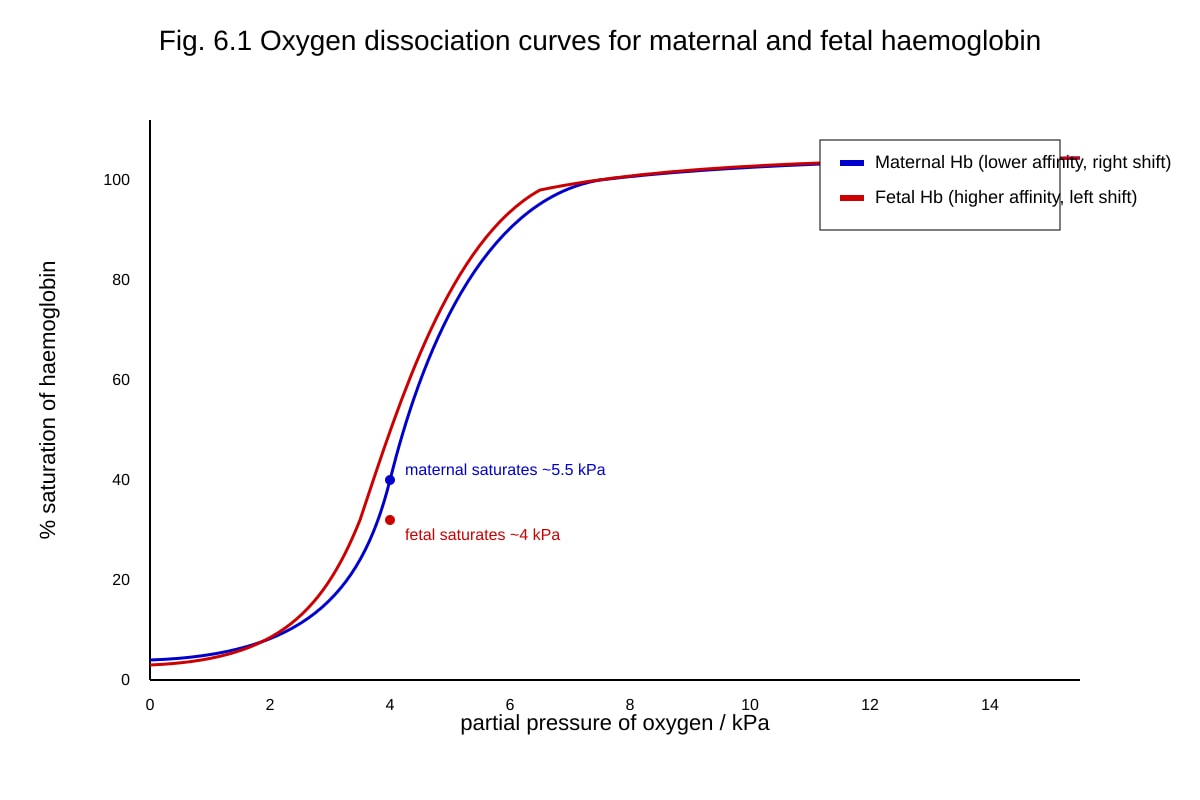
Fetal haemoglobin (HbF) has different γ subunits replacing β subunits, reducing affinity for 2,3-BPG. [1] This left-shifts curve so it saturates at lower pO₂, extracting O₂ from maternal blood. [1]
Q7. [2 marks]
MAP = 76 + ⅓(118 − 76) = 76 + 14 = 90 mmHg. [2 for correct; 1 for formula only]
Q8. [2 marks]
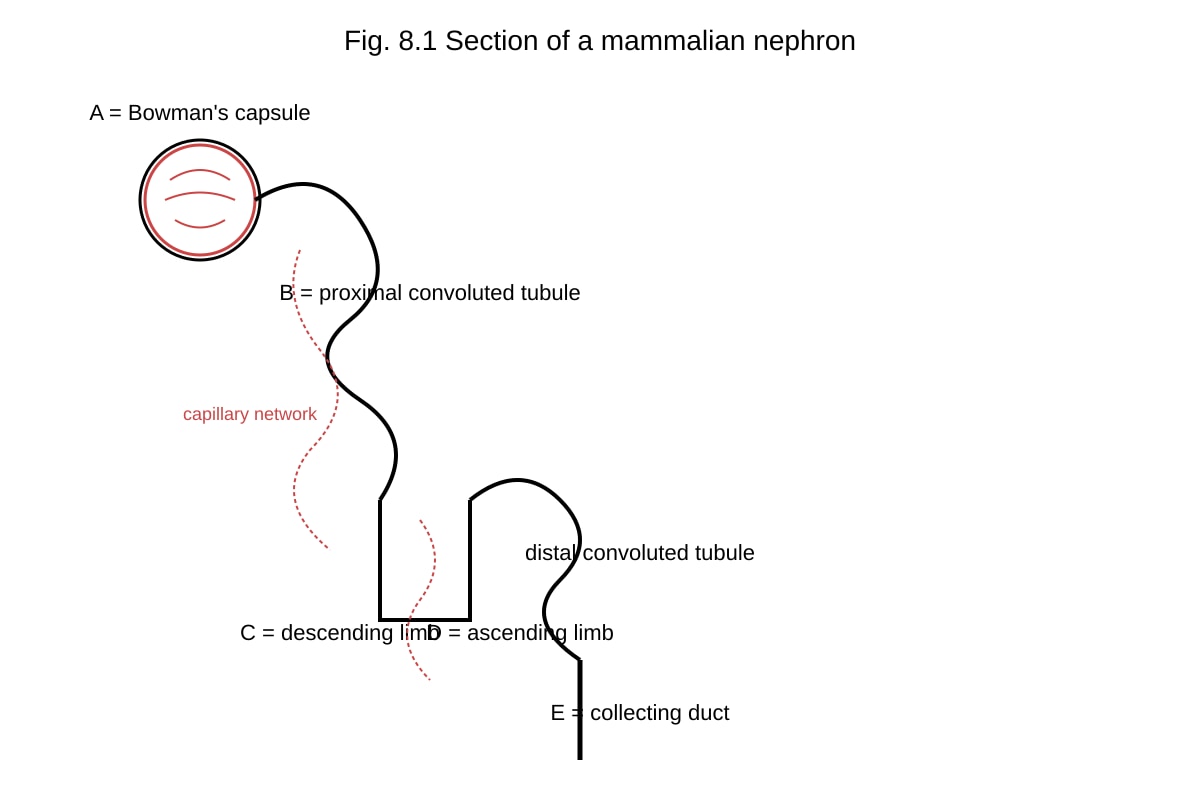
B = proximal convoluted tubule. [1] Process: selective reabsorption of glucose, amino acids, salts, water. [1]
Q9. [2 marks]
Bicarbonate buffer: CO₂ + H₂O ⇌ H₂CO₃ ⇌ H⁺ + HCO₃⁻. [2]
Q10. [2 marks]
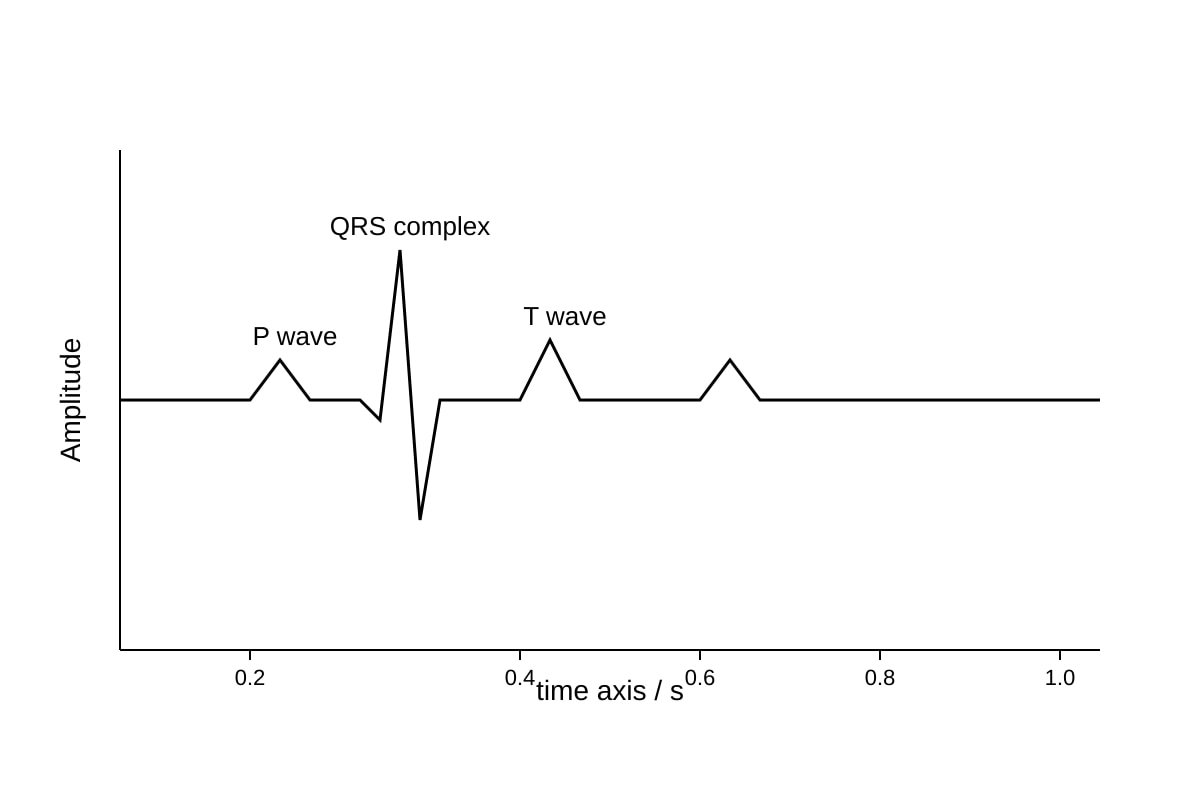
QRS complex = ventricular depolarisation. [1] Immediately followed by ventricular contraction (systole). [1]
Q11. [2 marks]
Type A has anti-B antibodies in plasma. [1] These bind B antigens on donor RBCs → agglutination/clumping. [1]
Q12. [2 marks]
Fold increase = 1.60 / 0.25 = 6.4 times. [2]
Q13. [2 marks]
SA node = pacemaker, sets heart rate via electrical impulses. [1] If fails, ventricles rely on slower ectopic pacemakers → bradycardia. [1]
Section C
Q14. [3 marks]
- Ascending limb actively transports Na⁺/Cl⁻ out (impermeable to water). [1]
- Descending limb permeable to water, not solutes → water leaves. [1]
- Counter-current flow multiplies gradient → hypertonic medulla. [1]
Q15. [3 marks]
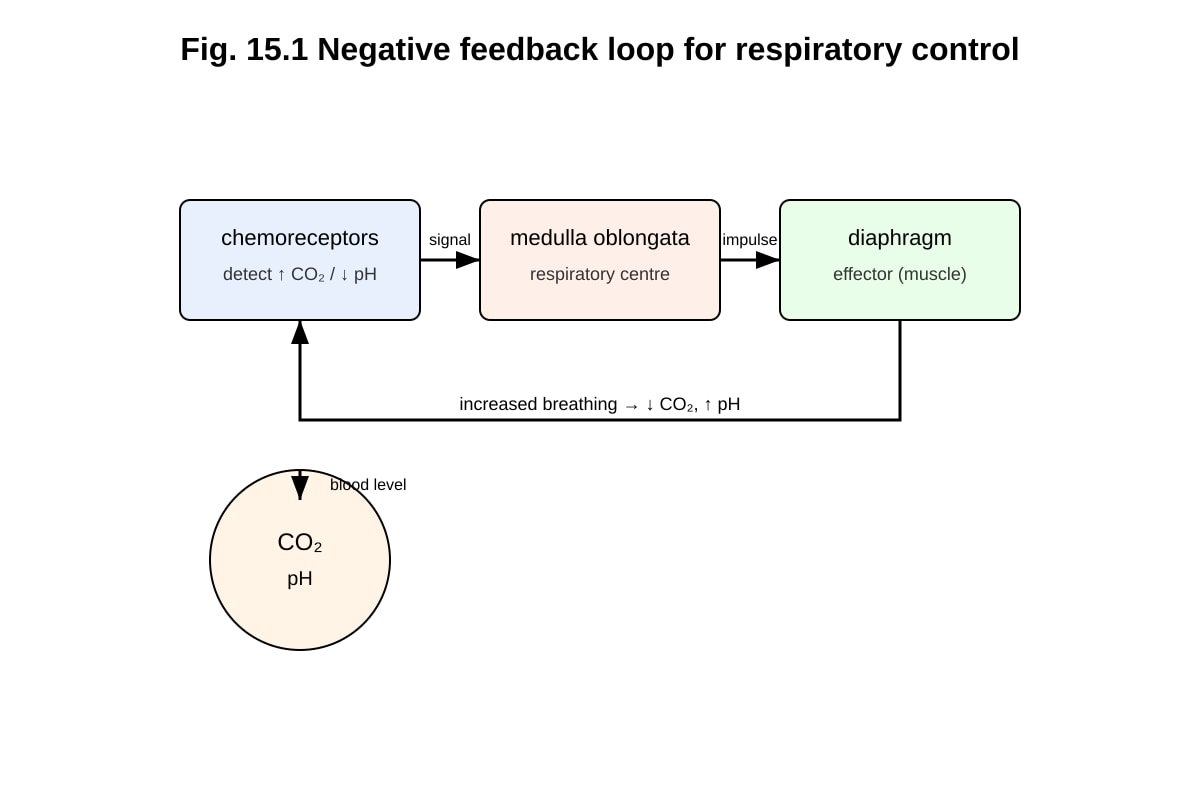
- CO₂ rises → CSF pH falls. [1]
- Central chemoreceptors signal medulla. [1]
- Medulla increases inspiratory nerve firing → faster breathing. [1]
Q16. [3 marks]
- Iron deficiency anaemia. [1]
- Fe²⁺ needed for haem synthesis. [1]
- Low haem → low Hb → small pale RBCs (microcytic hypochromic). [1]
Q17. [3 marks]
- Aldosterone: increases Na⁺ reabsorption, K⁺ secretion in DCT. [1]
- ADH: increases water permeability via aquaporins. [1]
- Both concentrate urine but different solutes/mechanism. [1]
Q18. [3 marks]
- CO binds Hb with ~200× affinity. [1]
- Forms carboxyhaemoglobin, reduces O₂ carrying. [1]
- Left-shifts curve, impairs unloading at tissues. [1]
Q19. [3 marks]
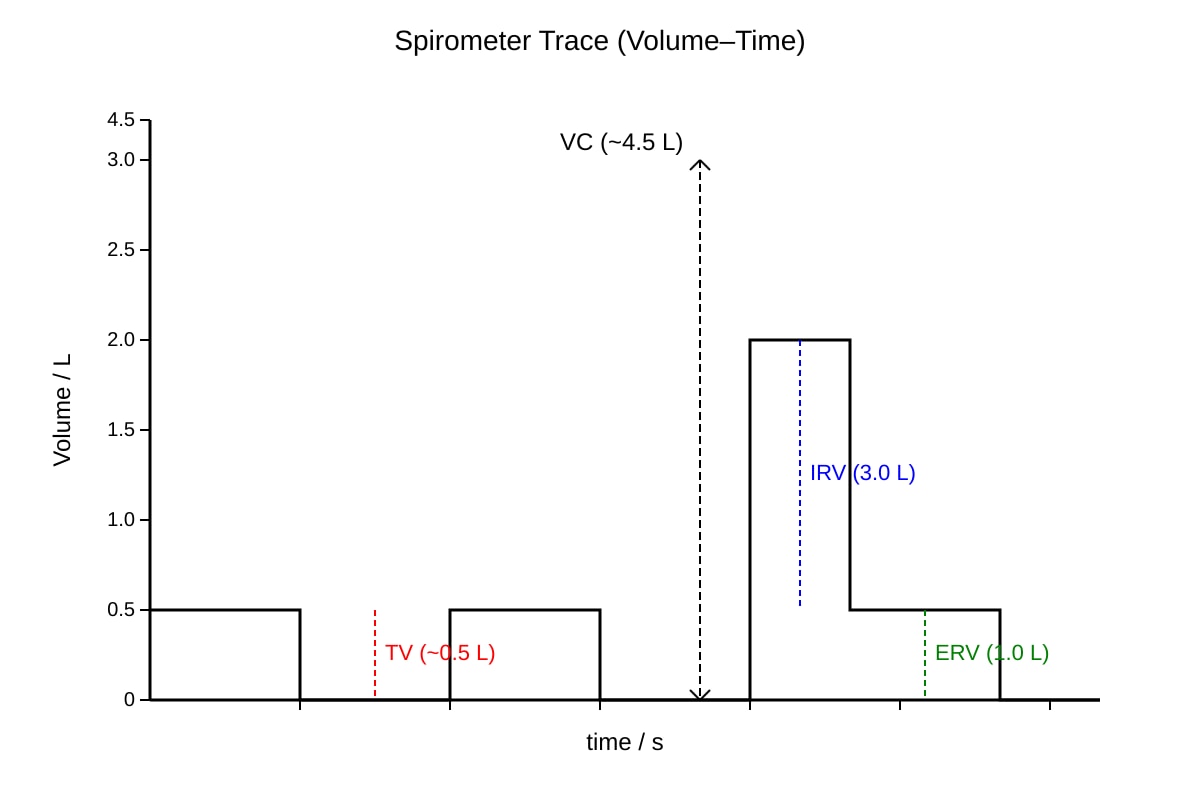
VC = TV + IRV + ERV = 0.5 + 3.0 + 1.0 = 4.5 L. [2 for calc, 1 for definition]
Q20. [4 marks]
- Pulmonary and systemic circuits separate. [1]
- Pulmonary pumps to lungs at lower pressure (protects capillaries). [1]
- Systemic at high pressure delivers O₂ rapidly to tissues. [1]
- Supports high metabolic rate via efficient O₂ delivery and CO₂ removal. [1]