AI Generated Quiz
A Level H2 Biology Genetics Inheritance Quiz
Free A Level H2 Biology Genetics Inheritance quiz, LongCat AI version, with questions, answers, and A Level-style practice for Singapore students.
These static practice materials are generated from the site's syllabus and paper-generation workflow, with source and model context shown so students and parents can evaluate the material before use.
Questions
Free quiz and exam paper access
Enter your details to view this paper
Your access is remembered on this device.
Answers
A-Level Biology H2 Quiz - Genetics Inheritance: Answer Key
Section A: Multiple Choice Questions
1. Answer: B [1]
Explanation: A cross between two heterozygotes (Tt × Tt) produces a genotypic ratio of 1 TT : 2 Tt : 1 tt. Since T (tall) is dominant over t (short), both TT and Tt individuals are tall, giving a phenotypic ratio of 3 tall : 1 short. This is the classic monohybrid cross ratio for a dominant-recessive relationship.
2. Answer: C [1]
Explanation: The woman is a carrier (X^B X^b) and the husband is normal (X^B Y). Sons inherit their X chromosome from their mother and Y from their father. There is a 50% chance the son inherits X^b (colour blind) and a 50% chance he inherits X^B (normal). Daughters would inherit X^B from the father, so they would not be affected (though they have a 50% chance of being carriers).
3. Answer: B [1]
Explanation: A dihybrid cross involves two traits, each controlled by a gene with two alleles. For example, a cross examining both seed colour and seed shape in peas. The classic dihybrid cross between two double heterozygotes (e.g., YyRr × YyRr) produces the 9:3:3:1 phenotypic ratio when the genes assort independently.
4. Answer: C [1]
Explanation: A test cross involves crossing an individual with a dominant phenotype but unknown genotype with a homozygous recessive individual. If the unknown is homozygous dominant (BB), all offspring show the dominant phenotype. If the unknown is heterozygous (Bb), the offspring show a 1:1 phenotypic ratio. This allows the unknown genotype to be determined.
5. Answer: A [1]
Explanation: Epistasis occurs when the expression of one gene (the epistatic gene) affects or masks the expression of another gene at a different locus (the hypostatic gene). This is different from dominance, which involves alleles at the same locus. Codominance involves both alleles being expressed equally; pleiotropy is when one gene affects multiple traits; polygenic inheritance involves multiple genes affecting one trait.
6. Answer: B [1]
Explanation: Two pink-flowered plants have genotype Rr. Crossing Rr × Rr gives: 1 RR (red) : 2 Rr (pink) : 1 rr (white). Therefore, 1/4 (25%) of the offspring will be white. Incomplete dominance means the heterozygote has an intermediate phenotype, but the genotypic and phenotypic ratios are the same (1:2:1).
7. Answer: A [1]
Explanation: The man with blood group AB has genotype I^A I^B. The woman with blood group O has genotype i i. The man can only pass on I^A or I^B, and the woman can only pass on i. Therefore, all children will have genotype I^A i (blood group A) or I^B i (blood group B). Blood groups AB and O are not possible from this cross.
8. Answer: B [1]
Explanation: Codominance occurs when both alleles in a heterozygote are fully and equally expressed. In speckled chickens, both the black feather allele and the white feather allele are expressed, producing feathers with both colours visible. Option A describes incomplete dominance (blending). Option C describes simple dominance. Option D describes dominance with complete masking.
9. Answer: C [1]
Explanation: Using the Hardy-Weinberg equation: p + q = 1 and p² + 2pq + q² = 1. Given q = 0.3, p = 1 − 0.3 = 0.7. The frequency of heterozygotes = 2pq = 2 × 0.7 × 0.3 = 0.42. Common mistake: students may select A (q² = 0.09, the frequency of homozygous recessives) or D (p² = 0.49, the frequency of homozygous dominants).
10. Answer: A [1]
Explanation: Multiple alleles refers to the existence of more than two alleles for a single gene in a population. The ABO blood group system has three alleles: I^A, I^B, and i. Although any individual can only carry two alleles, the population has three. This is distinct from polygenic inheritance (multiple genes affecting one trait) or epistasis (gene-gene interaction).
Section B: Structured Questions
11.
(a) Codominance occurs when both alleles in a heterozygous individual are fully and equally expressed in the phenotype, so that both phenotypic traits are visible simultaneously. [2]
Marking: 1 mark for "both alleles expressed" / "both phenotypes visible"; 1 mark for "in the heterozygote" / "equally expressed" / "not blended".
(b) Genetic diagram: [4]
- Parental phenotypes: Tortoiseshell female × Black male
- Parental genotypes: C^B C^W × C^B C^B
- Gametes: female produces C^B and C^W; male produces C^B only
| C^B (male) | C^B (male) | |
|---|---|---|
| C^B (female) | C^B C^B (black) | C^B C^B (black) |
| C^W (female) | C^B C^W (tortoiseshell) | C^B C^W (tortoiseshell) |
- Genotypic ratio: 1 C^B C^B : 1 C^B C^W
- Phenotypic ratio: 1 black : 1 tortoiseshell
Marking: 1 mark for correct parental genotypes; 1 mark for correct gametes; 1 mark for correct offspring genotypes in Punnett square; 1 mark for correct phenotypic ratio.
(c) Male cats are XY. The gene for fur colour is X-linked. Males have only one X chromosome, so they can only carry one allele (either C^B or C^W). They cannot be heterozygous (C^B C^W), which is required for the tortoiseshell phenotype. [2]
Marking: 1 mark for stating males are XY / have only one X; 1 mark for linking this to inability to be heterozygous for the X-linked gene.
12.
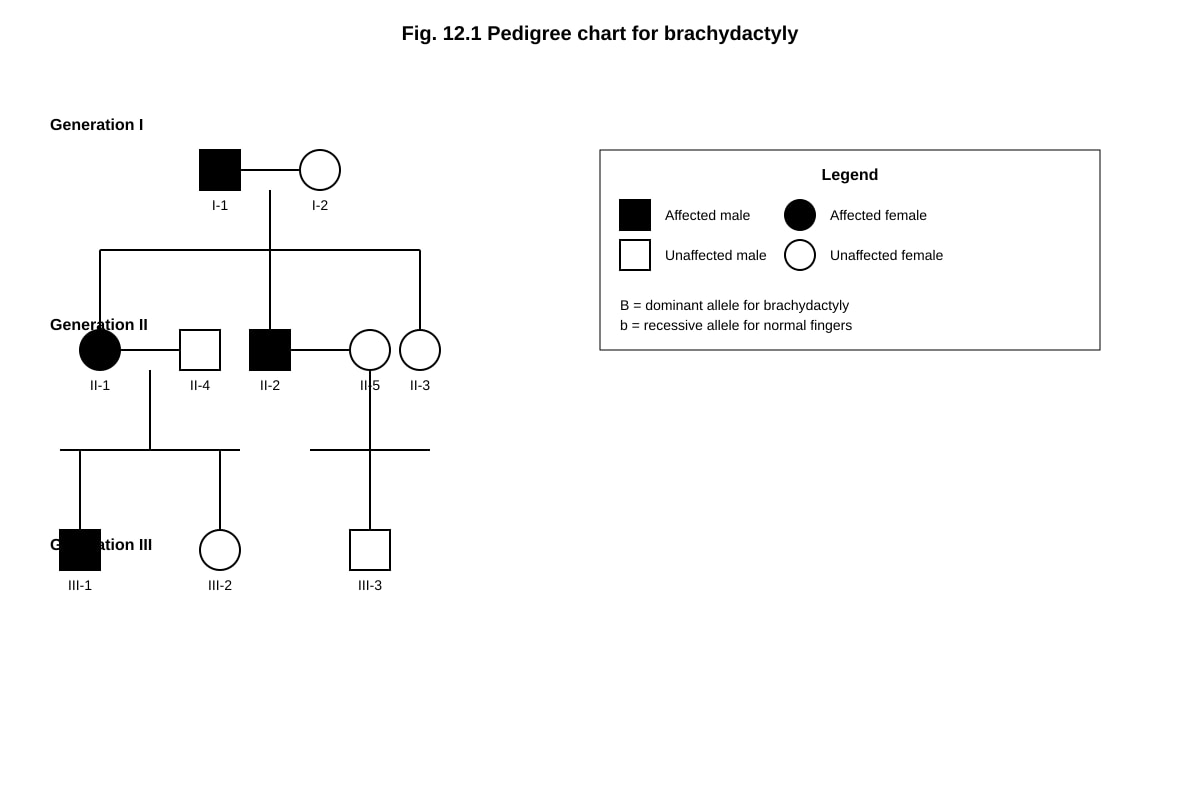
(a) The affected male in Generation I must be heterozygous (Bb). [1] He is affected (has the dominant phenotype), but he has an unaffected daughter in Generation II. Since the unaffected daughter must be bb, she must have inherited a b allele from each parent. Therefore, the affected father must carry one b allele, making him Bb. [1]
(b) Genetic diagram: [3]
- Parental phenotypes: Affected female × Unaffected male
- Parental genotypes: Bb × bb
- Gametes: female produces B and b; male produces b only
| b (male) | b (male) | |
|---|---|---|
| B (female) | Bb (affected) | Bb (affected) |
| b (female) | bb (unaffected) | bb (unaffected) |
- Genotypic ratio: 1 Bb : 1 bb
- Phenotypic ratio: 1 affected : 1 unaffected
Marking: 1 mark for correct parental genotypes (Bb × bb); 1 mark for correct gametes and offspring genotypes; 1 mark for correct phenotypic ratio.
(c) The probability is 1/2 (50%). [1]
Note: The pedigree shows the affected female in Generation II is crossed with an unaffected male. From the genetic diagram in (b), half the offspring are expected to be affected.
13.
(a) Epistasis is the interaction between two or more genes at different loci, where the expression of one gene (the epistatic gene) affects or masks the expression of another gene (the hypostatic gene). [1] In this example, gene A is epistatic to gene B. [1] Individuals with genotype aa cannot produce the red pigment precursor, so regardless of the genotype at gene B, the flowers are white. Gene A therefore masks the effect of gene B. [1]
Marking: 1 mark for definition of epistasis; 1 mark for identifying gene A as epistatic; 1 mark for explaining how aa masks gene B expression.
(b) Punnett square: [2 for correct genotypes, 2 for correct ratio]
| AB | Ab | aB | ab | |
|---|---|---|---|---|
| AB | AABB | AABb | AaBB | AaBb |
| Ab | AABb | AAbb | AaBb | Aabb |
| aB | AaBB | AaBb | aaBB | aaBb |
| ab | AaBb | Aabb | aaBb | aabb |
Phenotypes:
- A_B_ (9): Has precursor AND converts to blue → Blue
- A_bb (3): Has precursor but does NOT convert → Red
- aaB_ (3): No precursor → White
- aabb (1): No precursor → White
Phenotypic ratio: 9 Blue : 3 Red : 4 White [2]
(c) The standard 9:3:3:1 ratio assumes that both genes contribute independently to the phenotype. [1] However, in this case, when gene A is homozygous recessive (aa), no pigment precursor is produced, so gene B has no substrate to act upon. The aaB_ and aabb genotypes both produce white flowers, collapsing two phenotypic classes into one. This changes the ratio from 9:3:3:1 to 9:3:4. [1]
Marking: 1 mark for stating independent phenotypes expected; 1 mark for explaining that aa masks B, collapsing two classes into white.
14.
(a) A single base substitution (point mutation) in the DNA sequence of the β-globin gene changes one nucleotide in the coding strand. [1] This alters the mRNA codon during transcription. [1] Specifically, the codon GAG (coding for glutamic acid) is changed to GUG (coding for valine) at position 6 of the β-globin chain. [1] This amino acid substitution changes the charge and shape of the haemoglobin molecule, causing the haemoglobin S molecules to polymerise (form long fibres) under low oxygen conditions, distorting red blood cells into a sickle shape. [1]
Marking: 1 mark each for the four points above. Accept equivalent descriptions of the specific mutation (GAG→GUG, glutamic acid→valine).
(b) Individuals with genotype HbA HbS (heterozygotes) have a survival advantage in malaria-endemic regions because the presence of some sickled cells makes them more resistant to malaria infection. [1] The Plasmodium parasite has difficulty infecting and reproducing in red blood cells that contain HbS. [1] HbA HbA individuals are susceptible to malaria, and HbS HbS individuals suffer from sickle cell anaemia. Therefore, HbA HbS individuals have the highest fitness, and both alleles are maintained in the population through balancing selection. [1]
Marking: 1 mark for heterozygote resistance to malaria; 1 mark for mechanism (Plasmodium difficulty); 1 mark for balancing selection / both alleles maintained.
Section C: Free Response Questions
15.
(a) Parental genotypes: GGNN (grey body, normal wings) and ggnn (black body, vestigial wings). [2]
Marking: 1 mark each for the two correct genotypes.
(b) Test cross: F1 (GgNn) × ggnn [4]
- F1 genotype: GgNn (grey body, normal wings)
- Test cross parent genotype: ggnn (black body, vestigial wings)
- F1 gametes: GN, Gn, gN, gn (each 1/4)
- Test cross parent gametes: gn only
| gn (test cross) | |
|---|---|
| GN | GgNn (grey, normal) |
| Gn | Ggnn (grey, vestigial) |
| gN | ggNn (black, normal) |
| gn | ggnn (black, vestigial) |
Expected ratio: 1 grey normal : 1 grey vestigial : 1 black normal : 1 black vestigial (1:1:1:1)
Marking: 1 mark for correct F1 and test cross genotypes; 1 mark for correct gametes; 1 mark for correct offspring genotypes; 1 mark for correct 1:1:1:1 phenotypic ratio.
(c) Expected numbers (if independent assortment): Total offspring = 142 + 138 + 38 + 42 = 360. With independent assortment, each phenotype = 360 ÷ 4 = 90. [1]
The observed results do NOT support independent assortment. [1] The observed numbers show two much larger classes (grey normal = 142, black vestigial = 138) and two much smaller classes (grey vestigial = 38, black normal = 42). [1] If the genes assorted independently, all four classes would be approximately equal (90 each). The large deviation from the expected 1:1:1:1 ratio suggests the genes are linked (located close together on the same chromosome) and do not assort independently. The two smaller classes represent recombinant offspring resulting from crossing over. [1]
Marking: 1 mark for correct expected number (90 each); 1 mark for stating independent assortment is NOT supported; 1 mark for identifying the unequal distribution; 1 mark for suggesting linkage as the explanation.
16.
(a) Sex-linked (X-linked) inheritance refers to the pattern of inheritance of genes located on the X chromosome. [1] Because males have only one X chromosome (XY), they express X-linked recessive alleles even though they have only one copy (they are hemizygous for X-linked genes). Females have two X chromosomes and can be homozygous dominant, heterozygous (carriers), or homozygous recessive. [1]
Marking: 1 mark for genes on X chromosome; 1 mark for explaining different expression in males vs females.
(b) Genetic diagram: [4]
- Parental phenotypes: Carrier female × Normal male
- Parental genotypes: X^H X^h × X^H Y
- Gametes: female produces X^H and X^h; male produces X^H and Y
| X^H (male) | Y (male) | |
|---|---|---|
| X^H (female) | X^H X^H (normal female) | X^H Y (normal male) |
| X^h (female) | X^H X^h (carrier female) | X^h Y (haemophiliac male) |
- 25% normal female (X^H X^H)
- 25% carrier female (X^H X^h)
- 25% normal male (X^H Y)
- 25% haemophiliac male (X^h Y)
Probability of a son having haemophilia: 1/2 (50%) (among sons) or 1/4 (25%) (among all children).
Marking: 1 mark for correct parental genotypes; 1 mark for correct gametes; 1 mark for correct offspring genotypes; 1 mark for correct probabilities.
(c) Males have only one X chromosome (XY). [1] If a male inherits the X chromosome carrying the recessive haemophilia allele (X^h), he will express the condition because there is no corresponding allele on the Y chromosome to mask it (the Y chromosome does not carry the factor VIII gene). [1] Females have two X chromosomes, so they must inherit two copies of the recessive allele (X^h X^h) to express the condition, which is much less likely. A female with one copy (X^H X^h) is a carrier but phenotypically normal. [1]
Marking: 1 mark for males XY / one X; 1 mark for no masking allele on Y; 1 mark for females needing two copies.
(d) The mother must be a carrier (X^H X^h). [1] The son has haemophilia (X^h Y), meaning he inherited X^h from his mother and Y from his father. Since the mother is unaffected, she must have one normal allele (X^H) and one haemophilia allele (X^h), making her a heterozygous carrier. [1]
Marking: 1 mark for correct genotype; 1 mark for correct reasoning.
17.
(a) Within the moth population, there was variation in body colour due to the presence of two alleles (C for carbonaria and c for typica). [1] Before industrialisation, the selection pressure was predation by birds, which could more easily spot the dark carbonaria moths against light tree bark. This meant the typica form had differential survival — they survived and reproduced at higher rates. [1] During industrialisation, soot darkened the trees, reversing the selection pressure: carbonaria moths were now better camouflaged and had higher survival. [1] As a result, more carbonaria moths survived to reproduce, passing on the C allele to the next generation, causing the allele frequency of C to increase in the population. [1]
Marking: 1 mark each for the four key terms used correctly in context.
(b) After clean air legislation, pollution decreased and tree bark became lighter again (lichens regrew). [1] The typica form was once again better camouflaged, so natural selection now favoured the typica moths. The typica form survived and reproduced more successfully, increasing the frequency of the c allele in the population. [1]
Marking: 1 mark for reduced pollution / lighter bark; 1 mark for typica favoured / c allele frequency increased.
(c) This statement is incorrect because evolution by natural selection does not involve organisms "choosing" to change. [1] The variation in moth colour already existed in the population due to genetic differences (alleles C and c). Natural selection acted on this pre-existing variation — moths that happened to be better camouflaged survived predation more often and passed their alleles to the next generation. Individual moths did not change their colour; rather, the proportion of different-coloured moths in the population changed over generations. [1]
Marking: 1 mark for stating variation pre-existed; 1 mark for explaining natural selection acts on existing variation, not individual choice.
18.
(a) Frequency of homozygous recessive individuals: q² = 1,600 / 10,000 = 0.16 [1]
q = √0.16 = 0.4 [1]
(b) p = 1 − q = 1 − 0.4 = 0.6 [1]
(c) Frequency of heterozygotes: 2pq = 2 × 0.6 × 0.4 = 0.48 [1]
Number of heterozygous individuals: 0.48 × 10,000 = 4,800 [1]
(d) Three conditions for Hardy-Weinberg equilibrium: [3]
- No mutation — no new alleles are created or existing alleles are not changed.
- Random mating — individuals mate without regard to genotype (no sexual selection).
- No natural selection — all genotypes have equal fitness (no differential survival or reproduction).
Also accept: large population size (no genetic drift), no gene flow (no migration into or out of the population).
Marking: 1 mark each for any three valid conditions.
19.
(a) Epistasis is a type of gene interaction in which the expression of one gene (the epistatic gene) masks or suppresses the expression of another gene (the hypostatic gene) at a different locus. [1] In this case, gene I is epistatic to gene C — when the dominant allele I is present, it suppresses colour production regardless of the genotype at gene C. [1]
Marking: 1 mark for definition; 1 mark for identifying gene I as epistatic to gene C.
(b) Punnett square: [2 for correct genotypes, 2 for correct ratio]
| CI | Ci | cI | ci | |
|---|---|---|---|---|
| CI | CCIi | CCIi | CcIi | CcIi |
| Ci | CCii | CCii | Ccii | Ccii |
| cI | CcIi | CcIi | ccIi | ccIi |
| ci | Ccii | Ccii | ccii | ccii |
Phenotypes:
- C_I_ (9): I suppresses colour → White
- C_ii (3): No suppression, colour produced → Coloured
- ccI_ (3): No colour to suppress → White
- ccii (1): No colour produced → White
Phenotypic ratio: 12 White : 3 Coloured (or 12:3:1 simplified to 12:3) [2]
Marking: 2 marks for correct completion of Punnett square with genotypes; 2 marks for correct phenotypic ratio 12:3 (or 12 White : 3 Coloured : 1 White, simplified to 12:3).
(c) The first white-feathered parent must have genotype CCIi (or CcIi). [1] When crossed with ccii, some coloured offspring (Ccii) are produced. [1] For coloured offspring to appear, the white parent must carry the recessive i allele (to allow colour expression) and the C allele (to produce colour). Since the parent is white, it must also carry the dominant I allele (which makes it white despite having C). The simplest genotype that fits is CCIi, which when crossed with ccii produces Ccii (coloured) and ccii (white) offspring. [1]
Marking: 1 mark for correct genotype (CCIi or CcIi); 1 mark for identifying need for C and i alleles; 1 mark for explaining I makes parent white.
20.
(a) Frequency of affected individuals (ff) = q² = 1/2,500 = 0.0004 [1]
q = √0.0004 = 0.02 [1]
(b) p = 1 − 0.02 = 0.98 [1]
Frequency of carriers (Ff) = 2pq = 2 × 0.98 × 0.02 = 0.0392 (approximately 1 in 25.5, or about 3.92% of the population) [1]
(c) The woman's brother has CF (ff), but her parents are unaffected. This means both parents must be carriers (Ff × Ff). [1]
The woman is unaffected, so she could be FF or Ff. From a Ff × Ff cross, the genotypic ratio among unaffected offspring is 1 FF : 2 Ff. Therefore, the probability that the woman is a carrier (Ff) = 2/3. [1]
The man from the population has no family history of CF. The probability that he is a carrier = frequency of carriers in the population = 2pq = 0.0392. [1]
For their child to have CF (ff), both parents must be carriers AND both must pass on the f allele:
Probability = (2/3) × (0.0392) × (1/4) = (2/3) × 0.0392 × 0.25 = 0.00653 (approximately 1 in 153) [1]
Marking: 1 mark for both parents being carriers; 1 mark for woman being carrier with probability 2/3; 1 mark for man's carrier probability = 2pq = 0.0392; 1 mark for final calculation (2/3 × 0.0392 × 1/4 ≈ 0.0065).
END OF ANSWER KEY