AI Generated Quiz
A Level H2 Biology Genetics Inheritance Quiz
Free A Level H2 Biology Genetics Inheritance quiz, HY3 AI version, with questions, answers, and A Level-style practice for Singapore students.
These static practice materials are generated from the site's syllabus and paper-generation workflow, with source and model context shown so students and parents can evaluate the material before use.
Questions
A-Level Biology H2 Quiz - Genetics Inheritance
Name: ___________________________
Class: ___________________________
Date: ___________________________
Score: _______ / 60
Duration: 75 minutes
Total Marks: 60
Instructions:
- Answer all 20 questions.
- Section A: Short structured questions (1–8). Section B: Data and cross analysis (9–14). Section C: Extended reasoning (15–20).
- Show all working for calculation questions.
- Use clear biological terminology.
Section A: Short Structured Questions (1–8)
1. Define the term codominance and give one named example in human genetics. [2]
2. State the genotype of a human male with normal colour vision, given that the allele for colour blindness (Xc) is recessive to the normal allele (XC). [1]
3. In a test cross, an organism showing a dominant phenotype is crossed with a homozygous recessive individual. Explain why this is done. [2]
4. A gene undergoes a substitution mutation. State one possible effect on the encoded protein. [1]
5. Distinguish between discontinuous and continuous variation, giving one example of each. [2]
6. What is the purpose of the chi-squared (χ2) test in genetics? [1]
7. In meiosis, explain the importance of crossing-over between homologous chromosomes. [2]
8. Define epistasis and state the typical modified dihybrid ratio produced by recessive epistasis. [2]
Section B: Data and Cross Analysis (9–14)
9. In Drosophila, red eye (R) is dominant to white eye (r) and the gene is X-linked. A red-eyed female heterozygous for the allele is crossed with a red-eyed male.
(a) State the genotypes of the parents. [1]
(b) Give the expected phenotypic ratio of offspring. [2]
(a) _______________________________________________________
(b) _______________________________________________________
10. In mice, coat colour depends on two genes, A and B. Functional pigment requires at least one dominant allele at both loci (complementary epistasis). A cross AaBb×AaBb yields 9 coloured : 7 albino.
(a) State the genotypes that produce coloured coat. [1]
(b) Calculate the expected fraction of albino offspring. [2]
(a) _______________________________________________________
(b) _______________________________________________________
11. A population of 1000 plants has 160 showing a recessive dwarf phenotype (tt). Assume Hardy–Weinberg equilibrium.
(a) Calculate the frequency of the recessive allele t. [2]
(b) Calculate the frequency of heterozygous tall plants (Tt). [2]
(a) _______________________________________________________
(b) _______________________________________________________
12. The table below shows observed and expected numbers for a genetic cross expecting a 3:1 ratio from 200 offspring.
| Phenotype | Observed | Expected |
|---|---|---|
| Dominant | 155 | 150 |
| Recessive | 45 | 50 |
Using χ2=∑E(O−E)2, calculate χ2 to 2 decimal places. [3]
13. A couple are both carriers of the sickle cell allele (HbAHbS).
(a) Draw a genetic diagram to show the possible genotypes of their children. [3]
(b) State the probability of a child having sickle cell anaemia. [1]
(a) _______________________________________________________
(b) _______________________________________________________
14.
Image pending generation: graph for Q14.
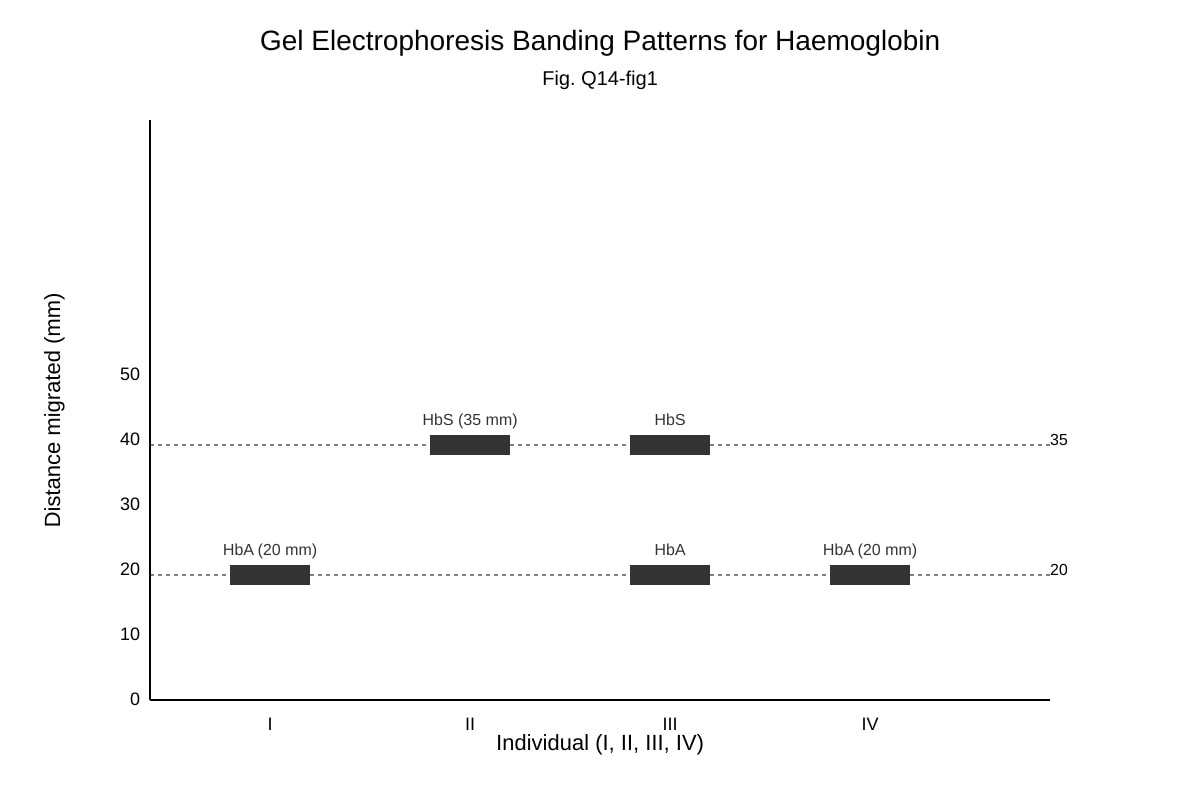
With reference to Fig. Q14-fig1, identify which individual is heterozygous for sickle cell trait and explain your reasoning. [3]
Section C: Extended Reasoning (15–20)
15. Explain how non-disjunction during meiosis can lead to Down syndrome (trisomy 21). Include the stage at which it may occur. [4]
16. Describe the process of semi-conservative DNA replication and state the role of DNA polymerase. [4]
17. A plant species shows incomplete dominance for flower colour: RR red, Rr pink, rr white. A pink-flowered plant is selfed.
(a) State the expected genotype and phenotype ratios. [3]
(b) Explain why this differs from a typical Mendelian monohybrid ratio. [2]
(a) _______________________________________________________
(b) _______________________________________________________
18. Discuss how environmental factors can affect phenotype using one genetic example. [4]
19. Compare and contrast autosomal linkage and sex linkage, with respect to inheritance patterns. [4]
20. The gene for fur colour in a mammal shows dominant epistasis: Y_ yields yellow regardless of B/b; yyB_ black; yybb brown. A YyBb×YyBb cross produces 12 yellow : 3 black : 1 brown.
(a) Explain the genetic basis of this ratio. [4]
(b) State the expected number of brown offspring from 64 total. [1]
(a) _______________________________________________________
(b) _______________________________________________________
Answers
A-Level Biology H2 Quiz - Genetics Inheritance (Answer Key)
Total Marks: 60
Topic: Genetics & Inheritance (Syllabus 9477 Core Idea 2)
Section A Answers (1–8)
1. [2 marks]
- Codominance: both alleles in a heterozygote are fully expressed, neither is dominant or recessive. [1]
- Example: ABO blood group IAIB gives blood group AB where both A and B antigens present. [1]
Teaching note: Contrast with incomplete dominance (blended). Mark both parts separately.
2. [1 mark]
- XCY
Teaching note: Male is XY; normal vision needs XC on his single X.
3. [2 marks]
- To determine the unknown genotype of the dominant-phenotype individual. [1]
- If any recessive offspring appear, the parent must be heterozygous; if all dominant, likely homozygous. [1]
Teaching note: Test cross reveals hidden recessive allele.
4. [1 mark]
- May cause a single amino acid change (missense) or no change (silent) due to degenerate code.
Accept: nonsense (stop codon) also valid. [1]
5. [2 marks]
- Discontinuous: few distinct categories (e.g., blood group). [1]
- Continuous: range of phenotypes from many genes + environment (e.g., height). [1]
6. [1 mark]
- To test whether observed ratios differ significantly from expected (null hypothesis). [1]
7. [2 marks]
- Crossing-over exchanges segments between non-sister chromatids. [1]
- Increases genetic variation in gametes. [1]
8. [2 marks]
- Epistasis: one gene masks expression of another gene. [1]
- Recessive epistasis typical ratio: 9:3:4. [1]
Section B Answers (9–14)
9. [3 marks]
(a) Female: XRXr; Male: XRY [1]
(b) Offspring: females all red-eyed (XRXR, XRXr); males 1/2 red (XRY), 1/2 white (XrY). Overall: 2 red female : 1 red male : 1 white male, or phenotype ratio red : white = 3:1 with sex split. [2]
Mark: (a) 1, (b) 2
10. [3 marks]
(a) A_B_ (i.e., AABB,AABb,AaBB,AaBb) [1]
(b) Albino = 3/16+3/16+1/16=7/16 [2: 1 for correct complement, 1 for sum]
Teaching: Complementary needs both dominants.
11. [4 marks]
(a) Recessive phenotype tt=q2=160/1000=0.16; q=0.16=0.4. [2]
(b) p=1−0.4=0.6; heterozygote 2pq=2×0.6×0.4=0.48 (48%). [2]
Show formulas clearly.
12. [3 marks]
χ2=150(155−150)2+50(45−50)2=15025+5025=0.1667+0.5=0.67 (2 dp). [3: 1 for each term, 1 for total]
Teaching: Use given formula; small χ2 means no significant difference.
13. [4 marks]
(a) Genetic diagram:
Parents: HbAHbS×HbAHbS
Gametes: HbA,HbS each
Offspring: HbAHbA (normal), HbAHbS (carrier), HbSHbS (sickle cell anaemia) in ratio 1:2:1. [3]
(b) Probability = 1/4 or 25%. [1]
14. [3 marks]
- Individual III is heterozygous. [1]
- Shows two bands at 20 mm (HbA) and 35 mm (HbS), indicating both alleles present. [2]
Image note: Bands at stated mm; heterozygote has both.
Section C Answers (15–20)
15. [4 marks]
- Non-disjunction = failure of homologous chromosomes (Anaphase I) or sister chromatids (Anaphase II) to separate. [2]
- Gamete receives two copy of chr21; fertilisation gives trisomy 21 (47, +21). [2]
Marking: stage 2, consequence 2.
16. [4 marks]
- Strand separation by helicase; each acts as template. [1]
- DNA polymerase adds complementary nucleotides 5'→3'. [1]
- Semi-conservative: each new DNA has one old and one new strand. [1]
- DNA polymerase also proofreads. [1]
17. [5 marks]
(a) Rr×Rr: genotypes 1 RR : 2 Rr : 1 rr; phenotypes 1 red : 2 pink : 1 white. [3]
(b) Incomplete dominance means heterozygote is intermediate, not dominant, so 1:2:1 not 3:1. [2]
18. [4 marks]
- Example: temperature affects fur colour in Himalayan rabbits (cool extremities dark). [2]
- Genotype fixed but phenotype varies with environment. [2]
Accept other valid examples.
19. [4 marks]
- Autosomal linkage: genes on same non-sex chromosome, inherited together, fewer recombinants. [2]
- Sex linkage: gene on X/Y, shows sex-biased inheritance (e.g., more males affected). [2]
20. [5 marks]
(a) Y dominant epistatic masks B/b. Y_ = 3/4 yellow (12/16); yyB_ = 3/16 black; yybb = 1/16 brown → 12:3:1. [4]
(b) Brown = 1/16 of 64 = 4. [1]
Free quiz and exam paper access
Enter your details to view this paper
Your access is remembered on this device.