AI Generated Quiz
A Level H2 Biology Evolution Diversity Quiz
Free A Level H2 Biology Evolution Diversity quiz, HY3 AI version, with questions, answers, and A Level-style practice for Singapore students.
These static practice materials are generated from the site's syllabus and paper-generation workflow, with source and model context shown so students and parents can evaluate the material before use.
Questions
Free quiz and exam paper access
Enter your details to view this paper
Your access is remembered on this device.
Answers
A-Level Biology H2 Quiz - Evolution Diversity (Answer Key)
Total Marks: 40
Topic: Evolution & Diversity (syllabus-first, AI-inferred from Stage 4 templates; not claimed as past-year derived)
Section A: Answers (2 marks each)
1. [2 marks]
Biological evolution is a change in allele frequencies in a population over generations.
Teaching note: Emphasise "population", not individual. Evolution acts on allele pools, not single organisms.
2. [2 marks – 1 each]
(i) Comparative anatomy / homologous structures
(ii) Molecular sequences (DNA, proteins) / biogeography / direct observation (e.g., antibiotic resistance)
Any two accepted.
3. [2 marks – 1 each]
Allopatric: Speciation due to geographic separation of populations.
Sympatric: Speciation within the same geographic area without physical barrier.
4. [2 marks]
Biodiversity = variety of life at all levels. Three levels: genetic, species, ecosystem diversity.
Mark: 1 for definition, 1 for three levels.
5. [2 marks]
represents the frequency of the homozygous recessive genotype in the population.
Teaching: =dominant allele freq, =recessive; =AA, =Aa, =aa.
6. [2 marks]
Bacteria with resistance alleles survive antibiotic treatment and reproduce, shifting the population mean towards resistance (directional selection).
Common mistake: saying individuals "mutate on demand" – mutation pre-exists selection.
7. [2 marks]
A species is a group of actually or potentially interbreeding natural populations that are reproductively isolated from other such groups.
8. [2 marks]
rRNA changes slowly and is less affected by convergent morphology; molecular data reflect common ancestry directly.
Section B: Answers
9. [3 marks]
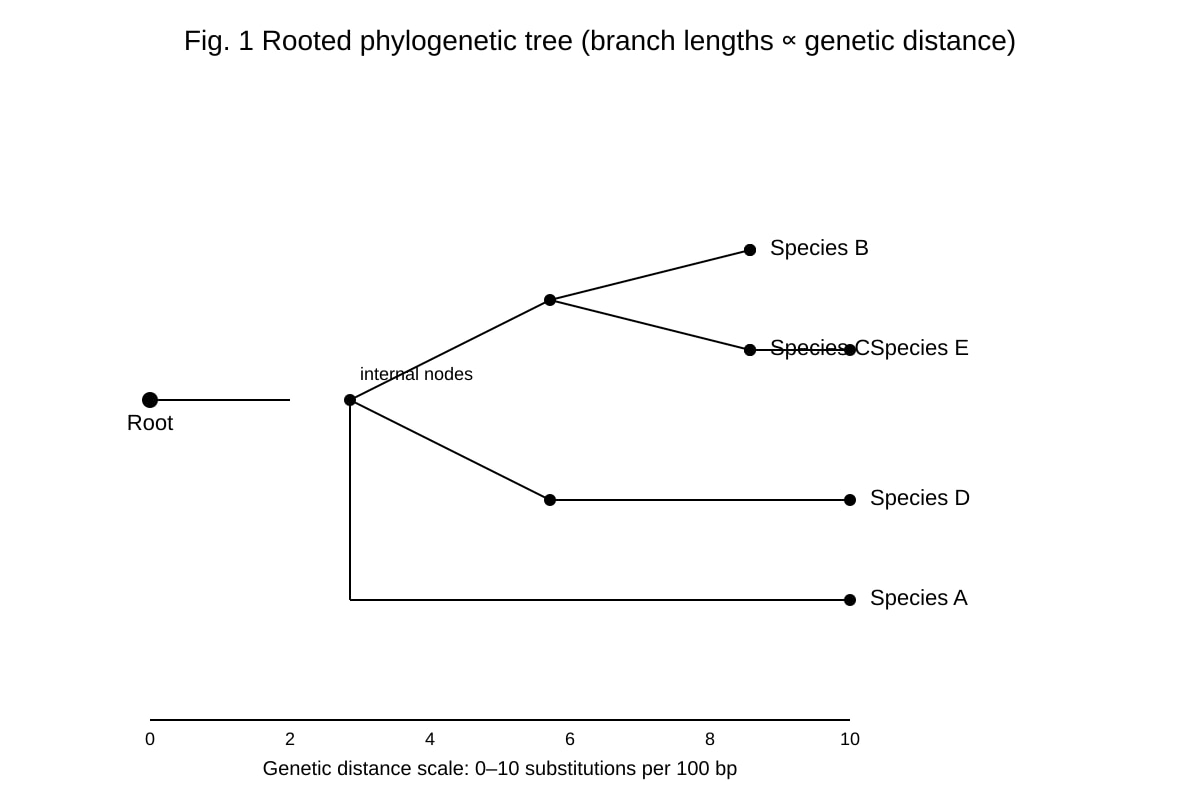
Most closely related: C and D (sister group). [1] They share the most recent common internal node and shortest branch distance. [2] A is outgroup (longest root distance). [1]
Image requirement: Tree must show C and D joined at nearest node.
10. [3 marks]
Drought reduced small soft seeds; birds with deeper beaks accessed remaining hard seeds and survived. [2] Type: directional selection. [1]
11. [3 marks]
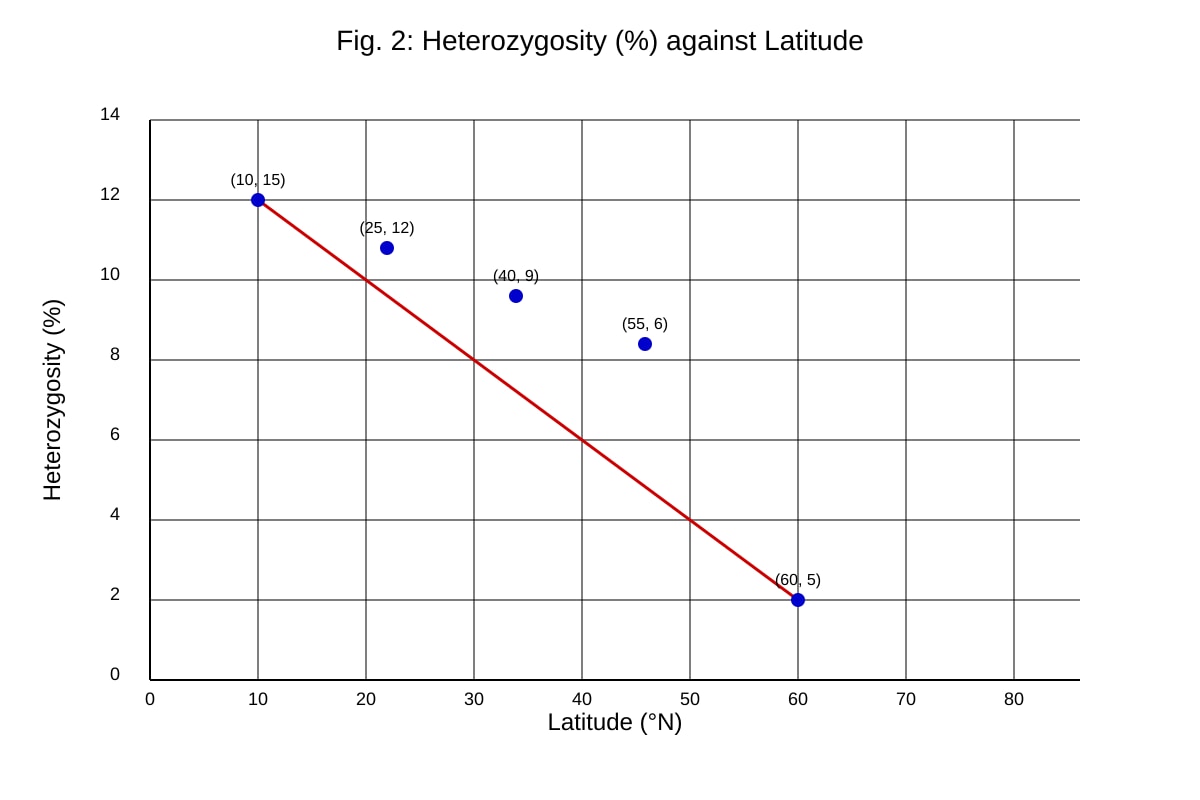
Pattern: heterozygosity decreases with increasing latitude. [1] Explanation: bottleneck or founder effects during glacial colonisation reduced variation in north. [2]
12. [3 marks]
Translocation changes chromosome structure; carriers produce unbalanced gametes with duplication/deletion. [2] This reduces fertility with non-translocated individuals → reproductive isolation. [1]
13. [3 marks]
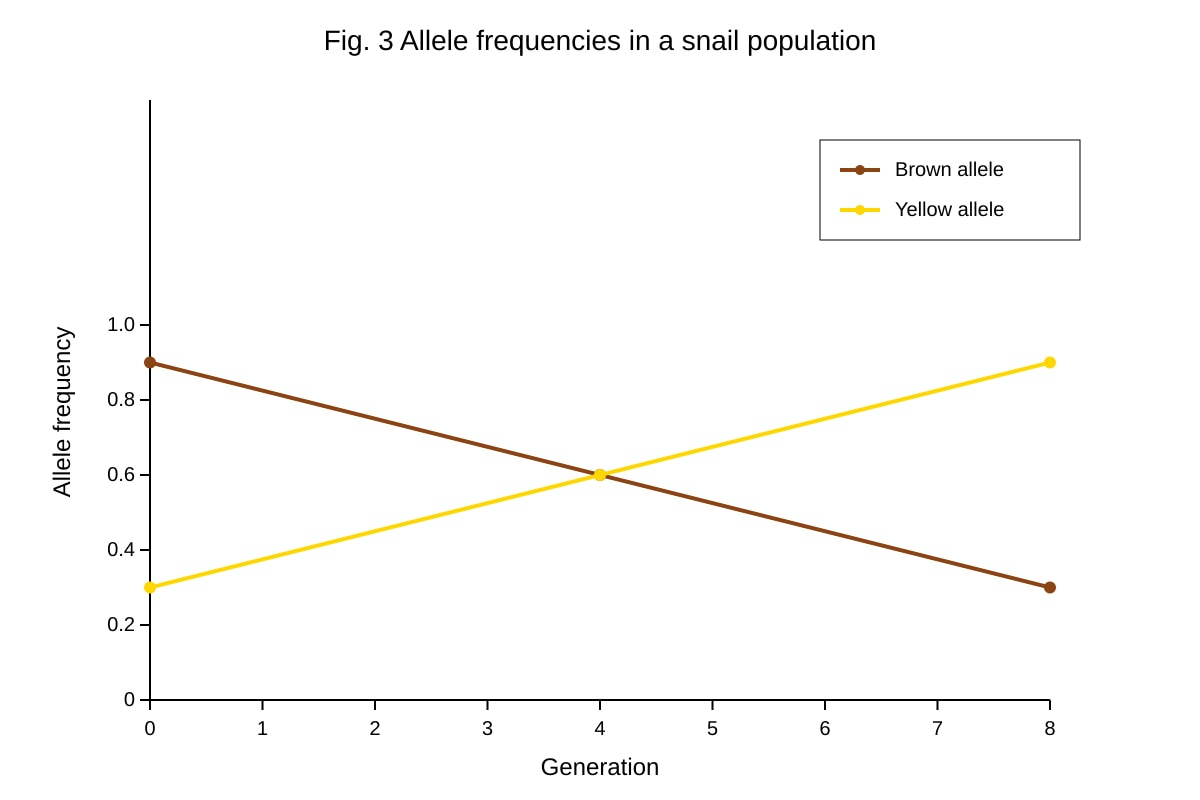
Directional selection. [1] One allele (yellow) increased steadily to fixation tendency while brown declined. [2] – consistent with consistent selective advantage.
14. [4 marks]
Gene flow = transfer of alleles between populations via migration/interbreeding. [2] It homogenises allele frequencies and can swamp local adaptation by introducing maladaptive alleles. [2]
Section C: Answers
15. [4 marks]
[1]
[1]
[1]
Heterozygotes ; number = [1]
16. [4 marks]
Initially sympatric divergence via habitat/behavioural isolation in lake. [2] Land bridge then made it allopatric, preventing gene flow, completing reproductive isolation. [2]
17. [4 marks]
Convergent: unrelated lineages evolve similar traits (e.g., wings of bat & insect). [2] Divergent: related lineages accumulate differences (e.g., finches of Galápagos). [2]
18. [4 marks]
[1] → fail to reject H–W null. [1] Population fits expected 1:2:1 ratio. [1] No significant deviation at . [1]
19. [5 marks]
Endosymbiosis: mitochondria originated from engulfed aerobic bacteria. [1] Evidence: (i) own circular DNA like prokaryotes [2]; (ii) 70S ribosomes similar to bacteria [2].
20. [5 marks]
Resistant mutants pre-existed in population. [2] Antibiotic killed susceptibles, resistant reproduced → 60% survival. [2] Survivors not "newly mutated"; selection acted on existing variation. [1]