From Real Exams Quiz
A Level H2 Biology Plant Biology Quiz
Free A Level H2 Biology Plant Biology quiz, HY3 Exam version, with questions, answers, and A Level-style practice for Singapore students.
These static practice materials are generated from the site's syllabus and paper-generation workflow, with source and model context shown so students and parents can evaluate the material before use.
Questions
Free quiz and exam paper access
Enter your details to view this paper
Your access is remembered on this device.
Answers
A-Level Biology H2 Quiz - Plant Biology: Answer Key
Total Marks: 60
Topic: Plant Biology
Section A Answers (1–8)
Q1 [2 marks]
- Plant cell walls are made of cellulose (β-1,4 glycosidic linked glucose polymers). [1]
- Fungal cell walls are made of chitin (not cellulose). [1]
Teaching note: Cellulose microfibrils provide tensile strength; chitin is a nitrogen-containing polysaccharide. Common mistake: stating "plants have cellulose, fungi have protein" – incorrect.
Q2 [2 marks]
- Transpiration is the loss of water vapour from the aerial parts of a plant, mainly through stomata. [2 if full, 1 if partial]
Teaching note: It is passive, driven by evaporation, not active secretion.
Q3 [2 marks]
- Tissue: phloem (specifically sieve tube elements). [1]
- Adaptation: sieve plates with pores allowing continuous flow of sap / companion cells for metabolic support. [1]
Q4 [3 marks]
- Water evaporates from mesophyll cells into air spaces, then out via stomata (transpiration). [1]
- This creates negative pressure (tension) in xylem. [1]
- Cohesion between water molecules (H-bonding) and adhesion to xylem wall transmits pull from leaves to roots. [1]
Marking: 1 mark each point.
Q5 [2 marks]
- Raw materials: water (H₂O) and light energy (also NADP⁺, ADP+Pi implicit). [1]
- Site: thylakoid membrane of chloroplast. [1]
Q6 [3 marks]
- High light → photosynthesis in guard cells produces ATP. [1]
- K⁺ pumped into guard cells, lowering water potential. [1]
- Water enters by osmosis, guard cells become turgid and curved, opening stoma. [1]
Q7 [2 marks]
- C4 plants minimise photorespiration by concentrating CO₂ in bundle sheath cells using PEP carboxylase (higher affinity than RuBisCO). [2]
Accept: C4 closes stomata more / uses less water per CO₂ fixed.
Q8 [3 marks]
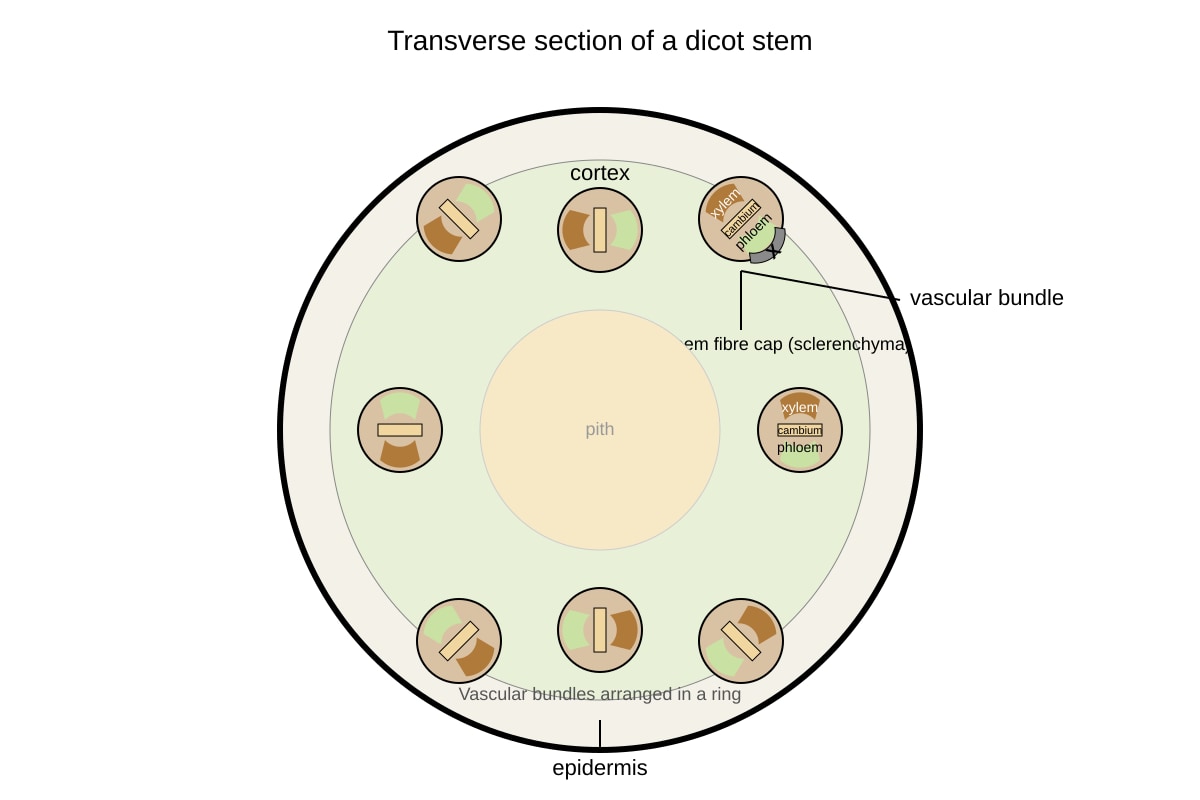
- Tissue X = sclerenchyma fibres (phloem fibres). [1]
- Function: mechanical support / protection of vascular bundle. [2]
From image: X is outer cap of bundle.
Section B Answers (9–14)
Q9 [4 marks]
(a) [2] As relative humidity increases, transpiration rate decreases (inverse relationship). From 30% to 90% RH, rate drops from 4.2 to 1.1 g h⁻¹.
(b) [2] Lower humidity = steeper water vapour gradient between leaf interior and air → faster diffusion of water out; high humidity reduces gradient.
Q10 [4 marks]
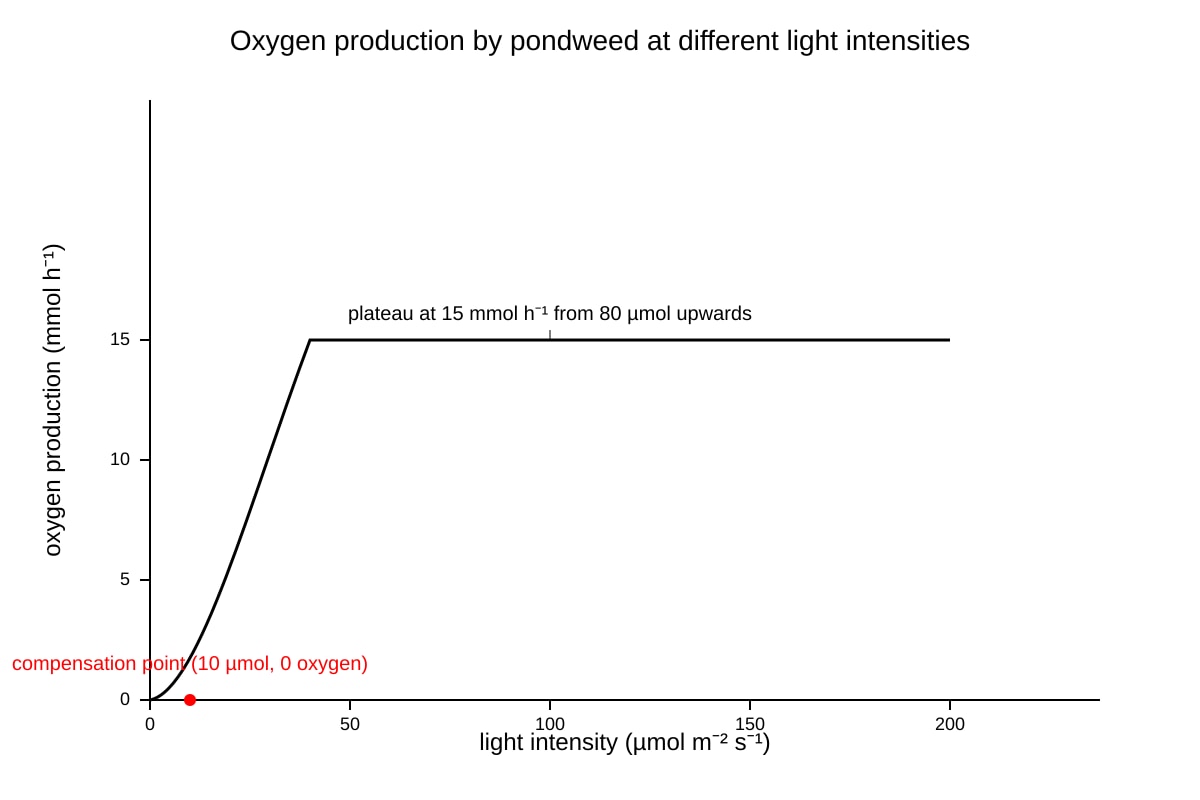
(a) [1] 10 µmol m⁻² s⁻¹ (compensation point).
(b) [3] At high light, photosynthetic machinery (RuBisCO, electron carriers) saturated; another factor limits rate – e.g., CO₂ concentration or enzyme amount. Thus oxygen production plateaus.
Q11 [4 marks]
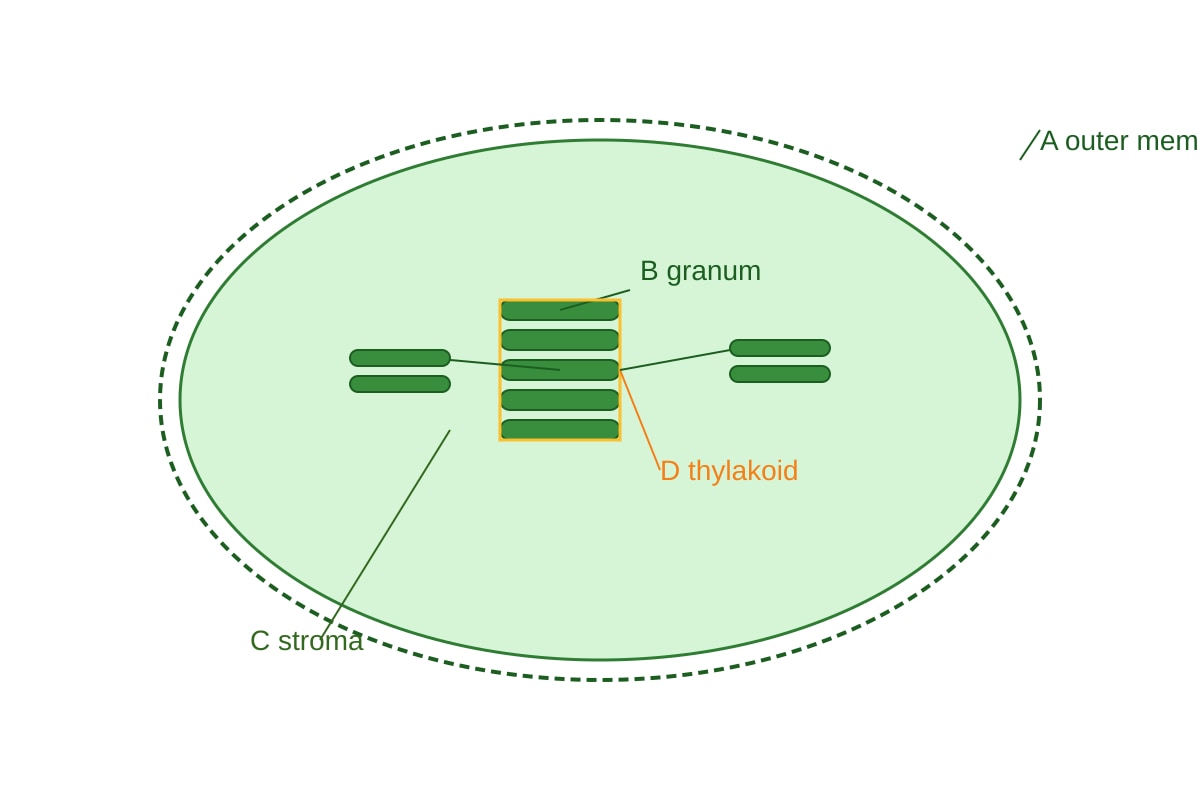
A = outer membrane [0.5], B = granum [0.5], C = stroma [0.5], D = thylakoid membrane [0.5].
Role of C [2]: Site of Calvin cycle; contains enzymes for CO₂ fixation (RuBisCO), where ATP and NADPH are used to make glucose.
Q12 [5 marks]
(a) [2] % increase = ((1.8 – 0.4) / 0.4) × 100 = 350%.
(b) [3] Midday: light and warmth increase photosynthesis demand for CO₂; stomata open to allow CO₂ in; despite water loss risk, gas exchange priority. Also higher temp increases membrane fluidity.
Q13 [4 marks]
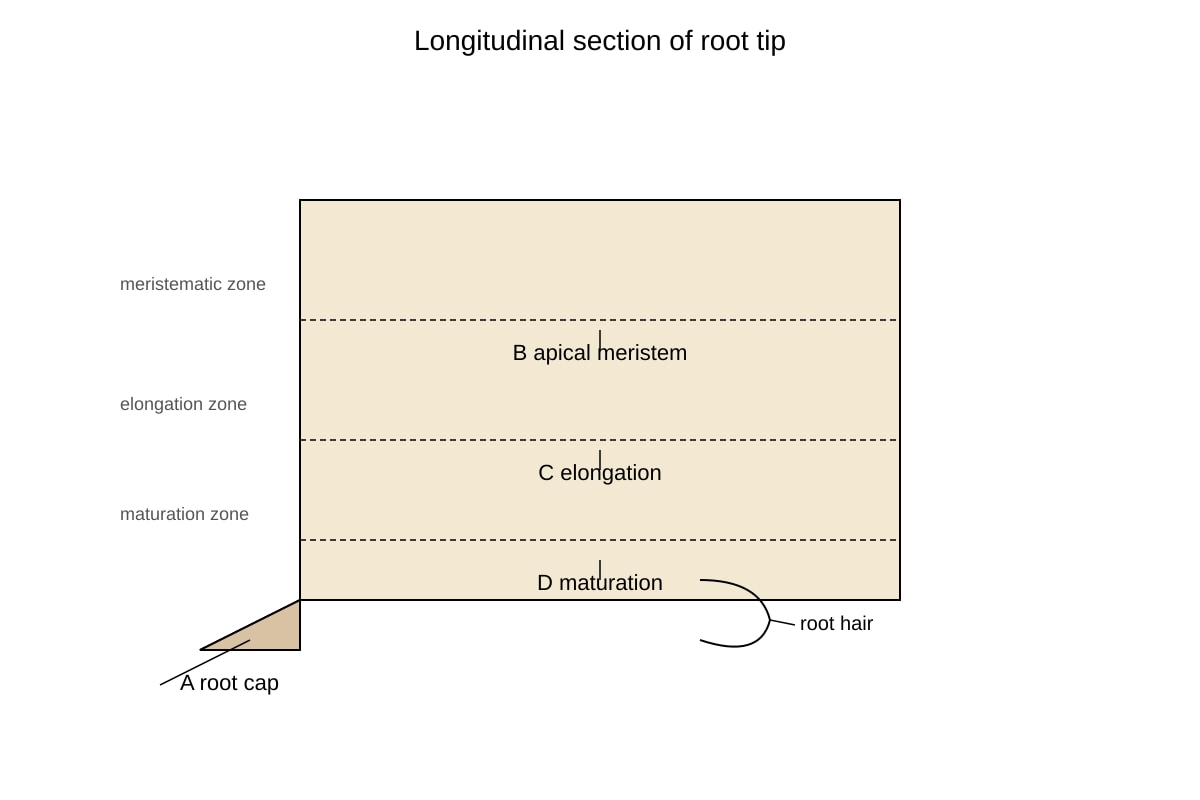
- Zone D (maturation) with root hairs. [1]
- Root hair cells: elongated protrusions increase surface area. [1]
- Thin walls, many mitochondria for active mineral uptake. [1]
- Water follows osmotically after solute accumulation. [1]
Q14 [4 marks]
- Light drives electron transport, pumping H⁺ from stroma into thylakoid space. [1]
- Gradient (high H⁺ inside) stores potential energy. [1]
- H⁺ flows back via ATP synthase (chemiosmosis). [1]
- Released energy phosphorylates ADP → ATP. [1]
Section C Answers (15–20)
Q15 [4 marks]
- Xylem: unidirectional (roots→leaves), passive (transpiration pull), no metabolic energy. [2]
- Phloem: bidirectional, active (source→sink), uses ATP for loading/unloading. [2]
Q16 [4 marks]
- Stomata allow CO₂ in, O₂ out. [2]
- Closure reduces CO₂ entry → Calvin cycle slows, photosynthesis drops; also reduces water loss. [2]
Q17 [5 marks]
- Carbon fixation: CO₂ + RuBP → 2 GP; needs none directly but RuBisCO. [1+1]
- Reduction: GP → GALP using ATP and NADPH. [1+1]
- Regeneration: RuBP from GALP using ATP. [1]
Q18 [5 marks]
- State null hypothesis (no diff), calculate t from means, variances, n; compare to critical t at p<0.05. [3]
- Controlled: light intensity / temp / soil volume. [2]
Q19 [5 marks]
- Dead cells form hollow tubes with no cytoplasm → low resistance to flow. [2]
- Lignified walls prevent collapse under tension. [2]
- No metabolic demand on transported water. [1]
Q20 [5 marks]
- Transpiration pull: strong on hot dry day (high evap), main driver at height. [3]
- Root pressure: weak (few atm), only night/low transp; insufficient for 30 m. [2]
- Conclusion: transpiration pull dominant.